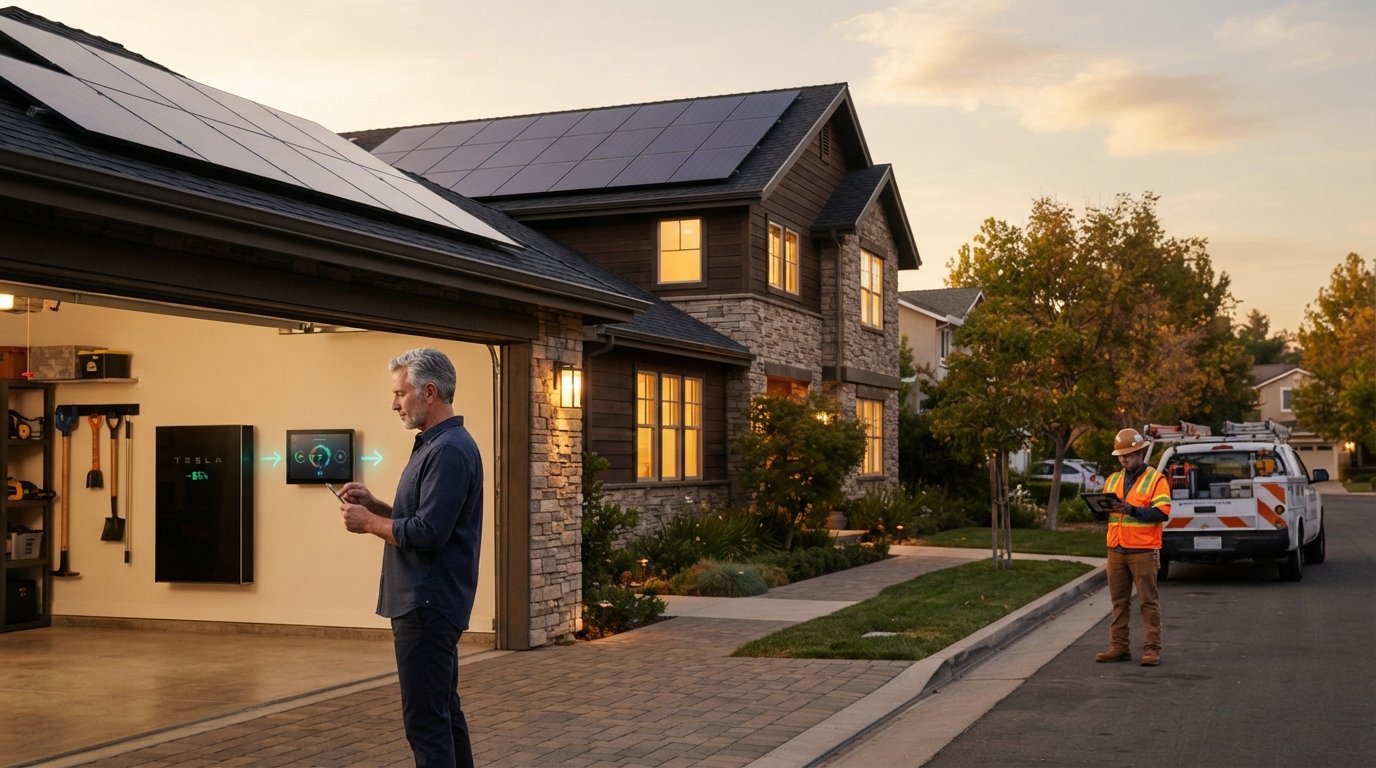
Virtual Power Plant Programs: Solar Battery Income for Homeowners
Virtual power plant programs can turn your solar battery into income. Compare offers and call (833)-434-4023 to review your options.

By Mason Carter
Find Local Pros Near You

Enter your ZIP code to compare top-rated local professionals and request free quotes.
Your solar battery might be earning money while you sleep, and most homeowners have no idea. Across the United States, utility companies and aggregators are quietly paying thousands of battery owners to share a sliver of their stored energy during peak demand. These arrangements, known as virtual power plant programs, turn home batteries into a coordinated grid resource. For homeowners, the pitch is simple: get paid for capacity you already own. But the details matter. Dispatch events, per-kWh rates, battery warranties, and contract terms all shape whether a virtual power plant program is genuinely profitable or just a headline. This guide breaks down how VPP programs work, what they pay, what you give up, and how to compare offers in your utility territory so you can decide with confidence.
How Virtual Power Plant Dispatch Events Work
A virtual power plant is a network of distributed energy resources, usually home batteries, that an aggregator or utility controls remotely. When grid demand spikes, the operator sends a signal to enrolled batteries to discharge a small amount of stored electricity. This is called a dispatch event. Most events last one to three hours and occur a handful of times per month, often on hot summer afternoons or cold winter evenings when electricity prices climb. The battery does not empty entirely; programs typically reserve a floor, such as 20 percent state of charge, so the homeowner still has backup power.
What homeowners give up is partial control during those windows. You agree to let the program draw from your battery when called, usually with some ability to opt out of individual events. Some programs allow a limited number of opt-outs per season before penalties apply. Others offer a "backup reserve" setting that guarantees a minimum charge for outages. Understanding this trade-off is central to evaluating whether the income justifies the loss of autonomy. If you regularly experience outages or rely on your battery for medical equipment, a program with a strict dispatch schedule may not suit your household.
Dispatch events are typically triggered automatically through your inverter or a separate control device. You do not need to do anything during an event. The system logs the energy discharged, and the program credits your account or sends a payment. Most reputable programs provide a dashboard or app showing event history, energy contributed, and earnings to date. That transparency matters because it lets you verify that dispatch events are happening as promised and that payments match the fine print.
Payment Structures and Typical Per-kWh Incentives
Virtual power plant compensation comes in several forms, and the differences can add up to hundreds of dollars per year. The most common structures are capacity payments, per-kWh dispatch payments, and upfront incentives. Capacity payments pay you for making your battery available, regardless of whether it is dispatched. Per-kWh payments pay only for energy actually discharged during events. Upfront incentives are one-time bonuses for enrolling, sometimes tied to a multi-year commitment. Many programs blend two or more of these structures.
Per-kWh incentives vary widely by market. In competitive electricity markets, dispatch payments often range from $0.50 to $2.00 per kWh discharged, with higher rates during grid emergencies. Capacity payments might run $20 to $100 per kW of enrolled battery capacity per year. A typical home battery with 10 kWh of usable capacity could earn anywhere from $100 to $500 annually depending on the program and how often it is dispatched. Upfront incentives can range from a few hundred dollars to over $1,000 in aggressive markets.
Here is a quick comparison of common payment structures to help you frame offers:
- Capacity payment: Fixed annual or monthly payment for keeping your battery available; predictable income but often lower total value.
- Per-kWh dispatch payment: Variable income tied to actual events; higher upside in volatile markets but less predictable.
- Upfront enrollment bonus: One-time payment, sometimes with clawback if you leave early; good for offsetting installation costs.
- Blended structure: Combines a smaller capacity payment with per-kWh dispatch and occasional bonuses; balances predictability and upside.
When comparing offers, convert everything to an annual expected value. Ask the program representative for the average number of dispatch events per year, the average duration, and the average per-kWh rate paid over the last two seasons. If they cannot provide historical data, treat the offer with caution. A program that pays $1.50 per kWh but dispatches only twice a year is worth far less than one that pays $0.75 per kWh across 30 events.
Battery Warranty Considerations for Frequent Cycling
Every dispatch event cycles your battery, and cycling affects warranty terms. Most home battery warranties guarantee a certain throughput, expressed in megawatt-hours or equivalent full cycles, over a set number of years. Frequent VPP dispatch can accelerate throughput and potentially shorten the battery's useful life if the program dispatches aggressively. The key question is whether the manufacturer explicitly permits VPP participation without voiding coverage.
Many major battery manufacturers now publish VPP-friendly warranty terms, but the details differ. Some count VPP cycling toward the throughput limit, meaning you may hit the cap sooner. Others exclude VPP dispatch from throughput calculations up to a certain annual limit. Before enrolling, ask the program and the manufacturer three questions: Does VPP participation void or alter my warranty? How is VPP throughput counted against my warranty limit? What happens if the battery degrades faster than expected?
It also helps to understand how much cycling a typical program adds. If a program dispatches 30 times per year for two hours at 5 kW, that is 300 kWh of additional throughput annually, or roughly 30 full cycles on a 10 kWh battery. Over a 10-year warranty, that is 3,000 kWh, which may be a meaningful share of a 20,000 to 30,000 kWh throughput limit. Run the numbers for your specific battery and program. If the added cycling consumes more than 10 to 15 percent of your warranty throughput, the income may not compensate for the reduced battery lifespan.
For homeowners who want to maximize battery longevity while still earning, look for programs that cap annual dispatch events or offer a "battery health" guarantee. Some aggregators now provide performance warranties that cover degradation beyond normal use, which can offset the risk. In our guide on how AI improves energy efficiency for home solar, we explain how smart dispatch algorithms can reduce unnecessary cycling while still meeting grid needs, a feature worth asking about when comparing programs.
How to Compare VPP Offers in Your Utility Territory
Virtual power plant programs are not standardized, and offers differ dramatically by state, utility, and aggregator. Some are run directly by utilities, while others are managed by third-party aggregators that bundle thousands of homes. The first step is to identify which programs operate in your utility territory. Your utility's website often lists approved VPP providers, and your battery installer may have partnerships with specific aggregators. State public utility commissions also publish program filings that reveal compensation details.
Once you have a shortlist, compare offers using a consistent framework. Start with eligibility: does your battery model qualify, and is your inverter compatible? Then review the contract length, exit fees, and opt-out rules. A program with a generous per-kWh rate but a five-year lock-in and steep early termination fee may be less attractive than a shorter, more flexible agreement. Next, examine the dispatch protocol: how often are events called, how long do they last, and can you set a reserve for backup power? Finally, calculate the expected annual income and compare it to the added cycling cost.
Here is a practical comparison checklist you can use when evaluating offers:
- Confirm eligibility for your battery make, model, and inverter.
- Request historical dispatch data: average events per year, duration, and per-kWh rate paid.
- Review warranty language from both the manufacturer and the program regarding VPP cycling.
- Calculate expected annual income and divide by the added throughput to get a dollars-per-kWh-cycled figure.
- Check contract terms: length, exit fees, opt-out limits, and payment timing.
After you have the numbers, sanity-check them against your goals. If your primary motivation is backup power, prioritize programs with strong reserve guarantees and low dispatch frequency. If income is the priority, lean toward programs with higher per-kWh rates and transparent event histories. Many homeowners find a middle ground: a blended program with a modest capacity payment and a per-kWh rate that rewards participation without excessive cycling.
For homeowners still exploring the broader solar and battery landscape, resources that connect you with vetted installers and quote comparisons can simplify the process. Platforms like FreeSolarPowerQuotes help homeowners understand installation options and financing before committing to a battery and VPP enrollment. Getting multiple quotes on the battery itself is just as important as comparing VPP offers, because the battery you choose determines which programs you can join.
Weighing the Income Against the Trade-Offs
Virtual power plant income is real, but it is rarely life-changing on its own. For most homeowners, the annual earnings range from a few hundred to perhaps a thousand dollars, depending on the market and battery size. The value proposition improves when you factor in other benefits: some programs offer bill credits that stack with net metering, and enrollment can strengthen the case for battery storage in the first place. If you were already planning to buy a battery for backup power, VPP income can shorten the payback period by a year or more.
The trade-offs deserve equal weight. You lose some control over your battery during dispatch events, your warranty throughput may be consumed faster, and you take on contract obligations that can outlast your interest in the program. Homeowners who value energy independence above all may prefer to skip VPP enrollment and keep their battery exclusively for outages. Others find the income and grid contribution worthwhile, especially when the program offers a backup reserve and flexible opt-outs.
A balanced approach is to enroll only if three conditions hold: the program explicitly preserves your warranty, the expected income exceeds the value you place on the cycling, and the contract terms let you exit without punitive fees if your needs change. If any of those conditions fails, wait for a better offer or a program with more homeowner-friendly terms. The VPP market is evolving quickly, and new programs with stronger protections are launching each year.
Key Takeaways for Homeowners
Virtual power plant programs can turn a home solar battery into a modest income stream, but the details determine whether the deal is worthwhile. Focus on dispatch frequency, per-kWh rates, warranty treatment, and contract flexibility. Compare offers using historical data rather than marketing promises, and calculate the added cycling cost against the income. If you are still shopping for a battery, get multiple quotes and ask installers which VPP programs their customers have joined successfully. With careful comparison, you can capture the income without sacrificing the backup power and battery longevity you paid for.