Solar Panel Cleaning Robot: Worth It for Your Home?
Is a solar panel cleaning robot worth it for your home? We break down soiling losses, costs, and roof limits. Call (833)-434-4023 for expert help.

By Dylan Harris
Learn more about Solar Panel Cleaning for guides, costs, and what to expect.
Compare Solar Panel Cleaning Pros Near You

Enter your ZIP code to compare top-rated local professionals and request free quotes.
Your solar panels are an investment in lower energy bills and cleaner power, but dust, pollen, bird droppings, and wildfire ash quietly erode their output month after month. You have probably seen ads for automated cleaning robots that scurry across rooftop arrays and promise to restore lost production without you lifting a hose. The pitch sounds compelling, especially if your roof is steep, your array is large, or you simply dread climbing a ladder. But the real question is whether a solar panel cleaning robot is worth it for a residential installation, and the honest answer depends on where you live, how your system is mounted, and what you are comparing the robot against. This guide breaks down the economics, the technology, and the practical limits so you can decide with clear eyes instead of marketing hype.
How Much Energy Soiling Actually Costs You
Before you can judge any cleaning solution, you need a realistic baseline for soiling loss, which is the reduction in solar production caused by dirt accumulating on the glass. The numbers vary dramatically by region and season. In the desert Southwest, dust storms and agricultural activity can cut output by 15 to 25 percent between cleanings if rain is scarce. In the Southeast, pollen season coats panels in a yellow film for several weeks each spring, while the frequent summer rains often rinse them clean afterward. In the Northeast and Midwest, soiling tends to be milder, typically 3 to 8 percent annually, with snow cover causing temporary outages that no robot can fix.
To translate soiling into dollars, start with your system size and local electricity rate. A 7 kilowatt residential array in a sunny climate might generate roughly 10,000 kilowatt hours per year. If soiling costs you 10 percent of that production and your utility charges 20 cents per kilowatt hour, you are losing about 200 dollars annually. If your losses are closer to 4 percent, the figure drops to 80 dollars. Those numbers frame the entire buying decision: a cleaning robot that costs 400 to 1,500 dollars needs to recover several hundred dollars of production per year, or last many years, before it pays for itself. Homeowners who want a more precise estimate of their system's output and savings potential can use a solar savings calculator to model production before factoring in soiling losses.
It also helps to understand how soiling interacts with your specific hardware. Panels mounted at a steep tilt shed dirt more readily than low-angle roof mounts. Arrays near highways, farms, or industrial areas accumulate grime faster. And panels with microinverters or power optimizers may show per-panel production data, which lets you spot soiling hot spots rather than guessing. If your monitoring app shows a gradual decline that rain does not reverse, that is your cue that cleaning, by robot or otherwise, has real value.
Waterless Versus Water-Based Cleaning Robots
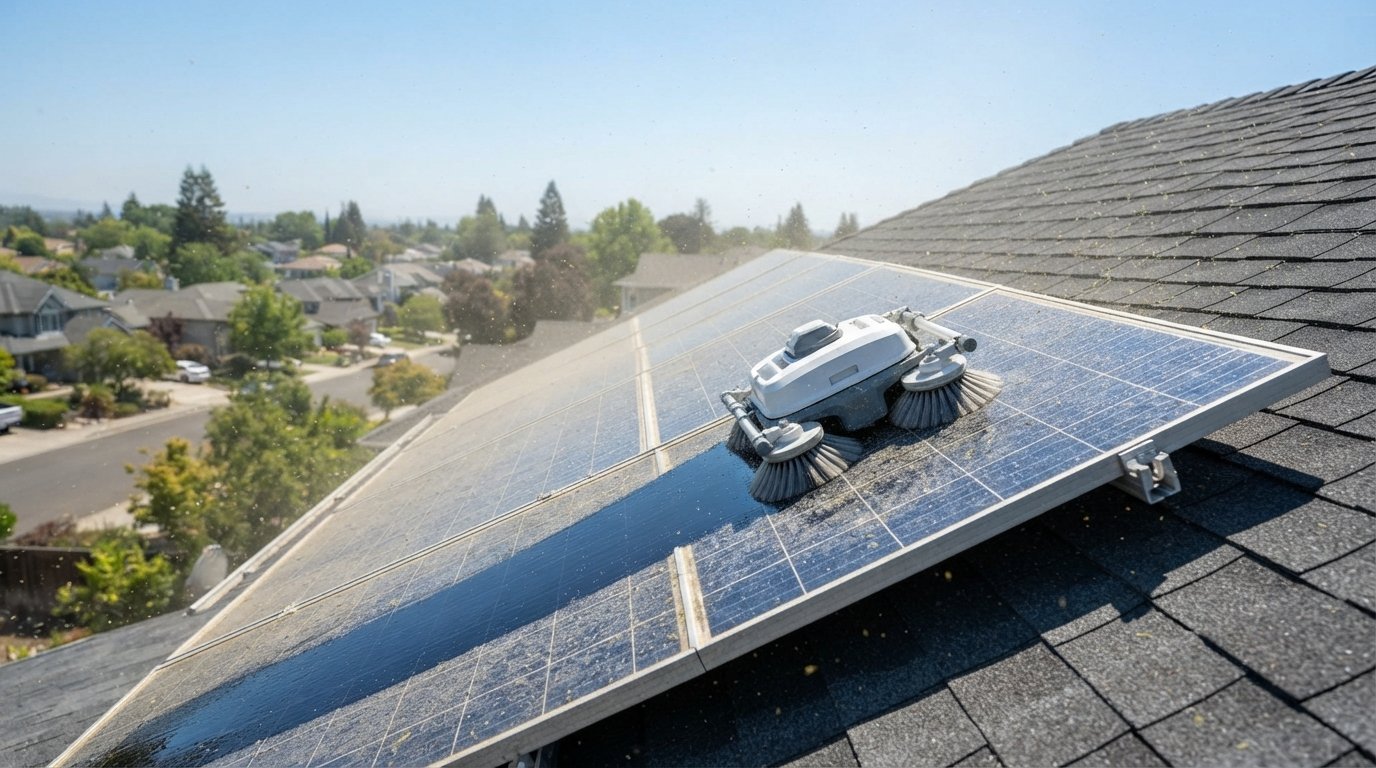
Residential cleaning robots fall into two broad camps, and the distinction matters for both performance and practicality. Waterless robots rely on microfiber brushes, silicone rollers, or air blasts to lift dust from the glass. They are lighter, need no hose connection, and avoid the mineral spotting that hard water can leave behind. However, they struggle with sticky residues like bird droppings, tree sap, and pollen that has bonded to the surface after a light dew. In dry, dusty climates, waterless designs are often sufficient and far easier to deploy.
Water-based robots spray a small amount of water or cleaning solution ahead of a squeegee or brush, then vacuum or wipe it away. They handle stubborn grime better, but they introduce complications: you need a water source near the array, you must manage runoff, and in freezing climates the water system needs winterizing. Some models combine both approaches, using a damp microfiber pad followed by a dry wipe. For most homeowners, the practical tradeoff looks like this:
- Waterless robots: best for arid regions, light dust, and simple roof layouts; lowest maintenance and no plumbing.
- Water-based robots: better for sticky soiling, humid climates, and larger arrays; higher cost and more setup complexity.
- Hybrid designs: flexible but heavier, and typically priced at the top of the residential range.
Whichever type you consider, check the manufacturer's guidance on cleaning frequency. Running a dry brush over gritty glass too often can micro-scratch the anti-reflective coating, and running a wet system in dusty conditions can create mud that dries into stubborn streaks. The best results usually come from cleaning before heavy accumulation, not after.
Roof Access, Safety, and Installation Limits
The single biggest constraint on residential cleaning robots is not technology but geometry. Most consumer robots are designed for ground-mounted arrays or low-slope roofs with a few rows of panels. They move along the panel frame, often guided by rails or edge sensors, and they need a way to transition between rows or return to a docking station. On a typical pitched roof with multiple small arrays, valleys, and obstructions like vents and chimneys, deployment becomes awkward at best. Many manufacturers explicitly limit use to roof pitches under 20 to 30 degrees, and some require a dedicated rail system that adds cost and installation complexity.
Safety deserves equal weight. Even a lightweight robot means getting on the roof to place it, retrieve it, and clear jams, which is the very activity that causes thousands of homeowner injuries every year. If your roof is steep, tall, or has fragile tiles, the risk may outweigh any production gain. Before buying, confirm three things: the maximum roof pitch the device supports, whether it needs a rail or guide system, and how you will physically move it on and off the array. If any of those answers makes you uncomfortable, professional cleaning is the safer route.
There is also the warranty question. Some panel manufacturers require that cleaning be performed with approved methods to keep the performance warranty intact. Review your panel documentation and your homeowner's insurance policy before letting any device, or any person, onto the roof. A quick call to your installer can clarify what is covered.
The Real Math: Robot Versus Manual Versus Professional Cleaning
To decide whether a solar panel cleaning robot is worth it for your home, compare all three options on cost per cleaning and total cost of ownership over five to ten years. Manual cleaning with a soft brush and hose costs little in supplies but consumes hours of your time and carries fall risk. Professional cleaning typically runs 150 to 400 dollars per visit for a residential array, depending on size and location, and most companies recommend one to three visits per year in dusty regions. A robot costs 400 to 1,500 dollars upfront plus occasional brush or battery replacements, and it requires your time for each cycle.
Run a simple five-year comparison. If professional cleaning costs 250 dollars twice a year, that is 2,500 dollars over five years. A 700 dollar robot that lasts five years and needs 50 dollars in parts looks far cheaper, but only if it cleans as effectively and you actually use it. If the robot cannot handle your roof layout and sits in the garage, the math collapses. For homeowners with ground mounts or simple low-slope arrays in dusty climates, the robot often wins. For steep roofs, small arrays, or mild soiling, professionals or occasional DIY cleaning usually make more sense.
One more factor: effectiveness per pass. Professional crews typically use deionized water and squeegees that leave no residue, restoring nearly all lost production. Consumer robots vary widely in real-world results, and some leave streaks that reduce the gain. Look for independent reviews with before-and-after production data rather than relying on manufacturer claims. If you are still weighing system size and output assumptions, our guide on maximizing energy with a 200 watt solar panel illustrates how small production gains compound across a system's life.
When Professional Cleaning Still Makes More Sense
Professional cleaning remains the better choice in several common situations. If your roof pitch exceeds 30 degrees, if your array is split across multiple roof planes, or if your home has skylights and complex obstructions, a robot is unlikely to navigate reliably. The same applies if you have sticky soiling from trees or heavy bird activity, which often requires targeted hand cleaning and sometimes a mild cleaning agent. Professionals also inspect the array while they work, catching cracked glass, loose mounting hardware, or failing connectors that a robot would roll right past.
Homeowners who are uncomfortable on ladders, have limited mobility, or simply value their weekends should also lean professional. The cost per visit is predictable, the work is insured, and you avoid storing another piece of equipment. Many installers bundle cleaning with annual inspections, which protects both performance and warranty coverage. If you want to compare local cleaning and maintenance providers, an independent resource like NewSolarQuotes can help you understand typical pricing and connect with vetted professionals in your area.
There is also a seasonal argument. In snowy climates, neither robots nor most professionals can do much during winter, so the cleaning season is short. In regions with mild soiling, one professional visit after pollen season may be all you need, making a robot's cost hard to justify. Match the tool to your climate and roof, not to the excitement of owning a gadget.
A Practical Decision Framework
If you are still on the fence, work through a short checklist before spending money. First, estimate your annual soiling loss in dollars using your monitoring data and local rates. Second, confirm your roof pitch, array layout, and whether the robot you are considering supports them. Third, compare five-year costs across robot, manual, and professional options. Fourth, check warranty and insurance implications. Finally, be honest about whether you will actually deploy the device several times a year.
As a rule of thumb, a solar panel cleaning robot is most likely worth it for residential owners when three conditions hold: you live in a dusty or high-pollen region with meaningful soiling losses, your array is ground-mounted or on a low-slope roof with a simple layout, and you plan to keep the system for at least five years. If any of those conditions fails, manual cleaning or periodic professional service is usually the smarter financial and safety choice.
The right answer is the one that maximizes net production per dollar without putting you on a ladder you should not be on. Measure your soiling losses, respect your roof's limits, and let the math, not the marketing, make the call.