Heat Pump Water Heater With Solar Production Scheduling
Shift water heating to sunny hours with a heat pump water heater with solar production scheduling. Call (833)-434-4023 for expert help.

Learn more about Solar Panel Installation and Repair for guides, costs, and what to expect.
Compare Solar Panel Installation and Repair Pros Near You

Enter your ZIP code to compare top-rated local professionals and request free quotes.
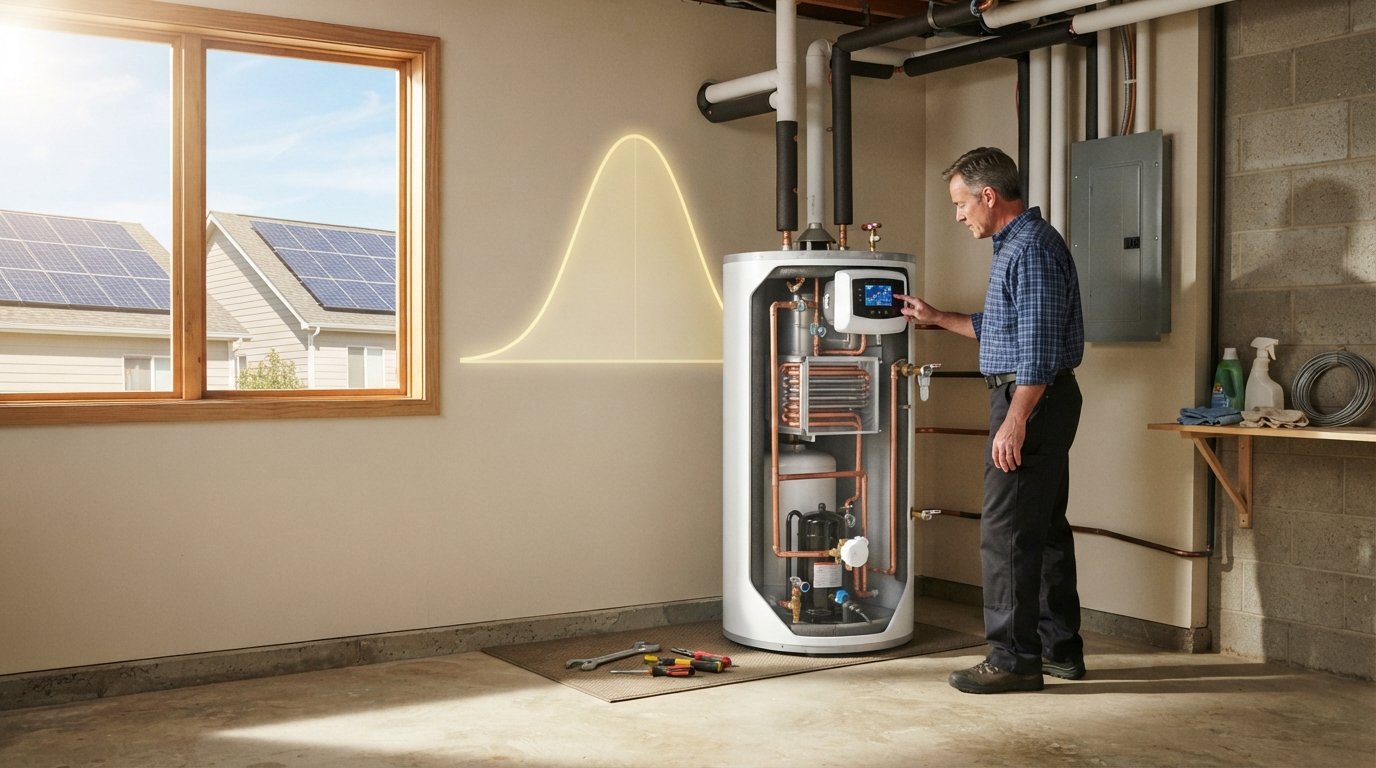
Your solar panels hit peak output at noon, but your water heater often works hardest at 7 a.m. and 8 p.m. That timing mismatch is why so many solar homeowners still see high utility bills. A heat pump water heater with solar production scheduling solves this problem by shifting water heating into the sunniest hours, storing thermal energy in a tank instead of exporting cheap electricity to the grid. The result is a lower bill, fewer grid imports, and a smarter use of the clean power you already generate.
Why Timing Matters: Load Profile vs. Solar Bell Curve
Solar production follows a predictable bell curve: output climbs through the morning, peaks around midday, and falls to zero by early evening. A standard electric resistance water heater, by contrast, draws power whenever the tank cools, often in the early morning and late evening when solar is weak or absent. Heat pump water heaters (HPWHs) are far more efficient, using roughly 60 to 70 percent less electricity than resistance models, but their load profile still tends to concentrate in the morning and evening if left on default settings.
When you overlay the two curves, the overlap is small. Without scheduling, a HPWH may run mostly on grid power, especially during peak rate periods. With solar production scheduling, you deliberately move the heating load into the midday window when your panels are generating excess energy. That excess would otherwise be exported to the grid at a low net metering rate, if you are compensated at all. Using it to heat water is often worth more than exporting it, because you avoid buying that same electricity later at a higher retail or time-of-use rate.
The shift also reduces strain on the grid and can improve the economics of your solar investment. If you have a battery, midday water heating frees up stored energy for evening use, extending your backup capacity. If you are on a time-of-use (TOU) plan, the savings compound: you avoid expensive peak rates while soaking up cheap or free solar kilowatt-hours.
Control Strategies: Timers, Smart Controls, and Solar-Aware Scheduling
Most heat pump water heaters include a built-in timer or scheduling feature. At the simplest level, you set the unit to heat only during a window that matches your solar production, typically 10 a.m. to 3 p.m. The tank stores hot water for later use, so you still have plenty for evening showers and morning routines. This approach requires no extra hardware beyond a compatible water heater and a basic understanding of your solar output pattern.
Smart controls take this a step further. Many modern HPWHs connect to Wi-Fi and support app-based scheduling, allowing you to adjust setpoints by hour, monitor energy use, and receive alerts. Some models integrate with home energy management systems (HEMS) that can read solar production data from your inverter or a dedicated sensor. When solar output exceeds a threshold, the HEMS signals the water heater to raise its setpoint or turn on the heat pump, effectively using surplus solar energy to preheat water. This is the core of a heat pump water heater with solar production scheduling: an automated response to real-time solar generation rather than a fixed timer.
For homeowners who want deeper integration, solar-aware scheduling can be paired with TOU rate schedules. The system prioritizes water heating when solar is abundant and rates are low, then minimizes or avoids heating during peak windows. If your utility offers a demand response program, the water heater may also curtail heating during grid emergencies, earning you bill credits. The key is to ensure the controls can handle multiple inputs (solar production, TOU rates, and household demand) without sacrificing comfort.
Practical Steps to Implement Solar Production Scheduling
Before you adjust settings, gather a few data points: your solar production curve (from your inverter app or utility portal), your household hot water usage pattern, and your TOU rate schedule. Then follow these steps:
- Set a midday heating window. Program the HPWH to run between 10 a.m. and 3 p.m., when solar output is highest. If your tank is large enough, you can heat only during this window and coast through the evening.
- Raise the setpoint slightly. Increasing the tank temperature to 130-140°F during the solar window stores more thermal energy, giving you a buffer for evening demand. A mixing valve at the outlet ensures safe delivery temperature.
- Enable smart solar integration. If your HPWH supports it, connect it to a HEMS or a solar production monitoring device. Set rules to activate heating when solar production exceeds a set threshold (e.g., 1.5 kW).
- Avoid peak TOU windows. Program the unit to avoid heating during expensive evening rates unless the tank temperature drops below a safety minimum.
- Monitor and adjust. After a week, review energy use and comfort. Tweak the window or setpoint as needed to balance solar self-consumption and hot water availability.
These steps are straightforward for a DIY-savvy homeowner, but if you are unsure about wiring or controls, a qualified electrician or solar installer can help. Many solar companies now offer integrated energy management services that include water heater scheduling as part of a whole-home optimization package.
Sizing Storage to Cover Evening Demand
The storage tank is your thermal battery. Its size determines how much of your midday solar harvest you can carry into the evening. A typical HPWH has a tank between 50 and 80 gallons. For a family of four, an 80-gallon tank heated to 140°F during the solar window can often cover evening showers, dishwashing, and laundry without needing grid power. If your tank is smaller, you may need to supplement with a second heating window in the morning or accept some grid use.
Sizing also depends on your solar array size and climate. In sunny regions, a larger tank can absorb more surplus solar energy, maximizing self-consumption. In cloudier climates, you may want a slightly larger tank to ride through consecutive cloudy days, though the heat pump's efficiency means you still draw less power than a resistance heater. A good rule of thumb: aim for a tank that can store at least one day's worth of hot water demand, and use scheduling to keep it hot during solar hours.
If you are planning a new installation, consider a tank with a higher first-hour rating (FHR) to meet peak demand. Also, check whether the unit qualifies for utility rebates or federal tax credits. The Inflation Reduction Act offers a 30% tax credit for qualified heat pump water heaters, up to $2,000, which can offset a significant portion of the cost. Combining that with solar production scheduling amplifies the savings.
Interaction with Battery Storage and Time-of-Use Rates
If you have a home battery, scheduling your HPWH to run during solar hours preserves battery charge for evening use. Without scheduling, the water heater might draw from the battery at night, draining it faster and reducing your backup capacity. With solar-aware scheduling, the battery stays full for critical loads or TOU arbitrage, while the water heater uses direct solar surplus. This synergy can extend battery life and improve your overall energy independence.
Time-of-use rates add another layer. Many utilities charge more in the evening (4 p.m. to 9 p.m.) and less overnight or midday. By heating water during the midday solar window, you avoid the evening peak entirely. If your solar production exceeds water heating needs, you can export the surplus or store it in the battery. Some advanced systems can even pre-cool or pre-heat the home to shift HVAC loads, but water heating is often the easiest and most cost-effective load to shift because of the tank's inherent storage.
To maximize savings, review your TOU schedule and set your HPWH to heat only when rates are low and solar is strong. If your utility offers a super-off-peak window overnight, you might also consider a secondary heating window then, but only if solar is insufficient. The goal is to minimize grid imports during expensive periods and maximize solar self-consumption.
Real-World Savings and Getting Started
How much can you save? A heat pump water heater typically uses 2,000-3,000 kWh per year, compared to 4,000-5,000 kWh for a resistance heater. With solar production scheduling, you can shift most of that load to solar, potentially eliminating 1,500-2,500 kWh of grid purchases annually. At a retail rate of $0.15/kWh, that is $225-$375 per year in savings, on top of the efficiency gains. In areas with high TOU rates, the savings can be even greater.
To get started, assess your solar production and hot water usage, then choose a HPWH with smart controls and a tank sized for your household. If you need help sizing a system or finding a qualified installer, platforms like NewSolarQuotes connect homeowners with vetted solar and energy efficiency professionals. For a deeper dive into how AI can predict solar production accurately for your home, see our guide on AI solar production forecasting. These tools can help you fine-tune your scheduling strategy.
Finally, consider pairing your HPWH with a home energy audit to identify other load-shifting opportunities. Many utilities offer rebates for both the water heater and the audit. With the right controls and a bit of planning, your heat pump water heater with solar production scheduling can turn your solar array into a more powerful financial and environmental asset.
By aligning water heating with solar production, you turn a timing mismatch into an opportunity. The technology is mature, the savings are real, and the integration with smart home systems is easier than ever. Start with a simple timer, then upgrade to solar-aware controls as your system grows. Your wallet and the grid will thank you.