Used Solar Panels for Sale: Safety Risks and Testing
Evaluate used solar panels for sale safety risks and testing before buying. Call (833)-434-4023 for expert guidance on safe secondhand solar purchases.

By Victor Walsh
Find Local Pros Near You

Enter your ZIP code to compare top-rated local professionals and request free quotes.
Buying used solar panels can slash equipment costs by 50% or more, but the savings come with hidden dangers that range from electrocution hazards to voided warranties. Unlike refurbished electronics, secondhand photovoltaic modules carry risks that are not always visible: microcracks, insulation breakdown, and degraded junction boxes can turn a bargain into a fire hazard. For homeowners and businesses exploring used solar panels for sale safety risks and testing, the difference between a smart purchase and a costly mistake often comes down to a few critical checks performed before money changes hands. This guide walks through the real risks, the testing steps that matter, and the situations where used panels make sense versus buying new.
Why Used Solar Panels Are Flooding the Market
The secondary solar market is growing fast. Utility-scale farms routinely decommission panels after 10 to 15 years to make room for more efficient models, and homeowners who upgrade their systems often sell perfectly functional older panels. Meanwhile, manufacturers are producing more modules than ever, pushing prices down and encouraging early replacements. The result is a steady supply of used panels listed on marketplaces, classified sites, and specialty resellers.
For budget-conscious buyers, the appeal is obvious. A used 250W panel might cost $50 to $80 compared to $150 to $250 for a new equivalent. On a large DIY array, those savings add up quickly. But the used market is largely unregulated. Sellers range from professional refurbishers with testing equipment to individuals who pulled panels off a roof with a crowbar. Without a standardized grading system, buyers must rely on their own due diligence.
Safety Risks You Cannot See
The most dangerous aspects of used solar panels are often invisible. A panel that looks clean and intact can harbor internal defects that only appear under load or after thermal cycling. Understanding these risks is essential before you hand over cash.
Microcracks and Hot Spots
Microcracks are hairline fractures in the silicon cells that occur during manufacturing, shipping, or installation. They may not affect output immediately, but over time they can cause hot spots, where a damaged cell resists current flow and heats up dramatically. In severe cases, hot spots can melt backsheets or ignite nearby combustible materials. A visual inspection cannot detect microcracks; electroluminescence imaging or infrared thermography is required.
Insulation and Wiring Degradation
Solar panels are exposed to decades of ultraviolet radiation, temperature swings, and moisture. The insulation on output cables can become brittle and crack, exposing live conductors. Junction boxes may develop loose connections or water intrusion. Connectors like MC4s can corrode or lose their locking mechanism. Any of these issues creates a shock or fire risk, especially in grid-tied systems where the panel is always energized during daylight.
Grounding and Frame Integrity
The aluminum frame of a solar panel is part of the grounding path. If the anodized coating is scratched or corroded, or if the frame is bent, proper grounding becomes difficult. A compromised frame also affects mounting integrity, raising the risk of panels becoming airborne in high winds. Buyers should inspect frames for cracks, bends, and corrosion, particularly at mounting holes.
Voltage and Insulation Testing Before Purchase
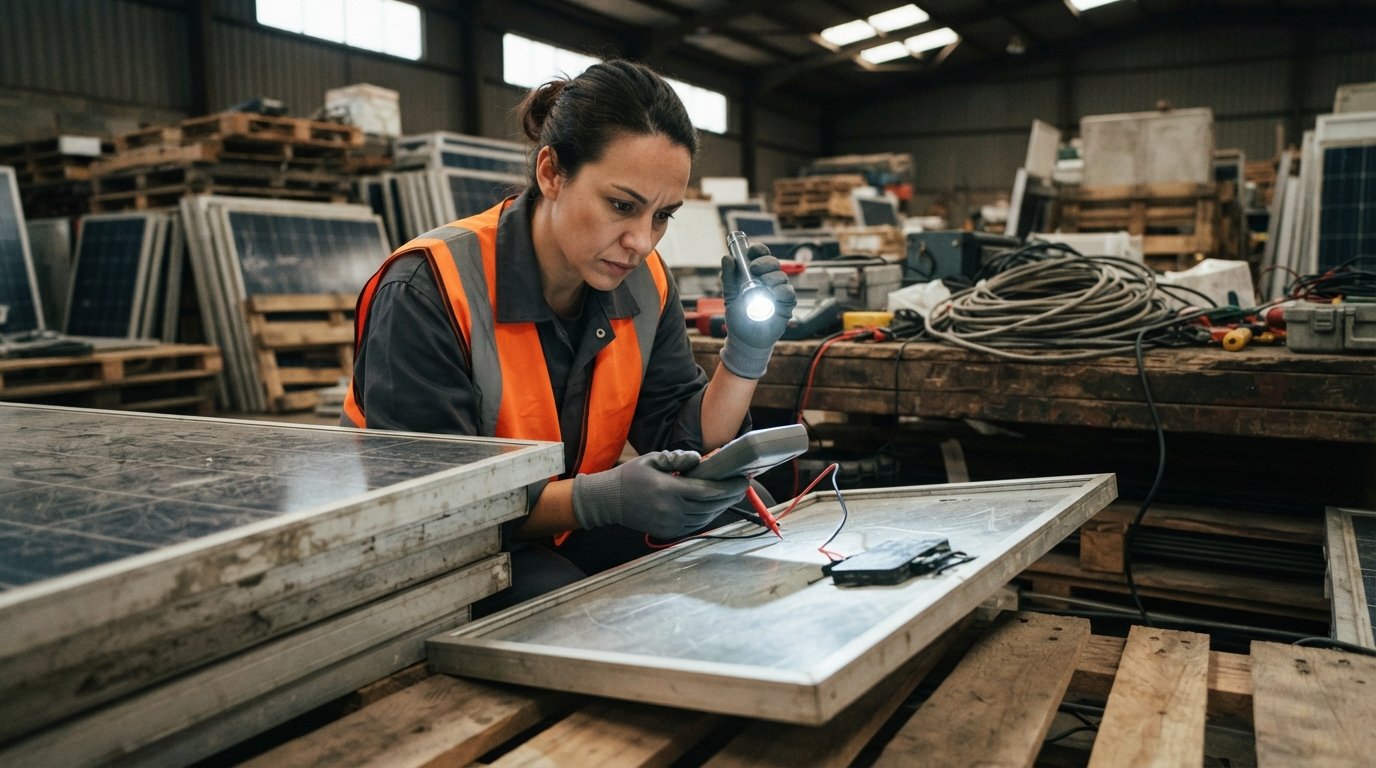
You would not buy a used car without starting the engine, and you should not buy a used solar panel without measuring its electrical integrity. The following steps can be performed with a basic multimeter and, ideally, an insulation resistance tester (megohmmeter). If you are not comfortable working with live DC circuits, ask the seller to demonstrate these tests or hire a licensed electrician.
- Open-circuit voltage (Voc) test: Measure the voltage across the panel's output terminals under bright sunlight. Compare the reading to the nameplate Voc. A deviation of more than 5% suggests cell or interconnection damage. Note that voltage drops roughly 0.3% per degree Celsius above 25 C, so adjust expectations on hot days.
- Short-circuit current (Isc) test: Using a clamp meter rated for DC current, measure the short-circuit current. This should be close to the nameplate Isc under standard test conditions. Significant deviation indicates shading, cracked cells, or faulty bypass diodes.
- Insulation resistance test: With the panel disconnected and ideally in low light, use a megohmmeter to measure resistance between the output terminals and the frame. A reading below 40 megohms at 1000V test voltage is a red flag for insulation breakdown. This test is critical for preventing ground faults and shock hazards.
- Bypass diode check: Many panels have bypass diodes in the junction box. A failed diode can cause partial shading to drag down the whole panel or create a hot spot. A simple diode test with a multimeter can reveal open or shorted diodes.
Document every reading and compare it to the manufacturer's datasheet. If the seller cannot provide access to the panel's junction box or refuses testing, walk away. Reputable resellers expect these checks and often provide test reports as part of the sale.
Warranty Transfer and Degradation History
New solar panels typically carry a 25- to 30-year performance warranty and a 10- to 12-year product warranty. Used panels rarely come with transferable coverage. Most manufacturers limit warranty claims to the original purchaser and require proof of professional installation. Before buying, ask the seller for the original purchase date, installation records, and any warranty documents. If the warranty is non-transferable, factor that into the price: you are assuming all risk.
Degradation history matters just as much as warranty status. Solar panels degrade at an average rate of 0.5% to 0.8% per year. A 10-year-old panel should retain roughly 92% to 95% of its original output. However, degradation is not always linear. Panels from hot, humid climates or systems with poor ventilation may degrade faster. Ask for historical production data if available, or at minimum, request a flash test report from a reputable reseller. Without that data, assume the panel has lost at least 10% of its rated output and price accordingly.
Permitting and Interconnection Hurdles
Even if the hardware is sound, used panels can create bureaucratic obstacles. Many local permitting authorities require equipment listing to UL 1703 or UL 61730, and some utilities will not approve interconnection for modules that lack clear certification labels. If the label is faded or missing, the inspector may reject the installation. Before purchasing, check with your local building department and utility about their requirements for used equipment. Some jurisdictions allow used panels if they bear visible UL marks and are installed by a licensed contractor; others prohibit them entirely for grid-tied systems.
Interconnection agreements also often require proof of equipment warranty. Without a transferable warranty, you may struggle to satisfy utility requirements. For off-grid or DIY systems not tied to the grid, these hurdles are lower, but insurance companies may still balk at covering a structure with uncertified equipment. If you plan to mount panels on a roof, review our guide on attaching solar panels to roof safely, and confirm that your insurer accepts secondhand modules.
When Used Panels Make Sense Versus Buying New
Used solar panels are not for everyone. They work best in specific scenarios where the buyer can manage risk and perform proper testing. Consider the following factors when deciding between used and new.
- Off-grid or DIY projects: If you are building a small off-grid system for a cabin, shed, or RV, used panels can deliver excellent value with minimal permitting hassle. You can test each panel individually and replace failures without complex warranty claims.
- Budget-constrained expansion: Adding a few used panels to an existing system can be cost-effective if the new panels match the voltage and current characteristics of your current array. Mismatched panels can drag down performance, so consult a professional before mixing.
- Short-term installations: For a temporary setup expected to last five to seven years, used panels may pay for themselves faster than new ones. Just be honest about the reduced lifespan.
- New installations with warranty needs: If you want long-term peace of mind, financing options, and full insurance coverage, new panels are the safer choice. The price gap has narrowed in recent years, and new panels often come with integrated monitoring and higher efficiency.
For homeowners who want professional guidance on system design and incentives, platforms like NewSolarQuotes provide independent educational resources and cost calculators to compare options. Weigh the savings against the risk of premature failure, and remember that labor and mounting hardware often cost more than the panels themselves. A failed used panel can be expensive to replace if it is already on a roof.
Building a Testing Protocol for Used Panel Purchases
If you decide to proceed with used panels, establish a repeatable testing protocol for every module you consider. Start with a visual inspection in bright, diffuse light: look for cracked glass, discolored cells, burnt spots, and loose frames. Then perform the electrical tests described earlier, recording all values. If possible, ask the seller to run the panels under load for 15 to 20 minutes and use a thermal camera to check for hot spots. Thermal imaging can reveal defects that a multimeter misses.
Finally, consider the total cost of ownership. Used panels may require new connectors, mounting hardware, and possibly a new inverter or charge controller. Add those costs to the purchase price and compare against a new panel quote. Sometimes the savings disappear once you factor in your time and risk. For larger projects, a licensed solar installer can help you evaluate used equipment and ensure it integrates safely with your existing system.
Final Thoughts on Buying Used Solar Panels Safely
Used solar panels can be a smart way to cut costs on off-grid or DIY projects, but they demand careful testing and a clear understanding of the risks. Voltage and insulation tests, warranty checks, and permitting research are non-negotiable steps. If you are not prepared to perform those checks, buy new or work with a professional who can. The savings are real, but so are the hazards. By approaching the used market with the same rigor you would apply to any electrical equipment, you can capture value without compromising safety.
Find Local Pros Near You
Enter your ZIP code to compare top-rated local professionals and request free quotes.