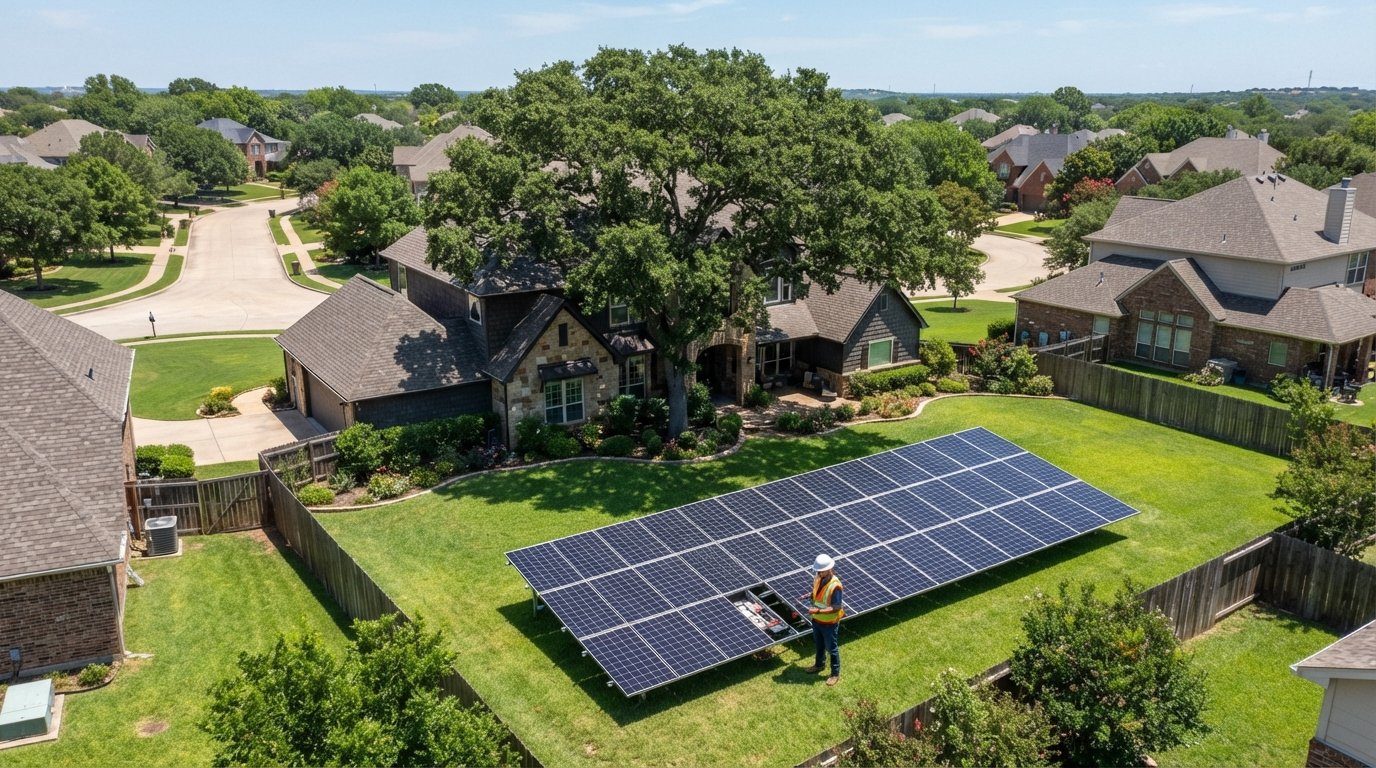
Ground Mount Solar vs Rooftop: Shaded or Small Roof?
Ground mount solar versus rooftop for shaded or small roofs: which wins? Compare costs and production gains. Call (833)-434-4023 for expert guidance.

By Dylan Harris
Learn more about Solar Panel Installation and Repair for guides, costs, and what to expect.
Compare Solar Panel Installation and Repair Pros Near You

Enter your ZIP code to compare top-rated local professionals and request free quotes.
Your roof is shaded by a towering oak, or maybe it is simply too small to host the array you need. You still want solar, but the standard rooftop installation feels like a square peg in a round hole. This is exactly where the ground mount solar versus rooftop for shaded or small roofs debate becomes practical rather than theoretical. The good news: you have options, and some of them may actually outperform a traditional rooftop system in both production and long-term savings. In this guide, we break down space requirements, permitting, costs, and hybrid designs so you can decide which path fits your property and your budget.
Why Your Roof Might Not Be a Solar Candidate
Not every roof is built for solar. Shade from trees, nearby buildings, or even a tall chimney can drag production down significantly, especially in the morning and late afternoon when panels are most valuable to the grid. Small roof planes, complex hips and valleys, and multiple penetrations also limit usable area. Even a roof with good sun exposure can be a poor host if its orientation is east or west when your utility offers the best net metering rates for south-facing production.
Homeowners often assume that any roof can host panels, but a solar assessment frequently reveals otherwise. Shading analysis, structural review, and a quick look at the roof's age all matter. If your roof is nearing replacement, adding panels now could mean paying for removal and reinstallation later. In these cases, a ground-mounted array sidesteps the roof entirely and often delivers better performance per panel.
Ground Mount Solar vs Rooftop: Key Differences at a Glance
The core trade-off is simple: rooftop solar saves yard space and often costs less upfront, while ground mounts unlock better sun exposure, easier maintenance, and flexible sizing. But the details matter, especially when your roof is shaded or small. Here is how the two approaches compare on the factors that most often decide the choice.
- Sun exposure: Ground mounts can be positioned in the sunniest part of your property, while rooftop systems are stuck with the roof's orientation and shade profile.
- Space needs: Rooftop systems use existing square footage, but ground mounts require clear yard area plus setbacks and access paths.
- Installation cost: Ground mounts add trenching, foundations, and wiring runs, which can raise upfront costs by 10 to 30 percent compared with a straightforward rooftop job.
- Maintenance and snow: Ground arrays are easier to clean, inspect, and clear after snow, while rooftop panels may require specialized access.
- Permitting and aesthetics: Ground mounts often face additional zoning, HOA, and easement reviews, and they change the look of your yard.
These differences are not just academic. For a shaded roof, the production gains from a ground mount can easily outweigh the extra installation cost. For a small but unshaded roof, a hybrid approach may make more sense. The right answer depends on your specific site, which is why a professional assessment is worth the time.
Space, Setback, and Permitting Requirements for Ground Mounts
Ground-mounted solar systems need more than just open grass. Most jurisdictions require setbacks from property lines, typically ranging from 5 to 15 feet, and some require a certain distance from neighboring structures for fire access and aesthetics. You also need space for equipment pads, conduit runs, and maintenance access. A common rule of thumb is that a 5 kW ground mount needs roughly 300 to 400 square feet of clear area, depending on panel tilt and row spacing.
Permitting is another layer. While rooftop solar often qualifies for streamlined permitting, ground mounts may trigger additional zoning review, especially in historic districts or environmentally sensitive areas. Some utilities also require a visible disconnect or additional signage for ground-mounted systems. Before you commit, check with your local building department and homeowner's association. A solar professional can usually handle this paperwork, but knowing what to expect helps you avoid surprises.
One more consideration: soil conditions and frost depth. In cold climates, foundations must be engineered below the frost line, which adds cost. In rocky or sloped terrain, ground screws or ballasted mounts may be necessary. These site-specific factors are why ground mount costs vary more widely than rooftop costs.
Production Gains from Optimal Tilt and Orientation
The single biggest advantage of a ground mount is the ability to optimize tilt and orientation. Rooftop panels are typically installed flush with the roof pitch, which may be steeper or shallower than ideal for your latitude. A ground mount can be set at the perfect angle, often 20 to 35 degrees depending on your location, and oriented due south for maximum annual production. In many cases, this alone can boost output by 10 to 20 percent compared with a suboptimal roof.
Shade avoidance is the other major gain. By placing the array away from trees and buildings, you eliminate the production losses that plague shaded roofs. Even partial shade on a rooftop system can disproportionately reduce output because of how panels are wired in series. Ground mounts let you choose a clear spot, and if you have the room, you can even use microinverters or power optimizers to further mitigate any remaining shade.
For homeowners with small roofs, ground mounts also allow for a larger system. A 6 kW array might not fit on a 400 square foot roof, but it can easily fit in a sunny side yard. That extra capacity can be the difference between covering most of your bill and merely trimming it.
Cost Differences: Trenching, Wiring, and Foundations
Ground mounts are not automatically more expensive, but they do have different cost drivers. The biggest adders are trenching, foundations, and wiring. Trenching from the array to your main electrical panel can cost $10 to $30 per foot, depending on distance and soil. Foundations, whether concrete piers or ground screws, add another $500 to $2,000 per array. And if the run is long, you may need larger gauge wire or a separate combiner box.
On the other hand, ground mounts avoid some rooftop costs, such as roof penetrations, flashing, and the labor of hauling panels onto a roof. They also make future roof replacement easier because the solar equipment is not in the way. For a shaded or small roof, the production gains often translate into a faster payback even with the added installation costs. To get a clearer picture, use a solar savings calculator that accounts for system size, local incentives, and your utility's net metering policy.
It is also worth noting that ground mounts can be DIY-friendly for handy homeowners, though we generally recommend professional installation for safety and warranty reasons. If you are comparing quotes, ask installers to break out trenching, foundation, and wiring costs so you can see where the money goes.
HOA, Easement, and Utility Considerations for Yard Installations
Not every yard is free for solar. Homeowner's associations may have rules about visible equipment, setbacks, and screening. Some states have solar access laws that override HOA restrictions, but the details vary. Easements, such as utility right-of-ways or drainage easements, can also limit where you can dig. Always check your property deed and HOA covenants before finalizing a ground mount location.
Utilities may have their own requirements. Some require a lockable disconnect at the array, and others may have restrictions on where the conduit can run. If you are in a rural area with a well and septic system, you also need to avoid those areas. A site survey by a qualified installer will flag these issues early, saving you from costly redesigns later.
For homeowners who are planning a move, it is worth noting that ground-mounted systems are generally considered part of the real property, so they transfer with the home. If you are thinking about relocation, resources like Moving.Homes offer checklists and guides that can help you plan a move without losing track of your solar investment.
Hybrid Designs: Combining Roof and Ground Arrays
You do not have to choose one or the other. Hybrid designs combine a rooftop array with a ground-mounted array to maximize total capacity and production. This is especially useful when your roof has some usable area but not enough for your full energy needs, or when one roof plane is shaded but another is clear. A hybrid system can also provide redundancy: if one array is shaded or needs maintenance, the other keeps producing.
Hybrid systems require careful electrical design. You may need multiple inverters or a combination of string and microinverters to handle different orientations and shading profiles. The added complexity can raise costs, but for many homeowners, the ability to offset a larger share of their bill makes it worthwhile. If you are considering a hybrid, ask your installer to model production for each array separately and then combined, so you can see the incremental value.
For a deeper comparison of these two primary options, our guide on ground mount vs rooftop solar walks through the decision framework step by step. It is a helpful companion to this article, especially if you are still weighing the basics.
Making the Decision: A Simple Framework
So how do you decide? Start by evaluating your roof's solar potential. If a shading analysis shows more than 20 percent production loss during peak hours, a ground mount is likely the better choice. If your roof is small but unshaded, a hybrid or a ground mount in a side yard may work. If your roof is large and sunny, rooftop solar is usually the most cost-effective path.
Next, assess your yard. Do you have clear space that meets setbacks? Is the ground stable and accessible? Are there HOA or easement restrictions? If the answer to any of these is no, a ground mount may not be feasible. Finally, compare quotes for both options, including all costs. A trustworthy installer will give you a side-by-side production and savings estimate, not just a price.
Remember that incentives can tip the scale. The federal residential clean energy credit applies to both rooftop and ground-mounted systems, and many states and utilities offer additional rebates. Be sure to verify current incentives with official sources, as programs change. A solar professional can help you navigate the paperwork and maximize your savings.
Next Steps: Get a Professional Assessment
Every property is unique, and the ground mount solar versus rooftop for shaded or small roofs decision should be based on site-specific data, not guesswork. A professional solar assessment will measure shade, evaluate your roof and yard, and provide production estimates for both options. It is the fastest way to know which path will deliver the best return on your investment.
If you are ready to explore your options, connect with vetted solar pros in your area. They can answer your questions, handle permitting, and help you design a system that fits your property and your budget. Whether you end up with a ground mount, a rooftop array, or a hybrid, the goal is the same: clean, reliable energy that lowers your bills for decades to come.
Learn more about Solar Panel Installation and Repair for guides, costs, and what to expect.
Compare Solar Panel Installation and Repair Pros Near You
Enter your ZIP code to compare top-rated local professionals and request free quotes.