Commercial Energy Audit Before Solar: What to Expect
A commercial energy audit process for businesses before solar reveals efficiency fixes that shrink system size and boost ROI. Call (833)-434-4023 for expert help.

By Wendy Young
Learn more about Solar Panel Installation and Repair for guides, costs, and what to expect.
Compare Solar Panel Installation and Repair Pros Near You

Enter your ZIP code to compare top-rated local professionals and request free quotes.
Before you sign a solar contract, a commercial energy audit can reveal whether you are sizing a system for today's waste or tomorrow's efficiency. Many businesses rush to install panels only to discover that aging HVAC units, uncontrolled lighting, and poor power factor inflate their energy demand, forcing them to buy a larger and more expensive solar array than necessary. A proper audit bridges that gap, giving you the data to right-size your system, maximize incentives, and avoid unpleasant surprises. This guide walks through the commercial energy audit process for businesses before solar, from the initial walkthrough to the final report, so you know exactly what to expect and how to act on the findings.
What a Commercial Energy Audit Covers and Why It Precedes Solar
A commercial energy audit is a systematic evaluation of how your facility uses electricity, gas, and other fuels. It goes beyond your utility bill to examine equipment, operations, and building envelope. The goal is to identify inefficiencies, quantify their cost, and prioritize improvements. When solar is on the table, the audit becomes even more critical because it determines the load profile your solar array must serve. Without it, you risk oversizing the system, paying for capacity you could have eliminated through simple retrofits.
Audits come in different depths. A walkthrough audit is a visual inspection with basic measurements, often free or low cost. A detailed audit adds metering and sub-metering to break down consumption by system. An investment-grade audit includes engineering analysis, modeling, and financial projections suitable for capital planning. For solar projects, at least a detailed audit is recommended, because you need interval data to match solar production with your actual consumption patterns.
The Three Core Phases: Walkthrough, Metering, and Load Profile Analysis
The audit typically unfolds in three phases. First, the walkthrough identifies obvious issues: incandescent or fluorescent lighting, oversized motors, simultaneous heating and cooling, and leaky building envelopes. The auditor interviews facility staff about operating hours and schedules. Second, metering involves installing data loggers on main feeders and key circuits for one to four weeks. This captures real-time demand and reveals how much energy each system uses. Third, load profile analysis compiles the interval data into daily, weekly, and seasonal patterns. The auditor examines peak demand timing, base load, and load factor. These patterns are essential for solar sizing because a system that produces power when you need it most yields higher savings.
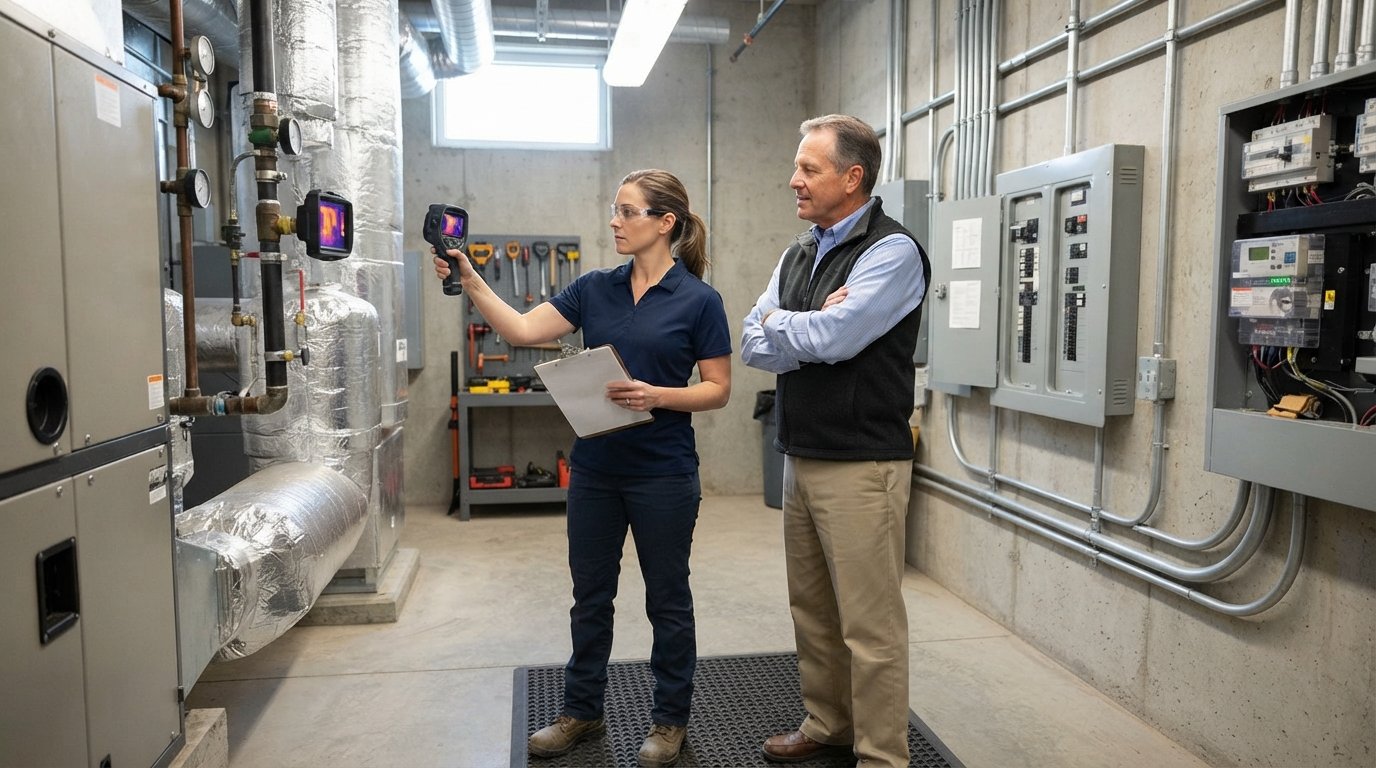
During the walkthrough, the auditor may use thermal imaging to spot insulation gaps or infrared scans to detect overheating electrical panels. They will also review utility bills for demand charges, power factor penalties, and rate structure. All of this feeds into the load profile analysis, which becomes the foundation for solar ROI modeling.
Identifying Efficiency Fixes That Reduce the Solar System Size Needed
Every kilowatt-hour saved through efficiency is a kilowatt-hour you do not need to generate with solar panels. Efficiency improvements directly shrink the required system size, lowering equipment costs, roof space requirements, and potentially the inverter capacity. Common findings include lighting retrofits to LED, HVAC upgrades or controls, variable frequency drives on motors, and building envelope sealing. The auditor quantifies savings and implementation costs for each measure, allowing you to prioritize.
For example, replacing T8 fluorescent fixtures with LEDs might cut lighting energy by 50 percent. Adding occupancy sensors in low-traffic areas can yield another 20 to 30 percent. Upgrading an old chiller or adding economizers can reduce cooling demand significantly. These measures often have payback periods of two to five years, and they reduce the solar array size by a corresponding amount. In some cases, efficiency alone can eliminate the need for solar, but more often it makes the solar investment more attractive by improving ROI.
After the audit, you will have a list of recommended measures with estimated savings, costs, and incentives. You can then decide which to implement before solar and which to phase in later. The key is to model the solar system based on post-efficiency load, not current consumption. Otherwise, you may oversize and overpay.
How Audit Findings Feed Into ROI and Payback Modeling
The audit's load profile and efficiency recommendations become inputs for solar financial modeling. A reputable solar developer will use the interval data to simulate solar production and match it against your load. This produces a more accurate estimate of solar savings than using generic averages. The model accounts for time-of-use rates, demand charges, and net metering policies. It also factors in the reduced load from efficiency measures, which can lower the optimal system size.
For instance, if your audit shows a peak demand of 500 kW but efficiency measures can reduce it to 400 kW, the solar array and inverter can be sized accordingly. This avoids unnecessary demand charges and improves the return on investment. The audit also identifies whether battery storage or load shifting could further reduce demand charges, which is especially valuable in commercial settings with high demand fees.
To explore how solar output prediction and smart energy management can enhance your ROI, see our guide on solar output prediction and smart energy. It explains how data-driven forecasting aligns solar production with facility demand, a natural extension of the audit's load analysis.
Typical Audit Costs and Timelines for Small and Mid-Size Facilities
Audit costs vary by scope and facility size. A basic walkthrough audit for a small commercial building might be free or cost a few hundred dollars, often offered by utilities or energy service companies. A detailed audit with metering for a mid-size facility (50,000 to 200,000 square feet) typically ranges from $5,000 to $25,000, depending on the number of meters and complexity. Investment-grade audits with engineering analysis can cost $20,000 to $50,000 or more. Some utilities offer rebates or free audits for qualifying businesses, so check with your local utility first.
Timelines also vary. A walkthrough can be completed in a day or two, with a report within a week. Detailed audits with metering usually take two to six weeks, including the metering period. Investment-grade audits may take eight to twelve weeks. For solar projects, plan to complete the audit at least three to six months before you intend to install solar, so you have time to implement efficiency measures and incorporate them into the solar design.
Small businesses with limited budgets can start with a utility-sponsored audit or engage a certified energy manager for a targeted assessment. Mid-size facilities with complex operations should invest in a detailed audit to capture all savings opportunities.
Deliverables to Expect and How to Act on the Recommendations
A professional audit delivers a written report with several key components. You should receive an executive summary, a description of the facility and systems, the metering data and load profiles, a list of energy conservation measures (ECMs) with savings and costs, and financial analysis including payback and ROI. The report may also include a prioritized implementation plan and recommendations for solar sizing.
Here is a checklist of typical deliverables to review:
- Interval data and load profile charts
- Equipment inventory and condition assessment
- Energy conservation measures with estimated savings and costs
- Financial analysis (simple payback, ROI, cash flow)
- Solar readiness assessment and recommended system size
To act on the recommendations, start with no-cost and low-cost measures, then implement higher-cost retrofits with attractive paybacks. Use the audit's solar sizing guidance when requesting quotes from installers. If you need help finding qualified solar professionals, NewSolarQuotes connects you with vetted installers who can incorporate audit findings into their proposals.
Finally, use the audit as a baseline for measuring post-implementation performance. Many auditors offer measurement and verification services to confirm savings. This data also strengthens future solar proposals by demonstrating a track record of energy management.
In short, a commercial energy audit before solar is not an added expense but a strategic step that protects your investment. It reveals hidden savings, right-sizes your system, and provides the data lenders and incentive programs require. By following the process outlined here, you can approach solar with confidence and clarity.