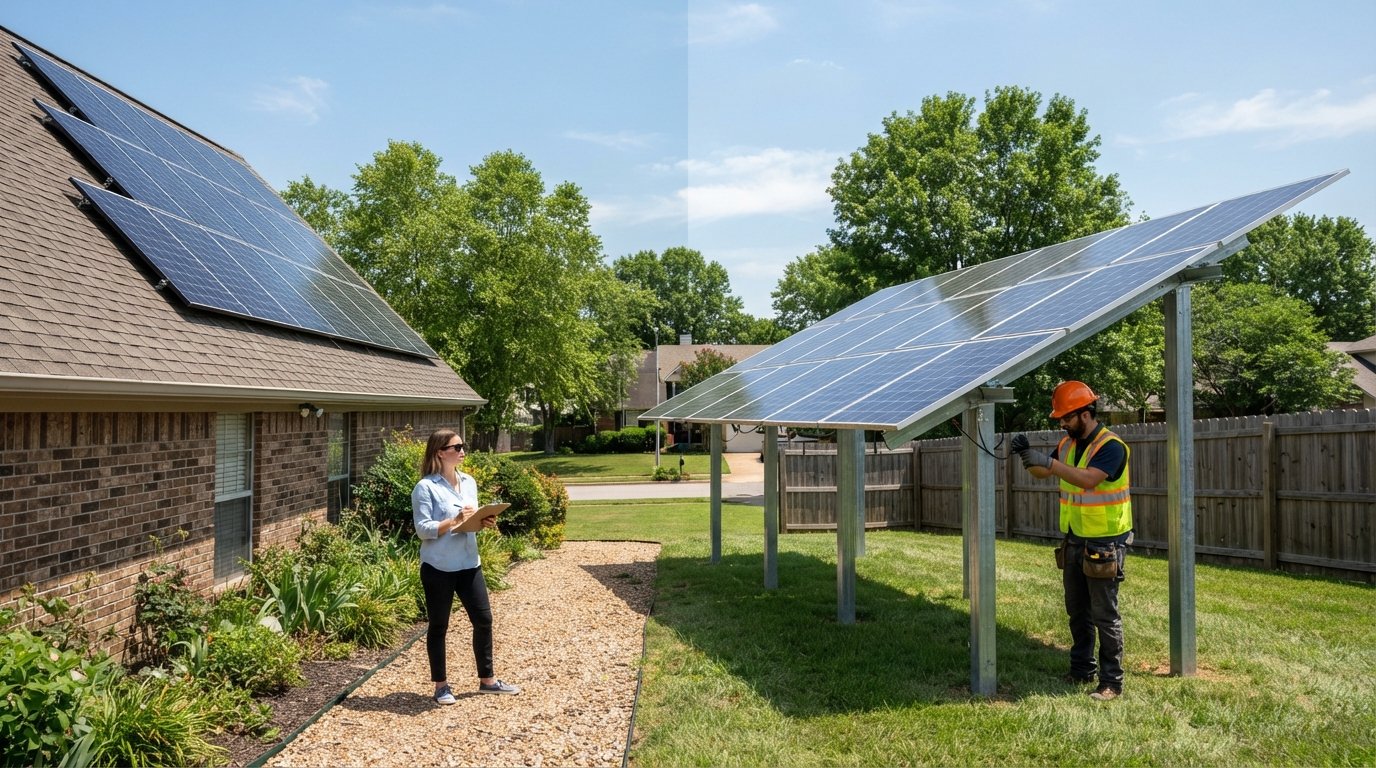
Ground Mount vs Rooftop Solar: Which Is Right for You?
Ground mount vs rooftop solar which is right for my property? Compare costs, production, and maintenance to find the best fit for your home.

By Mason Carter
Learn more about Solar Panel Installation and Repair for guides, costs, and what to expect.
Compare Solar Panel Installation and Repair Pros Near You

Enter your ZIP code to compare top-rated local professionals and request free quotes.
You have decided to go solar, but the moment you start researching mounting options, a fundamental question surfaces: should the panels go on your roof or on the ground? It sounds like a simple preference, yet the answer shapes your system's cost, performance, maintenance schedule, and even your property insurance. Choosing wrong can mean thousands of dollars in unnecessary expenses or a system that underperforms for 25 years. Choosing right means decades of predictable production and lower bills. This guide breaks down the real differences between ground mount vs rooftop solar so you can match the right design to your specific property, budget, and energy goals.
Why Mounting Location Matters More Than You Think
The mounting decision is not cosmetic. It affects how much sunlight your panels capture, how easily technicians can service them, how much you pay for installation labor, and how your homeowner's insurance policy treats the system. A rooftop array and a ground mount of identical wattage can behave very differently in the real world. One might produce more energy in winter because it tilts steeply toward the low sun, while the other might cost less upfront because it requires no structural engineering.
Most residential solar installations in the United States are rooftop mounts, largely because they use existing square footage and require no additional land. Ground mounts make up a smaller share of residential projects, but they dominate in rural areas, on properties with shaded or aging roofs, and wherever homeowners want maximum control over panel angle. Neither option is universally better. The right answer depends on variables unique to your home site.
How Rooftop Solar Systems Work
Rooftop solar uses mounting hardware, typically aluminum rails and flashing, to secure panels directly to your roof structure. The panels sit a few inches above the shingles or tiles, allowing air to circulate underneath and cool the equipment. Installers penetrate the roof at specific points, seal those penetrations, and route wiring through the attic or along exterior conduit to an inverter and your electrical panel. The roof itself becomes the foundation, so its age, pitch, and condition matter enormously.
Because the roof already exists, you avoid the cost of land preparation, trenching, and separate foundation work. That is why rooftop solar usually carries a lower upfront price tag. The trade-off is that you inherit whatever orientation and tilt your roof offers. If your roof faces east or west instead of south, production drops. If a chimney or mature tree casts afternoon shade, you cannot simply move the array. You can optimize within those constraints using microinverters or power optimizers, but you cannot change the underlying geometry.
Rooftop systems also concentrate all your solar equipment in one elevated location. That is convenient for space, but it complicates maintenance. Cleaning, troubleshooting, and replacing components require ladder work or roof access, which some homeowners are not comfortable with and some installers charge extra to perform. If your roof needs replacement in 10 years, you will likely pay to remove and reinstall the entire array.
How Ground Mount Solar Systems Work
Ground mount solar places panels on engineered racks anchored into the earth, usually with concrete footings, ground screws, or driven piles. The racks can be fixed-tilt or equipped with tracking motors that follow the sun from east to west. Because the ground offers unlimited orientation freedom, you can set the perfect azimuth and tilt for your latitude, often boosting production compared with a compromised roof plane. Panels also stay cooler near the ground, and cooler panels generate more electricity.
The trade-offs are space, permitting, and cost. A typical residential ground mount needs a clear area roughly the size of a small parking spot or larger, depending on system size and row spacing. You must trench conduit from the array to your home, which adds labor and inspection requirements. Many jurisdictions treat ground mounts as accessory structures, triggering additional permits, setbacks, and sometimes screening requirements. In cold climates, you may need to account for frost depth when pouring footings.
Ground mounts shine in specific scenarios: properties with large lots, roofs that are shaded, steep, or nearing replacement, and homeowners who want easy access for cleaning or snow removal. They also suit future expansion, since you can add rows or panels without touching the roof. If you plan to stay in your home for decades and want a serviceable, upgradeable system, ground mount deserves serious consideration.
Cost Comparison: Where the Money Actually Goes
Upfront cost is the most common deciding factor, and the gap between the two options can be significant. Rooftop systems benefit from existing structure and simpler logistics. Ground mounts add site work, trenching, foundation materials, and often more permitting. Industry data generally puts ground mount installation at roughly 10 to 30 percent more than a comparable rooftop system before incentives, though the exact premium varies by terrain, distance from the house, and local labor rates.
That said, the sticker price is not the whole story. Consider these cost-related factors before deciding:
- Roof condition: If your roof is within 5 to 10 years of replacement, factor in the cost of removing and reinstalling panels, or replace the roof before going solar.
- Trenching distance: The farther the array sits from your main electrical panel, the more you pay for conduit, wire, and labor.
- Terrain and soil: Rocky, sloped, or unstable ground increases foundation costs for ground mounts.
- Permitting and inspections: Some municipalities charge more for ground mounts or require additional engineering stamps.
- Incentives: The federal Investment Tax Credit applies to both options, but some state or utility rebates may differ.
Financing works similarly for both. You can pay cash, take a solar loan, or sign a lease or power purchase agreement, though leases and PPAs are more common with rooftop systems because lenders prefer the lower risk profile. To compare real numbers for your address, use a solar savings calculator that accounts for your utility rate, roof or ground orientation, and local incentives.
Energy Production and Efficiency Differences
Production depends on three main variables: sunlight intensity, panel temperature, and angle of incidence. Ground mounts win on angle because you can optimize tilt and azimuth precisely. They also win slightly on temperature because air flows freely around the panels and the ground stays cooler than a roof surface. A well-designed ground mount in a hot climate can outperform a rooftop array of the same size by 5 to 15 percent over a year.
Rooftop systems lose some of that advantage to compromise. A south-facing roof at a 30-degree pitch is ideal for most U.S. latitudes, but many homes have roofs that face east, west, or a mix. Installers can split the array across multiple roof planes and use module-level power electronics to reduce losses, but they cannot beat physics. Shading from trees, chimneys, and nearby buildings also hits rooftops harder because you cannot relocate the array.
Snow and debris tell a similar story. Ground mounts are easier to clear after a storm, and their steeper tilt options help snow slide off naturally. Rooftop panels on shallow pitches may stay covered for days, cutting winter production. If you live in a snowy region, this accessibility alone can justify the ground mount premium.
Maintenance, Access, and Long-Term Reliability
Every solar system needs occasional attention: cleaning, visual inspections, inverter checks, and the rare panel replacement. Ground mounts make all of these tasks simpler and safer. You can walk up to the array, hose it down, and inspect wiring without climbing. That ease of access often translates to lower lifetime maintenance costs and faster troubleshooting when something goes wrong.
Rooftop systems are not high-maintenance, but they are harder to reach. Many homeowners never clean their panels and rely on rain, which works fine in most climates. However, if you live in a dusty area or have heavy pollen, rooftop cleaning requires either hiring a professional or carefully working on a ladder. If a panel or microinverter fails, the repair is more time-consuming and therefore more expensive.
Reliability itself is comparable. Both mounting types use the same panels, inverters, and wiring, so failure rates are similar. The difference is serviceability. Ground mounts also make it easier to add battery storage or expand the array later, since you have room to work and space for additional equipment.
Permits, Zoning, and Insurance Considerations
Rooftop solar usually faces fewer zoning hurdles because the panels sit on an existing structure and rarely violate setback rules. Ground mounts, by contrast, are often classified as accessory structures. That means you may need to meet front, side, and rear setbacks, respect height limits, and sometimes install landscaping screening. Homeowners associations can also restrict visible ground mounts, though many states have solar access laws that limit HOA prohibitions.
Insurance is another differentiator. Most homeowner policies cover rooftop solar as part of the dwelling, sometimes with a small premium increase. Ground mounts may require a separate rider or a scheduled personal property endorsement because they are detached from the home. Some insurers also ask about ground-mounted equipment because it is more exposed to theft, lawnmower damage, or flooding. Contact your insurer before you sign a contract so you understand exactly what is covered.
Permitting timelines vary widely. A straightforward rooftop permit might take a few weeks, while a ground mount with grading, trenching, and electrical inspections can take several months. If you are working toward a deadline, such as a expiring tax credit or a summer installation window, factor permitting time into your decision.
Property Size, Shading, and Aesthetics
Your lot size and shading profile often make the decision for you. If you live in a dense suburban neighborhood with a small yard and a sunny south-facing roof, rooftop solar is the obvious choice. You simply do not have the space for a ground mount, and the roof is already ideal. Conversely, if you own several acres with a shaded roof and a sunny meadow, a ground mount unlocks production that a rooftop system could never match.
Aesthetics matter too, and they cut both ways. Some homeowners prefer the clean look of panels hidden on the roof. Others dislike seeing panels from the street and would rather place them behind a fence or on a back slope. Ground mounts can be screened with landscaping, but that adds cost and maintenance. Rooftop panels are visible from the air and from upper-story windows, but they blend into the roof plane from ground level.
Think about future land use as well. A ground mount occupies yard space that could otherwise hold a garden, play area, or outbuilding. If your lot is tight, that opportunity cost is real. If you have unused acreage, it is irrelevant.
A Simple Framework for Choosing
When you weigh ground mount vs rooftop solar for your property, run through a short decision sequence. Start with your roof: is it structurally sound, free of heavy shade, and likely to last another 25 years? If yes, rooftop is probably your most cost-effective path. If no, ground mount moves to the front. Next, check your land: do you have a sunny, buildable area with reasonable trenching distance and no HOA or zoning blockers? If yes, ground mount becomes viable. If no, you may need to address shading or consider a roof replacement before going solar.
Finally, think about your long-term plans. If you expect to move in five years, a rooftop system may add resale value without complicating the sale. If you plan to stay for decades and want maximum control, ground mount offers better serviceability and expansion potential. There is no universal winner, only the design that fits your site and goals.
Whatever you choose, professional guidance prevents expensive mistakes. A vetted local installer can assess your roof, measure shade, evaluate soil and setbacks, and model production for both options. You can compare free solar quotes from local installers to see how ground mount and rooftop pricing stack up for your address, with no obligation. Getting multiple quotes also helps you spot outliers and negotiate better terms.
If you want to monitor and optimize whichever system you install, understanding how automation compares with manual tracking can pay off. Our guide on AI vs manual solar monitoring explains how each approach affects savings and system health over time.
Solar is a 25-year investment, and the mounting decision is one of the few choices you cannot easily change later. Take the time to evaluate your roof, land, budget, and maintenance preferences. When you match the mount to the property instead of forcing the property to fit a default, you end up with a system that produces more, costs less to own, and keeps paying you back long after the installation crew has left.