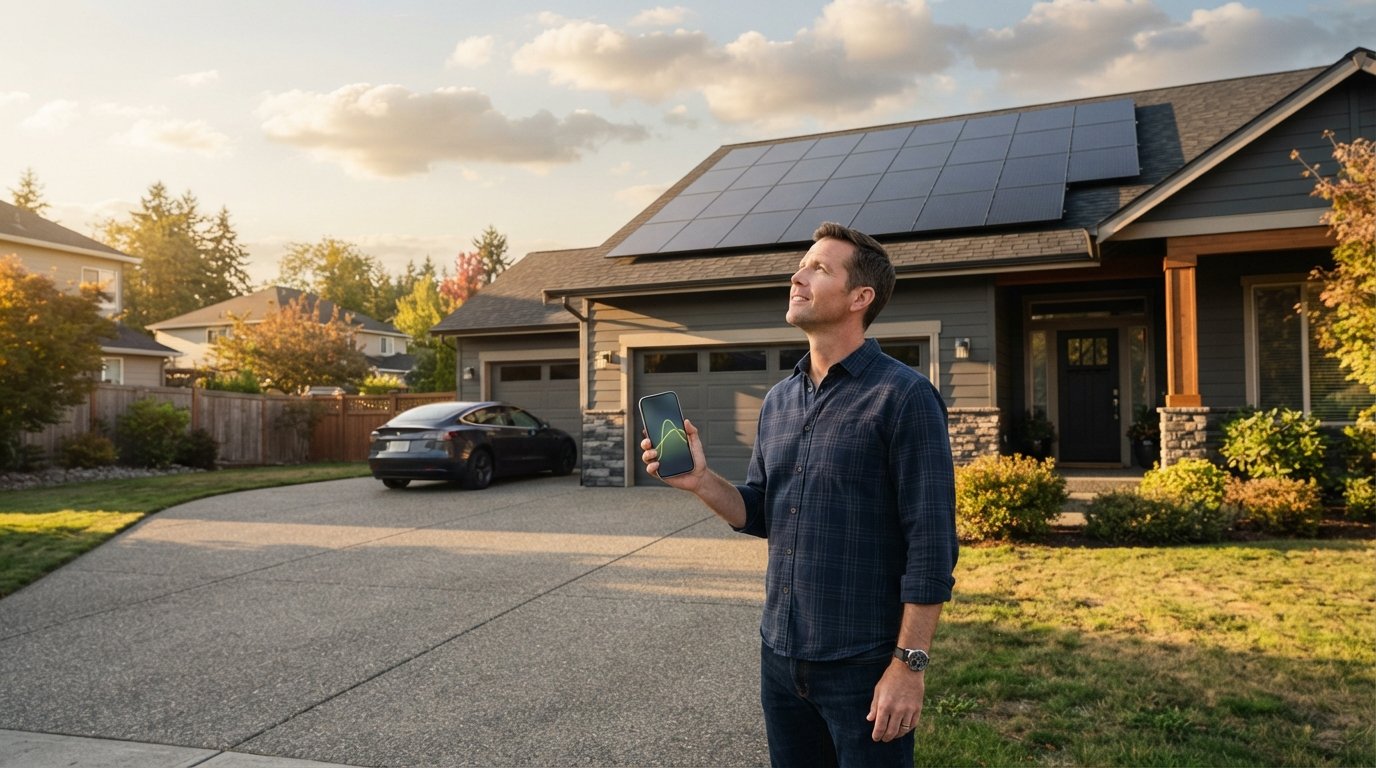
AI Solar Forecasting: Maximize Home Energy Savings
AI solar forecasting predicts your panels' output so you can shift energy use to peak hours, cut grid dependence, and lower electric bills.

By Dylan Harris
Learn more about Solar Panel Installation and Repair for guides, costs, and what to expect.
Compare Solar Panel Installation and Repair Pros Near You

Enter your ZIP code to compare top-rated local professionals and request free quotes.
Solar power has transformed how American homeowners produce and consume electricity. But as any experienced solar owner will tell you, the sun is not always predictable. Clouds roll in, storms develop, and seasonal changes shift daylight hours. These fluctuations can quietly reduce the return on your solar investment. That is where artificial intelligence steps in. AI solar forecasting is changing the game by predicting solar output with remarkable accuracy, helping homeowners squeeze more value from every panel on their roof. This article explains how this technology works, why it matters for your wallet, and how you can use it to lower your electricity bills in 2026 and beyond.
What Is AI Solar Forecasting?
AI solar forecasting uses machine learning algorithms to predict how much electricity your solar panels will generate in the coming hours, days, or weeks. Instead of relying on simple weather forecasts, these systems analyze vast datasets, including satellite imagery, local weather station data, historical solar output, and even real-time sensor readings from your home. The AI learns patterns and makes highly accurate predictions that adapt to changing conditions.
For homeowners, this technology takes the guesswork out of solar energy management. You no longer need to wonder whether tomorrow will be a high-production day. Instead, you can see a clear forecast of expected solar generation, allowing you to plan your energy usage accordingly. This is especially valuable for households with battery storage, time-of-use electricity rates, or smart home devices that can shift energy-intensive tasks to peak solar hours.
Traditional forecasting methods, such as simple weather-based estimates, often miss local microclimates and sudden weather changes. AI models continuously learn from new data, improving their accuracy over time. A study from the National Renewable Energy Laboratory found that AI-based solar forecasts can reduce prediction errors by up to 30% compared to conventional methods. That improvement translates directly into better energy management and more savings on your monthly bill.
How AI Models Learn Solar Patterns
Machine learning models for solar forecasting typically use historical data to train algorithms. These models examine thousands of past weather events, solar output logs, and geographic factors. Over time, they identify complex relationships between cloud cover, temperature, humidity, wind speed, and solar panel performance.
For example, a model might learn that in your area, certain types of cumulus clouds tend to form in the late afternoon during spring, temporarily reducing solar output. It can then factor that pattern into its predictions. Some advanced systems even use deep learning, which mimics how the human brain processes information, to handle nonlinear relationships that simpler models miss.
The result is a forecast that is tailored to your specific location and your specific solar array. That level of personalization is what sets AI solar forecasting apart from generic weather apps or utility-level predictions.
Why AI Solar Forecasting Matters for Homeowners
The primary benefit of AI solar forecasting is financial. When you know exactly when your panels will produce the most electricity, you can align your consumption to maximize self-consumption. This reduces the amount of energy you draw from the grid, and under net metering, it can also help you export surplus power at the most favorable times.
Consider a typical homeowner with a 6 kW solar system. Without forecasting, they might run the dishwasher or washing machine whenever it is convenient. But if the forecast predicts a cloudy morning followed by a sunny afternoon, they can delay those loads by a few hours. Over a year, small shifts like this can add up to hundreds of dollars in savings, especially if your utility charges higher rates during peak demand periods.
Battery storage adds another layer of value. AI solar forecasting can optimize when to charge and discharge your battery. If the system knows that tomorrow will be overcast, it may decide to conserve battery power tonight rather than exporting it to the grid. Conversely, if a sunny stretch is predicted, it can charge the battery aggressively during the day and discharge it in the evening when electricity rates spike.
Protecting Your Investment
Solar panels are a long-term investment, and monitoring their performance is essential. AI forecasting systems often include anomaly detection. If your array underperforms relative to the forecast, the system flags a potential issue, such as a dirty panel, a faulty inverter, or shading from a new tree. Early detection helps you address problems before they cost you significant lost production.
For homes with AI solar forecasting boost home energy savings systems, the integration with smart home ecosystems is seamless. You can set rules like "pre-cool the house when solar output is forecast to be above 5 kW" or "delay EV charging until the forecast predicts peak production." These automations require no manual input, making energy efficiency effortless.
Key Features of AI Solar Forecasting Tools
Not all AI solar forecasting tools are created equal. When evaluating options, look for these essential features:
- Real-time data integration: The system should pull live data from your inverter, weather services, and local sensors.
- Cloud cover modeling: Advanced algorithms that account for cloud movement and density are far more accurate than simple irradiance estimates.
- Battery optimization: If you have storage, the tool should automatically manage charge and discharge cycles to maximize savings.
- Time-of-use rate awareness: It should factor in your utility's rate structure to decide when to export or consume energy.
- User-friendly dashboard: A clear interface that shows today's forecast, weekly trends, and historical performance.
Additionally, consider whether the tool offers mobile alerts. If a sudden weather change threatens to reduce your solar generation, you can receive a notification and adjust your plans accordingly. Some platforms even let you share your forecast with your utility or grid operator, which can be beneficial for demand response programs.
How to Choose the Right AI Solar Forecasting Platform
Start by checking if your solar inverter manufacturer offers a forecasting feature. Many modern inverters, such as Enphase and SolarEdge, include built-in AI capabilities. If not, third-party platforms like SolarEnergy.ai can provide the service. When comparing options, look for independent validation of forecast accuracy. Some companies publish their mean absolute error (MAE) statistics, which measure how close predictions are to actual output.
Also, consider the cost. Some tools are free, while others require a subscription. In many cases, the savings generated by optimized energy management far exceed the subscription fee. For example, if a tool costs $10 per month but saves you $30 per month on your electric bill, the return on investment is compelling.
Finally, read user reviews to understand the typical experience. Look for feedback on forecast reliability, ease of use, and customer support. A tool that is difficult to understand will not be used effectively, so choose one that fits your technical comfort level.
Practical Steps to Start Using AI Solar Forecasting
Getting started is easier than you might think. Follow these steps to harness the power of AI for your home solar system:
- Assess your current setup: Check if your inverter or solar monitoring app already includes forecasting. If it does, begin by exploring that feature.
- Choose a forecasting tool: If you need a dedicated platform, research options that support your inverter brand and battery system. Many tools offer free trials, so take advantage of those.
- Connect your energy data: Link your utility bill, rate plan, and any smart home devices. The more data the AI has, the better its predictions will be.
- Set your optimization goals: Decide whether you want to minimize grid dependence, maximize export revenue, or reduce your carbon footprint. The AI can prioritize accordingly.
- Monitor and adjust: Review weekly reports to see how the forecast performed and tweak your settings if needed. Over time, the system will learn your habits and preferences.
Once you have the tool running, you can start shifting discretionary loads to forecasted peak production times. For example, schedule your pool pump, electric water heater, or dehumidifier to run during sunny afternoons. If you have an EV, set the charger to activate only when the forecast predicts surplus generation.
As you become more comfortable, explore advanced features like load shifting for space heating and cooling. Some AI systems can even pre-heat or pre-cool your home during solar peaks, effectively using your home as a thermal battery. This reduces strain on the grid and saves money without sacrificing comfort.
The Future of AI Solar Forecasting
The evolution of AI solar forecasting is far from over. Researchers are developing models that incorporate data from new sources, such as rooftop cameras, sky imagers, and even satellite-based sensors that can see cloud formation in real time. These innovations promise even higher accuracy and earlier warnings for sudden weather changes.
Another exciting development is the integration of AI forecasting with peer-to-peer energy trading. In the near future, homes with excess solar power could automatically sell it to neighbors during peak demand periods, with AI determining the optimal price and timing. This would create a more dynamic and efficient energy marketplace, benefiting both producers and consumers.
Utility companies are also leveraging AI solar forecasting to manage grid stability. By predicting distributed solar generation across thousands of homes, they can better balance supply and demand, reducing the need for expensive peaker plants. This leads to lower electricity prices for everyone, even those without solar panels.
For homeowners, the takeaway is clear: AI solar forecasting is not just a novelty. It is a practical tool that delivers measurable financial and environmental benefits. Whether you are new to solar or have been generating your own power for years, adopting AI forecasting is a smart step toward maximizing your investment.
If you are ready to take control of your solar energy production, explore the AI solar forecasting boost home energy savings options available today. Many platforms offer free trials, so you can test the waters without commitment. Also, check out AI solar forecasting explained for a deeper dive into the technology.
In a world where every kilowatt-hour counts, AI solar forecasting gives you the edge you need to lower your bills, increase your energy independence, and contribute to a cleaner planet. The sun is a powerful resource. With AI, you can make the most of every ray.
Learn more about Solar Panel Installation and Repair for guides, costs, and what to expect.
Compare Solar Panel Installation and Repair Pros Near You
Enter your ZIP code to compare top-rated local professionals and request free quotes.