Home Energy Management Systems: Solar, Storage & Smart Devices
A home energy management system integrating solar storage smart devices cuts bills and boosts backup power. Call (833)-434-4023 for expert guidance.

By Adam Adler
Learn more about Solar Panel Installation and Repair for guides, costs, and what to expect.
Compare Solar Panel Installation and Repair Pros Near You

Enter your ZIP code to compare top-rated local professionals and request free quotes.
Your rooftop solar panels are producing power, your battery is charged, and your smart thermostat is set. But without a central brain coordinating these assets, you are likely leaving savings and resilience on the table. A home energy management system integrating solar storage smart devices solves that problem by acting as the conductor of your home's energy orchestra, deciding in real time when to use solar, when to charge or discharge the battery, and which appliances should run. The result is lower bills, greater backup power during outages, and a home that adapts to utility price signals without you lifting a finger.
What a Home Energy Management System Actually Controls
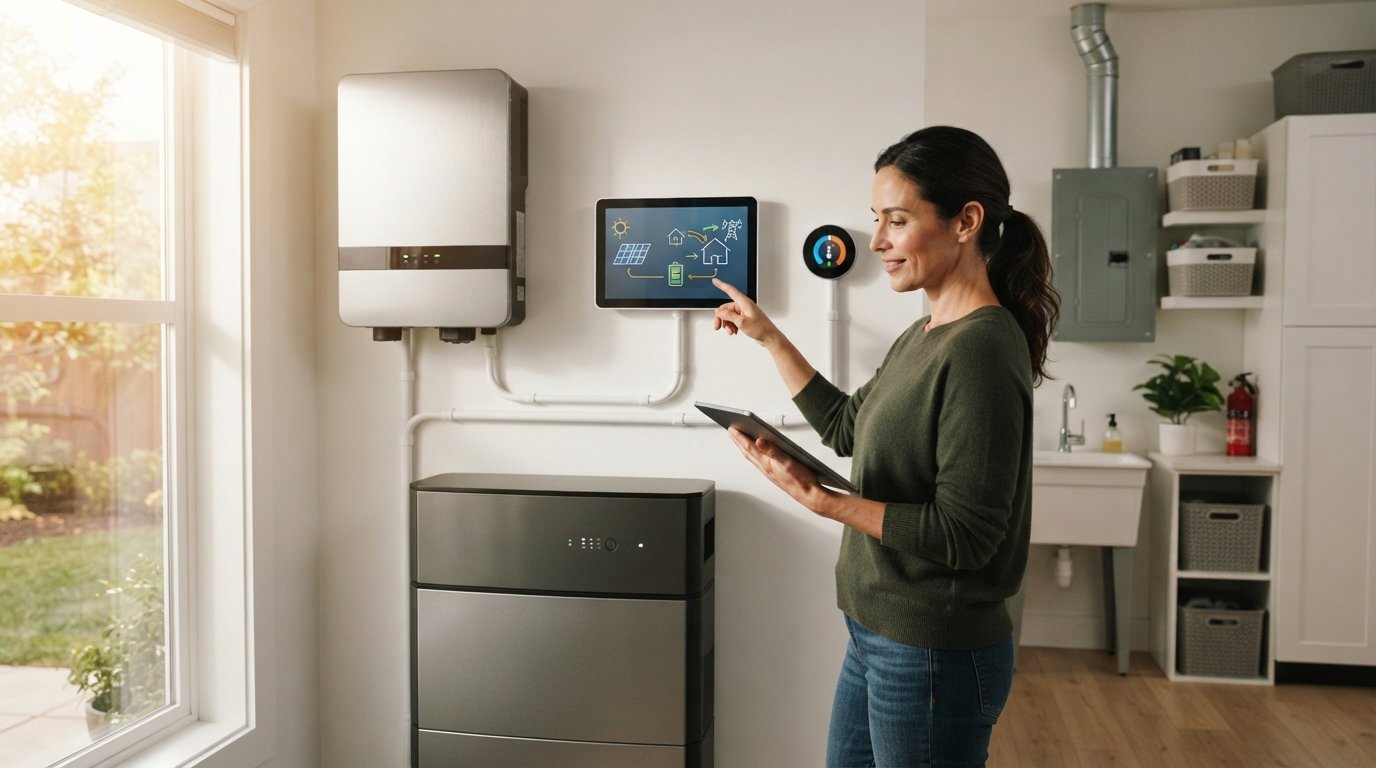
At its core, a home energy management system (HEMS) is a hardware and software platform that monitors and directs energy flows throughout your property. It collects data from your solar inverter, battery, smart meter, and connected appliances, then makes automated decisions based on your preferences, utility rates, and real-time conditions. Unlike a basic inverter app that only shows production figures, a HEMS actively orchestrates devices. It can decide to charge your battery from solar instead of exporting to the grid, preheat your water heater when electricity is cheapest, or pause your EV charger during a peak pricing event.
The difference matters because solar and storage alone are passive assets. Without coordination, you might export power at a low rate and then buy it back at a higher rate later. A HEMS closes that gap by maximizing self-consumption and minimizing expensive grid imports. It also provides a single dashboard for monitoring, which is far more useful than juggling three or four separate apps from different manufacturers.
Modern systems go further by incorporating weather forecasts and learning algorithms. If a cloudy day is predicted, the HEMS may prioritize battery charging overnight or delay heavy loads. If a heat wave is coming, it might precool the house while solar production is strong. This predictive capability is where artificial intelligence adds tangible value, and you can read more about it in our guide on how AI improves energy efficiency for home solar.
Device Compatibility: What Your HEMS Can Talk To
The usefulness of a home energy management system integrating solar storage smart devices depends heavily on compatibility. Not every appliance or brand will communicate with every HEMS, so it pays to check supported protocols before you buy. Most quality systems support common standards such as Wi-Fi, Zigbee, Z-Wave, and Modbus, and many now embrace open APIs for broader integration.
Here are the device categories most commonly controlled or monitored by a HEMS, along with what to verify:
- Thermostats: Smart thermostats from major brands can receive setpoint adjustments during peak events or when solar production is high. Look for models that support demand response or an open API.
- EV chargers: Level 2 chargers with smart scheduling can be told to charge only when solar is abundant or rates are low. Some chargers offer direct integration with solar inverters.
- Water heaters: Electric water heaters are excellent thermal batteries. A HEMS can heat water during cheap or surplus periods and let it coast during peaks.
- Batteries: Storage systems from major manufacturers typically expose control interfaces, but the depth of control varies. Some allow only monitoring, while others permit full charge and discharge scheduling.
- Solar inverters: Inverter data is essential for deciding when to divert surplus solar to loads or storage. Check that your inverter brand is on the HEMS compatibility list.
Beyond these, some systems also integrate pool pumps, lighting, and motorized shades. The key is to confirm that the HEMS you choose supports the specific models you own or plan to buy. A system that claims broad compatibility but lacks certified integrations can lead to disappointing results.
Load Prioritization During Outages and Peak Pricing
One of the most valuable functions of a HEMS is deciding which loads get power when supply is limited. This is critical during grid outages when your battery becomes the sole source, and during peak pricing windows when grid electricity is expensive.
During an outage, a well-configured HEMS will shed non-essential loads to extend battery life. It might keep the refrigerator, internet router, and a few lights running while disabling the pool pump and EV charger. Some systems allow you to designate critical circuits that always stay powered, giving you peace of mind without manual intervention.
During peak pricing events, the HEMS can automatically reduce consumption or switch to battery power. For example, if your utility charges triple rates from 4 p.m. to 9 p.m., the system can discharge the battery to cover household load and recharge later when rates drop. It can also delay EV charging and water heating until off-peak hours. These automated decisions add up to significant annual savings, especially in areas with time-of-use rates or demand charges.
The table below summarizes common load prioritization strategies:
- Outage mode: Prioritize critical loads (refrigeration, communications, medical equipment) and shed discretionary loads.
- Peak shaving: Discharge battery to reduce grid import during high-price windows.
- Solar soaking: Divert surplus solar to water heating or EV charging instead of exporting at low rates.
- Storm prep: Charge battery to full when severe weather is forecast, even if rates are higher.
These strategies are configurable, so you can tailor them to your comfort and savings goals. A good installer will help you set up profiles that match your lifestyle.
Installation Requirements and Retrofitting Existing Systems
If you already have solar and possibly a battery, you may wonder whether you can add a HEMS without replacing major equipment. In many cases, the answer is yes. Retrofitting is often feasible if your inverter and battery expose data and control interfaces. The HEMS installs as an additional layer, communicating with existing devices through wired or wireless connections.
That said, older equipment may lack the necessary ports or protocols. In such cases, you might need a firmware update, a communication gateway, or in rare instances, a replacement inverter. A qualified installer can assess compatibility and recommend the least invasive path. For new installations, it is far easier to specify a HEMS from the start and choose solar and storage equipment that integrates cleanly.
Installation typically involves mounting a control unit near your electrical panel, connecting current transformers to monitor circuits, and configuring the software. Depending on complexity, the process can take a few hours to a full day. It is not a DIY project if you are not comfortable working inside an electrical panel; hire a licensed electrician or solar professional.
If you are also planning a move or need to coordinate a solar upgrade with a relocation, resources like Moving.Homes offer practical checklists and guides that can help you plan the transition without losing momentum on your energy goals.
Questions to Ask Installers About Open Standards and Future Upgrades
Because home energy technology evolves quickly, you want a system that will not become obsolete in a few years. Asking the right questions upfront can save you from locked-in proprietary ecosystems that limit future choices.
Start with open standards. Does the HEMS support common protocols like OpenADR, IEEE 2030.5, or SunSpec Modbus? These standards enable demand response and interoperability between brands. A system built on open standards is more likely to work with new devices you add later, such as a second battery or a different EV charger.
Also ask about software updates. Will the manufacturer provide regular firmware updates, and for how long? Is there a subscription fee for advanced features? Some HEMS platforms charge monthly for demand response participation or detailed analytics, so clarify costs before committing.
Finally, inquire about data ownership and privacy. Who owns the energy data collected by the system, and can you export it? A reputable installer will provide clear answers and documentation.
To summarize, here is a short checklist of questions:
- Which open standards and APIs does the HEMS support?
- Is my existing solar inverter and battery officially compatible?
- What is the process and cost for adding new devices later?
- Are there recurring fees for software or demand response programs?
- How long will the hardware be supported with updates?
Getting satisfactory answers to these questions helps ensure your home energy management system integrating solar storage smart devices remains a valuable asset for years.
Bringing It All Together
A home energy management system integrating solar storage smart devices transforms separate energy assets into a coordinated, intelligent system. It maximizes solar self-consumption, reduces reliance on expensive grid power, and keeps essential loads running during outages. By choosing a system with strong device compatibility, open standards, and retrofit-friendly design, you future-proof your investment. And by asking installers the right questions, you avoid lock-in and ensure you can expand as your needs change. The result is a home that is not only more efficient but also more resilient and comfortable, year after year.