Can AI Increase Solar Efficiency? Yes, Here’s How
Solar energy has become a cornerstone of the global shift toward renewable power, but even the most advanced photovoltaic panels face a hard limit: they only convert a fraction of sunlight into electricity. For years, engineers have chased incremental gains in panel materials and manufacturing. Today, a more powerful lever has emerged: artificial intelligence. The question is no longer whether solar works, but how much better it can perform when guided by intelligent software. This article explores the real-world mechanisms through which AI is boosting solar output, reducing waste, and transforming how we think about clean energy generation.
How AI Optimizes Solar Panel Performance in Real Time
The most immediate impact of AI on solar efficiency comes from real-time optimization. Traditional solar installations operate on fixed parameters. Panels tilt at a predetermined angle, inverters follow a standard curve, and the system responds to environmental changes only after they happen. AI flips this model by continuously analyzing data from sensors, weather feeds, and historical performance to make split-second adjustments that maximize energy capture.
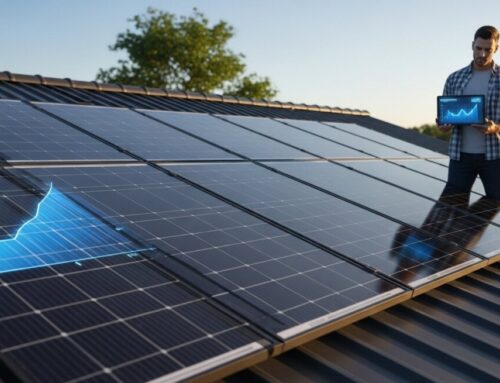
Machine learning models can predict cloud cover and adjust inverter settings before irradiance drops. They can detect partial shading from a tree or a neighboring structure and reconfigure the panel array to route power around the affected cells. This dynamic response is far more effective than static programming. In side-by-side tests, AI-optimized systems have shown efficiency gains of 5 to 15 percent compared with conventional setups, depending on site conditions and weather variability.
For homeowners and businesses considering solar, this means a smaller system can deliver the same energy output as a larger, unmanaged one. That translates directly into lower upfront costs and faster payback periods. AI does not require new panels or expensive hardware upgrades. It works with existing equipment by adding a layer of intelligent control, often through cloud-based software or a retrofit controller.
Predictive Maintenance and Fault Detection
Solar panels are durable, but they are not immune to degradation. Dust accumulation, microcracks, connector corrosion, and inverter failures all chip away at efficiency over time. The challenge is that many of these issues develop slowly, and by the time a human technician notices a drop in output, weeks or months of lost energy have already accumulated.
AI changes this by performing continuous health monitoring. Algorithms trained on thousands of system signatures can detect anomalies that are invisible to the naked eye. For example, a voltage fluctuation of 0.5 percent in one string of panels might indicate a failing bypass diode. AI flags this issue and schedules a targeted inspection before the diode fails completely, preventing a cascading loss across the entire string. This predictive maintenance approach reduces downtime and keeps the system operating near its peak efficiency year-round.
For residential and commercial installations alike, the financial impact is significant. A system that maintains 98 percent availability instead of 92 percent can generate thousands of additional kilowatt-hours over its lifetime. AI-driven diagnostics also reduce the need for manual site visits, which lowers operating costs and makes solar more affordable for the average homeowner. In our guide on how AI boosts home solar output, we explain the specific software tools that enable this level of monitoring.
Smart Inverters and Maximum Power Point Tracking
Every solar panel has a unique point on its voltage-current curve where it produces the most power, known as the maximum power point (MPP). Traditional inverters use a simple algorithm called perturb and observe to track this point, but they are slow and can oscillate around the true MPP, wasting energy. AI-powered inverters use deep learning models that predict the exact MPP based on irradiance, temperature, and panel age, adjusting the load almost instantaneously.
This is especially valuable in partially cloudy conditions, where irradiance can change by 50 percent in a matter of seconds. A conventional inverter might take several seconds to converge on the new MPP, losing energy with every adjustment. An AI inverter anticipates the change and shifts the operating point in milliseconds, capturing energy that would otherwise be lost. Field studies have shown that AI-based maximum power point tracking (MPPT) can improve energy harvest by 3 to 8 percent over conventional MPPT in variable weather.
Beyond tracking, smart inverters can also communicate with the grid to manage voltage and frequency. This capability is critical as more homes and businesses add solar, because excess power can destabilize the grid. AI-equipped inverters can throttle output or store energy in batteries to match grid demand, ensuring that the system remains a net positive for the homeowner and the utility alike.
AI-Driven Solar Panel Cleaning Schedules
Dust, pollen, bird droppings, and soot create a thin film on solar panels that blocks sunlight. The efficiency loss from soiling can range from 5 percent in moderately dusty areas to over 30 percent in arid or agricultural regions. Cleaning every panel manually is expensive and wasteful. Cleaning too rarely leaves energy on the table. AI solves this dilemma by creating optimized cleaning schedules based on real-time soiling data and weather forecasts.
Optical sensors or power output analytics detect when a panel is dirty. An AI model then combines this data with the local precipitation forecast. If rain is expected within 48 hours, the system postpones cleaning, letting nature do the work. If a dry spell is forecast, the model schedules a targeted cleaning for the panels that need it most, rather than cleaning the entire array. This approach reduces water usage, labor costs, and system downtime while keeping efficiency high.
The key benefits of AI-optimized cleaning schedules include:
- Reduced water consumption by up to 50 percent compared with fixed-interval cleaning.
- Lower labor costs because cleaning crews are deployed only when and where needed.
- Higher average annual energy yield through consistent removal of light-blocking debris.
- Extended panel lifespan by preventing corrosive buildup from sitting too long.
For large commercial installations, these savings add up quickly. A 10 megawatt solar farm that saves 3 percent in soiling losses can recapture enough electricity to power hundreds of homes each year. For residential systems, the benefit is simpler: the homeowner gets closer to the rated output of their panels without lifting a finger.
Integrating AI with Home Energy Management Systems
A solar panel system does not operate in a vacuum. It is part of a larger home energy ecosystem that includes appliances, heating and cooling, electric vehicle charging, and battery storage. AI can orchestrate all of these components to maximize self-consumption of solar power, which is the most efficient way to use the energy you generate.
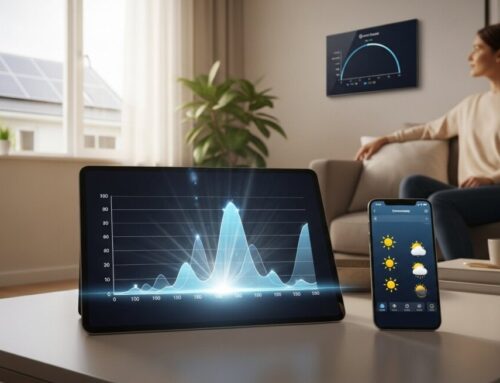
An AI-powered energy management system learns the household’s usage patterns. It knows when the family wakes up, when the dishwasher runs, and when the electric car is plugged in. It also tracks solar production forecasts for the coming hours. Using this information, the system can pre-cool the house before a cloud passes, delay the dryer cycle until the sun is high, or charge the EV battery during peak solar hours. The result is that less power is exported to the grid at low feed-in tariffs, and less power is pulled from the utility at peak retail rates.
This intelligent load shifting can improve the effective self-consumption rate from around 30 percent in a typical home to over 70 percent. That means the solar array effectively powers more of the home’s needs, boosting the financial return of the entire installation. AI makes this possible without requiring the homeowner to manually schedule appliances or monitor weather apps. The system handles the complexity in the background.
AI and Solar Panel Design: Better Layouts from the Start
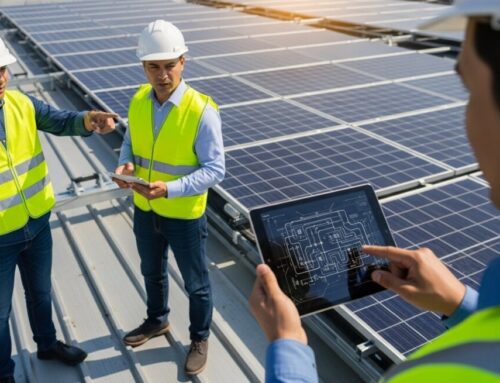
Efficiency is not just about operating an existing system better. AI also improves solar efficiency during the design phase. When a solar installer plans a rooftop array, they must balance panel orientation, tilt, spacing, and shading from nearby objects. Traditional design software uses simplified models that often miss subtle interactions. AI-powered design tools use 3D modeling, satellite imagery, and machine learning to simulate thousands of possible layouts and identify the one that maximizes annual energy production.
These tools account for seasonal sun angles, local weather patterns, and even the reflectivity of surrounding surfaces. They can recommend whether to use microinverters or a string inverter, where to place optimizers, and how many panels fit without exceeding the inverter’s capacity. The result is a system that is not only efficient on paper but also performs well in the real-world conditions of that specific location.
For a deeper look at how these design tools work and what they mean for your installation, read our detailed analysis on AI-driven solar panel design and efficiency. The article breaks down the software options and cost implications for homeowners.
The Data Feedback Loop: Continuous Improvement
One of the most powerful aspects of AI is its ability to learn from every system it monitors. Every solar installation that feeds data into an AI platform becomes part of a growing knowledge base. The algorithm learns which inverter settings work best for a particular panel model in a specific climate. It discovers that certain cleaning intervals are more effective in coastal areas versus desert regions. Over time, the AI becomes better at predicting and optimizing for every new installation.
This feedback loop means that the efficiency gains are not static. A system installed today will benefit from the learnings of thousands of systems installed before it. And as more data accumulates, the AI models will continue to improve. This is a fundamentally different paradigm from traditional solar engineering, where improvements require new hardware or manual recalibration. With AI, the software gets smarter automatically, and the entire fleet of connected systems improves together.
For the solar industry, this creates a virtuous cycle. Better efficiency leads to lower cost per kilowatt-hour, which drives more adoption, which generates more data, which fuels even better efficiency. AI is not just a tool for improving solar panels; it is a catalyst for accelerating the entire renewable energy transition.
The evidence is clear: AI can increase solar efficiency across every stage of the system lifecycle, from initial design to daily operations to long-term maintenance. Whether you are a homeowner looking to maximize your rooftop investment or a utility manager overseeing a large solar farm, integrating AI into your solar strategy is one of the most effective ways to get more energy from the same sunlight. The technology is mature, the costs are falling, and the benefits are measurable. The future of solar is not just more panels; it is smarter panels guided by intelligent software.