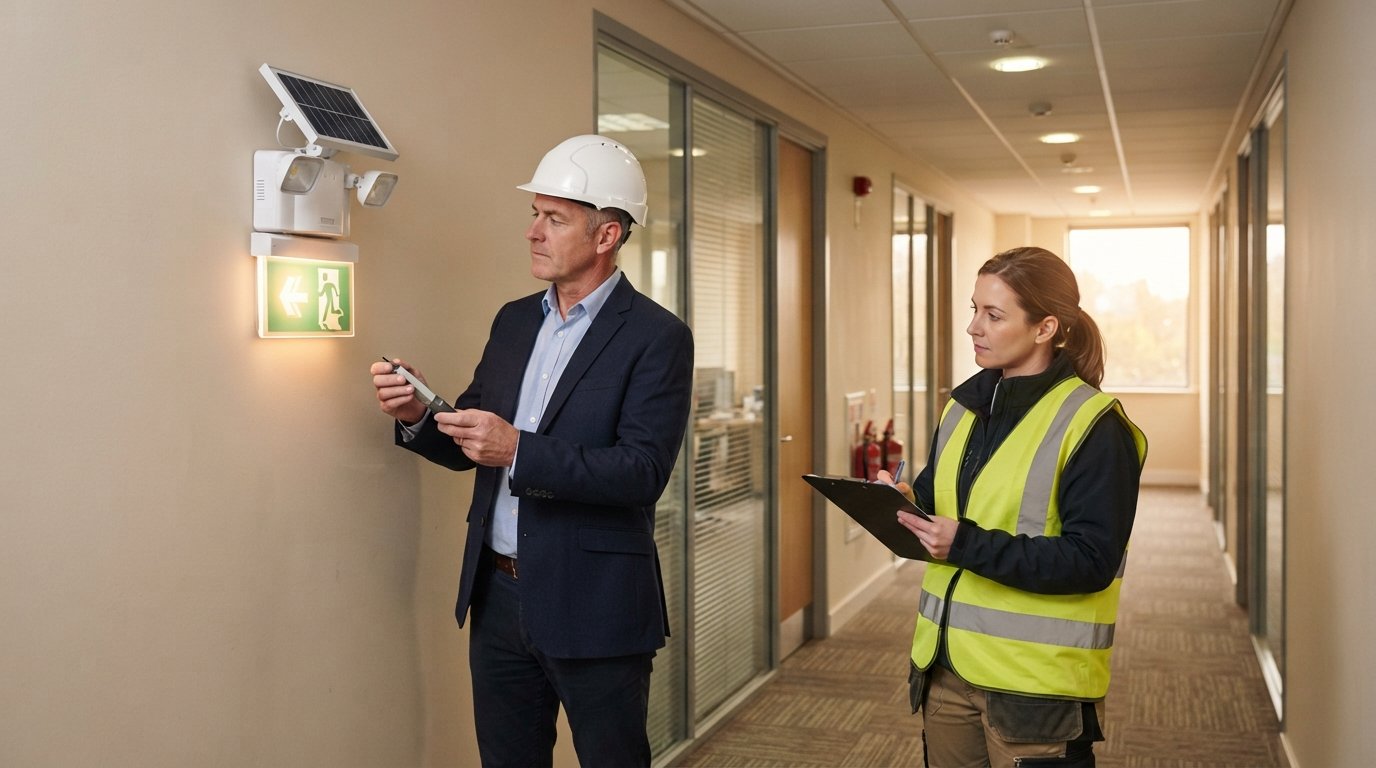
Solar Powered Emergency Lighting for Commercial Buildings
Solar powered emergency lighting for commercial buildings keeps egress paths lit during outages. Call (833)-434-4023 to compare local providers.

By Dylan Harris
Learn more about Wiring Installation for guides, costs, and what to expect.
Compare Wiring Installation Pros Near You

Enter your ZIP code to compare independent local professionals and request free quotes.
When the grid goes down, every second counts. For commercial property owners, a power outage is not just an inconvenience; it is a safety and liability event. Emergency lighting that fails during an outage can turn a routine evacuation into a chaotic, dangerous situation. That is why solar powered emergency lighting for commercial buildings has moved from a niche green feature to a core component of resilient building design. By pairing photovoltaic generation with battery storage, you can keep exit signs and egress paths illuminated even when the utility grid is dark, while also reducing ongoing energy costs and demonstrating environmental responsibility.
This article explains what building owners and facility managers need to know about code compliance, system architectures, testing schedules, and how an energy survey can tie everything together. Whether you are retrofitting an existing structure or planning new construction, the insights below will help you ask the right questions and make informed decisions.
Why Solar Powered Emergency Lighting Makes Sense for Commercial Properties
Commercial buildings already consume significant energy for lighting, HVAC, and plug loads. Emergency lighting circuits are typically idle but must be ready at all times. Traditional systems rely on the grid to keep batteries charged and on centralized inverters or self-contained units to take over during an outage. Solar powered emergency lighting adds a layer of independence: the system generates its own power from sunlight, stores it in batteries, and uses that stored energy to run emergency luminaires when the grid fails.
This approach offers several practical benefits. First, it reduces demand on backup generators, which are often sized for critical loads and expensive to fuel and maintain. Second, it future-proofs the building against rising electricity rates and grid instability. Third, it supports sustainability goals and can contribute to green building certifications. Finally, for buildings in remote locations or with limited electrical infrastructure, solar emergency lighting can be the most cost-effective way to meet code requirements without trenching new conduit or upgrading service panels.
Code Requirements for Emergency Egress Lighting in Commercial Buildings
Before selecting any equipment, you must understand the applicable codes. In the United States, emergency lighting for commercial buildings is primarily governed by the National Electrical Code (NEC), NFPA 101 (Life Safety Code), and local building codes. The core requirement is that means of egress must remain illuminated for a specified duration, typically 90 minutes, during a power failure. Illumination levels must be sufficient to allow occupants to safely exit the building, with specific foot-candle minimums along egress paths.
Codes also dictate where emergency lighting is required: exit signs, stairwells, corridors, and other egress components must be illuminated. The system must be designed so that a single fault does not leave an area in darkness. That is why many jurisdictions require either self-contained emergency luminaires or centrally supplied emergency circuits with approved transfer switches. Solar powered systems must meet the same performance standards as grid-tied systems, and the authority having jurisdiction (AHJ) will inspect for proper installation, battery capacity, and testing records.
Key Code Considerations for Solar Systems
When integrating solar power, you must ensure that the emergency lighting system remains compliant with the same codes. The solar array and battery storage must be sized to provide at least the required 90 minutes of illumination, and often longer for high-rise or assembly occupancies. You also need to consider the interaction between the solar inverter and the emergency lighting distribution. Some codes require that emergency circuits be kept separate from normal lighting circuits, and the solar system must not compromise that separation.
In our guide on emergency lighting requirements for commercial buildings with solar, we break down the specific code sections and inspection checklists. That resource is a valuable companion to this article, especially if you are preparing for a plan review or a routine inspection.
How Solar and Battery Backup Support Emergency Circuits
Solar powered emergency lighting systems typically consist of three main components: solar panels, a battery bank, and emergency luminaires (either self-contained or centrally fed). The solar panels charge the batteries during daylight hours. When the grid fails, a transfer device or inverter switches the emergency lighting load to the battery bank. The system must be designed so that the batteries are always sufficiently charged, even during periods of low sunlight, and so that the emergency lighting activates within the time required by code.
There are two common architectures. In a self-contained system, each emergency luminaire has its own battery and control circuitry, and the solar array may be dedicated to charging those batteries. This approach simplifies wiring and provides redundancy, but it can be more expensive per fixture. In a centrally inverter-fed system, the solar array and a central battery bank supply power to a dedicated emergency lighting panel. This architecture is often more efficient for larger buildings and allows for easier monitoring and maintenance.
The choice between self-contained and central systems depends on building size, layout, budget, and maintenance capabilities. Both can be designed to meet code requirements, and both can incorporate solar power. The key is to work with a qualified designer who understands the interplay between solar production, battery capacity, and emergency lighting loads.
Self-Contained vs. Centrally Inverter-Fed Emergency Lighting
Understanding the trade-offs between these two approaches will help you make a more informed decision. Here is a comparison of key factors:
- Installation complexity: Self-contained units are easier to retrofit because they do not require dedicated emergency circuits to a central location. Central systems require dedicated wiring and a central equipment room.
- Scalability: Central systems scale more easily for large buildings and can support many fixtures from a single battery bank. Self-contained systems require a battery in each unit.
- Maintenance: Self-contained units are tested individually, which can be time-consuming in large buildings. Central systems can be monitored from a single point.
- Redundancy: Self-contained units offer distributed redundancy; a single failure affects only one fixture. Central systems have a single point of failure at the battery bank or inverter.
- Cost: For small buildings, self-contained may be more affordable. For large buildings, central systems often have a lower total cost of ownership.
Solar integration can work with either architecture. For self-contained systems, you might use small solar panels dedicated to each unit or a shared solar array that charges a central battery bus. For central systems, the solar array and battery bank are sized together to meet the emergency load. In either case, you must ensure that the solar charging system is reliable and that the batteries are properly maintained.
Testing and Maintenance Schedules Inspectors Expect
Emergency lighting systems are life-safety equipment, and they must be tested regularly. The NFPA 101 Life Safety Code and NFPA 72 (for alarm systems) outline testing frequencies. Typically, you need a monthly functional test (briefly activating the emergency mode) and an annual test that verifies the system will run for the full 90-minute duration. Some jurisdictions require additional testing for battery-powered systems.
For solar powered systems, testing must also include the solar charging components. You should verify that the solar panels are producing power, that the charge controller is functioning, and that the batteries are holding a charge. Inspectors will want to see written records of all tests, including dates, results, and any corrective actions taken. It is wise to keep a log book on site and to use automated monitoring where possible to simplify compliance.
Maintenance goes beyond testing. Batteries have a limited lifespan and must be replaced according to manufacturer recommendations. Solar panels should be kept clean and free of debris. Inverters and charge controllers should be inspected for fault codes. A proactive maintenance plan will reduce the risk of a system failure during an actual emergency.
Pairing Emergency Lighting with an On-Site Energy Survey
If you are considering solar powered emergency lighting, an on-site energy survey is an excellent starting point. A professional energy assessment will evaluate your building's current electrical infrastructure, identify opportunities for solar generation, and help size a system that meets both your emergency lighting needs and your broader energy goals. The survey can also uncover issues such as inadequate wiring, outdated panels, or code violations that should be addressed before installing new equipment.
SolarEnergy.ai connects building owners with independent local providers who can perform these assessments and install emergency lighting systems. The platform is a free matching service, not a contractor, so you can compare quotes from multiple providers with no obligation. Whether you need a simple retrofit or a comprehensive energy upgrade, the network can help you find the right professionals for the job.
For homeowners and business owners alike, 180Remodel is another resource that connects you with independent providers for a wide range of improvement projects, including solar installations and electrical upgrades. It is a useful complement when your emergency lighting project is part of a larger renovation.
Designing a Solar Emergency Lighting System: Key Steps
Designing a compliant and reliable system requires a methodical approach. Here is a step-by-step framework you can follow:
- Conduct a load analysis: Determine the total wattage of all emergency luminaires and the required runtime (typically 90 minutes).
- Evaluate solar potential: Assess roof space, shading, and local climate to estimate solar production.
- Size the battery bank: Choose a battery capacity that can power the emergency load for the required duration, accounting for depth of discharge and efficiency losses.
- Select the architecture: Decide between self-contained and central systems based on building size and maintenance preferences.
- Ensure code compliance: Verify that the design meets NEC, NFPA 101, and local amendments, and consult with the AHJ early.
- Plan for testing and maintenance: Include monitoring and testing provisions in the design, and establish a maintenance schedule.
Each step involves trade-offs. For example, a larger battery bank increases resilience but also cost and space requirements. A central system may be more efficient but requires dedicated space. Working with experienced professionals will help you balance these factors and avoid costly mistakes.
Cost Considerations and Financial Incentives
The cost of solar powered emergency lighting varies widely based on building size, system architecture, and local labor rates. While the upfront investment may be higher than a conventional emergency lighting system, the long-term savings can be significant. Solar power reduces electricity costs, and battery storage can provide demand reduction benefits. Additionally, some utility companies offer incentives for solar installations, and federal tax credits may apply. However, always verify current programs and consult a tax advisor, as incentives change frequently.
It is also important to factor in the cost of ongoing maintenance and battery replacement. Lithium-ion batteries, for example, have a longer lifespan than lead-acid batteries but cost more upfront. A life-cycle cost analysis will give you a clearer picture of the true economic impact.
Common Pitfalls to Avoid
Even well-intentioned projects can run into problems. Here are some common pitfalls to watch for:
- Undersizing the battery bank: This can lead to insufficient runtime during an outage, violating code and compromising safety.
- Ignoring maintenance: Batteries and solar panels require periodic attention; neglect can cause system failure.
- Overlooking code requirements: Each jurisdiction has specific rules; failing to obtain proper permits and inspections can result in costly rework.
- Poor solar orientation: Shading or suboptimal panel placement can reduce charging capacity and leave batteries depleted.
- Inadequate documentation: Inspectors expect detailed test records; missing documentation can delay approvals.
Avoiding these pitfalls requires careful planning and qualified professionals. By engaging experts early and staying involved throughout the process, you can ensure a successful installation.
Future Trends in Solar Emergency Lighting
Technology is advancing rapidly. We are seeing more integrated systems that combine solar, battery storage, and smart controls. These systems can communicate with building management systems, provide real-time status updates, and even predict battery health. Some manufacturers are developing luminaires with embedded solar cells, reducing wiring needs. As codes evolve to recognize these technologies, we can expect wider adoption and lower costs.
Another trend is the integration of emergency lighting with other resilient building systems, such as microgrids. In a microgrid, solar and storage can power critical loads during an outage, and emergency lighting is a natural fit. This holistic approach to energy resilience is gaining traction among commercial property owners who want to maintain operations during grid disruptions.
Taking the Next Step
Solar powered emergency lighting for commercial buildings is a smart investment in safety, compliance, and sustainability. By understanding the code requirements, choosing the right system architecture, and committing to proper testing and maintenance, you can protect occupants and your property. Start with an energy survey to assess your building's potential, and compare quotes from independent local providers to find the best solution for your needs. With careful planning, you can turn a regulatory requirement into a long-term asset.