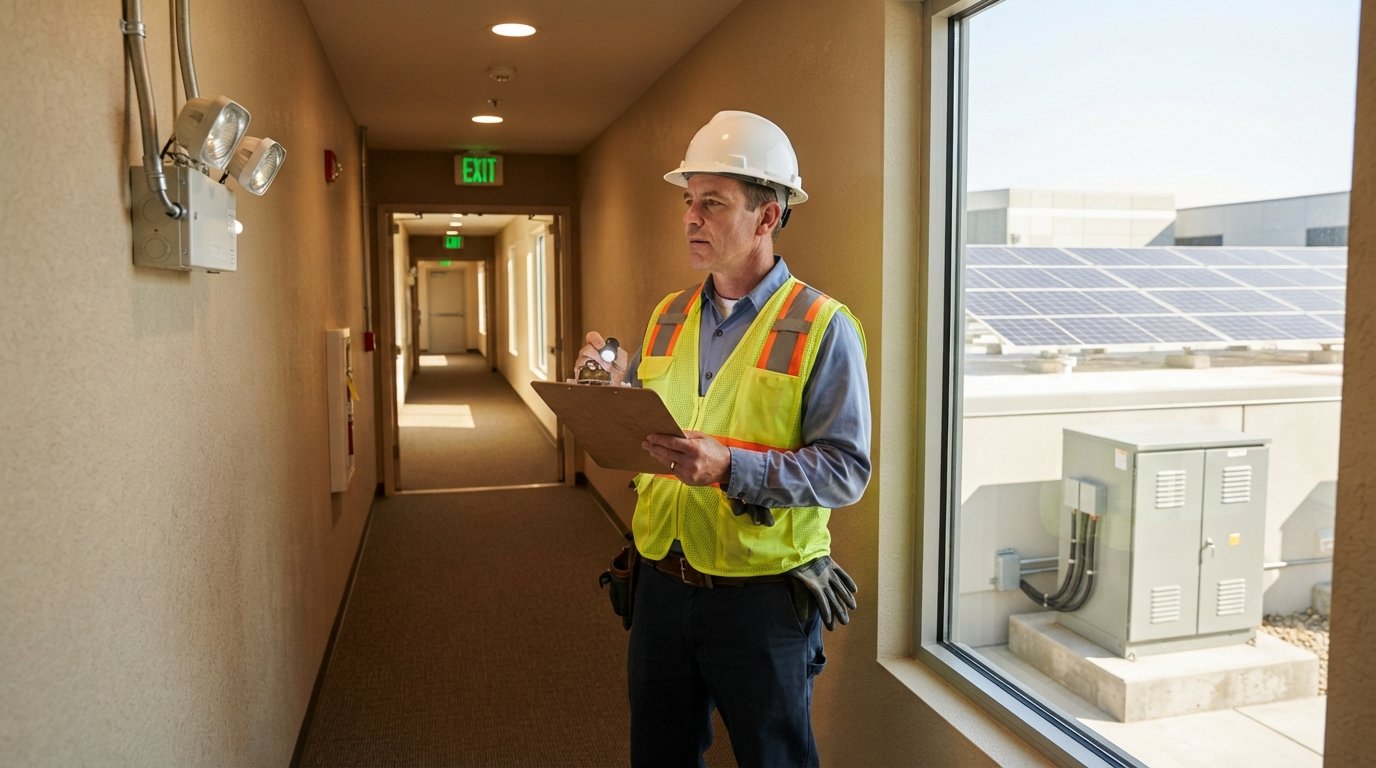
Emergency Lighting Requirements for Commercial Buildings with Solar
Ensure code-compliant emergency lighting for your commercial solar building. Call (833)-434-4023 for expert guidance on design, testing, and integration.

By Wendy Young
Learn more about Solar Panel Installation and Repair for guides, costs, and what to expect.
Compare Solar Panel Installation and Repair Pros Near You

Enter your ZIP code to compare top-rated local professionals and request free quotes.
When a commercial building loses grid power, the difference between a safe evacuation and a chaotic one often comes down to a few seconds of reliable illumination. Emergency lighting systems are life-safety infrastructure, and building codes treat them with zero tolerance. If you are adding solar plus battery storage to your commercial property, you cannot simply bolt panels onto the roof and assume the emergency lights will keep working. The intersection of solar energy and life-safety code compliance is nuanced, and getting it wrong can mean failed inspections, insurance headaches, and genuine risk to occupants. This guide walks through the code basics, design options, testing obligations, and integration strategies that business owners and facility managers need to understand in 2026.
The stakes are higher than many owners realize. The National Electrical Code (NEC), NFPA 101 (Life Safety Code), and the International Building Code (IBC) all contain provisions that govern how emergency lighting must perform, how long it must last, and how it must be tested. Solar photovoltaic (PV) systems introduce a wrinkle: they can keep producing power when the grid is down, but only if the system is designed with battery backup and a transfer mechanism that supports the emergency loads. A grid-tied solar system without storage will shut down during an outage, leaving your emergency lights dark unless they have their own battery backup. Understanding these interactions is the first step toward a compliant, resilient design.
Code Basics: What Emergency Lighting and Exit Signage Must Do
Emergency lighting requirements for commercial buildings with solar begin with the fundamental performance criteria that apply to all commercial occupancies. The core requirement is that means of egress must be illuminated to a minimum level when normal power fails. NFPA 101 and the IBC generally require an average of 1 foot-candle (approximately 10 lux) along the path of egress, with a minimum at any point of 0.1 foot-candle. Exit signs must be illuminated and visible, and the emergency lighting system must provide power for at least 90 minutes. These requirements apply whether the building has solar or not; the solar system does not exempt you from them.
Beyond illumination levels, the codes specify which areas require emergency lighting. Typically, these include exit access corridors, stairwells, exit discharge areas, and rooms with high occupant loads. The specific requirements vary by occupancy classification, so a warehouse, a restaurant, and a multi-story office building may have different scopes. Local amendments can be stricter than the model codes, so always verify with your authority having jurisdiction (AHJ). The key takeaway is that emergency lighting is not optional, and the presence of a solar array does not reduce the obligation to provide dedicated, code-compliant emergency illumination.
Another critical code concept is the separation of emergency circuits from normal power circuits. The NEC requires that emergency lighting circuits be kept separate from other wiring and be protected from damage. In a solar-plus-storage system, this means you cannot simply feed emergency lights from a general-purpose inverter output. You need a dedicated emergency distribution path, often involving a transfer switch or a dedicated inverter circuit, to ensure that the emergency loads receive power even if the main inverter or battery system experiences a fault. This separation is a common point of confusion for solar installers who are not familiar with life-safety codes, and it is a frequent cause of inspection failures.
Battery-Backed and Solar-Coupled Emergency Lighting Design Options
There are several design pathways for meeting emergency lighting requirements for commercial buildings with solar. The most traditional approach is to use self-contained emergency lighting units (often called "bug-eye" lights) that have their own internal batteries and chargers. These units are not connected to the solar system at all; they rely on their own battery backup and are tested independently. This approach is simple and code-compliant, but it does not leverage the solar-plus-storage investment and may require many individual units, each with its own maintenance needs.
A second option is a central battery system (also called a central inverter system) that powers emergency lighting circuits from a dedicated battery bank. In a solar-coupled design, this central battery can be charged by the solar array and can also serve as the emergency power source during an outage. This approach can be more efficient and easier to monitor, but it requires careful engineering to ensure that the emergency loads are isolated from the solar inverter's normal output. The central battery must be sized to provide 90 minutes of power to all emergency loads, and the system must include a transfer switch that automatically connects the emergency loads to the battery when normal power is lost.
A third option is to use a solar-plus-storage system with a dedicated emergency load panel. In this design, the solar inverter and battery are configured to provide backup power to a specific panel that feeds only emergency lighting and exit signs. This is often the most elegant solution because it uses the same battery that provides other backup power, but it requires that the inverter and battery be sized to handle the emergency loads in addition to any other backed-up circuits. It also requires that the system be designed so that the emergency loads remain powered even if the main inverter fails. Some advanced inverters offer a dedicated emergency output that can be configured for this purpose.
For homeowners who are interested in a smaller-scale version of this concept, our guide on emergency lighting design for home solar backup explains how similar principles apply in residential settings. While commercial requirements are more stringent, the underlying idea of integrating emergency lighting with solar storage is the same.
When selecting a design option, consider the following factors:
- Reliability: Self-contained units are simple but numerous; central systems are efficient but require single points of failure to be addressed.
- Maintenance: Central systems can be monitored remotely, while self-contained units require periodic manual testing.
- Cost: Upfront costs vary widely; central systems may have higher initial costs but lower long-term maintenance.
- Scalability: If you plan to expand the building or add more emergency loads, a central system may be easier to scale.
- Code compliance: All options must meet the 90-minute duration and illumination level requirements, and must be listed for emergency use.
Regardless of the design chosen, the system must be listed by a nationally recognized testing laboratory (NRTL) for emergency lighting use. Components that are not listed for emergency service may be rejected by the AHJ, even if they perform the same function. This is a critical detail that often trips up solar installers who are used to working with general-purpose equipment.
Testing, Inspection, and Documentation Obligations
Emergency lighting systems are not install-and-forget. The codes require periodic testing to ensure that the system will perform when needed. For battery-backed systems, the standard requirement is a monthly functional test (often a 30-second test) and an annual 90-minute discharge test. For generator-backed systems, the testing schedule may differ. In a solar-coupled system, the testing must verify that the emergency loads transfer to the battery backup and that the battery can sustain the load for the full 90 minutes. The test must be documented, and the documentation must be available for inspection by the AHJ or fire marshal.
Documentation is a common weak point. Many building owners fail inspections not because the system is non-compliant, but because they cannot produce the required test records. The codes typically require that a written record be kept of all tests, including the date, the duration, the results, and any repairs or replacements. Some jurisdictions require that the records be kept for a specific period, such as three years. In a solar-coupled system, the documentation should also include the system design, the battery capacity calculations, and the sequence of operations for the transfer switch. This documentation is essential for demonstrating that the emergency lighting requirements for commercial buildings with solar have been met.
Inspection failures often stem from a few common issues. First, the emergency lighting circuits may not be properly separated from normal power, leading to a failure when the main inverter shuts down. Second, the battery may not be sized correctly for the 90-minute duration, especially if the emergency loads were increased after the initial design. Third, the transfer switch may not function correctly, either because it was not installed properly or because it was not tested. Fourth, the exit signs may not be illuminated by the emergency system, or they may be on a separate circuit that is not backed up. Fifth, the documentation may be incomplete or missing. Avoiding these failures requires careful design, thorough testing, and diligent record-keeping.
To stay compliant, establish a testing schedule and assign responsibility to a specific person. Use a checklist that covers all emergency lighting units, exit signs, and the transfer switch. Record the results in a logbook or a digital system. If you use a central battery system, consider a remote monitoring system that can alert you to battery failures or transfer switch problems. And always keep the manufacturer's instructions and the system design documents on site. When the AHJ arrives, you want to be able to demonstrate that your system is not only installed correctly but also maintained properly.
Integrating Emergency Lighting with a Commercial Solar and Storage Plan
The most effective way to meet emergency lighting requirements for commercial buildings with solar is to integrate the emergency lighting design into the overall solar and storage plan from the beginning. This means involving the solar designer, the electrical engineer, and the life-safety consultant early in the project. The goal is to ensure that the solar-plus-storage system is sized and configured to support the emergency loads, and that the emergency lighting system is designed to work seamlessly with the solar system. This integrated approach can reduce costs, improve reliability, and simplify compliance.
Start by conducting a load analysis of all emergency lighting and exit signage. Determine the total wattage and the required duration (usually 90 minutes). Then, evaluate the solar-plus-storage system's capacity to support that load. If the battery is sized primarily for arbitrage or demand reduction, it may not have enough reserve capacity for emergency lighting. You may need to increase the battery size or add a dedicated emergency battery. Also consider the inverter's ability to provide power during an outage. Some inverters are grid-tied only and will shut down during an outage, while others are hybrid or off-grid capable. You need a hybrid inverter or a dedicated emergency inverter to support the emergency loads.
Another important consideration is the sequence of operations. When the grid fails, the transfer switch must disconnect the emergency loads from the grid and connect them to the battery backup. This transfer must happen quickly enough to prevent the emergency lights from extinguishing for more than a brief moment. The codes typically allow a brief transition, but the lights must come back on within a few seconds. The transfer switch must be tested to ensure it operates correctly under load. In some designs, the emergency loads are always powered by the battery/inverter, and the grid simply charges the battery. This is called an online or double-conversion design, and it provides the fastest transfer, but it may be less efficient.
For businesses that need assistance with the electrical and mechanical aspects of the integration, a platform like Repairmen can connect you with licensed electricians and contractors who understand both solar and life-safety systems. This can be especially helpful if you are retrofitting an existing building or if you need to coordinate multiple trades. However, always ensure that the contractor you hire has experience with emergency lighting codes and solar interconnection.
Finally, consider the role of energy management systems. Advanced solar-plus-storage systems often include monitoring and control platforms that can also monitor emergency lighting status. This can help you stay ahead of maintenance issues and provide documentation for inspections. Some systems can even run automatic tests and log the results, reducing the administrative burden. When evaluating solar proposals, ask whether the monitoring system can integrate with your emergency lighting system or at least provide alerts if the emergency circuit loses power.
In summary, emergency lighting requirements for commercial buildings with solar are not a barrier to solar adoption; they are an opportunity to design a more resilient building. By understanding the code basics, choosing the right design option, committing to testing and documentation, and integrating the emergency lighting with your solar and storage plan, you can achieve compliance and peace of mind. The key is to plan early, involve the right experts, and treat life-safety systems with the seriousness they deserve.