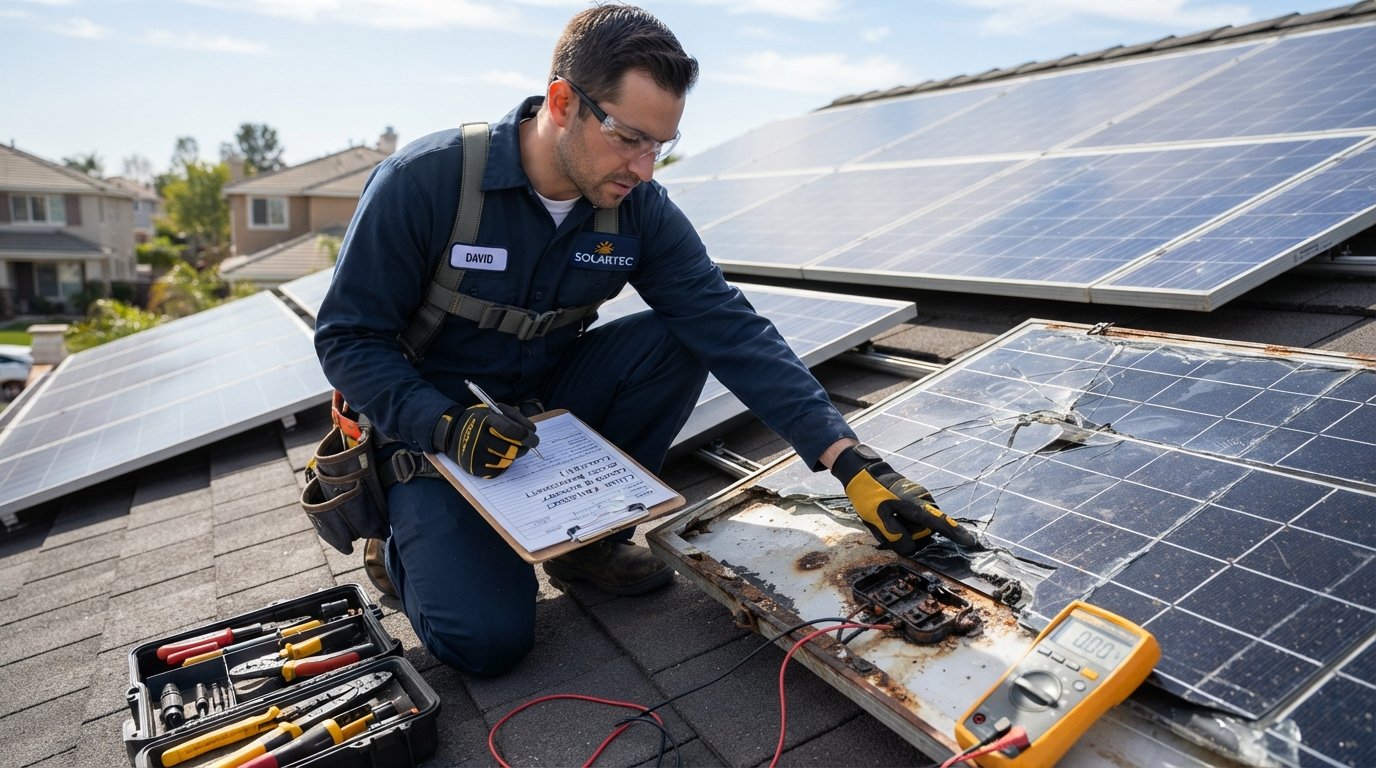
Solar Panel Warranty Claim: What Is Covered in 2026
Understand exactly what a solar panel warranty claim covers, from defects to output loss. Call 8334344023 for expert guidance on your claim.

By Maya Hayes
Learn more about Solar Panel Installation and Repair for guides, costs, and what to expect.
Compare Solar Panel Installation and Repair Pros Near You

Enter your ZIP code to compare top-rated local professionals and request free quotes.
Your solar panels are supposed to deliver clean, predictable power for decades, so the moment a panel cracks, an inverter fails, or your output quietly drops, the first question is simple: will the warranty actually pay? The answer depends on which warranty applies, what caused the problem, and how carefully you documented the claim. Understanding what a solar panel warranty claim covers before something goes wrong can save you thousands of dollars and weeks of frustration.
This guide breaks down the coverage you can realistically expect, the exclusions that trip up most homeowners, and the step-by-step process for filing a claim that gets approved instead of denied.
The Three Warranties Behind Every Solar Panel Claim
Most homeowners assume they have one solar warranty. In reality, a typical rooftop system carries at least three separate warranties, and each one covers different parts of the system. Knowing which warranty applies to your problem is the first step in any successful claim.
The first is the product warranty, sometimes called the manufacturing warranty, provided by the panel maker. It covers defects in materials and workmanship, such as cracked backsheets, delamination, faulty junction boxes, and frame corrosion. Most Tier 1 manufacturers now offer product warranties of 12 to 25 years, with premium brands stretching to 25 or even 30 years.
The second is the performance warranty, which guarantees your panels will produce at least a minimum percentage of their rated output over time. A typical performance warranty promises around 90 percent output at year 10 and 80 percent at year 25. If your panels fall below that threshold, the manufacturer must repair or replace them.
The third is the workmanship warranty, offered by your installer rather than the manufacturer. This covers installation-related problems: loose mounting hardware, improper wiring, roof penetrations that leak, and similar issues caused by how the system was put together. Workmanship warranties typically run 5 to 10 years, though some installers offer 25.
On top of those, you may also hold an inverter warranty (usually 10 to 12 years, extendable to 25), a battery warranty (10 years is common), and a roof penetration warranty from either the installer or a roofing company. When you file a claim, you must identify which warranty governs the failure.
What a Solar Panel Warranty Claim Typically Covers
Manufacturers design warranties to cover defects, not damage. If your panel failed because of a flaw that existed when it left the factory, you are generally covered. If it failed because a hailstorm hit it or a squirrel chewed the wiring, you are usually not.
Here is what most solar panel warranty claims legitimately cover:
- Manufacturing defects such as microcracks, solder bond failures, and faulty bypass diodes
- Material failures including backsheet cracking, encapsulant discoloration, and frame corrosion
- Output degradation below the guaranteed performance threshold in your warranty document
- Defective junction boxes, connectors, and terminal blocks
- Installation errors covered under the installer's workmanship warranty, such as improper grounding or torque
- Inverter and optimizer failures within the equipment warranty period
In a successful claim, the manufacturer or installer will repair or replace the defective component at no cost for parts. Labor coverage varies widely. Some manufacturers reimburse labor for the first 5 to 10 years, while others cover parts only. Shipping of replacement panels is often included, but removal and reinstallation of the old unit may fall to you or your installer.
Performance warranty claims work differently. You typically need to demonstrate that output has dropped below the guaranteed curve, which requires production data from your monitoring system or an on-site IV curve test. Manufacturers may prorate the payout based on how many years the system has been in service, meaning an older system yields a smaller settlement.
What Solar Warranties Do Not Cover
Exclusions are where most claims die. Even the best warranty documents contain long lists of situations the manufacturer will not pay for, and homeowners often discover these only after filing.
Common exclusions include:
- Damage from storms, hail, lightning, floods, fire, or earthquakes (these belong to your homeowners insurance)
- Physical abuse, vandalism, or animal damage such as rodent chewing or bird nesting
- Improper installation by an unlicensed or uncertified installer
- Modifications, unauthorized repairs, or use of non-approved replacement parts
- Cosmetic changes that do not affect performance, such as slight color variation or frame scratches
- Power failures, voltage spikes, or grid issues on the utility side
- Neglected maintenance, including uncleaned panels that cause soiling losses
There is also the installer bankruptcy problem. If your workmanship warranty came from a company that has since closed, the coverage effectively disappears unless a manufacturer or third-party administrator has stepped in. This is one reason it pays to choose established installers with long track records and, ideally, third-party warranty backing.
Finally, read the fine print on transferability. Most manufacturer warranties transfer to a new homeowner, but some require written notice within a set window after the sale. If you are buying a home with solar, confirm the warranty is still valid in your name before you close.
How to File a Solar Panel Warranty Claim Step by Step
A warranty claim is only as strong as the documentation behind it. Manufacturers deny claims every day because homeowners cannot prove when the system was installed, what the output used to be, or that the failure was not caused by something excluded.
Follow this sequence to give your claim the best chance:
- Document the problem with photos, dates, and monitoring data showing the drop in production.
- Locate your warranty documents, including the manufacturer's written warranty, your installer contract, and the original invoice with serial numbers.
- Contact the manufacturer or installer in writing and request a claim form, keeping a copy of every message.
- Allow the required inspection, which may be performed by the manufacturer, a certified technician, or a third-party adjuster.
- Review the written determination and, if denied, ask for the specific exclusion cited so you can appeal or pivot to an insurance claim.
If the manufacturer denies the claim but you believe the failure is storm-related, turn to your homeowners insurance policy. Most policies cover solar panels as part of the dwelling, though you will pay a deductible. If the installer caused the problem and is still in business, pursue the workmanship warranty directly with them.
One more practical note: if your system includes a battery or smart monitoring, download your production history before contacting anyone. Data is the single most persuasive piece of evidence in a performance claim, and it is much harder to retrieve once equipment has been swapped out. For homeowners thinking about scaling up their system or adding panels later, our guide on maximizing output with a 200 watt solar panel explains how smaller additions interact with existing warranties.
Performance Warranty Claims: Proving Your Panels Underproduce
Performance claims are the most misunderstood part of solar warranty coverage. Your panels do not need to stop working entirely to qualify; they only need to fall below the guaranteed degradation curve in your warranty.
To prove underperformance, you generally need one of two things. The first is long-term monitoring data from your inverter or a production meter, showing that output has dropped below the warranted percentage. The second is an on-site test, such as an IV curve trace or electroluminescence imaging, performed by a certified technician. Some manufacturers accept either; others require both.
Be prepared for prorating. If your warranty guarantees 80 percent output at year 25 and your panels are at 78 percent in year 12, the manufacturer may replace only the underperforming modules or issue a cash settlement based on the shortfall and remaining warranty term. Read the remedy section of your warranty carefully, because it tells you whether you get replacement panels, a refund, or a prorated payment.
Working With Installers and Manufacturers on Claims
The installer is often your first call, even for a manufacturer defect. Good installers handle the paperwork, perform the diagnostic, and coordinate with the manufacturer on your behalf. If your original installer is unresponsive, you can contact the manufacturer directly, but you may need to hire a certified technician to document the failure.
This is where choosing the right partner upfront pays off. Platforms that connect homeowners with vetted solar professionals, like the network available through NewSolarQuotes, help ensure your installation is performed by qualified crews whose workmanship warranties are backed by real businesses. When a problem arises, having a documented installation by a reputable company makes the difference between a smooth claim and a dead end.
Keep in mind that manufacturers track claim history by installer. If a particular installer generates excessive claims, some manufacturers scrutinize those systems more heavily. Working with a professional who follows manufacturer guidelines to the letter protects your coverage long term.
Key Documents to Keep for Any Future Claim
Warranty coverage is only as good as your paperwork. Before you need to file, assemble a simple folder (digital or physical) with the documents that every claim will require. This takes an hour now and can save weeks later.
At minimum, keep:
- The manufacturer's written warranty for panels, inverter, and battery
- Your installer contract, including the workmanship warranty terms
- The final invoice with model numbers and serial numbers for every component
- Permit and inspection records from your local authority
- Monitoring account credentials and a periodic export of production data
Photograph your installation shortly after commissioning, including close-ups of labels and serial numbers. If panels are later replaced, update the records. When you sell the home, hand this folder to the buyer and complete any warranty transfer paperwork the manufacturer requires.
Common Reasons Solar Warranty Claims Get Denied
Understanding denial patterns helps you avoid them. The most frequent reasons manufacturers reject claims are missing proof of professional installation, evidence of unauthorized modifications, damage that points to an excluded event like a storm, and output losses traced to soiling or shading rather than defects.
Shading deserves special attention. If a new tree, chimney, or neighboring building shades your array, production drops, but that is an environmental change, not a warranty defect. The same applies to heavy soiling after a wildfire season or construction nearby. Before filing, confirm that your production loss is not explained by shading, dirt, or a monitoring error.
Another frequent denial involves DIY or handyman installations. Most manufacturer warranties require installation by a licensed professional following the manufacturer's manual. If you installed the system yourself or used an unlicensed crew, the product warranty may still cover a genuine manufacturing defect, but the workmanship side is gone.
When to Escalate: Appeals, Insurance, and Legal Options
If a claim is denied and you believe the decision is wrong, you have options. Start with a written appeal to the manufacturer, citing the specific warranty language and including your documentation. Many denials are reversed at this stage simply because the homeowner provided better evidence.
If the manufacturer stands firm and the loss is storm-related, file a homeowners insurance claim. If the installer is at fault and still operating, send a formal demand letter citing the workmanship warranty. For larger disputes, state consumer protection agencies, arbitration clauses in your contract, or small claims court may come into play. Check whether your warranty requires arbitration before pursuing litigation, since that clause is common and binding.
Building a System That Is Easy to Warranty
The best warranty claim is the one you never have to file. Choosing Tier 1 panels from manufacturers with long track records, hiring certified installers, registering your system with the manufacturer after installation, and keeping monitoring active all reduce the odds of a dispute. Registration is especially important: some manufacturers require it within a set period after installation or the warranty is void.
It also helps to review your production data monthly. A slow decline is easy to miss but simple to catch when you look at trends. Early detection means smaller claims, faster resolutions, and less downtime. If you are still planning your system or comparing quotes, prioritize warranties as heavily as price, because a 25-year product warranty from a stable manufacturer is worth far more than a slightly cheaper panel with weak backing.
Solar warranties reward the prepared. Know which warranty covers what, keep your documents organized, document problems the moment they appear, and work with professional installers who stand behind their work. Do that, and a warranty claim becomes a routine service request rather than a financial headache.