Solar Panel Cleaning Frequency and Soiling Losses Explained
Solar panel cleaning frequency and soiling losses directly affect your savings. Call 8334344023 to find trusted local cleaning pros fast.

By Wendy Young
Learn more about Solar Panel Cleaning for guides, costs, and what to expect.
Compare Solar Panel Cleaning Pros Near You

Enter your ZIP code to compare top-rated local professionals and request free quotes.
Every hour that dust, pollen, bird droppings, or agricultural spray sits on your solar array, you are losing money. That is not a scare tactic, it is physics. Soiling losses quietly erode the return on one of the largest investments a homeowner can make, and most owners never see the drain until their utility bill creeps back up. Understanding the real relationship between solar panel cleaning frequency and soiling losses is the difference between a system that performs at its rated capacity for 25 years and one that underdelivers from the first dry season onward.
This guide breaks down how much energy dirt actually costs, which conditions demand aggressive cleaning schedules, and how to build a maintenance routine that protects both your production and your warranty. Whether you own a small rooftop array or manage a commercial installation, the principles here translate directly into dollars recovered.
What Soiling Losses Actually Cost You
Soiling losses describe the reduction in solar energy output caused by anything blocking sunlight from reaching the photovoltaic cells. Dust is the most common culprit, but the category also includes pollen, soot, volcanic ash, sea salt, lichen, and the sticky residue left behind by bird droppings. Even a thin, barely visible film can scatter incoming light before it reaches the silicon, and the effect compounds the longer it remains.
The financial impact is larger than most people assume. According to research summarized by the National Renewable Energy Laboratory, annual soiling losses in some regions of the United States range from 1 percent in rainy climates to more than 25 percent in dusty, arid environments. A 7 kilowatt residential system producing roughly 10,000 kilowatt hours per year at 15 cents per kilowatt hour generates about $1,500 in value annually. A 10 percent soiling loss on that system costs $150 every year, and a 20 percent loss doubles that figure. Over a decade, neglected cleaning can quietly drain thousands of dollars.
What makes soiling especially frustrating is its invisibility. Unlike a cracked panel or a failed inverter, dirt does not trigger an alert. Production simply declines, and many monitoring apps normalize the drop as seasonal variation. Homeowners often blame weather, shading, or aging equipment while the real problem sits right on the glass.
How Often Should You Clean Solar Panels?
There is no universal answer, and anyone who quotes a single number without asking about your location is guessing. Cleaning frequency depends on your climate, the angle of your roof, nearby pollution sources, and how much rain your region receives. That said, useful benchmarks exist. Most residential systems in moderate climates perform well with two cleanings per year, typically in late spring and early fall. Systems in dusty, dry, or high-pollen regions often need quarterly attention, and some desert installations benefit from cleaning every four to six weeks during peak soiling season.
Commercial and utility scale arrays operate under different economics. Because a single cleaning crew can service thousands of panels in one visit, the cost per panel drops dramatically, making more frequent cleaning profitable. A common rule in the industry is to clean whenever soiling losses exceed the cost of cleaning, which usually lands around a 5 percent production loss threshold for large systems.
To translate these benchmarks into a practical schedule, consider the following factors:
- Climate and rainfall: Regions with regular, heavy rain self clean effectively and need fewer manual cleanings, while arid zones require more.
- Local pollution and agriculture: Highways, factories, farms, and construction sites accelerate soiling dramatically.
- Roof pitch and panel tilt: Steeper arrays shed dirt and water better than flat or low angle mounts.
- Wildlife activity: Heavy bird traffic or nesting nearby means droppings, which cause hot spots and require prompt removal.
- Seasonal events: Pollen season, wildfire smoke, and dust storms each justify a cleaning afterward.
Beyond the schedule itself, the method matters. Abrasive scrubbers, hard water, and harsh detergents can scratch the anti reflective coating on your glass, permanently reducing performance. Soft brushes, deionized or filtered water, and cleaning during cool morning hours protect the panels while removing contaminants. If you are unsure where to start, professional panel cleaning services connected through SolarEnergy.ai handle the process safely and inspect for damage at the same time.
The Real World Factors That Change Your Cleaning Schedule
Two homes on the same street can have dramatically different soiling rates. Geography is the biggest variable, but it is not the only one. A house downwind of a dairy farm will collect organic film far faster than one surrounded by lawn and trees. A rooftop array near an airport or industrial corridor accumulates jet exhaust and particulate matter that rain alone cannot fully rinse away. Even the color and texture of nearby surfaces matter, since light colored dust reflects differently than dark soot.
Rainfall is the most misunderstood factor. Many homeowners assume rain cleans their panels, and to some degree it does. Moderate to heavy rain removes loose dust and can restore most of the lost output. But light drizzle often makes things worse by mixing with existing dust to form a muddy film that bakes onto the glass in the sun. Similarly, rain cannot remove bird droppings, tree sap, or the hardened mineral deposits left after water evaporates. In fact, repeated evaporation of hard water leaves calcium and mineral spots that permanently etch the glass if not addressed.
Panel tilt plays a supporting role as well. Panels mounted at a steep angle shed water and debris naturally, while low angle or flat mounted arrays trap moisture and dirt. If your roof pitch is shallow, plan on more frequent cleaning regardless of your climate. Tracking systems that follow the sun also tend to stay cleaner because their movement helps debris slide off, though they still require periodic inspection.
Finally, consider your system size. A small 200 watt solar panel setup may be easy to inspect and clean by hand in a few minutes, while a whole home array of twenty or more panels turns cleaning into a half day project. In our guide on maximizing energy with a 200 watt solar panel, we explain how smaller systems still benefit from consistent maintenance habits. The same principles scale up, which is why many owners eventually hand the job to professionals.
Monitoring Production to Detect Soiling Early
The most reliable way to know whether your panels need cleaning is to measure their output against a baseline. Most modern inverters and monitoring platforms track daily and monthly production, and comparing current numbers to the same month in previous years reveals trends that raw daily readings hide. A gradual decline that cannot be explained by weather or seasonality is almost always soiling.
Here is a simple monitoring routine that catches problems before they cost real money:
- Record your system's production on a clear, sunny day each month and note the weather conditions.
- Compare that figure to the same month from the prior year, adjusting for known changes like new shading.
- Inspect the panels visually from the ground after any dust storm, wildfire, or heavy pollen event.
- Clean a small test section and compare its output to an uncleaned section if your monitoring supports string level data.
- Schedule a professional cleaning or inspection if production drops more than 5 percent without an obvious weather explanation.
String level monitoring makes this process far easier because it isolates underperforming sections of the array. If one string consistently lags the others, soiling or shading on that section is the likely cause. Without string level data, you can still spot whole system trends, but diagnosing the exact source takes longer.
It also helps to understand the difference between soiling and degradation. Solar panels lose roughly 0.5 percent of their output per year to normal degradation, and that decline is permanent. Soiling losses are reversible, which means every cleaning is an opportunity to recover value that would otherwise be lost forever. Treating soiling as a maintenance item rather than a permanent condition is the mindset shift that separates high performing systems from average ones.
DIY Cleaning Versus Professional Service
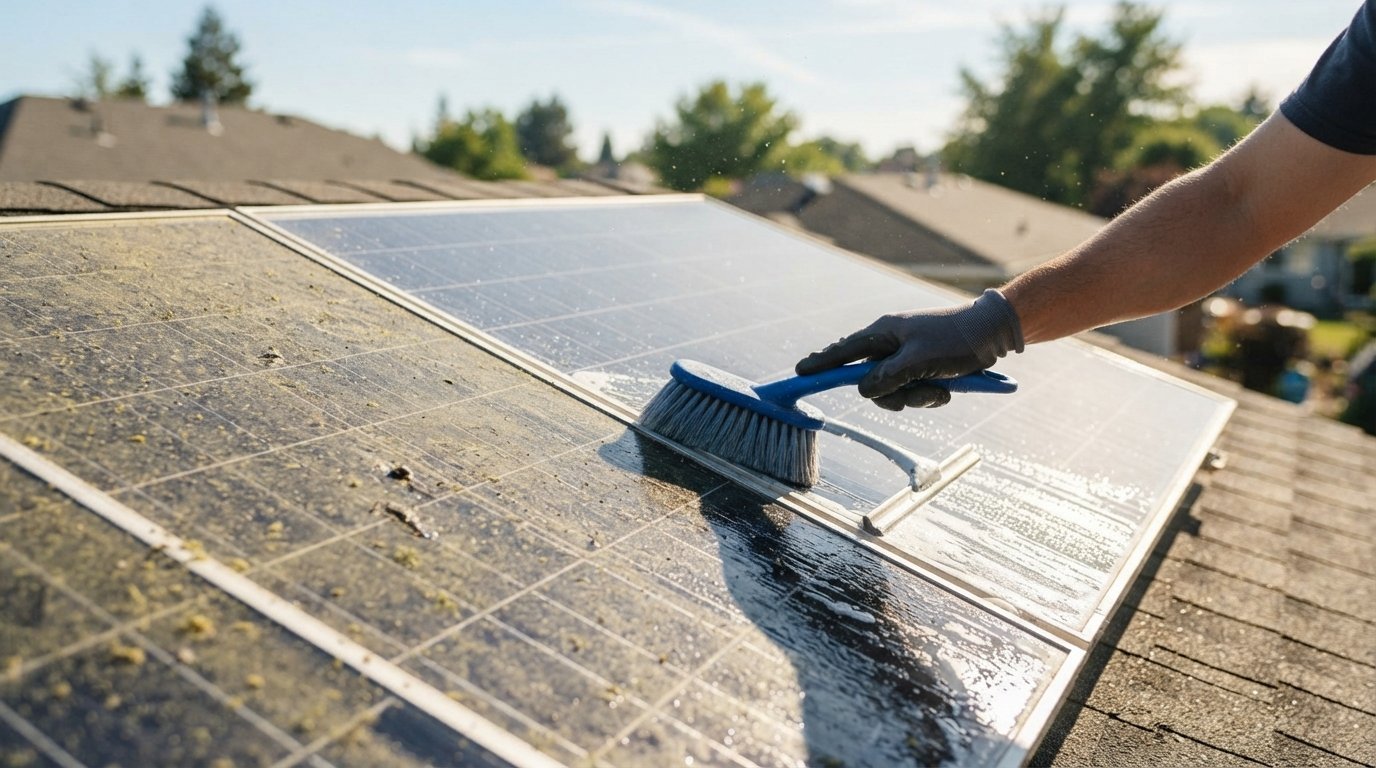
Cleaning solar panels yourself is entirely possible, and for small, ground mounted, or easily accessible arrays it is often the most economical choice. The basic requirements are simple: a soft bristle brush or microfiber mop, a garden hose with filtered water if your tap water is hard, and a mild soap only when necessary. Work in early morning or late evening when the panels are cool, because spraying cold water on hot glass can cause thermal stress and micro cracks.
Safety is the limiting factor for most homeowners. Rooftop arrays require ladder work, fall protection, and careful foot placement to avoid cracking panels. Walking on panels voids most warranties, and even stepping on the mounting rails can damage flashing and create leaks. If your roof is steep, two stories or higher, or covered in fragile tiles, professional cleaning is the safer and often cheaper option once you factor in the risk of a fall or a broken panel.
Professional cleaning services offer several advantages beyond safety. Trained technicians use deionized water that dries without spots, soft rotating brushes designed for photovoltaic glass, and extension poles that reach arrays without roof traffic. Many also bundle a visual inspection that catches cracked glass, loose wiring, and hot spots before they become expensive repairs. If you want to compare local providers and request quotes without making dozens of phone calls, starting with a trusted solar marketplace saves time and usually surfaces better pricing.
For homeowners exploring the full scope of renewable options beyond solar, including hydropower and wind, independent educational resources such as NewSolarQuotes provide guides and cost calculators that help put solar production and savings into a broader energy context. Understanding where your solar output goes and how maintenance affects it makes those comparisons far more meaningful.
Building a Maintenance Plan That Protects Your Investment
A solar array is a 25 year asset, and like any asset it rewards consistent care. The most effective maintenance plans combine scheduled cleanings with annual professional inspections, monitoring reviews, and prompt attention to anything unusual. Homeowners who follow this approach routinely report production within a few percentage points of their system's original output, even after a decade of operation.
The economics are straightforward. Two professional cleanings per year on a typical residential system might cost a few hundred dollars, while recovering even 5 percent of a $1,500 annual production value saves $75 per year, and that figure grows as electricity rates rise. In dustier regions where losses reach 15 percent or more, the payback on cleaning is measured in weeks, not years. Add the extended equipment life that comes from preventing hot spots and thermal stress, and the case for regular cleaning becomes overwhelming.
Start by assessing your local conditions, set a realistic schedule, and monitor your production so you can adjust as needed. If you would rather hand the work to trained professionals who understand both the cleaning and the inspection side of solar maintenance, connecting with vetted local installers is the fastest path to a cleaner, more productive array. Your panels will thank you with every sunny day.