Solar Battery Buying Guide: Choose the Right Home Storage
Find the best solar battery for your home with this buying guide. We cover capacity, power, chemistry, sizing, and cost to maximize your energy independence.

By Owen Phillips
Learn more about Solar Panel Installation and Repair for guides, costs, and what to expect.
Compare Solar Panel Installation and Repair Pros Near You

Enter your ZIP code to compare top-rated local professionals and request free quotes.
Adding a solar battery to your home solar system can transform how you use the energy your panels produce. Instead of sending excess power back to the grid for a small credit, you store it for evening use, during outages, or when utility rates spike. But the market is crowded with options, and the technical specs can feel overwhelming. This solar battery buying guide cuts through the jargon and gives you a clear, practical framework for choosing the right home storage system for your budget and goals.
Before you compare brands or look at price tags, you need to understand what a battery actually does in a home solar setup. A battery stores direct current (DC) electricity generated by your solar panels. When your home needs power, an inverter converts that DC back into alternating current (AC) your appliances can use. Some batteries have built-in inverters, while others require a separate one. The key is to match the battery's capabilities to your household's energy patterns and your reasons for going solar in the first place.
Why Homeowners Are Adding Battery Storage
The biggest shift in residential solar over the past few years is the move toward energy independence. With a battery, you are no longer fully dependent on the grid when the sun goes down. You can run your lights, refrigerator, Wi-Fi router, and even medical devices during a blackout. For homeowners in regions prone to extreme weather or grid instability, this backup capability is often the primary motivation for investing in storage.
There is also a financial angle. Many utilities have moved away from generous net metering policies that paid solar owners retail rates for excess energy. Instead, they now offer lower export rates or introduce time-of-use (TOU) pricing, where electricity costs more during peak demand hours. A battery lets you store cheap solar power during the day and use it during expensive peak periods, effectively shielding you from those higher rates. In some cases, you can even participate in demand response programs or sell stored energy back to the grid when prices spike.
Key Specifications to Understand Before You Buy
When you start shopping, you will see a list of numbers on every battery spec sheet. Knowing what they mean is essential to making a smart choice. Here are the four most important metrics to compare:
- Usable capacity (kWh): This is the amount of electricity the battery can actually deliver to your home. Ignore the total capacity; usable capacity is what matters for sizing.
- Power rating (kW): This tells you how much electricity the battery can deliver at once. A higher power rating means you can run more appliances simultaneously, including high-draw items like air conditioners or electric vehicle chargers.
- Round-trip efficiency: This percentage shows how much energy is lost during the charge and discharge cycle. Higher efficiency means more of your solar energy actually gets used.
- Depth of discharge (DoD): This indicates how much of the battery's capacity can be safely used before recharging. Most lithium-ion batteries allow 80-100% DoD, while older lead-acid batteries are limited to 50%.
Beyond these core specs, you will also see metrics like warranty, expected lifespan (often expressed in cycles), and operating temperature range. A cycle is one full charge and discharge. Most modern batteries are rated for 6,000 to 10,000 cycles, which translates to 10 to 15 years of daily use. Pay close attention to the warranty terms, especially the throughput guarantee, which caps the total energy the battery can process over its life.
Choosing the Right Battery Chemistry
Nearly all residential batteries sold today use lithium-ion chemistry, but there are important subcategories. Lithium iron phosphate (LFP or LiFePO4) batteries are the current market leader because they offer excellent safety, long cycle life, and good thermal stability. They do not overheat easily and can handle higher temperatures without degrading. This makes them ideal for garage or outdoor installations in warmer climates.
Nickel manganese cobalt (NMC) batteries, used by some manufacturers, have a slightly higher energy density, meaning they can pack more capacity into a smaller footprint. However, they are more prone to thermal runaway and typically have a shorter cycle life than LFP. For most homeowners, LFP is the safer, more reliable choice. If you are considering a battery from a lesser-known brand, verify that it uses reputable cells and has passed safety certifications like UL 9540 or IEC 62619.
Comparing the Top Solar Battery Brands
The market has consolidated around a few major players, each with distinct strengths. The Tesla Powerwall is still the most recognizable name, offering solid performance, a sleek design, and seamless integration with the Tesla app. It has a 13.5 kWh usable capacity, a 5 kW continuous power rating (7 kW peak), and a 10-year warranty. However, it requires a Tesla Gateway or compatible inverter, and availability can be an issue during high-demand periods.
Enphase offers a modular system based on its IQ Battery series. Each unit provides 3.5 kWh (IQ Battery 3) or 5 kWh (IQ Battery 5) of usable capacity, so you can stack multiple units to reach your desired size. This flexibility is great for homes with limited space or those that want to expand over time. Enphase batteries integrate smoothly with Enphase microinverters, making them a natural fit for new solar installations.
LG Energy Solution's RESU series is another popular option, known for its compact size and high energy density. The RESU10 and RESU16 provide 9.6 kWh and 16 kWh of usable capacity, respectively. They require an external inverter, which adds complexity but also allows you to pair them with a high-quality inverter of your choice. LG has had some recall issues in the past, so check the current warranty and production status before buying.
Other notable brands include Generac's PWRcell, which offers a scalable DC-coupled system, and Sonnen, which focuses on premium, AI-driven energy management. When comparing brands, look beyond the spec sheet. Consider the company's financial stability, the quality of their mobile app, customer service reputation, and the ease of finding a certified installer in your area. A battery is a 10-year+ investment, so you want a brand that will be around to honor its warranty.
How to Size Your Solar Battery
Sizing a battery is not about buying the biggest one you can afford. It is about matching capacity to your actual needs. Start by reviewing your electricity bills to find your average daily usage in kilowatt-hours (kWh). A typical US home uses about 30 kWh per day, but this varies widely based on square footage, number of occupants, heating and cooling systems, and appliances.
Next, decide what you want the battery to accomplish. If you only want to cover essential loads during an outage, you might need just 5-10 kWh to run lights, a refrigerator, and a few outlets for 8-12 hours. If you want to shift most of your evening usage to solar power, you will need enough capacity to cover the hours between sunset and sunrise, which is often 10-15 kWh. For full off-grid living, you will need a much larger bank, typically 20-30 kWh or more, plus a generator for extended cloudy periods.
Once you have a target capacity, factor in your solar panel output. A battery only charges when your solar system is producing more than your home is using. If you have a small solar array that barely covers your daytime use, you will not have surplus energy to store. In that case, adding more solar panels might be a better first step than buying a battery. On the other hand, if you have a large array with significant excess production, a battery can capture that waste and put it to work.
Battery Installation and Integration
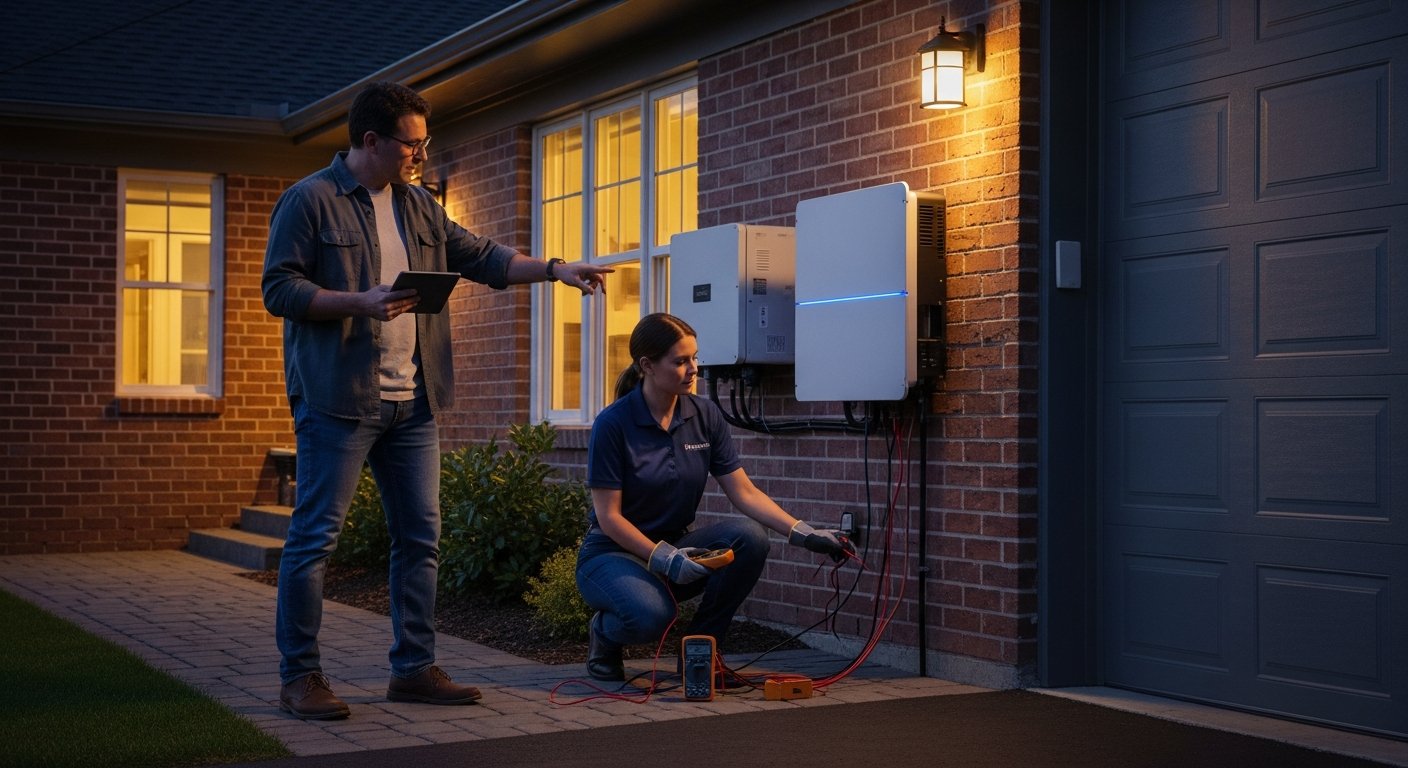
Installing a solar battery is not a DIY project. It involves high-voltage DC wiring, complex inverters, and often coordination with your utility company. You will need a licensed electrician with experience in solar storage systems. Before you buy, get at least three quotes from different installers and ask them to assess your home's electrical panel capacity, available wall space, and connection type (AC vs. DC).
AC-coupled systems are the most common for retrofits. They connect the battery to your home's AC electrical panel, and the battery has its own inverter to convert DC to AC. This approach is simpler and works with any existing solar inverter. DC-coupled systems connect the battery directly to the solar panels' DC line, which can be more efficient (one conversion step instead of two) but requires a hybrid inverter and is usually only installed with new solar systems.
Your installer will also need to handle permits and inspections. Most utilities require an interconnection agreement before you can use a battery for grid-connected operation. Some utilities also offer incentives or rebates for battery installation, which can significantly reduce your upfront cost. Be sure to check with your local utility and state energy office for current programs.
Cost, Incentives, and Return on Investment
The cost of a solar battery has dropped dramatically over the past decade, but it is still a significant investment. A typical 10-15 kWh battery system costs between $10,000 and $15,000 installed, before incentives. The price varies based on brand, capacity, complexity, and your location. For example, a Tesla Powerwall installed in California might cost $12,000-15,000, while a smaller Enphase system could be $8,000-12,000.
Fortunately, there are ways to offset the cost. The federal Investment Tax Credit (ITC) currently offers a 30% credit on the full cost of a battery system, as long as it is charged by solar panels (which is almost always the case). For a $12,000 battery, that is a $3,600 credit on your federal taxes. Some states, like California, Massachusetts, and New York, offer additional rebates or performance-based incentives. Your utility might also have a peak demand reduction program that pays you for letting them draw from your battery during high usage events.
To calculate your ROI, you need to estimate your annual savings from the battery. This includes the value of backup power (harder to quantify but very real), plus any electricity bill savings from avoiding peak rates or selling stored energy. A simple payback period for a battery is typically 6-10 years, depending on your utility rates and usage patterns. If you live in an area with high electricity costs or frequent outages, the payback can be much shorter. Conversely, if your utility has flat rates and reliable service, the financial case for a battery is weaker, and you might prefer to wait until prices drop further.
Make an Informed Decision
Choosing the right solar battery is about balancing your energy needs, budget, and long-term goals. Start by understanding your home's consumption patterns, decide what you want from the battery (backup, bill savings, or both), and then compare systems based on usable capacity, power rating, efficiency, and warranty. Always get multiple quotes from reputable installers and check for available incentives.
For more in-depth analysis, explore our solar battery banks guide, which covers the future of energy storage and how to build a multi-battery system. You can also read our solar battery guide for additional tips on matching storage to your home. And if you are still weighing options, our solar battery guide offers a step-by-step comparison of popular models.
Remember, a solar battery is not just a gadget; it is a shift in how you interact with the grid. It gives you control over your energy, resilience during emergencies, and a path to greater sustainability. With the right research and a trusted installer, you can find a system that pays for itself in comfort and savings for years to come.
Learn more about Solar Panel Installation and Repair for guides, costs, and what to expect.
Compare Solar Panel Installation and Repair Pros Near You
Enter your ZIP code to compare top-rated local professionals and request free quotes.