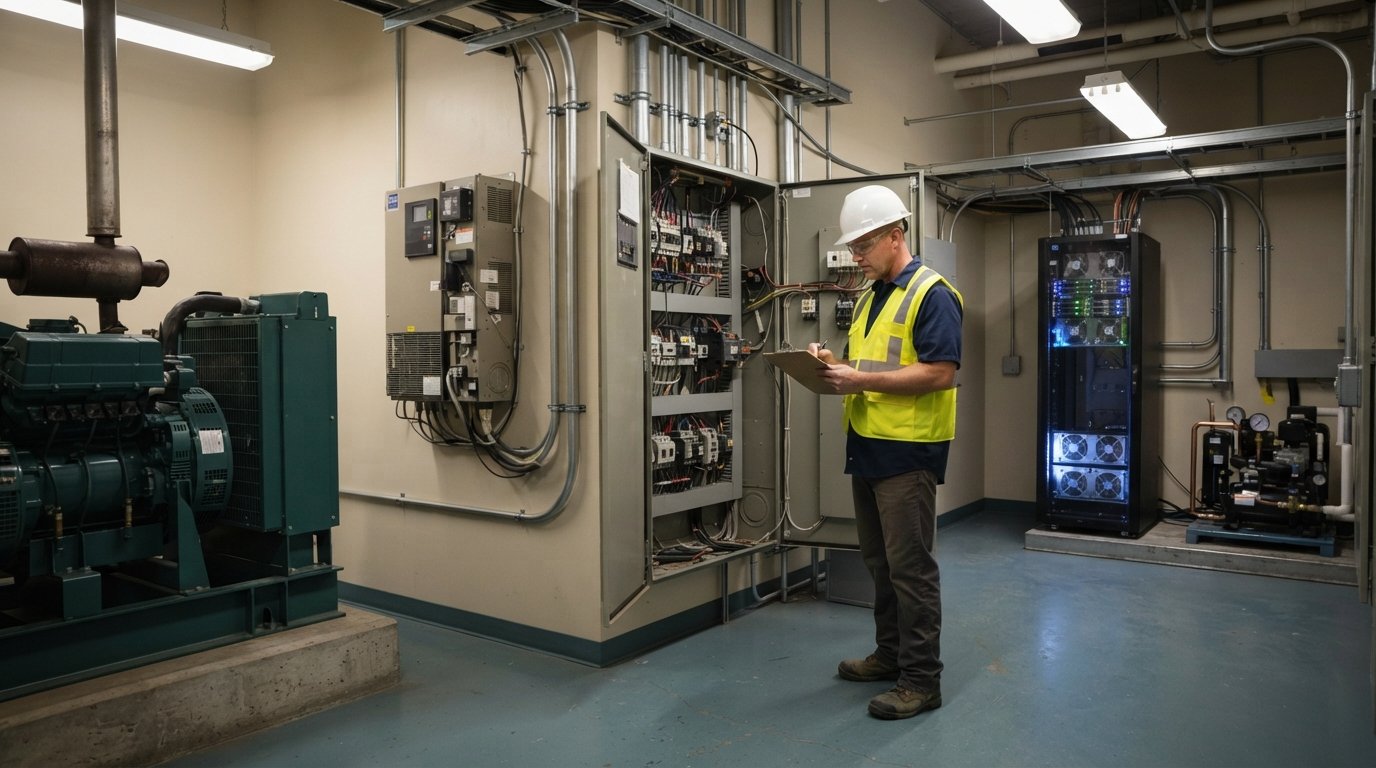
Emergency Power Options for Businesses Beyond Solar Batteries
Explore emergency power options for businesses beyond solar batteries, from generators to UPS systems. Call (833)-434-4023 for expert guidance.

By Adam Adler
Learn more about Generator Installation for guides, costs, and what to expect.
Compare Generator Installation Pros Near You

Enter your ZIP code to compare top-rated local professionals and request free quotes.
When the grid goes down, a solar battery alone may not carry your entire operation. Many business owners discover this during their first outage: the battery covers the server room, but the freezer thaws, the security system drops offline, and the production line stalls. The real question is not whether to add backup power, but how to layer the right technologies so that critical loads stay energized without overspending on capacity you do not need. This guide explores emergency power options for businesses beyond solar batteries, from generators and UPS systems to fuel cells and microgrids, and explains how to match each option to your load profile, code obligations, and resilience goals.
Start with Load Mapping, Not Equipment Shopping
Before comparing generators or batteries, you need a precise picture of what must stay on and for how long. An energy survey is the foundation of any resilience plan. It identifies every circuit, measures actual runtime demand, and separates critical loads (life safety, IT, refrigeration) from discretionary loads (comfort cooling, decorative lighting). Without this step, businesses routinely oversize generators or buy batteries that cannot handle inrush currents from motors and compressors.
SolarEnergy.ai offers on-site energy surveys that document your load profile and flag circuits that should be backed up first. The survey also notes existing transfer switches, panel capacity, and fuel storage constraints, which directly affect which emergency power options are feasible. Once you have that data, you can match loads to three broad categories of backup: batteries for instant, short-duration coverage; generators for long-duration, high-capacity output; and UPS systems for ride-through protection on sensitive electronics.
Here is a simple framework for matching critical loads to the right technology:
- Batteries and solar storage: Best for IT closets, security systems, refrigeration, and lighting during outages of 4 to 12 hours. They respond in milliseconds and require no fuel.
- Standby generators: Suited for whole-building or large-load backup lasting days, provided you have fuel storage and maintenance contracts in place.
- UPS systems: Essential for servers, medical equipment, and controls that cannot tolerate even a brief transfer time. UPS units bridge the gap until a generator starts or a battery takes over.
- Fuel cells and microgrids: Viable for facilities with strict emissions rules or long-duration resilience needs, though capital costs remain high.
After mapping loads, calculate the total connected load in kilowatts and the required runtime in hours. This determines generator sizing and battery capacity. A common mistake is to size a generator for peak summer demand when the actual critical load during an outage is half that figure. Right-sizing saves capital and fuel costs while improving reliability.
Code and Life-Safety Requirements Shape Your Design
Emergency power systems for businesses are governed by codes that vary by occupancy type and jurisdiction. The National Electrical Code (NEC) Article 700 covers emergency systems for life safety, Article 701 covers legally required standby systems, and Article 702 covers optional standby systems. Healthcare facilities, high-rise buildings, and assembly occupancies face stricter rules, including automatic transfer within 10 seconds and periodic testing documentation.
These requirements affect which emergency power options you can use. For example, a battery system may satisfy Article 700 requirements if it can carry the load for the required duration and transfer automatically. Generators must be tested monthly under load and maintained according to manufacturer schedules. UPS systems are often classified as emergency systems when they support egress lighting or fire pumps, which means they need regular maintenance and battery replacement schedules.
Local fire codes may also restrict fuel storage. Diesel generators require spill containment and fire-rated enclosures, while natural gas generators avoid on-site fuel storage but depend on utility gas pressure during a wider outage. If your building has a solar array with storage, the interconnection must comply with UL 1741 and IEEE 1547, and your transfer switch must be rated for the combined output. Involving a licensed electrical engineer early prevents costly redesigns after equipment is ordered.
How Solar Plus Storage Interacts with Generator Transfer Switches
Many businesses already have a diesel or natural gas generator with a transfer switch. Adding solar plus storage does not mean removing the generator; instead, the two can work together in a layered architecture. The key is to configure the transfer switch and inverter controls so that the battery discharges first for short outages, and the generator starts only when the battery state of charge drops below a set threshold.
This setup extends generator life and reduces fuel consumption, because the generator no longer cycles for every brief outage. It also improves resilience: if the generator fails to start, the battery still carries critical loads. However, the integration requires careful sequencing. The inverter must be programmed to accept generator input without backfeeding, and the transfer switch must isolate the utility before the generator or battery energizes the emergency panel.
For businesses in states with strong solar adoption, such as West Virginia, pairing storage with existing generators is becoming more common. Our overview of West Virginia solar power explains how state policies and net metering affect the economics of adding storage to an existing backup system. In many cases, the battery can also provide demand charge reduction and backup power, improving payback beyond emergency use.
One practical constraint: older transfer switches may not be compatible with bidirectional inverter output. Upgrading to a listed smart switch or adding a dedicated critical-load panel solves this. The cost is modest compared to replacing a generator, and it future-proofs the system for additional battery capacity later.
Fuel Storage, Maintenance, and Testing Obligations for Generators
Generators remain the workhorse of long-duration business backup, but they come with operational obligations that are easy to underestimate. Diesel fuel degrades over time, so you need a fuel polishing schedule and a plan to test fuel quality quarterly. Natural gas generators avoid fuel storage but may be subject to curtailment during regional shortages. Propane requires a tank sized for at least 72 hours of runtime, and local codes may limit tank placement.
Maintenance is not optional. Most manufacturers require oil changes, filter replacements, and load bank testing at defined intervals to keep warranties valid. Monthly no-load exercises plus annual full-load tests are standard. If your generator fails during an outage because the battery was dead or the fuel was stale, the consequences can include lost inventory, regulatory penalties, and insurance disputes.
A practical testing schedule for a business generator includes:
- Weekly visual inspection of fuel levels, coolant, and oil.
- Monthly exercise run for 30 minutes with available load.
- Annual load bank test at 80 percent capacity for at least two hours.
- Fuel quality test and polishing every 6 to 12 months.
- Transfer switch operation test every quarter.
Documenting these tests matters for code compliance and for insurers, who increasingly ask for proof of maintenance before paying claims related to outage losses. A maintenance contract with a qualified generator service provider is often the most cost-effective way to stay compliant.
Phased Resilience Planning: Start with an Energy Survey
Not every business can afford a full microgrid on day one. A phased approach lets you build resilience incrementally while capturing savings along the way. Phase one is the energy survey and load mapping, which typically costs far less than new equipment and often reveals opportunities to reduce demand through controls and scheduling. Phase two adds a UPS or small battery for the most sensitive loads. Phase three adds a generator or expands battery capacity for longer outages. Phase four integrates solar and smart controls for fuel savings and sustainability.
Each phase should be justified by a risk assessment: what does an hour of downtime cost your business, and what is the probability of an outage lasting that long? For a grocery store, refrigeration loss can destroy inventory within hours; for a professional services firm, the cost may be limited to lost productivity. Matching investment to risk prevents overspending on capabilities you may never use.
Financing options also affect phasing. Solar and storage can qualify for tax credits and accelerated depreciation, while generators are typically depreciated over a longer schedule. If you are exploring solar plus storage as part of your resilience plan, you can request free quotes from vetted installers through FreeSolarPowerQuotes to compare options without obligation. Combining those quotes with your energy survey data gives you a clear picture of cost and performance.
Finally, consider non-equipment measures that improve resilience at low cost: surge protection on critical panels, backup communication links, and a written outage response plan. These steps complement hardware investments and often determine how quickly your business recovers.
Beyond the Battery: Building a Layered Backup Strategy
Emergency power options for businesses beyond solar batteries include generators, UPS systems, fuel cells, and microgrids, each with distinct strengths. The most resilient businesses do not choose one technology; they layer them so that a single failure does not darken the whole facility. A battery handles the first minutes, a generator handles the long haul, and a UPS protects the equipment that cannot tolerate any interruption.
Start with an energy survey to size each layer correctly, verify code requirements with local authorities, and schedule maintenance before you need it. Whether you are adding storage to an existing generator or building a new backup plan from scratch, the goal is the same: keep critical loads energized, control costs, and recover quickly when the grid goes down.