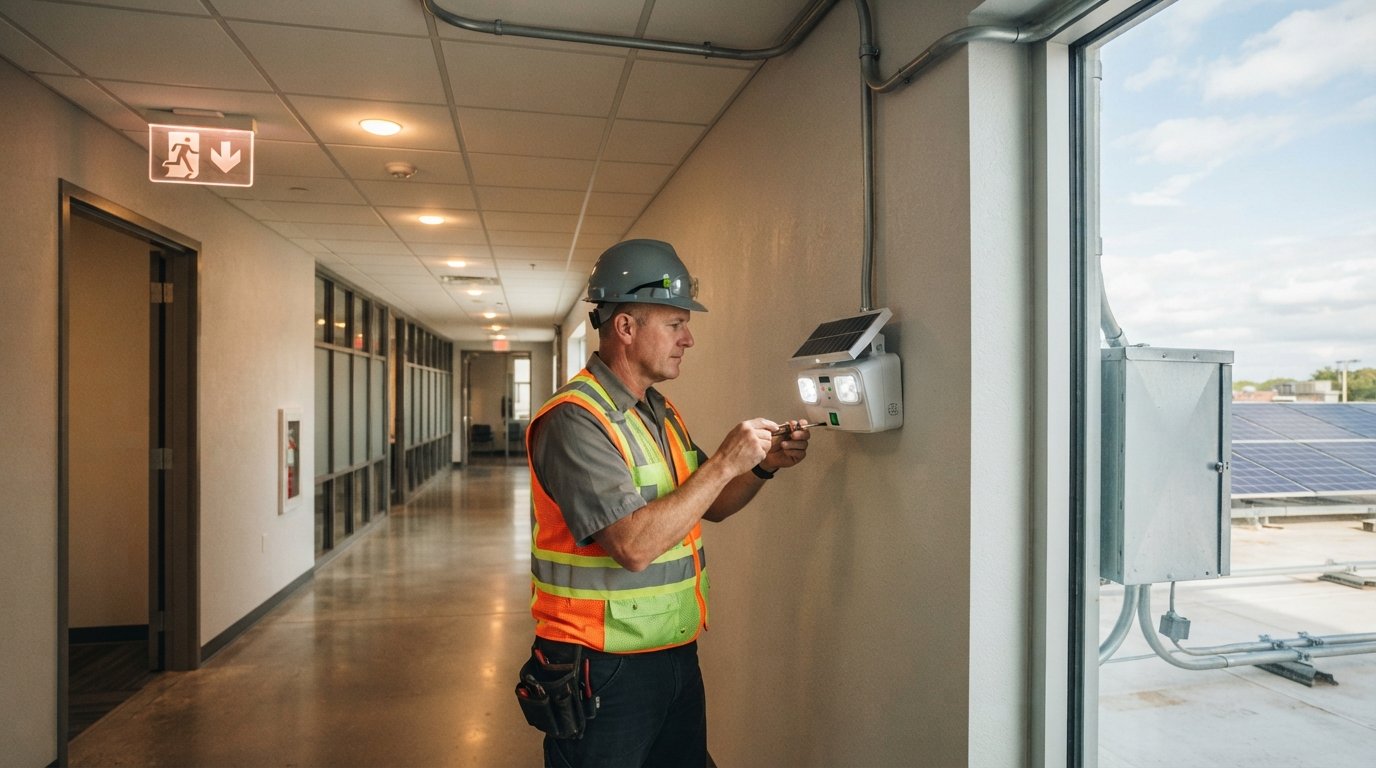
Commercial Solar Emergency Lighting Compliance and Safety
Commercial solar emergency lighting compliance and safety keeps buildings code-ready and resilient. Call 8334344023 for expert help.

By Mason Carter
Learn more about Solar Panel Installation and Repair for guides, costs, and what to expect.
Compare Solar Panel Installation and Repair Pros Near You

Enter your ZIP code to compare top-rated local professionals and request free quotes.
When the grid goes down, a commercial building does not simply go dark. Code requires it to stay safe. Commercial solar emergency lighting compliance and safety is the discipline of pairing photovoltaic power with code-compliant egress illumination, so that occupants can exit a facility during an outage, a fire, or a brownout without panic or injury. For facility managers, property owners, and solar contractors, this is no longer a niche add-on. It is a permit condition, an insurance question, and increasingly a selling point for tenants who demand resilient buildings.
The stakes are high because emergency lighting sits at the intersection of two fast-moving worlds: renewable energy adoption and life-safety regulation. A solar array can keep a building's critical loads alive for hours, but only if the emergency lighting system is designed, installed, and tested to recognized standards. Get it right, and you gain a building that stays operational when the neighborhood goes dark. Get it wrong, and you face failed inspections, voided coverage, and potentially catastrophic liability after an incident.
This guide walks through the code framework, the hardware choices, the testing obligations, and the practical safety habits that keep a commercial solar emergency lighting system compliant year after year. It is written for decision-makers who need clarity, not jargon, and who want to move from confusion to a concrete compliance plan.
Why Solar Emergency Lighting Deserves Serious Attention
Emergency lighting is one of those systems that nobody notices until it is needed. In a commercial setting, it must illuminate exit paths, stairwells, corridors, and large assembly areas when normal power fails. Traditionally, that job fell to battery-backed fixtures charged from the grid. Solar changes the equation because the power source itself can be independent, resilient, and located on-site. That independence is exactly what makes solar emergency lighting attractive, and exactly what makes compliance more complex.
Building codes do not treat solar as a magic exemption. NFPA 101, the Life Safety Code, requires means of egress to remain illuminated for a defined duration, typically 90 minutes, during a power loss. NFPA 70, the National Electrical Code, governs how that power is delivered, including Article 700 for emergency systems and Article 690 for solar photovoltaic systems. Underwriters Laboratories standards such as UL 924 define the performance of emergency lighting and power equipment. A solar-based system must satisfy all of these at once, plus any state or local amendments.
There is also a human factor. During a regional outage, a building with working emergency lighting becomes a safer refuge and a more attractive lease. Tenants in healthcare, education, manufacturing, and retail increasingly ask about backup power and egress safety during due diligence. A compliant solar emergency lighting system answers those questions before they become objections. It also supports continuity planning, because the same battery bank that powers egress lights can often support security panels, exit signs, and communications equipment.
The safety dimension extends beyond code. Solar emergency lighting systems involve stored energy, DC circuits, and rooftop or ground-mounted arrays. Technicians who service them need arc-flash awareness, rapid shutdown knowledge, and battery safety training. Compliance is not only about passing inspection. It is about protecting the people who install, maintain, and rely on the system.
The Core Compliance Framework for Commercial Buildings
Compliance starts with identifying which code edition your jurisdiction enforces. Most US states adopt a version of the International Building Code and International Fire Code, which reference NFPA 101 and NFPA 70. The specific edition matters because requirements for illumination levels, duration, and testing have tightened over time. A system designed to a 2012 code may not satisfy a 2021 or 2024 adoption. Before specifying equipment, confirm the adopted edition with the local authority having jurisdiction, often called the AHJ.
Once the code edition is known, map the building's egress paths and classify the occupancy. A warehouse with wide aisles has different needs than a hospital corridor or a nightclub. NFPA 101 sets minimum illumination along the path of egress and at points requiring emphasis, such as changes in elevation, doors, and intersections. It also specifies how long the illumination must last and how quickly it must activate after a power loss. Solar equipment must be sized to meet those numbers with margin, not just on paper.
Documentation is where many projects stumble. Inspectors expect to see a stamped design, equipment listings, battery calculations, and a testing log. If the solar array is also feeding normal building loads, you need clear separation between emergency and non-emergency circuits. That separation is both a code requirement and a safety feature, because it prevents a fault in one system from disabling the other. A well-organized compliance binder, physical or digital, turns a stressful inspection into a routine review.
Insurance carriers add another layer. Many commercial policies require proof of emergency lighting testing and may offer premium relief for resilient systems. A solar emergency lighting installation that is documented and maintained can become a negotiating asset. Carriers want fewer claims, and a building that stays lit during an outage generates fewer slip-and-fall and panic-related incidents.
How Solar Integrates With Emergency Lighting Systems
There are three common architectures for solar-powered emergency lighting in commercial buildings. Each has trade-offs in cost, complexity, and resilience.
- DC-coupled standalone fixtures: Individual emergency lights with their own small solar panel and battery. Simple to install, easy to zone, but limited capacity and more units to maintain.
- Central battery bank with solar charging: A shared battery room or cabinet charged by a solar array, feeding multiple emergency circuits. Efficient and scalable, but requires careful load calculations and ventilation.
- Hybrid grid-solar system: The solar array and batteries support both normal and emergency loads, with automatic transfer to emergency mode during an outage. Most flexible, but also the most complex to permit and commission.
The right choice depends on building size, occupancy type, and how long the facility must remain lit. A small retail strip may be well served by standalone fixtures, while a hospital or data center likely needs a hybrid design with redundant power paths. In every case, the emergency lighting must activate automatically and reliably, without human intervention.
Solar equipment selection matters too. Panels, charge controllers, inverters, and batteries should carry appropriate listings for the application. UL 924 covers emergency lighting and power equipment, while UL 1741 applies to inverters for distributed energy resources. Batteries must be rated for the environment, whether that is a conditioned electrical room or a hot rooftop enclosure. Temperature extremes degrade battery capacity, so sizing calculations should use realistic operating conditions, not laboratory ideals.
Commissioning is the moment of truth. The installer should simulate a utility outage, verify illumination levels with a light meter, confirm activation timing, and record the results. Any deficiency found during commissioning is far cheaper to fix than one discovered during a fire marshal inspection or, worse, after an actual emergency.
Step-by-Step: Achieving and Maintaining Compliance
Compliance is a process, not a one-time event. The following sequence reflects how experienced facility teams approach a commercial solar emergency lighting project, from concept through long-term operation.
- Assess the building and confirm the adopted codes. Identify egress paths, occupancy classification, and the specific NFPA and local amendments that apply. Talk to the AHJ early.
- Design the system with a qualified engineer. Produce stamped drawings, load calculations, and equipment schedules that show how solar and batteries meet the required duration and illumination.
- Select listed equipment and qualified installers. Use components rated for emergency use and crews trained in both solar and life-safety work. This is where a service like SolarEnergy.ai's vetted professional network can reduce risk by connecting you with experienced installers.
- Commission and document. Test the system under simulated outage conditions, measure performance, and compile a compliance binder with drawings, listings, and test results.
- Test and maintain on a schedule. Perform monthly functional tests and annual duration tests, log the results, and replace batteries before they fail. Keep the log available for inspectors and insurers.
Each step feeds the next. A weak assessment produces a design that cannot pass inspection. A rushed commissioning leaves hidden failures. A neglected maintenance log turns a compliant building into a liability. The discipline of documenting every action is what separates a smooth inspection from a stressful one.
Budgeting also deserves a mention. Solar emergency lighting systems have upfront costs for equipment, design, and installation, but they can reduce long-term energy expenses and may qualify for incentives depending on location and configuration. Your accountant or energy advisor can clarify what applies. The key is to treat compliance as part of the project cost from the beginning, not as an afterthought that blows the budget.
Safety Practices for Installation and Maintenance
Safety is not only about the building occupants. It is also about the people who work on the system. Solar emergency lighting combines DC electricity, stored battery energy, and life-safety circuits, a combination that demands respect and training.
Before any work begins, the technician should perform a hazard assessment. That includes identifying live conductors, confirming rapid shutdown functionality, and verifying that the emergency system cannot energize unexpectedly. Lockout-tagout procedures apply, and personal protective equipment should match the arc-flash risk. Batteries require special handling because they can deliver high current even when the solar array is dark.
During maintenance, testing should follow the manufacturer's instructions and the applicable code. Monthly tests confirm that fixtures activate and batteries hold. Annual tests verify full duration. Any failure should trigger immediate repair, not a note to address later. A system that works at 80 percent capacity may pass a casual glance but fail when it matters.
Training is the multiplier. Facility staff should know how to interpret indicator lights, perform basic tests, and escalate problems. Contractors should be briefed on the specific design before touching the system. A shared understanding of the compliance requirements prevents well-intentioned work from creating new violations.
Common Compliance Pitfalls to Avoid
Most failures are predictable. The same mistakes appear across projects, and each one has a straightforward fix.
- Ignoring the adopted code edition: Designing to an older standard because it is familiar. Always verify the current local adoption.
- Undersizing batteries: Calculating duration under ideal conditions rather than realistic temperature and load. Add margin.
- Mixing emergency and non-emergency circuits: A code violation and a safety risk. Keep the systems separate and clearly labeled.
- Skipping documentation: Inspectors and insurers want evidence. If it is not written down, it did not happen.
- Deferred maintenance: Batteries age quietly. A schedule with logged tests prevents surprise failures.
Avoiding these pitfalls is mostly about discipline and early planning. Engage the AHJ before design, use qualified professionals, and treat testing as a core operation rather than an administrative chore. The result is a system that performs when it is needed and a building that stays compliant without drama.
It also helps to learn from how financing and ownership decisions affect long-term maintenance responsibility. If you are weighing options for your solar investment, our guide on commercial solar lease vs purchase explains how each model shapes who handles repairs, testing, and compliance over the life of the system. That clarity prevents finger-pointing when an inspection date arrives.
For readers who want broader context on renewable energy options and how solar fits into a facility's overall strategy, independent resources such as NewSolarQuotes provide educational guides and cost analysis that complement the technical and regulatory details covered here. Pairing that big-picture perspective with a code-compliant design gives you a stronger business case when presenting the project to ownership or a board.
Building a Resilient, Compliant Future
Commercial solar emergency lighting compliance and safety is ultimately about trust. Tenants trust that they can exit safely. Inspectors trust that the documentation is accurate. Insurers trust that the system will perform. Regulators trust that the installation meets the letter and spirit of the code. Every one of those relationships depends on doing the unglamorous work: reading the adopted standards, sizing equipment honestly, testing on schedule, and keeping records.
The good news is that the path is well marked. Identify the codes, design with qualified professionals, use listed equipment, commission thoroughly, and maintain diligently. Solar adds resilience and can lower operating costs, while emergency lighting fulfills a life-safety obligation that no building can ignore. Together, they create a facility that is safer, more attractive to tenants, and better prepared for the unexpected.
If your building is due for an upgrade or you are planning a new solar installation, start the compliance conversation early. The earlier the code requirements enter the design, the smoother the approval, the lower the risk, and the stronger the safety outcome for everyone who walks through your doors.