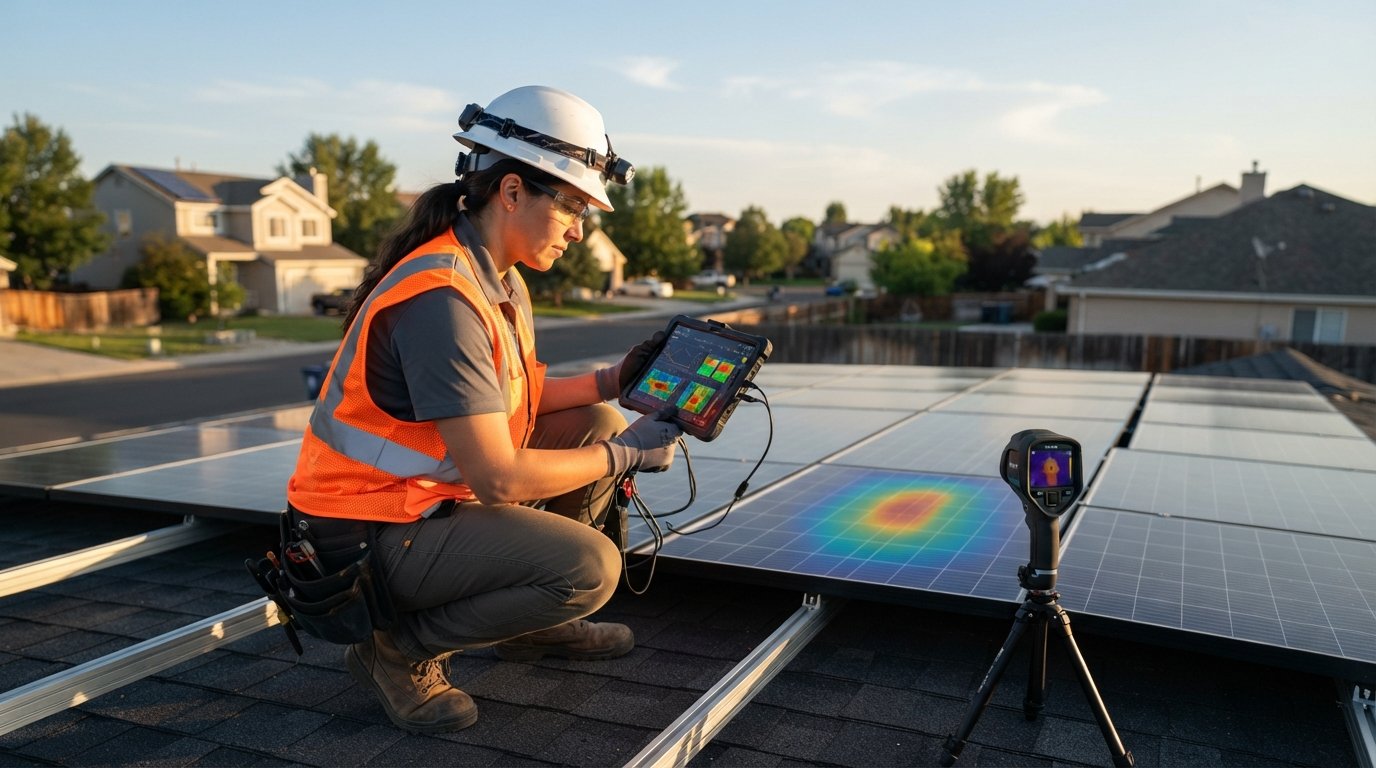
AI Solar System Diagnostics: Early Detection of Performance Issues
AI solar system diagnostics catch performance issues early and protect your savings. Call 8334344023 for expert solar guidance.

By Mason Carter
Learn more about Solar Panel Installation and Repair for guides, costs, and what to expect.
Compare Solar Panel Installation and Repair Pros Near You

Enter your ZIP code to compare top-rated local professionals and request free quotes.
Your solar panels are silently underperforming right now, and you probably do not know it. A single shaded cell, a failing inverter string, or a loose connection can quietly drain hundreds of dollars from your annual savings without triggering a single alarm on your monitoring app. Traditional solar monitoring waits for something to break. Artificial intelligence solar system diagnostics early detection performance issues work differently: they learn your system's normal behavior, then flag the tiny deviations that precede costly failures. For homeowners and businesses across the United States, this shift from reactive repair to predictive maintenance is changing the economics of going solar.
In this article, we will explain how AI-driven diagnostics actually work, what performance issues they catch early, and how to use the findings to protect your return on investment. We will also cover practical steps for adopting these tools and what to expect when you contact a professional.
What AI Solar System Diagnostics Actually Do
AI solar diagnostics is a layer of software intelligence that sits on top of your existing monitoring hardware. Instead of simply displaying production numbers, it analyzes patterns across your panels, inverter, weather data, and historical output. Machine learning models are trained on millions of hours of solar performance data, which allows them to recognize what a healthy system looks like under thousands of different conditions.
When your system's behavior drifts from that learned baseline, the AI flags it. This is the core of early detection: catching a problem while it is still a minor inefficiency, not after it becomes a broken component. For example, a gradual 4 percent drop in one string's output over three weeks might indicate a failing bypass diode. A conventional monitoring system would not alert you until the drop hit 15 or 20 percent. AI catches it earlier, when the fix is cheaper and the lost production is smaller.
These systems also separate real problems from normal variations. Clouds, dust, seasonal sun angles, and temperature changes all affect production. A well-trained AI model accounts for these factors, so you are not flooded with false alarms. That accuracy is what makes early detection actionable instead of annoying.
Performance Issues AI Can Catch Before They Get Expensive
The list of detectable problems is longer than most homeowners expect. AI diagnostics are particularly good at spotting gradual degradation, intermittent faults, and issues that only appear under specific conditions, such as high heat or partial shading.
- Inverter faults and string imbalances: AI can detect when one string is producing less than its neighbors, which often points to a failing inverter channel or a loose MC4 connector.
- Panel soiling and shading: Gradual output declines that match weather patterns can reveal dust buildup or new shade from growing trees before you notice a visual change.
- Hot spots and cell degradation: Thermal anomalies and unusual voltage curves can indicate a cell that is heating up and losing efficiency, a common precursor to panel failure.
- Wiring and connection issues: Intermittent voltage drops that appear only at certain times of day often trace back to corroded or loose wiring.
- Battery and storage inefficiencies: For systems with battery backup, AI can flag charging inefficiencies or unexpected discharge patterns that signal a degrading battery cell.
Each of these issues has a cost curve. Caught early, most are inexpensive fixes: a cleaning, a tightening, a firmware update, or a single component replacement. Caught late, they can mean lost production for months, emergency repair calls, and in some cases, premature replacement of major equipment. Early detection flattens that cost curve dramatically.
How Early Detection Translates Into Real Savings
The financial argument for AI diagnostics is straightforward. A solar system that loses 5 percent of its output for six months due to an undetected issue can cost a homeowner several hundred dollars in lost savings and utility credits. For a commercial system, the loss can run into thousands. AI diagnostics typically identify these issues within days or weeks rather than months.
There is also the avoided cost of emergency repairs. When an inverter fails completely, replacement is urgent and often more expensive because you are paying for expedited service. When AI flags the inverter's declining efficiency weeks in advance, you can schedule the replacement on your terms, often during a lower-demand period for installers.
Warranty claims are another area where early detection pays off. Many panel and inverter warranties require documented maintenance and prompt reporting of defects. AI-generated diagnostic reports provide a clear, timestamped record of when an issue first appeared and how it progressed. That documentation can strengthen a warranty claim and reduce the chance of a dispute.
If you want to explore how these savings fit into a broader solar plan, a good starting point is understanding the full range of AI solar services near you and how they connect to your energy bills.
Key Capabilities of an AI Diagnostics Platform
Not all AI solar tools are created equal. Some are basic anomaly detectors, while others offer full predictive maintenance suites. When evaluating a platform, look for the capabilities that actually drive early detection and savings.
- Baseline learning: The system should learn your specific installation, including panel orientation, local weather, and usage patterns, rather than relying on generic thresholds.
- Granular monitoring: Panel-level or string-level data gives far better diagnostic resolution than system-level totals.
- Predictive alerts: The best platforms do not just report what happened; they forecast what is likely to fail and when.
- Actionable reporting: Alerts should include a probable cause and a recommended next step, not just a red dot on a dashboard.
- Integration with service providers: The ability to share diagnostic reports directly with a qualified installer or technician speeds up repairs and reduces diagnostic fees.
These features matter because early detection only creates value if it leads to timely action. A platform that identifies a problem but does not help you fix it is only half a solution. The best systems close the loop between detection and resolution.
AI Diagnostics for Homes vs. Commercial Systems
Residential and commercial solar systems have different diagnostic priorities. For a typical home system, the biggest concerns are inverter health, panel soiling, and shading changes from trees or new construction. Homeowners also care about battery performance if they have storage, since a failing battery directly affects backup power reliability.
Commercial and industrial systems face additional complexity. They often have multiple inverters, hundreds or thousands of panels, and complex string configurations. A small inefficiency in one section can be masked by strong performance elsewhere. AI diagnostics are especially valuable here because they can isolate underperforming sections that would be invisible in aggregate data.
Commercial systems also have stricter financial reporting requirements. AI-generated performance reports can feed directly into operations and maintenance budgets, helping facility managers justify repairs and plan capital replacements. For businesses, the diagnostic data becomes part of a broader energy management strategy, not just a maintenance tool.
Steps to Adopt AI Solar Diagnostics
Getting started with AI diagnostics does not require replacing your entire solar system. In most cases, it is a software upgrade or an add-on service that works with your existing monitoring hardware. Here is a practical sequence to follow.
- Audit your current monitoring setup. Check whether your inverter or monitoring gateway provides panel-level or string-level data. If it only reports system totals, you may need a hardware upgrade to get the granularity AI diagnostics require.
- Choose a platform that fits your system. Confirm compatibility with your inverter brand and panel configuration. Some AI platforms are inverter-specific; others are hardware-agnostic.
- Establish a clean baseline. Allow the system to observe your solar production for several weeks under normal conditions. This baseline is what the AI uses to detect future anomalies.
- Set your alert preferences. Decide which issues you want to be notified about immediately and which can wait for a weekly summary. This prevents alert fatigue while ensuring critical issues get prompt attention.
- Connect with a qualified service provider. When the AI flags an issue, you want a trusted technician ready to act. Building that relationship in advance saves time when a problem appears.
After adoption, the ongoing process is simple: review alerts, act on recommendations, and track whether resolved issues restore expected production. Over time, the AI model becomes more accurate for your specific system, which improves both detection speed and reliability.
Common Misconceptions About AI Solar Diagnostics
One common misconception is that AI diagnostics are only for large commercial systems. In reality, residential systems benefit just as much, especially because homeowners often lack the technical background to interpret raw monitoring data. AI translates complex performance data into plain-language recommendations.
Another misconception is that AI replaces the need for physical inspections. It does not. AI tells you where to look and what is likely wrong; a technician still needs to confirm and repair the issue. The value is in directing inspections efficiently rather than eliminating them.
Finally, some homeowners worry that AI diagnostics are too expensive to justify. In practice, the cost is usually a small fraction of the savings from catching even one moderate issue early. When you consider that a single undetected inverter fault can cost more than a year of diagnostic service, the economics are compelling.
What the Future Holds for AI Solar Diagnostics
The technology is improving quickly. Future systems will integrate more tightly with smart home energy management, adjusting consumption automatically when solar production dips. They will also become better at predicting component lifespans, allowing homeowners to plan replacements years in advance rather than reacting to failures.
For the solar industry, the shift toward AI-driven diagnostics is part of a broader move toward data-centric operations. Installers who adopt these tools can offer better service contracts and differentiate themselves from competitors who still rely on manual inspections. Homeowners who adopt them get more predictable savings and fewer surprises.
If you are exploring solar for the first time or looking to optimize an existing system, an independent educational resource like NewSolarQuotes can help you compare options and understand the financial landscape. Combined with AI diagnostics, that knowledge gives you a strong position to maximize your solar investment.
The bottom line is simple: early detection is no longer a luxury. It is the difference between a solar system that quietly underperforms and one that delivers the savings you were promised. AI solar system diagnostics early detection performance issues turn your monitoring data into a maintenance advantage, catching problems while they are small and keeping your return on investment intact. Whether you manage a single rooftop array or a multi-site commercial portfolio, the tools are available today, and the savings start as soon as you turn them on.