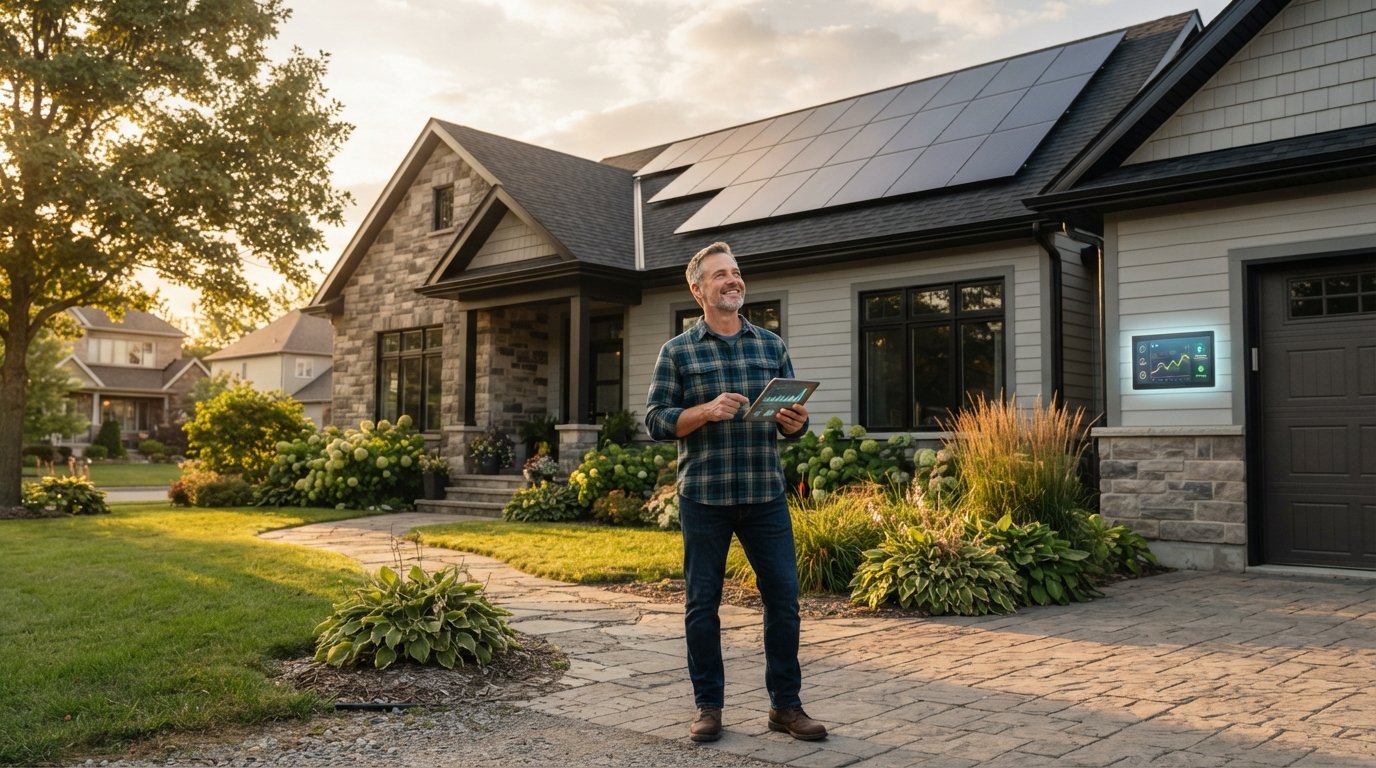
AI Solar Forecasting: Cut Bills with Smart Energy
AI solar forecasting predicts your panels' output and optimizes home battery use, slashing electricity bills and boosting energy independence.

By Dylan Harris
Learn more about Solar Panel Installation and Repair for guides, costs, and what to expect.
Compare Solar Panel Installation and Repair Pros Near You

Enter your ZIP code to compare top-rated local professionals and request free quotes.
Imagine your home's solar panels knowing exactly when to store power and when to sell it back to the grid. That is no longer science fiction. AI solar forecasting uses machine learning to predict sunshine, cloud cover, and your household energy needs with remarkable accuracy. For homeowners across the United States, this technology translates directly into lower electric bills, greater energy independence, and a smarter return on your solar investment. In this guide, we will break down how AI forecasting works, why it matters for your wallet, and how you can start using it today.
What Is AI Solar Forecasting and Why Does It Matter?
At its core, AI solar forecasting combines weather data, satellite imagery, and historical solar output to predict how much energy your panels will generate in the next hour, day, or week. Traditional solar systems rely on static weather forecasts that are often inaccurate. AI-driven models, however, continuously learn and adapt. They analyze real-time conditions, including cloud movement, air temperature, and even dust on your panels, to deliver hyperlocal predictions.
Why does this matter for you? First, accurate forecasts mean your home battery can charge when solar production is high and discharge when it is low. This maximizes the use of clean energy and minimizes the electricity you pull from the grid. Second, utilities in many states offer time-of-use rates, where power is cheaper during off-peak hours and expensive during peak demand. AI forecasting helps you shift your heavy appliance use to times when your solar system is generating the most power, or when grid rates are lowest.
How AI Solar Forecasting Works: A Simple Breakdown
Understanding the mechanics behind AI solar forecasting does not require a degree in data science. The process can be broken into a few clear steps that work together seamlessly.
Data Collection and Integration
The first step is gathering data. This includes satellite images of cloud cover, local weather station reports, and the historical output of your own solar system. Some advanced systems even use sky-facing cameras to capture real-time cloud formations above your home. All this data is fed into a central platform, often cloud-based, where algorithms can process it.
Machine Learning Models
Next, machine learning models take over. These algorithms are trained on years of past weather and solar production data. They learn to recognize patterns, such as how a certain type of cloud typically reduces output, or how temperature affects panel efficiency. The more data they process, the more accurate their predictions become. This is what sets AI apart from simple forecast apps: it learns from your specific location and system.
Continuous Refinement
Finally, the system continuously refines its predictions. It compares its forecasts to actual production in real time and adjusts its models accordingly. If a prediction was off because of unexpected rain, the AI notes the discrepancy and improves its next forecast. This cycle of prediction, measurement, and adjustment is what makes AI solar forecasting so powerful and reliable.
Top Benefits of AI Solar Forecasting for Homeowners
Adopting AI solar forecasting is not about having the latest tech. It is about tangible, everyday benefits that you can see in your bank account and your energy habits. Here are the key ways this technology works for you.
- Lower Electricity Bills: By predicting solar generation, you can program your home to use more self-generated power, reducing the amount you buy from the utility.
- Maximized Battery Value: Your home battery charges when solar power is abundant and discharges during expensive peak hours, saving you money on every kilowatt.
- Increased Energy Independence: With accurate forecasts, you rely less on the grid and more on your own clean energy, protecting you from rate hikes and outages.
- Extended Equipment Lifespan: Smart management reduces stress on your inverter and battery by avoiding deep discharges and overcharging, which can extend the life of your equipment.
- Better Grid Interaction: For those with net metering, AI helps you sell energy back to the grid at the most advantageous times, increasing your credits.
These benefits are not just theoretical. Many homeowners report saving 20 to 30 percent on their annual electric bills after integrating AI forecasting with their solar setup. The key is to pair this technology with a well-designed system and a clear understanding of your local utility rates.
Overcoming Challenges: Grid Variability and Weather Uncertainty
One of the biggest challenges for solar energy has always been its variability. The sun does not always shine, and clouds can roll in without warning. Traditional solar systems operate reactively: they produce power when the sun is out and stop when it is not. AI solar forecasting changes this by being proactive. Instead of reacting to changes, your system anticipates them.
For example, if the AI predicts a cloudy afternoon, it will ensure your battery is fully charged by the morning. It might also pre-cool your home or charge your electric vehicle during the sunny hours, so you do not need to draw from the grid later. This level of foresight reduces the impact of weather uncertainty and grid variability, making solar power a more reliable source of energy for your home.
Moreover, AI models can even predict grid outages and high-demand periods. By storing extra energy before a predicted heatwave, you can keep your air conditioning running without worrying about peak rates or blackouts. This resilience is a major advantage for homeowners in states with extreme weather, such as Arizona, Texas, or Florida.
Getting Started with AI Solar Forecasting
If you already have solar panels, integrating AI forecasting is easier than you might think. Most modern solar inverters and battery systems come with built-in monitoring software that includes basic forecasting. However, to unlock the full potential, you may want to consider a dedicated AI energy management platform.
Here is a simple step-by-step approach to get started:
- Check Your Current System: Review your inverter and battery manual to see if they offer smart forecasting features. Many do, but you might need to enable them in the settings.
- Install a Smart Energy Monitor: Devices like the Sense or Emporia Vue can track your home's energy usage in real time and feed that data to AI platforms.
- Connect to a Forecasting Service: Look for services that specialize in AI solar forecasting, such as SolarEdge's monitoring platform or third-party apps like Aurora Solar.
- Automate Your Appliances: Use smart plugs and smart thermostats that can be programmed based on your solar forecast. For instance, run your dishwasher or laundry when the AI predicts peak generation.
- Monitor and Adjust: After a few weeks, review your energy reports. You will see patterns and can tweak settings to maximize savings.
For those who are considering solar for the first time, it is wise to choose a system that supports AI forecasting from the start. When you unlock bigger home energy savings with AI from day one, you avoid the hassle of retrofitting later. Many installers now offer smart solar packages that include forecasting as a standard feature.
Real-World Applications: From Homes to Communities
AI solar forecasting is not limited to individual homes. It is also transforming how communities and businesses manage energy. For example, a neighborhood with many solar homes can use aggregate forecasting to optimize a shared battery storage system, reducing strain on the local grid. This is especially valuable in areas with high solar penetration, where excess energy can cause voltage fluctuations.
On a smaller scale, think about your own daily routines. An AI forecast can tell you that tomorrow will be sunny, so you can schedule your pool pump, hot water heater, and electric vehicle charging for the middle of the day. This not only saves money but also reduces the need for fossil fuel-powered peaker plants. The environmental impact is just as important as the financial one.
Businesses, too, benefit from AI forecasting. Commercial buildings with solar arrays can use predictive analytics to manage their HVAC systems, lighting, and refrigeration. In fact, a study from the National Renewable Energy Laboratory found that AI-based forecasting can improve solar integration by up to 20 percent, leading to significant cost reductions for large facilities.
Integrating AI Solar Forecasting with Home Batteries
If you have a home battery, AI solar forecasting is a game-changer. Batteries are expensive, and you want to maximize their value. Without AI, you might charge your battery in the morning and use that stored energy in the evening, but you may not be doing it optimally. AI takes the guesswork out of battery management.
For instance, the AI can predict that a storm will hit tomorrow, so it will hold off on discharging your battery today. Or, if it knows that electricity prices will spike at 6 PM, it will ensure your battery is fully charged by 5 PM. This intelligent charging and discharging not only saves money but also prolongs the life of your battery by avoiding extreme states of charge.
Moreover, AI can help you participate in demand response programs. Utilities often offer credits for customers who reduce their grid usage during peak events. With AI forecasting, you can automatically shift your consumption to off-peak times, earning you credits without any extra effort. To maximize your home solar savings, pairing AI with a high-capacity battery is the smartest move you can make.
The Future of AI in Home Energy Management
The role of AI in solar forecasting is only going to grow. As more homes adopt solar and batteries, the need for intelligent energy management becomes critical. We are already seeing the rise of virtual power plants, where thousands of homes with solar and batteries are aggregated to act as a single power plant. AI is the brain that coordinates these distributed resources, ensuring stability and efficiency.
For homeowners, this means even greater savings and reliability. Imagine a future where your home automatically buys electricity from your neighbor's solar panels when your own production is low, all without any action on your part. AI makes peer-to-peer energy trading possible, and it is already being tested in pilot programs across the country.
Furthermore, AI solar forecasting will become more accessible and affordable. As technology advances, the cost of smart monitoring and forecasting is decreasing. This opens the door for more families to benefit, regardless of their budget. The key is to stay informed and adopt these tools as they become available.
Actionable Tips for Maximizing Your Savings Today
You do not need to wait for the future to start saving. There are practical steps you can take right now to leverage AI solar forecasting in your home. First, if your system has a monitoring app, explore its forecasting features. Many apps, like Enphase Enlighten or SolarEdge Monitoring, offer basic predictions that you can use to plan your energy usage.
Second, consider upgrading your thermostat and major appliances to smart models that can communicate with your solar system. For example, a smart thermostat can pre-cool your home during peak solar hours, so the AC does not run as much in the evening. This simple change can cut your cooling costs by up to 15 percent.
Third, sign up for your utility's time-of-use rate plan if you have not already. AI forecasting is most effective when you are charged different rates at different times. Check your utility's website to see if they offer such plans and if they partner with any AI energy management services.
Finally, if you are in the market for a new solar system, ask your installer about AI solar forecasting explained in their proposal. Make sure the system includes a smart inverter and a monitoring platform that supports AI. A slightly higher upfront investment will pay off many times over through increased savings and system efficiency. Remember, the goal is not just to generate solar energy, but to use it as intelligently as possible.
Conclusion
AI solar forecasting is not a luxury; it is becoming a necessity for anyone who wants to maximize the value of their solar investment. By predicting generation and consumption, this technology empowers you to make smarter energy choices every day. It lowers your bills, increases your independence, and contributes to a cleaner grid. Whether you are a current solar owner or considering a new installation, now is the time to embrace AI forecasting. Start by exploring your system's capabilities, consider a smart battery, and connect with a qualified solar professional who can guide you. The future of home energy is intelligent, and AI is leading the way.
Learn more about Solar Panel Installation and Repair for guides, costs, and what to expect.
Compare Solar Panel Installation and Repair Pros Near You
Enter your ZIP code to compare top-rated local professionals and request free quotes.