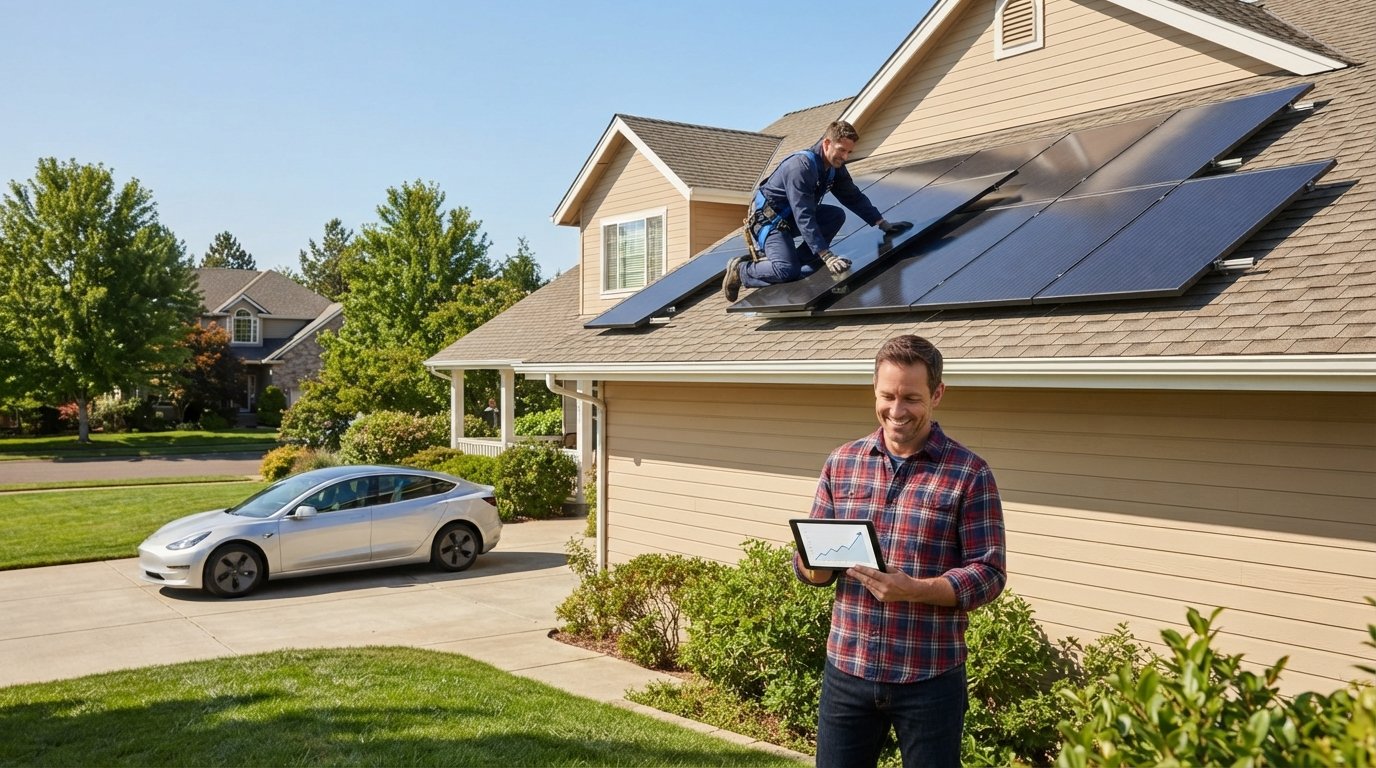
Renewable Energy 2026: Solar Savings for Homeowners
Discover how renewable energy slashes your utility bills and boosts home value with solar incentives and AI optimization.

By Ryan Brooks
Learn more about Solar Panel Installation and Repair for guides, costs, and what to expect.
Compare Solar Panel Installation and Repair Pros Near You

Enter your ZIP code to compare top-rated local professionals and request free quotes.
The push for renewable energy has moved from environmental idealism to a practical, financial decision for millions of American households. With electricity rates climbing and the cost of solar panels dropping by more than 50% over the past decade, the question is no longer if you should consider clean power, but how quickly you can start saving. For most homeowners, the smartest entry point into this revolution is solar energy, and the timing has never been better. This guide walks you through the real-world benefits, the financial landscape for 2026, and the exact steps to make the switch without the guesswork.
Why Renewable Energy Is a Smarter Financial Move Than Ever
Every month, the average American household spends over $130 on electricity, a figure that continues to rise with inflation and extreme weather driving up demand. By generating your own power, you are not just hedging against these increases, you are actively flipping the script. Solar panels turn your roof into a mini power plant, and with net metering policies in many states, you can sell excess energy back to the grid, effectively getting paid by your utility company.
Consider the long-term math. A typical 7 kW residential system costs between $15,000 and $25,000 before incentives. After the federal tax credit and state rebates, the net price often drops below $12,000. With average energy savings of $1,200 to $1,500 per year, the payback period usually lands between seven and nine years. Given that solar panels have a lifespan of 25 to 30 years, that leaves you with nearly two decades of nearly free electricity. This is not just a trend, it is a retirement plan for your energy budget.
Moreover, renewable energy adoption directly increases your property value. Studies from the National Renewable Energy Laboratory show that homes with solar panels sell for 4.1% more on average than comparable homes without them. In competitive markets like Phoenix and Austin, that premium can cover the entire cost of the system. So you are not just saving monthly, you are building equity in an asset you already own.
Key Benefits of Switching to Solar Power in 2026
Beyond the obvious bill reduction, solar energy offers a suite of advantages that make it a uniquely attractive investment this year. The combination of federal incentives, advanced technology, and rising utility rates has created a perfect storm for early adopters. Here are the standout benefits you can expect:
- Immediate utility bill reduction: Most homeowners see a 40% to 70% drop in their monthly electricity costs from the first month of operation.
- Protection against rate hikes: Lock in a fixed cost per kilowatt-hour for decades, insulating you from annual utility price increases that have averaged 4.2% over the last ten years.
- Increased home resale value: A solar array is a visible, transferable asset that makes your home more attractive to eco-conscious buyers.
- Energy independence: With the addition of a battery system, you can keep your lights on during grid outages and reduce your reliance on centralized power plants.
These benefits are not just theoretical. In states like California and Massachusetts, homeowners with solar plus storage are already achieving 90% energy self-sufficiency, meaning they only draw power from the grid when absolutely necessary. The key is to design a system that matches your specific consumption patterns, which is where professional guidance becomes invaluable.
How to Maximize Savings with Solar Incentives
The financial case for solar becomes even stronger when you layer on the available incentives. The federal Investment Tax Credit (ITC) remains the single biggest lever, and in 2026, it still covers 30% of your total system cost with no upper limit. This credit is applied directly to your federal tax liability, and any unused portion rolls over to future years, so you will not lose it. To benefit, you simply need to own your system, either through a cash purchase or a solar loan.
Many states add their own sweeteners. For example, Arizona offers a 25% state tax credit on the first $2,000 of qualified expenses, while New York provides a 25% credit up to $5,000. Additionally, dozens of utilities offer performance-based incentives, paying you per kilowatt-hour your system produces for the first five years. To sort through the options in your area, SolarEnergy.ai provides an up-to-date Incentives & Rebates Guide that is updated quarterly to reflect policy changes.
What about net metering? This policy, available in 38 states, credits you at the retail rate for any surplus energy you send to the grid. During sunny months, you accumulate credits that offset your usage during winter or at night. Combined with the ITC, net metering can slash your effective payback period to under six years in high-sun states. Always verify the current net metering rules with your local utility, as some states are transitioning to lower compensation rates for new solar customers.
Step-by-Step Guide to Installing Solar Panels
Going solar involves several moving parts, but breaking it down into clear steps removes the overwhelm. Here is a proven path from initial assessment to flipping the switch:
- Calculate your energy needs: Review your last 12 months of utility bills to find your average monthly and annual kilowatt-hour usage. This is the baseline for sizing your system.
- Get a professional site assessment: A solar installer will inspect your roof’s condition, orientation, tilt, and shading to determine the optimal panel placement and system capacity.
- Compare quotes from vetted installers: Obtain at least three detailed bids that include equipment brands, warranty terms, and total cost. Use a platform like SolarEnergy.ai to connect with pre-screened local professionals who offer free consultations.
- Secure financing or purchase: Choose between a cash purchase, a solar loan, or a lease/power purchase agreement. Cash and loans give you full ownership and access to all incentives, while leases offer little to no upfront cost but lower long-term savings.
- Handle permits and paperwork: Your installer will manage the necessary permits, interconnection agreements with your utility, and incentive applications. Make sure they provide a clear timeline for each step.
- Schedule installation and inspection: A typical rooftop installation takes one to three days. After that, a local inspector and your utility must approve the system before you can turn it on.
Throughout this process, the biggest mistake homeowners make is skipping the quote comparison. Prices for identical system sizes can vary by 20% or more between installers, so taking the time to evaluate bids can save you thousands. Additionally, do not overlook the importance of warranty coverage. A solid panel warranty should last 25 years, and a workmanship warranty should cover at least 10 years.
The Role of AI in Optimizing Renewable Energy Use
Once your solar panels are live, the journey to maximum savings continues with smart energy management. Artificial intelligence (AI) is now playing a pivotal role in how homeowners monitor and control their energy consumption. AI-driven systems learn your daily routines, weather patterns, and electricity pricing to automatically adjust when you charge your battery, run heavy appliances, or sell power back to the grid. For example, an AI system might delay your dishwasher cycle until solar production peaks or shift battery charging to off-peak hours when rates are lowest.
These tools are not just for tech enthusiasts. They deliver measurable results. Homeowners using AI energy management systems report an additional 15% to 25% reduction in their overall energy bills, on top of what solar alone achieves. This is particularly valuable if you have a time-of-use rate plan, where the cost of electricity varies by hour. By automating decisions, AI ensures you are always using the cheapest available power, whether that comes from your panels, your battery, or the grid.
For those interested in the technical side, our guide on AI renewable energy for smarter homes explains how machine learning algorithms forecast your energy needs with 95% accuracy. This allows for precise battery sizing and reduces wasted energy, making your entire system more efficient. You can also explore AI renewable energy solutions for home solar costs, which breaks down how these tools directly impact your return on investment.
Overcoming Common Challenges with Solar Adoption
Despite the clear benefits, many homeowners hesitate due to common misconceptions. Some worry that solar panels will not work on cloudy days, but modern panels still generate 25% to 40% of their rated capacity under overcast skies. Others are concerned about the aesthetics, yet today’s sleek, low-profile panels are designed to blend with your roofline and can even increase curb appeal. The most significant hurdle, however, is usually the upfront cost.
If you cannot afford the full price of a system, you still have viable options. Solar loans allow you to finance the entire system with low monthly payments, often less than your current utility bill, meaning you start saving from day one. For example, with a 0% down, 20-year loan at 4.9% APR, your monthly payment might be $80, while your energy savings are $120, putting $40 back in your pocket each month. Additionally, some states offer property-assessed clean energy (PACE) financing, where the loan is tied to your property and repaid through property taxes, making it easy to transfer to the next owner if you move.
Another common worry is the maintenance burden. Fortunately, solar panels require minimal upkeep. Rain naturally washes away most dirt, and an annual inspection from a qualified technician is usually enough to keep your system running at peak efficiency. Many installers also offer monitoring services that alert you to any performance issues, so problems are caught early. For those interested in broader energy upgrades, pairing your solar installation with an energy survey and electrical security system upgrade can further enhance your home’s efficiency and safety.
How to Choose the Right Solar Installer
Your choice of installer is the single most important factor in the long-term performance of your solar system. A poorly installed system can lead to leaks, reduced output, and voided warranties. Therefore, you need to do your due diligence. Start by verifying that the company is licensed and insured in your state, and check their Better Business Bureau rating. Look for installers who have been in business for at least five years and have a track record of successful installations in your area.
When evaluating bids, pay attention to the equipment specifications. High-efficiency panels like monocrystalline silicon offer the best performance per square foot, while polycrystalline panels are cheaper but slightly less efficient. Similarly, choose a reputable inverter brand, such as SolarEdge or Enphase, as the inverter is the component most likely to fail. Ask about the warranty on both the panels and the inverter, and ensure that the installer provides a workmanship warranty that covers labor for at least 10 years. A trustworthy installer will also help you navigate the paperwork for permits and incentives, so you do not have to deal with the bureaucracy alone.
Finally, do not be afraid to ask for references and speak with past customers. A reliable installer will happily connect you with homeowners who have had their system for a few years, giving you insight into the installation process and the company’s after-sales support. Platforms like SolarEnergy.ai simplify this process by connecting you with pre-vetted professionals who have passed background checks and quality reviews, saving you hours of research.
Frequently Asked Questions About Solar Energy
How much does a solar panel system cost in 2026?
The average cost of a residential solar system in the U.S. is between $2.50 and $3.50 per watt before incentives. For a 6 kW system, that translates to $15,000 to $21,000. After the 30% federal tax credit, the net cost drops to $10,500 to $14,700. State and local incentives can further reduce this by 10% to 25%, depending on where you live. Our Solar Panel Cost Guide provides a state-by-state breakdown to help you budget accurately.
Will solar panels work during a power outage?
Standard grid-tied solar systems automatically shut off during an outage to protect utility workers. However, if you have a solar battery system with islanding capability, you can continue to power essential appliances during an outage. Batteries also allow you to store excess energy for use at night, maximizing your self-consumption and further reducing grid reliance.
What is the lifespan of a solar panel system?
Most solar panels come with a 25-year performance warranty that guarantees they will still produce at least 80% of their original output. In practice, many panels continue to work well beyond 30 years. Inverters typically last 10 to 15 years and may need replacement once during the system’s lifetime. With proper maintenance, your system can provide clean energy for three decades or more.
If you are ready to explore your options, start by using a solar savings calculator to get an instant estimate of your potential savings. Then, connect with local installers to get personalized quotes. The journey to renewable energy is a smart investment in your home, your finances, and the planet. With the right guidance, you can make the switch with confidence and enjoy the benefits for decades to come.
Learn more about Solar Panel Installation and Repair for guides, costs, and what to expect.
Compare Solar Panel Installation and Repair Pros Near You
Enter your ZIP code to compare top-rated local professionals and request free quotes.