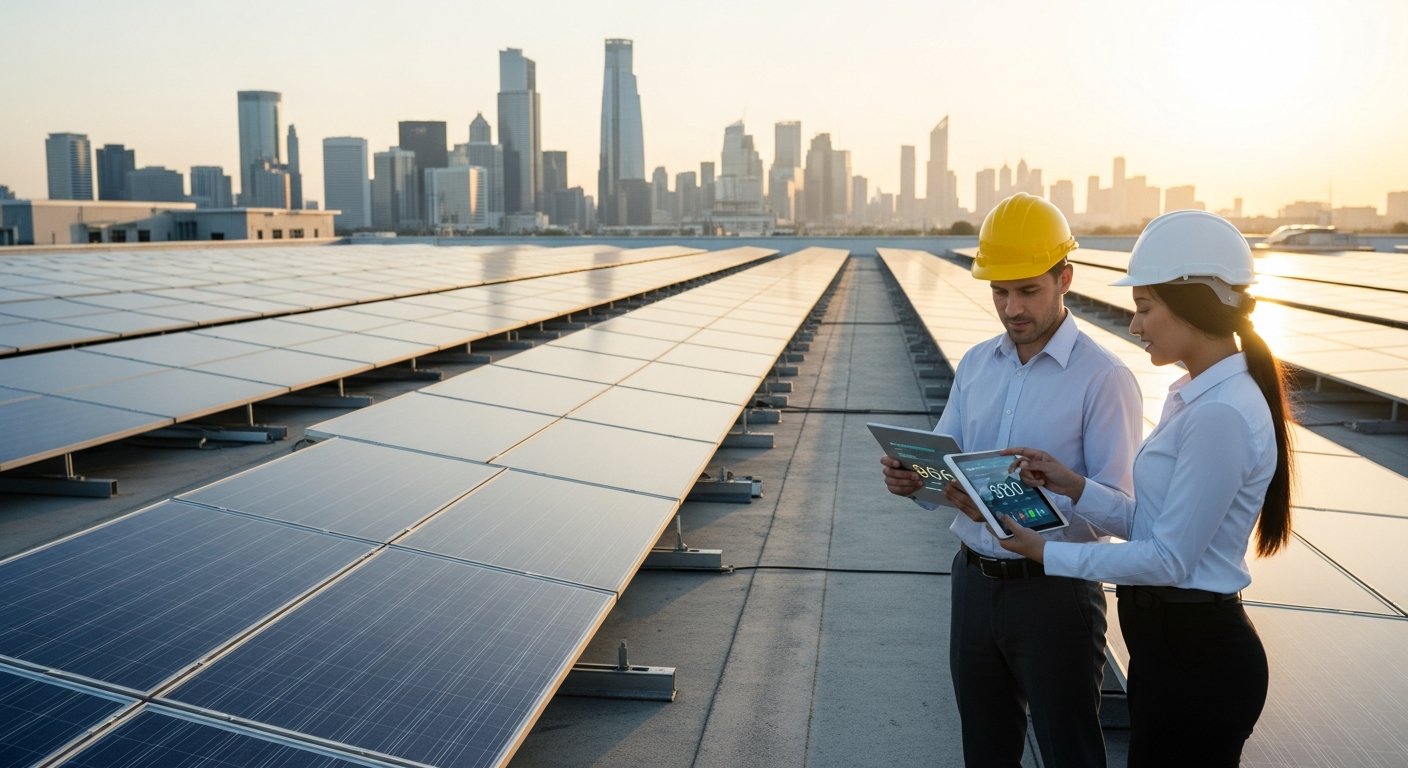
Commercial Renewable Energy: Cut Costs and Carbon
Discover how commercial renewable energy can slash operating costs, lock in predictable rates, and strengthen your brand.

By Owen Phillips
Learn more about Solar Panel Installation and Repair for guides, costs, and what to expect.
Compare Solar Panel Installation and Repair Pros Near You

Enter your ZIP code to compare top-rated local professionals and request free quotes.
For business owners, energy bills often rank among the highest operating expenses, and the pressure to reduce carbon footprints grows with every new regulation and customer expectation. Commercial renewable energy offers a way to tackle both challenges at once, transforming a fixed cost into a strategic advantage. While the upfront investment can seem substantial, the long-term savings, tax incentives, and operational resilience are driving a rapid shift across industries. This article explores how your business can navigate the shift to clean power, avoid common pitfalls, and maximize the financial and environmental returns.
Why Businesses Are Switching to Renewable Energy
The business case for renewable energy has never been stronger. Solar and wind costs have dropped dramatically over the last decade, while utility rates continue to rise in many regions. For commercial operations with high daytime electricity use, solar arrays often generate payback periods of five to seven years, followed by decades of nearly free power. Beyond simple economics, corporations face mounting pressure from investors, employees, and customers to demonstrate genuine sustainability commitments. Renewable energy procurement is one of the most visible and measurable actions a company can take.
Energy independence is another powerful motivator. Relying solely on the grid leaves your business vulnerable to price spikes, outages, and supply disruptions. By generating your own power, you gain predictability in budgeting and protect critical operations during emergencies. This resilience has become essential in areas prone to extreme weather or grid instability. Furthermore, governments at the federal, state, and local levels offer a complex web of incentives, including the Investment Tax Credit (ITC), accelerated depreciation, and various rebates, which can offset 30% to 50% of installation costs. Combined with rising utility rates, these incentives make the financial case compelling.
Key Options for Commercial Renewable Energy
Choosing the right renewable technology depends on your site's characteristics, energy load profile, and budget. Solar photovoltaic (PV) systems are the most common choice for commercial properties because they are scalable, low-maintenance, and highly predictable. Wind turbines may suit rural or industrial sites with strong, consistent wind resources, though they require more space and permitting. Biomass and geothermal systems offer baseload power or heating/cooling but are often site-specific. For many businesses, a hybrid approach that combines solar with battery storage provides the best balance of cost savings and reliability.
When evaluating options, consider these critical factors:
- Site assessment: Evaluate roof orientation, shading, structural integrity, and available land for ground-mounted systems.
- Energy consumption patterns: Analyze your load profile to size the system correctly and maximize self-consumption.
- Financial structure: Compare direct ownership, power purchase agreements (PPAs), and leases to find the best fit for your cash flow and tax position.
- Regulatory environment: Review local zoning laws, interconnection standards, and net metering policies that affect system viability.
Each option has distinct trade-offs. A PPA allows you to adopt solar with zero upfront costs, but you forgo some long-term savings. Direct ownership maximizes return on investment but requires capital and ongoing maintenance. Battery storage adds resilience but increases initial costs. A professional energy consultant can help you model these variables and identify the optimal configuration for your specific situation.
Financing Your Commercial Solar Project
Financing is often the biggest barrier for businesses, but multiple structures make solar accessible. Cash purchases deliver the highest long-term return, yet they tie up capital that might be needed elsewhere. Solar loans, whether secured or unsecured, spread costs over time while allowing you to own the system and capture incentives. Power purchase agreements (PPAs) and leases require little to no upfront investment; a third-party developer owns the system, and you buy the electricity at a predictable rate, often lower than the utility's. For businesses with significant tax liability, a PPA can also be advantageous because the developer monetizes the tax credits that your organization might not be able to use fully.
Another emerging trend is the use of green bonds and sustainability-linked loans, which offer favorable terms for projects that meet environmental criteria. Additionally, the federal Investment Tax Credit (ITC) currently provides a 30% credit for systems placed in service by 2032, and it can be stacked with state and local incentives. To navigate this complex landscape, consult with a financial advisor who specializes in renewable energy. They can help you model different scenarios, assess risk, and secure the most cost-effective structure for your business.
Overcoming Common Implementation Challenges
Even with strong financials, commercial renewable projects can face hurdles. Interconnection delays with local utilities are a frequent bottleneck, sometimes taking months or even years. To mitigate this, engage with your utility early, submit complete documentation, and consider hiring an experienced project manager who can expedite the process. Permitting challenges also vary widely by jurisdiction; your team must understand local codes and zoning requirements before construction begins.
Operational challenges include system maintenance and performance monitoring. Solar panels are durable and require minimal upkeep, but regular cleaning and annual inspections are necessary to maintain efficiency. Inverter failures are the most common issue; proactive monitoring can detect problems before they affect output. For businesses with battery storage, safety protocols and thermal management are critical. Finally, employee engagement and community relations matter. Communicate the project's benefits transparently, and involve stakeholders early to build support and avoid misinformation.
How to Start Your Commercial Renewable Energy Project
Starting a successful renewable energy project requires a systematic approach. First, conduct a comprehensive energy audit to establish a baseline and identify inefficiencies. Reducing energy waste before adding generation lowers the required system size and improves ROI. Next, evaluate your site's renewable potential using tools like solar maps or wind resource assessments. Then, assemble a qualified team, including engineers, contractors, and legal advisors who have experience with commercial installations.
After feasibility studies are complete, secure financing and permits simultaneously to avoid delays. Once construction begins, maintain clear communication with all parties and schedule regular inspections. After commissioning, set up a monitoring system to track performance and address issues proactively. Finally, document your achievements and communicate them to stakeholders, as this transparency builds trust and strengthens your brand's sustainability story. For a deeper look at how to choose the right system for your home or business, see our renewable energy guide for solar selection.
Measuring the Success of Your Investment
Key performance indicators (KPIs) for commercial renewable projects include energy production, capacity factor, avoided carbon emissions, and financial metrics like payback period and internal rate of return (IRR). Track these against your original projections to ensure the system performs as expected. Regularly review utility bills to verify that savings are being realized and that net metering credits are applied correctly. If performance lags, investigate causes such as soiling, shading, or equipment faults.
Beyond direct savings, consider the indirect benefits: enhanced brand reputation, increased property value, and improved employee morale. Many businesses also qualify for green certifications like LEED or B Corp, which can open doors to new markets and customers. By quantifying these benefits, you can build a compelling case for future sustainability investments. As technology evolves, your system can also integrate with smart energy management tools. In our article on AI renewable energy for homeowners, we discuss how artificial intelligence optimizes solar use, a concept equally applicable to commercial settings.
The Role of Smart Technology and AI
Modern commercial renewable projects increasingly incorporate smart inverters, battery management systems, and AI-driven energy optimization software. These technologies dynamically adjust energy consumption based on real-time prices, weather forecasts, and grid conditions, maximizing savings and reducing strain on the grid. For example, an AI system can shift heavy loads to periods of peak solar generation, charge batteries when electricity is cheapest, and even sell excess power back to the grid during high-demand events. This level of intelligence transforms a passive asset into an active revenue generator.
AI also enhances predictive maintenance. By analyzing performance data, algorithms can detect anomalies that indicate equipment failure, allowing you to address issues before they escalate. This reduces downtime and extends the lifespan of your investment. Furthermore, smart energy management platforms provide granular visibility into your energy usage, enabling continuous optimization and helping you meet sustainability reporting requirements. As these technologies mature, they become more accessible and affordable, making them a wise addition to any new commercial renewable project.
Future Trends in Commercial Renewable Energy
The commercial renewable energy landscape is evolving rapidly. Battery storage costs are declining, making solar-plus-storage the new standard for resilience and peak shaving. Community solar programs allow businesses without suitable roofs to subscribe to off-site solar farms and receive credits on their utility bills. Green hydrogen, produced from renewable electricity, is emerging as a viable fuel for heavy industry and transportation, offering a path to decarbonize sectors that are hard to electrify directly.
Microgrids are gaining traction as a way to enhance energy security. These localized grids can operate independently from the main utility, providing power during outages and reducing demand charges. They often combine solar, storage, and backup generators, controlled by intelligent software that optimizes energy flows. Additionally, regulatory changes are promoting more flexible interconnection and market participation, allowing commercial producers to sell ancillary services to the grid. Staying informed about these trends will help your business capitalize on new opportunities and maintain a competitive edge. For more insights on AI-driven approaches to reducing solar costs, visit our AI renewable energy solutions page.
Commercial renewable energy is not just an environmental choice; it is a strategic business decision that enhances profitability, resilience, and reputation. By carefully evaluating your options, securing the right financing, and leveraging smart technology, you can turn energy expenses into a source of long-term value. The journey requires diligence, but the rewards are substantial. Start with a professional energy audit, consult with experts, and take the first step toward a cleaner, more prosperous future for your business.