AI Renewable Energy: Smarter Solar for Homeowners
AI renewable energy transforms home solar with smarter storage and usage, cutting bills by up to 30% and boosting ROI.

By Owen Phillips
Learn more about Solar Panel Installation and Repair for guides, costs, and what to expect.
Compare Solar Panel Installation and Repair Pros Near You

Enter your ZIP code to compare top-rated local professionals and request free quotes.
The sun delivers more energy to Earth in one hour than humanity consumes in an entire year. Yet for decades, homeowners have struggled to harness that abundance efficiently. Solar panels sit on rooftops, generating power when the sun shines, but they often produce too little when you need it most and too much when you do not. This mismatch has historically limited the financial and environmental payoff of going solar. Now, artificial intelligence is changing that equation. By applying machine learning to energy production, consumption, and storage, AI renewable energy systems are turning static solar arrays into dynamic, self-optimizing power plants.
For homeowners, this means more than just lower bills. It means predictable energy costs, greater independence from the grid, and a faster return on your solar investment. In fact, the smartest systems can automatically shift your energy usage to times when your panels generate the most power, sell excess energy back to the utility at the best rates, and even predict maintenance needs before a failure occurs. This article explores how AI renewable energy is reshaping residential solar, what it costs, and how you can start benefiting from it today.
How AI Renewable Energy Works in a Home Solar System
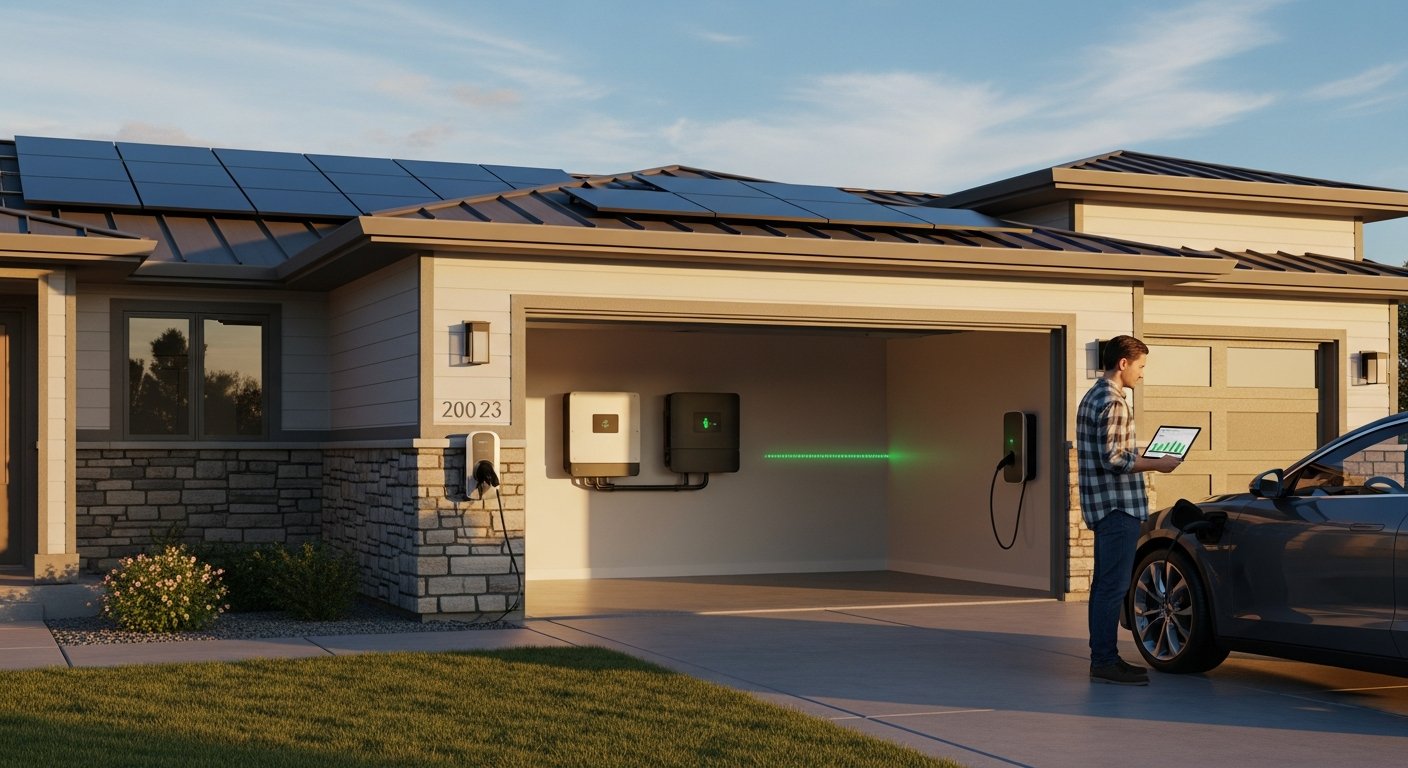
At its core, AI renewable energy is about using data to make better decisions. A typical home solar setup with AI includes smart inverters, connected batteries, and a central energy management platform that collects data from your panels, your home's appliances, your utility's rate schedule, and local weather forecasts. The AI analyzes this data in real time, then automatically adjusts how your system operates.
For example, on a cloudy morning, the AI might delay running your dishwasher or charging your EV until the afternoon, when solar production peaks. It can also decide when to charge your home battery: during the cheapest off-peak hours, when your panels produce a surplus, or right before a predicted storm. Some advanced systems even participate in grid demand response programs, where your utility pays you to reduce consumption during peak events. The result is a home that actively manages its energy, rather than passively receiving it.
Key Components of an AI-Driven Solar Setup
To understand how this works in practice, it helps to know the main parts of an AI-enabled solar system:
- Smart Inverter: Converts DC power from panels into AC power for your home, while communicating with the AI to optimize voltage and frequency.
- Energy Storage (Battery): Stores excess solar power for use at night or during outages; the AI manages charge and discharge cycles to maximize battery life and savings.
- Energy Management System (EMS): The AI brain that collects data from sensors, weather APIs, and your utility, then issues commands to your devices.
- Connected Appliances and EV Charger: Smart plugs, thermostats, and EV chargers that can be remotely controlled by the AI to shift usage to optimal times.
These components work together seamlessly, but the real intelligence lies in the software. The AI continuously learns your household's routines, preferences, and energy patterns, then refines its strategies over time. The more you use the system, the smarter it becomes, and the more you save.
The Financial Payoff: Cutting Costs and Boosting ROI
For most homeowners, the primary motivation for going solar is financial. AI renewable energy amplifies that benefit in several concrete ways. First, it maximizes self-consumption, meaning you use more of the power your panels generate instead of buying from the grid. Since grid electricity rates are typically 2 to 3 times higher than the levelized cost of solar, every kilowatt-hour you self-consume is money in your pocket. AI can increase self-consumption rates by 20 to 30 percent compared to a conventional system, according to studies from the National Renewable Energy Laboratory.
Second, AI optimizes time-of-use rates. Many utilities charge higher rates during peak hours (usually late afternoon and evening) and lower rates at night or midday. An AI system can shift your energy-hungry activities to off-peak times, or draw from your battery during peak hours to avoid expensive grid power. Over a year, these shifts can add up to hundreds of dollars in savings. Third, AI can predict maintenance issues early, such as a failing inverter or a dirty panel, allowing you to fix problems before they cause costly downtime or damage.
If you are still evaluating whether solar is worth it, the financial case becomes even stronger with AI. Using a solar savings calculator that factors in AI-optimized consumption can show you a payback period that is 1 to 2 years shorter than a traditional estimate. When you combine those savings with federal tax credits and local incentives, the return on investment becomes compelling. Moreover, AI systems often qualify for additional smart home rebates from utilities, further lowering the net cost.
Integrating AI Renewable Energy with Battery Storage
Battery storage is the natural partner to AI renewable energy. Without a battery, your solar system can only export excess power to the grid, often at wholesale rates that are lower than what you pay for electricity. With a battery, you can store that energy and use it when grid rates are high, or during outages. The challenge is knowing when to charge and discharge to maximize value, and that is exactly where AI excels.
An AI-managed battery can consider multiple factors simultaneously: your real-time solar production, your home's current demand, the utility's rate schedule, weather forecasts, and even your historical usage patterns. It might decide to charge the battery in the morning, discharge it during the evening peak, then recharge overnight at off-peak rates. It learns your habits, such as when you typically run the laundry or charge your EV, and pre-positions energy accordingly. Some systems even use predictive algorithms to anticipate grid outages, ensuring your battery is fully charged before a storm hits.
For homeowners considering off-grid or hybrid systems, AI becomes even more critical. In a fully off-grid setup, the AI must balance generation, storage, and consumption in real time, preventing blackouts while extending battery lifespan. SolarEnergy.ai offers expert guidance on such systems, and our AI renewable energy solutions page provides a detailed overview of how these technologies integrate with home solar installations.
How to Start Using AI Renewable Energy in Your Home
Transitioning to an AI-enabled solar setup does not require rebuilding your entire system. Many existing solar owners can add AI capabilities by upgrading their inverter, installing a smart energy monitor, or subscribing to an AI energy management service. If you are starting from scratch, you can design a system with AI from the ground up, ensuring compatibility and maximum efficiency. Here is a practical roadmap:
- Audit your energy usage: Review a year of utility bills to understand your consumption patterns, peak demand, and rate structure. This data will inform your system size and AI settings.
- Get a professional energy survey: A professional can assess your roof's solar potential, shading, and structural integrity. SolarEnergy.ai offers energy surveys that combine site inspection with AI modeling to predict system performance.
- Choose AI-compatible equipment: Select a smart inverter (such as those from Enphase, SolarEdge, or Tesla) and a storage system that supports AI communication. Ensure your EMS can talk to your smart appliances.
- Install and configure the AI: Have a certified installer set up your system and connect it to the AI platform. Configure your preferences, such as your electricity rate plan and backup priorities.
- Monitor and adjust: Review your system's performance monthly through the app. The AI will suggest optimizations, but you can also adjust settings manually if your lifestyle changes.
Throughout this process, working with an experienced provider is essential. SolarEnergy.ai's team can help you select the right components, estimate your savings with our AI-powered solar cost optimization tools, and connect you with trusted local installers. We also offer project management services to ensure the installation is seamless and code-compliant.
Real-World Benefits: What Homeowners Report
The proof of AI renewable energy lies in real-world performance. Homeowners who adopt AI-driven systems often report three major benefits: reduced energy bills, fewer outage disruptions, and peace of mind. For example, a family in Arizona with a 10 kW solar array and a 13.5 kWh battery saw their annual electricity bill drop from $2,400 to $400 after installing an AI energy management system. The AI automatically shifted their pool pump and EV charging to off-peak hours, and it used stored solar power during the expensive 4 to 9 PM peak period.
In Texas, a homeowner with a similar setup used AI to participate in a demand response program, earning $300 per year just for allowing the utility to adjust their thermostat and battery during extreme heat events. The AI ensured the home stayed comfortable while still contributing to grid stability. These examples illustrate how AI renewable energy is not a futuristic concept, but a practical tool that delivers measurable results today.
Beyond financial savings, AI systems also extend the lifespan of your equipment. By optimizing charge cycles, avoiding deep discharges, and reducing thermal stress on batteries, AI can add years to their useful life. This reduces the total cost of ownership and the environmental impact of manufacturing replacements. For a deeper dive into how AI optimizes off-grid systems, our guide on AI solar energy for off-grid systems offers expert insights and case studies.
Overcoming Common Misconceptions
Despite the clear advantages, some homeowners hesitate to embrace AI renewable energy due to misconceptions. One common myth is that AI systems are too complex for the average homeowner. In reality, modern AI platforms are designed with user-friendly interfaces, often requiring no more than a smartphone app to monitor and adjust. The AI does the heavy lifting, while you simply set your preferences and let it work.
Another misconception is that AI is expensive. While the upfront cost of a smart inverter or AI-enabled battery is slightly higher than conventional equipment, the additional savings typically recoup that cost within 2 to 3 years. Federal and state incentives, plus utility rebates, can further reduce the net cost. Moreover, as AI technology becomes standard, prices are falling. A survey by Wood Mackenzie found that smart inverters now cost only 5 to 10 percent more than traditional ones, making the upgrade accessible to most solar buyers.
Finally, some worry about data privacy and security. Reputable AI energy platforms encrypt your data and comply with privacy regulations, such as the California Consumer Privacy Act. You control what data is shared and can opt out of grid services if you prefer. SolarEnergy.ai prioritizes data security in all our recommendations, so you can trust that your home's energy data remains protected.
Future Trends: What's Next for AI in Solar
The integration of AI into renewable energy is still in its early stages, and the pace of innovation is accelerating. In the near future, we can expect AI systems to coordinate entire neighborhoods of solar homes, creating virtual power plants that can sell energy to the grid at premium rates. Machine learning will improve weather forecasting even further, allowing systems to predict solar output with hourly accuracy. Battery technology will evolve, with AI managing solid-state batteries that have higher capacity and faster charging.
Another exciting trend is the use of AI in solar panel design and installation. AI algorithms can optimize panel placement and wiring to maximize output, even on complex roofs. They can also detect micro-cracks and other defects during manufacturing, reducing failure rates. For homeowners, this means solar systems that are more reliable and efficient from day one. As these technologies mature, the cost of AI renewable energy will continue to drop, making it the default choice for new solar installations.
If you are ready to take advantage of these advances, the time to act is now. Whether you are a first-time solar buyer or looking to upgrade an existing system, SolarEnergy.ai provides the expertise and resources to guide you. Our team can help you design an AI-optimized solar solution that meets your energy goals and budget.
In summary, AI renewable energy is transforming how homeowners produce, store, and consume electricity. By leveraging data and automation, AI systems increase self-consumption, lower bills, enhance resilience, and extend equipment life. The financial and environmental benefits are clear, and the technology is more accessible than ever. With the right partner, you can unlock the full potential of your solar investment and enjoy a smarter, more sustainable home.
Learn more about Solar Panel Installation and Repair for guides, costs, and what to expect.
Compare Solar Panel Installation and Repair Pros Near You
Enter your ZIP code to compare top-rated local professionals and request free quotes.