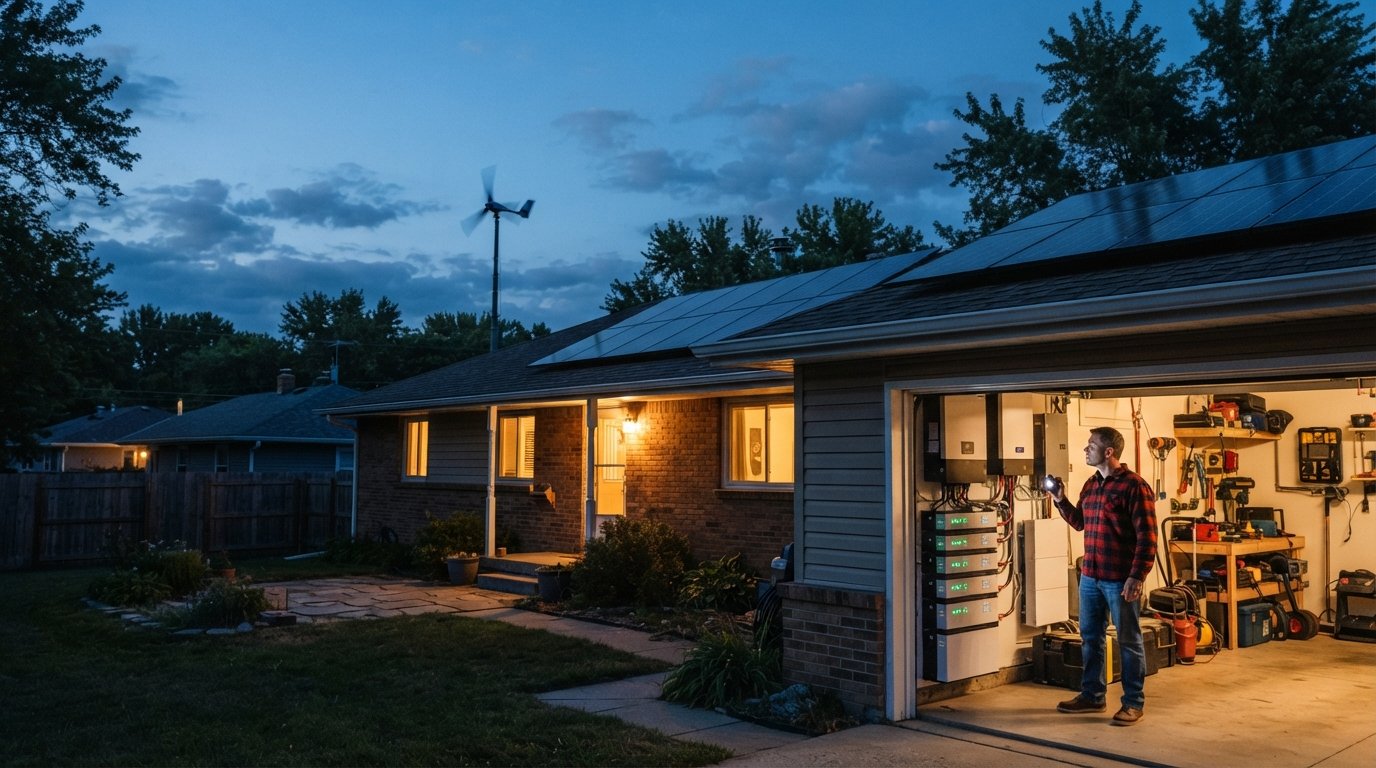
Solar Plus Wind Hybrid System for Residential Backup: 2026 Guide
A solar plus wind hybrid system for residential backup can keep essential loads running through winter storms and overnight outages. Call (833)-434-4023 to plan your system.

By Ryan Brooks
Learn more about Solar Panel Installation and Repair for guides, costs, and what to expect.
Compare Solar Panel Installation and Repair Pros Near You

Enter your ZIP code to compare top-rated local professionals and request free quotes.
When the grid goes down, most solar-only backup systems have a predictable weakness: they produce nothing after sunset and very little during stormy winter weather. A solar plus wind hybrid system for residential backup addresses that gap by pairing photovoltaic panels with a small wind turbine, so your home can generate power around the clock and across seasons. The concept is simple, but the engineering, permitting, and economics require careful planning. This guide walks through how the two resources complement each other, how to size a turbine and battery bank, what zoning rules to expect, and whether the investment beats simply adding more panels and batteries.
How Solar and Wind Profiles Complement Each Other Seasonally
Solar and wind resources follow opposite daily and seasonal patterns in most of the United States. Solar output peaks in summer and on clear afternoons, while wind often blows strongest at night, during frontal passages, and in winter months. That natural counter-cyclical behavior is the core argument for a hybrid system: when one resource is weak, the other frequently fills the gap.
Consider a homeowner in the Midwest. In July, a 6 kW solar array might produce 30 kWh on a sunny day, easily covering daytime air conditioning loads. But after 8 p.m., output drops to zero just as the battery begins discharging. A small 1.5 kW wind turbine with a 12 mph average wind speed could contribute 5 to 10 kWh over the same 24-hour period, much of it overnight. In January, solar production might fall to 10 kWh per day, but the turbine often performs at its rated capacity during winter gales. The combination smooths the annual energy curve and reduces the depth of battery discharge.
This complementarity is not universal. Some regions have strong summer wind and weak winter sun, while others have calm winters and abundant solar. Before committing, review at least one year of local wind speed data (from a nearby airport or university weather station) alongside your solar production estimates. If your site averages below 8 mph, a turbine likely will not justify its cost, and you should focus on a larger solar array and battery bank instead.
Sizing Residential Turbine Capacity and Battery Integration
Sizing a hybrid system starts with your critical load profile, not with equipment catalogs. Identify which circuits must stay powered during an outage: refrigeration, well pump, heating or cooling, medical devices, internet, and a few lights. Add up their continuous and surge wattage, then estimate daily energy use in kilowatt-hours. A typical backup panel might draw 8 to 15 kWh per day.
Next, size the wind turbine. Residential turbines range from 400 W to 10 kW, but most suburban lots can support only 1 to 3 kW due to height and setback limits. A 2 kW turbine rated at 25 mph will produce far less at average wind speeds; expect 10 to 20 percent of rated capacity as a realistic annual average. In a 12 mph wind regime, a 2 kW unit might generate 3 to 5 kWh per day. Pair that with a solar array sized to cover the remaining load and a battery bank sized for two to three days of autonomy.
Battery integration requires an inverter that can accept multiple DC inputs or a hybrid inverter with separate solar and wind charge controllers. Wind turbines produce wild, fluctuating voltage, so a dedicated charge controller with dump-load capability is essential to prevent overcharging. Most homeowners choose lithium iron phosphate (LiFePO4) batteries for their depth of discharge and cycle life, but lead-carbon batteries remain a lower-cost option if space and maintenance are not constraints.
For a deeper look at how solar pairs with other home energy loads, see our guide on solar plus EV charging setup and cost, which explains how to plan a system that supports both backup and transportation needs.
Zoning, Height Limits, and Noise Concerns for Residential Turbines
Wind turbines face far more regulatory friction than solar panels. Most municipalities regulate small wind systems through zoning ordinances that specify minimum lot size, maximum tower height, setback distances from property lines, and sound limits. A common rule allows a tower height of up to 80 feet on lots of one acre or more, with setbacks equal to the tower height plus the rotor radius. Historic districts and homeowner associations may impose stricter limits or ban turbines outright.
Noise is the second major hurdle. Modern small turbines are much quieter than older models, but they still produce aerodynamic swish and mechanical hum. Manufacturers typically rate sound at 45 to 55 dBA at 100 feet, which is comparable to a quiet conversation. However, low-frequency noise and vibration can travel farther than expected, and some neighbors are sensitive. Setbacks and tower height help: a taller tower lifts the rotor into smoother, stronger wind, reducing the turbulent thumping that causes most complaints.
Before purchasing, take these steps:
- Request the zoning ordinance and any HOA covenants in writing, and confirm the allowable tower height and setback.
- Schedule a pre-application meeting with your local building department to review structural and electrical permit requirements.
- Talk with neighbors early, and share manufacturer sound data and the proposed tower location.
- Hire a certified installer who has completed small wind projects in your state, as structural engineering and grid interconnection paperwork are often more complex than for solar.
If your lot cannot accommodate a tower, a roof-mounted turbine is rarely a good substitute: roof turbulence reduces output and transmits vibration into the structure. In that case, invest in additional solar and battery capacity instead.
Cost, Maintenance, and Payback Trade-Offs Versus More Solar and Batteries
A solar plus wind hybrid system for residential backup carries a higher upfront cost and more maintenance than a solar-only system. Installed costs for a small wind turbine typically range from $4,000 to $8,000 per kW, compared with $2,500 to $3,500 per kW for solar. A 2 kW turbine might cost $10,000 to $15,000 installed, including tower, wiring, charge controller, and permits. Battery costs add another $8,000 to $15,000 for a 10 to 15 kWh lithium bank.
Maintenance is the hidden variable. Solar arrays need occasional cleaning and inverter checks, but turbines have moving parts: bearings, blades, slip rings, and yaw mechanisms. Plan on an annual inspection and minor servicing, plus a major bearing replacement every 5 to 10 years. In harsh climates, icing and lightning strikes add risk. Budget $300 to $600 per year for professional maintenance, or more if you are not comfortable climbing a tower.
Payback analysis depends heavily on your electricity rate, net metering policy, and wind resource. In a state with full retail net metering and a 12 mph average wind speed, a 2 kW turbine might save $400 to $700 per year, implying a 15 to 25 year payback before incentives. By contrast, adding 2 kW of solar in a sunny climate might save $500 to $900 per year at a lower installed cost, with a 10 to 15 year payback. Batteries rarely pay back on energy arbitrage alone; their value lies in resilience and outage protection.
The trade-off is therefore not purely financial. If your goal is maximum backup resilience during winter storms or multi-day outages, the hybrid system can be worth the premium. If your goal is lowest cost per kilowatt-hour, more solar plus a modest battery is usually the better choice. Homeowners exploring financing options and incentive stacking can compare offers from vetted installers through independent resources such as NewSolarQuotes, which provides educational guides and cost calculators for solar, wind, and hydropower.
Finally, check incentives carefully. The federal residential clean energy credit generally applies to both solar and small wind equipment, but state and utility rebates vary widely. Some utilities offer separate wind production incentives, while others exclude wind from net metering. Verify current rules with your state energy office before finalizing a design.
Designing a Resilient Hybrid System: A Practical Framework
A well-designed hybrid system follows a logical sequence: reduce loads, size generation, size storage, then integrate controls. Start by weatherizing and upgrading to efficient appliances, because every watt saved reduces the size of both the turbine and the battery bank. Next, model solar and wind production using local data, and choose a turbine that fills the hours when solar is weakest. Then size the battery for your desired autonomy period, typically two days for essential loads. Finally, select a hybrid inverter and charge controllers that can manage multiple sources without conflict.
Commissioning and monitoring deserve equal attention. Insist on a system that logs production from each source separately, so you can verify performance and catch underperforming components early. A remote monitoring platform also helps your installer diagnose issues without a site visit. After the first year, review the data: if the turbine consistently underperforms, you may need to adjust tower height or accept that the site is marginal for wind.
For homeowners who want a turnkey assessment, professional energy surveys can identify the best tower location, estimate wind shear at different heights, and confirm structural feasibility. Pair that survey with a solar production estimate and a battery sizing analysis to get a complete picture before you commit.
A solar plus wind hybrid system for residential backup is not the right answer for every home, but in windy, storm-prone regions it can deliver resilience that solar alone cannot match. The key is honest site assessment, realistic performance expectations, and a design that prioritizes essential loads over whole-home luxury. If the numbers work for your site, the result is a quieter, more independent home energy system that keeps the lights on when the grid fails.