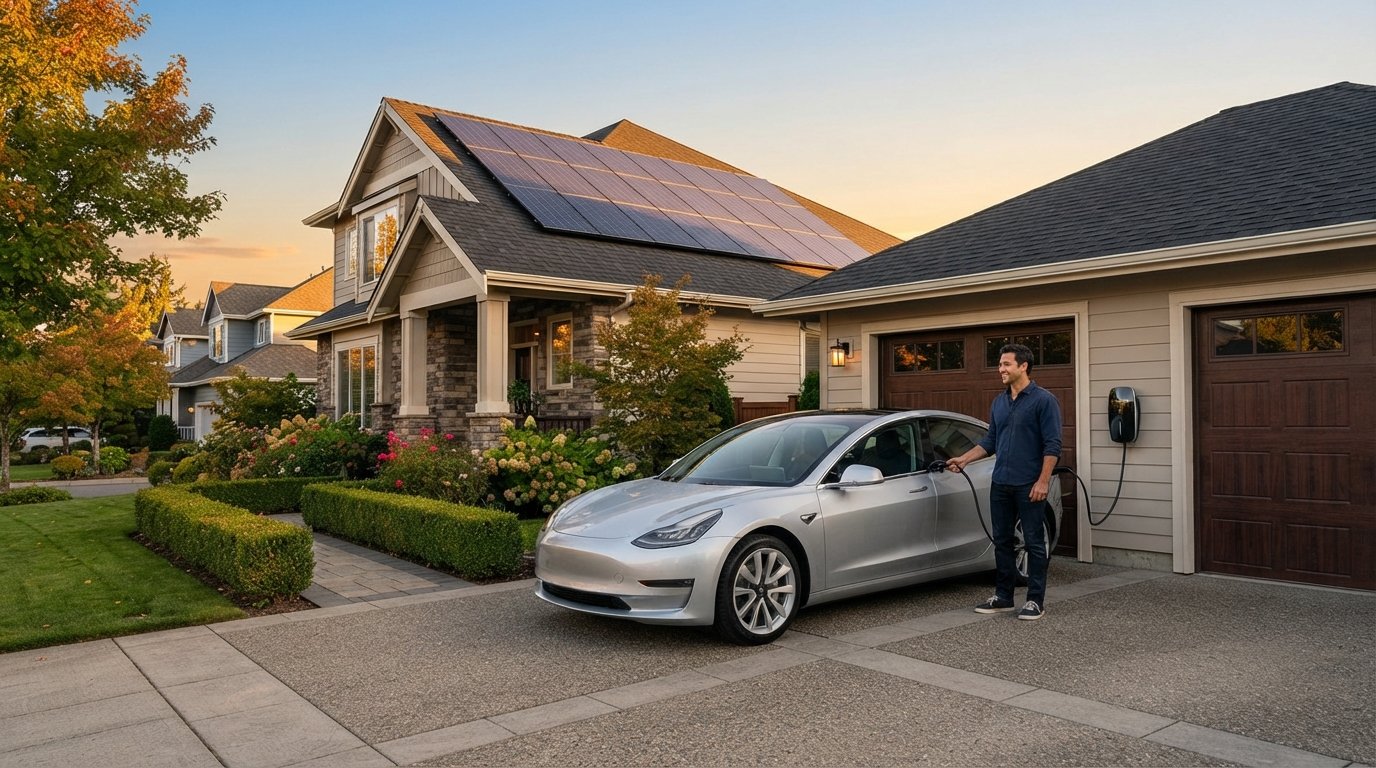
Solar Plus EV Charging Setup and Cost: 2026 Guide
Solar plus EV charging setup and cost explained: size your array, pick a smart charger, and cut fuel bills. Call 8334344023 for guidance.

By Mason Carter
Learn more about Solar Panel Installation and Repair for guides, costs, and what to expect.
Compare Solar Panel Installation and Repair Pros Near You

Enter your ZIP code to compare top-rated local professionals and request free quotes.
Charging an electric vehicle from rooftop solar panels is one of the most satisfying upgrades a homeowner can make. You pull into your driveway, plug in, and the sun that hit your roof earlier that day powers your commute. No gas station, no volatile utility rate spikes, no tailpipe emissions. The appeal is obvious, but the path to getting there involves real decisions about equipment, electrical capacity, and budget. Understanding how solar plus EV charging setup and cost work together before you sign any contract is the difference between a smooth installation and an expensive headache.
Why Pairing Solar With EV Charging Makes Financial Sense
The average American household that owns an EV spends roughly $500 to $800 per year on home charging, depending on local electricity rates and annual mileage. That figure climbs quickly in states with high utility rates, and it grows further if you charge during peak evening hours when utilities charge the most. Solar changes that math entirely. Once your panels cover your driving energy, your fuel cost drops to near zero for the 25 to 30 year life of the system.
There is also a compounding benefit. Adding an EV increases your household electricity consumption, which means you can size a solar system larger and spread fixed installation costs (permits, labor, inverter capacity) across more kilowatt-hours. A bigger system often produces a better cost per watt than a small one, so the EV effectively rides along on an already efficient installation. Homeowners who plan both upgrades together typically save thousands compared to installing solar first and adding EV charging two or three years later.
The environmental case reinforces the financial one. An EV charged from a coal-heavy grid still produces fewer lifetime emissions than a gasoline car, but an EV charged from your own solar array cuts its carbon footprint by roughly 80 to 90 percent. If energy independence is part of your motivation, combining the two technologies is the most direct route to it.
How Solar Plus EV Charging Setup Works
At its simplest, the setup is a solar array, an inverter, a home charging station (often called an EVSE, or electric vehicle supply equipment), and either a battery or a grid connection to bridge the gap between when the sun shines and when you drive. The complexity comes from how those pieces interact and where the electricity flows at any given moment.
During sunny daytime hours, solar production typically exceeds what the house needs. That surplus can charge your EV directly if the car is parked at home, flow into a home battery for later use, or export to the grid in exchange for net metering credits. At night, the car charges from the battery or from the grid, and net metering credits offset the cost. The exact flow depends on your utility rules, your equipment, and your driving schedule.
Three architecture choices dominate residential installations in 2026:
- Solar plus grid-tied EV charging: The lowest upfront cost. The EV charges from solar when possible and from the grid at night, with net metering balancing the books.
- Solar plus home battery plus EV charging: Higher upfront cost but greater independence. The battery stores daytime surplus for evening charging and provides backup power during outages.
- Solar plus battery plus smart EV charger with load management: The premium option. The charger communicates with the inverter and battery, adjusting charging speed based on real-time solar production and household demand.
Most homeowners land on the second or third option once they understand how much of their driving happens after sunset. A commuter who leaves at 7 a.m. and returns at 6 p.m. will do almost all charging at night, which means a battery or generous net metering policy is essential to get full value from the solar array.
What Solar Plus EV Charging Setup and Cost Actually Includes
When installers quote a combined project, they are bundling several distinct cost centers. Knowing what each one contributes helps you compare bids fairly and spot suspiciously low numbers that hide missing equipment or labor.
The solar array itself is usually the largest line item. In 2026, residential solar runs roughly $2.50 to $3.50 per watt before incentives, so a 10 kW system lands between $25,000 and $35,000. After the 30 percent federal Investment Tax Credit, that drops to roughly $17,500 to $24,500. The EV charger adds $800 to $2,500 for the unit plus $500 to $2,500 for installation, depending on whether your panel can accommodate a new 240 volt circuit and how far the charger sits from the electrical panel.
If you add battery storage, expect $8,000 to $15,000 installed for a 10 to 13.5 kWh unit, again before the 30 percent tax credit. Electrical panel upgrades, which many older homes need before adding both solar and a 240 volt EV circuit, run $1,500 to $4,000. Permitting and inspection fees vary widely by jurisdiction, from a few hundred dollars in rural areas to over $1,500 in dense urban markets.
One often overlooked cost is the utility interconnection application, which can range from $0 to $1,000 and sometimes includes a required meter upgrade. Some utilities also charge a monthly fixed fee for solar customers, which slightly erodes the payback period but rarely changes the overall verdict.
Typical Installed Cost Ranges
- Solar only, 8 kW: $20,000 to $28,000 before incentives.
- Solar plus Level 2 EV charger, 10 kW: $27,000 to $38,000 before incentives.
- Solar plus battery plus EV charger, 10 kW: $36,000 to $52,000 before incentives.
- After 30 percent federal tax credit: Subtract roughly 30 percent from each figure above.
These ranges matter because they frame the conversation with your installer. A bid that comes in dramatically below the range usually means smaller panels, a cheaper inverter, no monitoring, or hidden electrical work that will appear as a change order later. A bid far above the range may include premium equipment that you do not need, or simply a higher margin. Getting multiple quotes from vetted installers is the single most reliable way to find the fair market price in your area. You can compare local options through resources like FreeSolarPowerQuotes, which connects homeowners with pre-screened providers at no cost.
Choosing the Right EV Charger for a Solar Home
Not all Level 2 chargers are equal when solar is in the picture. A basic 40 amp charger will refill most EVs overnight, but it cannot adjust its draw based on how much solar your roof is producing. A smart charger can. Smart chargers communicate with your inverter, your utility, or a home energy management system to shift charging into the sunniest hours and throttle back when household demand spikes.
For solar households, three features are worth prioritizing. First, adjustable amperage, so the charger can match solar output rather than pulling the full 40 or 48 amps regardless of conditions. Second, scheduling and solar-only modes, which let you tell the charger to use only surplus solar. Third, load management, which monitors your home's total draw and prevents the main breaker from tripping when the EV, oven, and dryer all run at once.
Hardwired chargers generally outperform plug-in models for solar integration. They support higher amperage, they are more reliable in extreme temperatures, and they are eligible for more utility rebate programs. Many utilities also offer $500 to $1,500 rebates for installing a qualified smart charger, which can offset a meaningful share of the equipment cost. Check your utility's EV program page before buying, because the rebate often requires a specific model and a licensed installer.
Sizing Your Solar Array for EV Load
The most common mistake in combined solar and EV projects is undersizing the array. Homeowners estimate solar based on their historical electricity use, then add an EV and discover the system covers only 60 percent of their new consumption. The fix is straightforward: calculate EV energy needs first, then size solar to cover the total.
A simple estimate works for most drivers. Take your annual miles, divide by your EV's efficiency in miles per kWh (typically 3 to 4), and you have your annual kWh need. A driver covering 12,000 miles at 3.5 miles per kWh needs about 3,430 kWh per year. Depending on your location, that translates to roughly 2 to 3 kW of additional solar capacity. In sunny states like Arizona or California, 2 kW may be enough. In cloudier regions like the Pacific Northwest or the Northeast, plan for 3 kW or more.
If you expect to add a second EV, or if you plan to switch from a hybrid to a full EV in the next few years, size for that future load now. Adding panels later costs more per watt than installing them upfront, and it may require a new inverter or a revised permit. A 10 to 12 kW system covers most two-EV households comfortably, especially when paired with a battery and smart charging.
Incentives That Reduce Solar Plus EV Charging Cost
The federal landscape in 2026 still rewards homeowners who electrify. The 30 percent Residential Clean Energy Credit applies to solar panels, batteries, and the electrical work needed to connect them, including the circuit for an EV charger when it is installed as part of the solar project. The separate 30 percent Alternative Fuel Vehicle Refueling Property Credit covers EV charging equipment, though it has geographic eligibility rules that phase out in some urban areas.
State and utility incentives stack on top. Many states offer additional rebates for solar, batteries, or EV chargers, and some utilities pay per kilowatt of battery capacity installed. Net metering policies vary dramatically: some states credit exports at the full retail rate, others at a lower avoided-cost rate, and a few have moved to time-of-use structures that reward evening exports. These rules change the optimal system design, so confirm current policy details with your installer and your utility before finalizing the plan.
Because incentives shift frequently, treat any quoted savings figure as an estimate rather than a guarantee. Verify current rules with official sources and your tax advisor, and ask your installer to document which incentives they have included in their proposal. A reputable installer will separate gross cost, tax credits, and rebates clearly so you can see exactly what you are paying and what you expect to recover.
Installation Sequence and Timeline
Combining solar and EV charging in one project is more efficient than doing them separately, but the sequence still matters. The most common order is: energy audit, electrical panel evaluation, solar design and permitting, charger selection, installation of both systems, utility interconnection, and finally commissioning. Skipping the panel evaluation early is the leading cause of mid-project delays, because a panel upgrade can add weeks to the schedule.
A typical combined installation takes six to twelve weeks from signed contract to energized system, with the bulk of that time spent on permitting and utility review rather than physical labor. The actual installation is usually one to three days for solar and a few hours for the charger. If a panel upgrade or trenching is required, add one to three weeks.
During commissioning, your installer should walk you through the monitoring app, show you how to set solar-only charging schedules, and confirm that the charger, inverter, and battery (if present) are communicating correctly. Ask for the utility interconnection approval letter and the final permit sign-off in writing. These documents matter for warranty claims and for resale disclosure.
Comparing Quotes and Avoiding Common Pitfalls
The best protection against overpaying is a competitive bid process. Collect at least three quotes from installers who have experience with both solar and EV charging, not just one or the other. Ask each installer the same questions: system size, panel and inverter brands, charger model, whether load management is included, what the panel upgrade contingency is, and how long the workmanship warranty lasts.
Watch for these red flags. A quote that omits the EV charger circuit from the electrical scope will produce a surprise change order later. A quote that assumes net metering at full retail in a state that has moved to avoided-cost credits will overstate savings. A quote that promises a specific tax credit amount without noting that credits depend on your tax liability is misleading. And a quote that pressures you to sign before the end of the month to lock a price is usually a sales tactic, not a genuine deadline.
Once you have comparable bids, look beyond price. Installation quality, monitoring support, and warranty service matter enormously over a 25 year system life. A slightly higher quote from an installer with strong local reviews and a responsive service team is often the better long term decision. Your solar and EV investment should outlast your car, so build it to last.
Pairing solar with EV charging is one of the few home upgrades that pays you back twice: once in lower energy bills and again in reduced fuel costs. Getting the setup and cost right comes down to sizing the array for your actual driving, choosing a charger that can work with your solar production, and understanding exactly which incentives apply to your address. Do that homework before you sign, and the system will quietly pay dividends for decades.
Learn more about Solar Panel Installation and Repair for guides, costs, and what to expect.
Compare Solar Panel Installation and Repair Pros Near You
Enter your ZIP code to compare top-rated local professionals and request free quotes.