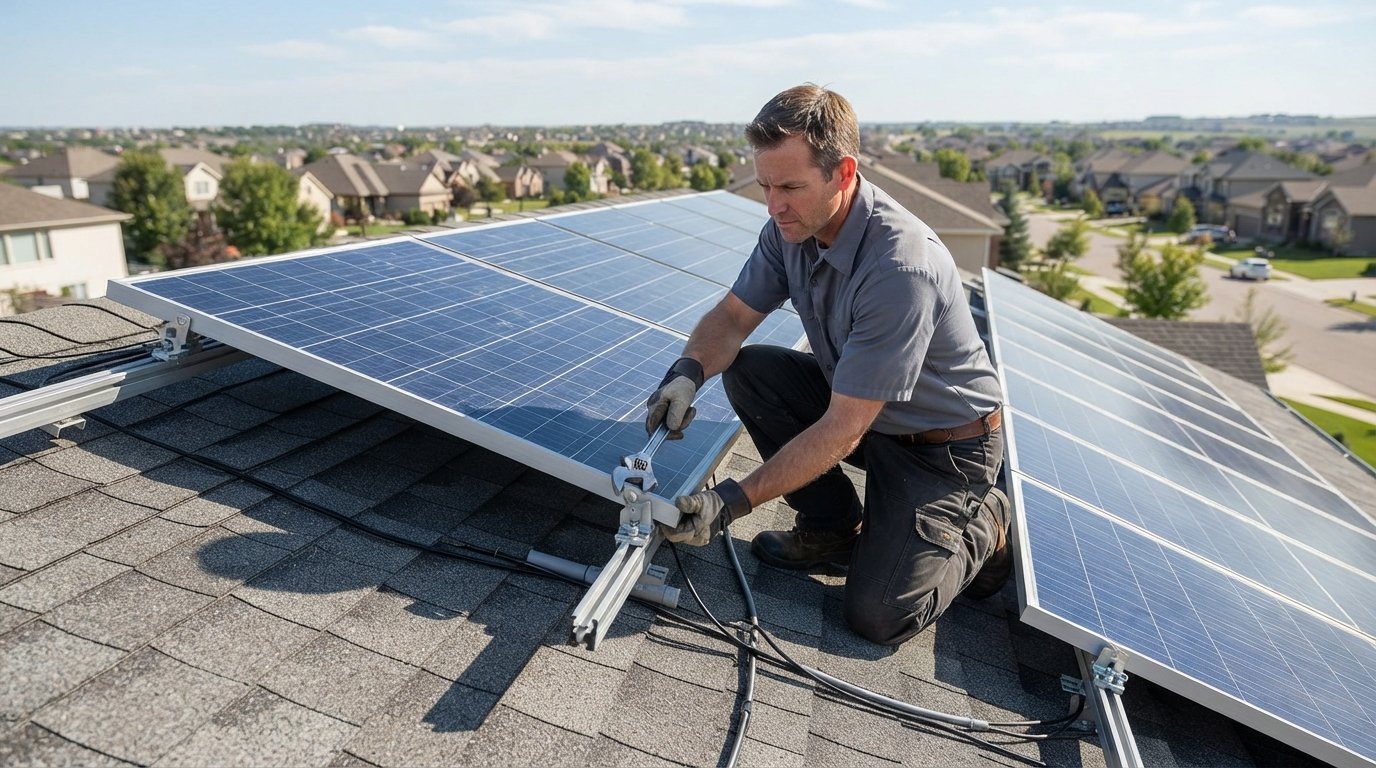
Solar Panel Angle Adjustment: Seasonal Savings for Fixed Mounts
Seasonal tilt changes can add 3-6% to solar output. Call (833)-434-4023 to see if adjustment pays for your fixed mount system.

By Isaac Reed
Learn more about Solar Panel Installation and Repair for guides, costs, and what to expect.
Compare Solar Panel Installation and Repair Pros Near You

Enter your ZIP code to compare top-rated local professionals and request free quotes.
Your solar panels are installed, the inverter is humming, and the first utility bill after activation looks promising. But a nagging question remains: could you be squeezing more savings out of those same panels simply by changing their tilt a few times a year? For homeowners with fixed mount systems, the answer is a qualified yes, and the size of that yes depends on where you live, how your racking is built, and how much effort you are willing to invest. This guide breaks down the real numbers behind solar panel angle adjustment seasonal savings for fixed mount systems, so you can decide whether seasonal tweaking is a worthwhile habit or a marginal chore.
Why Tilt Angle Matters More Than Most Homeowners Realize
Solar panels produce the most electricity when sunlight strikes the cells as close to perpendicular as possible. A fixed mount system locks the panels at one angle for the life of the array, which means that angle is a compromise. It might be optimized for annual production, or it might simply be set to whatever the installer found convenient on installation day. Either way, the sun's path across the sky changes dramatically between December and June, and a fixed tilt cannot follow it.
The penalty for a mismatched tilt is not trivial. Depending on latitude, a panel tilted for summer production can lose 15 to 25 percent of its potential output in the winter months, and a winter-optimized tilt sacrifices a similar share in summer. Seasonal adjustment recaptures a portion of that lost production by tilting the array steeper in winter (to catch the low sun) and flatter in summer (to catch the high sun). The exact gain varies by location, but the principle holds everywhere in the continental United States.
For a deeper dive into how orientation and tilt interact across the seasons, our guide on solar panel orientation and tilt angle explains the geometry in plain terms. The short version: latitude is your starting point, and the seasons are your adjustment dial.
Ideal Tilt Ranges by Latitude and Season
The classic rule of thumb for a fixed mount is to set the tilt equal to your latitude. That gives a reasonable annual average, but it leaves money on the table in both solstices. A more refined approach uses seasonal offsets from latitude. In winter, when the sun rides low, you want a steeper tilt, roughly your latitude plus 15 degrees. In summer, when the sun is high, you want a flatter tilt, roughly your latitude minus 15 degrees. Spring and fall sit close to your latitude itself.
Here is how those ranges play out across representative U.S. latitudes. These are starting points, not gospel; local climate, shading, and utility rates all shift the calculus.
- Latitude 25 to 30 degrees (Miami, Houston, Phoenix): Winter tilt around 40 to 45 degrees, summer tilt around 10 to 15 degrees, annual fixed tilt around 25 to 30 degrees.
- Latitude 35 to 40 degrees (Atlanta, Denver, Philadelphia): Winter tilt around 50 to 55 degrees, summer tilt around 20 to 25 degrees, annual fixed tilt around 35 to 40 degrees.
- Latitude 42 to 48 degrees (Boston, Minneapolis, Seattle): Winter tilt around 57 to 63 degrees, summer tilt around 27 to 33 degrees, annual fixed tilt around 42 to 48 degrees.
Notice that the winter tilt in northern states becomes quite steep. That is not just about catching more sun; it also helps snow slide off the panels, which is an underappreciated winter benefit in cold climates. A flatter summer tilt, meanwhile, keeps the array closer to the roof plane and reduces wind exposure during storm season.
Estimated Output Gains: Seasonal Adjustment vs. One Fixed Angle
The headline question is whether seasonal adjustment actually saves money. The honest answer is that it depends on your baseline. If your installer already set the array at a well-chosen annual tilt, seasonal adjustment might add 3 to 6 percent to annual production. If the array is set at a suboptimal angle, say, flush-mounted on a roof pitch that does not match your latitude, the gains can be much larger, sometimes 10 percent or more.
To make this concrete, consider a 7 kilowatt residential system in a mid-latitude state with an average electricity rate of 16 cents per kilowatt-hour. A well-optimized fixed array might produce around 9,500 kilowatt-hours per year. Seasonal adjustment, done four times a year, might push that to roughly 9,900 to 10,100 kilowatt-hours. At 16 cents, that extra 400 to 600 kilowatt-hours translates to $64 to $96 per year. Over a 25-year system life, ignoring rate escalation, that is $1,600 to $2,400 in additional savings.
That is real money, but it is not life-changing money, and it comes with labor. The math changes if you have a ground mount you can adjust with a wrench in ten minutes versus a roof mount that requires climbing a ladder and unbolting hardware. It also changes if your utility has time-of-use rates that make winter production more valuable, or if you live in a snowy region where steeper winter tilt improves snow shedding and reduces the risk of a production-killing snow cap.
For a personalized estimate, run your own numbers through a solar savings calculator that accounts for your location, rate structure, and system size. The seasonal adjustment delta is worth modeling before you commit to the routine.
Roof-Mount Limitations and Ground-Mount Adjustable Racking
Most residential solar in the United States is roof-mounted, and most roof mounts are fixed. That is not an accident. Roof pitch is dictated by the house, not the sun, and retrofitting adjustable racking onto an existing roof is expensive, intrusive, and often not worth the marginal gain. If your roof pitch is between 20 and 35 degrees and you live in the middle latitudes, you are already close enough to an annual optimum that seasonal adjustment would yield only modest returns.
Ground mounts are a different story. Adjustable ground-mount racking is widely available and relatively affordable, and it is designed to be moved. Many systems use a simple pin-and-hole or bolt-and-slot design that lets one person change the tilt in a few minutes per row. If you are planning a new installation and have the yard space, choosing adjustable racking from the start is the single best way to unlock solar panel angle adjustment seasonal savings for fixed mount systems. The incremental cost of adjustable racking over fixed racking is often a few hundred dollars, and it pays back over the system life in many climates.
If you already have a fixed ground mount, check whether the racking has any adjustment range built in. Some fixed mounts are actually adjustable but were never adjusted after commissioning. A quick look at the mounting brackets will tell you. If you are unsure, a local solar professional can assess the hardware and tell you whether adjustment is feasible.
DIY Adjustment Safety and When to Call a Professional
Adjusting tilt on a ground mount is within the reach of many homeowners, but it is not risk-free. Panels are heavy, fragile, and electrically live whenever the sun is up. Before you touch any hardware, review these safety basics.
- Shut down the system first. Turn off the inverter and, if your system has one, the DC disconnect. This reduces the risk of arc faults or shock if a cable is disturbed.
- Work in cool, low-light conditions. Early morning or late afternoon is safer and more comfortable. Panels produce less power and are less likely to be hot to the touch.
- Use the right tools and a second person. A torque wrench, proper sockets, and a helper to stabilize the panel make the job safer and prevent over-torquing or stripped bolts.
- Respect wind and height. Do not adjust panels in gusty conditions, and never work on a roof-mounted array without fall protection and a clear plan.
Even if you are handy, there are times to call a professional. If the mounting hardware is corroded, if the racking was not designed for adjustment, if the array is roof-mounted, or if you are unsure about torque specifications, a licensed installer should do the work. Re-torquing mounting hardware to the manufacturer's specification is critical for wind safety, and a professional will also inspect for loose connections, cracked panel frames, and other issues that are easy to miss from the ground.
If you want to compare quotes for professional adjustment or a racking upgrade, an independent resource like NewSolarQuotes can connect you with vetted local installers and help you understand typical costs in your area. For most homeowners, the decision comes down to a simple tradeoff: a few hours of your time each year versus a modest but real increase in production.
Building a Seasonal Adjustment Routine That Sticks
The homeowners who capture the most savings from seasonal adjustment are not the ones with the fanciest racking; they are the ones who actually do the adjustment. A simple routine helps. Mark four dates on your calendar, roughly at the equinoxes and solstices, and treat them as maintenance days. At each date, change the tilt to the seasonal setting, inspect the hardware, and note the inverter production for the preceding month. Over a year or two, you will build a personal dataset that tells you whether the adjustment is paying off in your specific location.
It also helps to pair adjustment with other cheap maintenance tasks. Clean the panels, check the wiring for rodent damage, and confirm that the inverter is logging production correctly. These tasks take minutes and protect the investment you have already made. If you are not comfortable on a ladder or with a wrench, schedule a professional maintenance visit at the seasonal change instead; many installers offer a combined inspection and adjustment service that is cheaper than two separate visits.
Finally, be realistic about the payback. Seasonal adjustment is a marginal optimization, not a transformative one. It makes the most sense for ground-mounted systems in mid-to-high latitudes, for homeowners with time-of-use rates that reward winter production, and for anyone who wants to squeeze the last few percent out of an existing array. For roof-mounted systems at a good annual tilt, the effort often outweighs the gain. The right answer for your home depends on your hardware, your climate, and your willingness to climb a ladder twice a year.
Start by checking what you have. If your racking is adjustable and safe to access, a seasonal routine is a low-cost way to boost production. If it is not, put the effort into cleaning, monitoring, and verifying that your system is performing as designed. Either way, understanding the tradeoffs puts you in a better position to make a smart decision about solar panel angle adjustment seasonal savings for fixed mount systems.