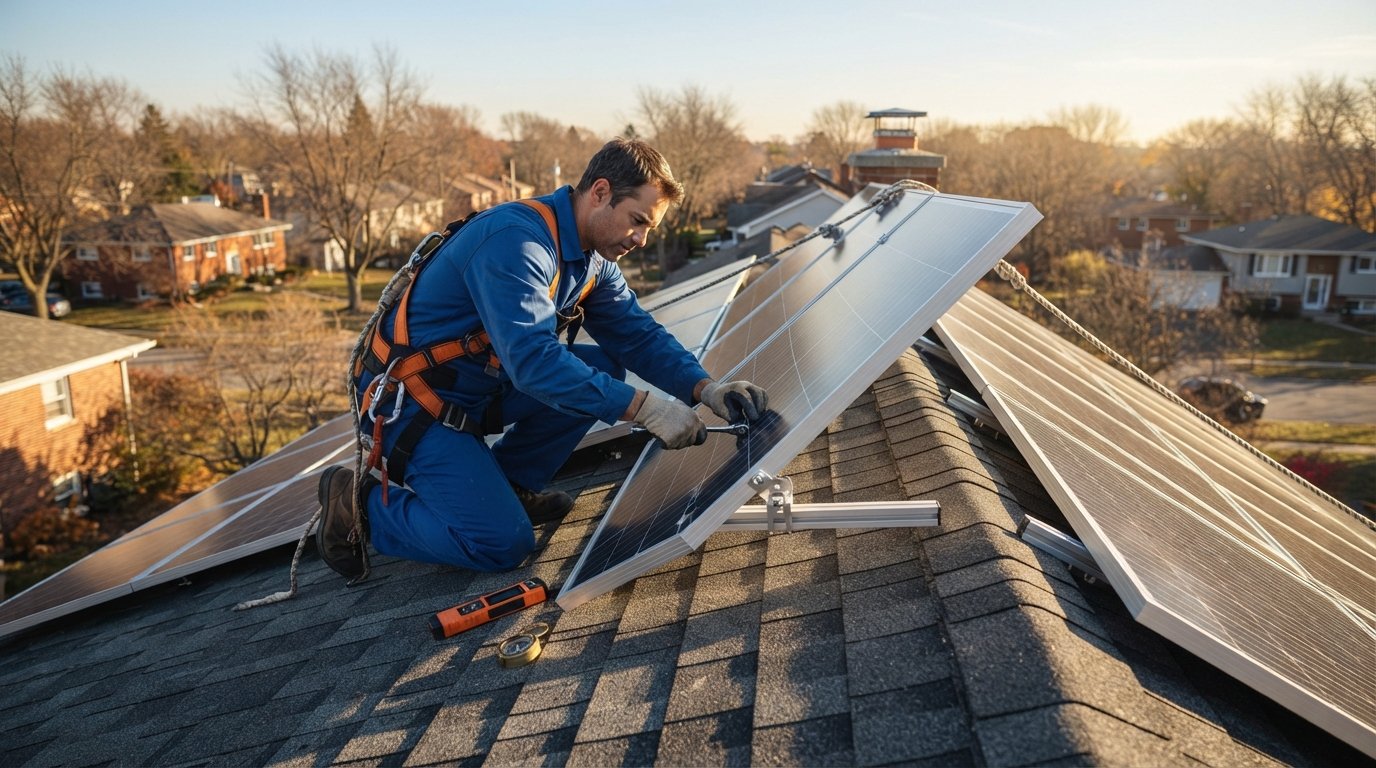
Solar Panel Orientation and Tilt Angle for Seasonal Performance
Solar panel orientation and tilt angle for seasonal performance can lift output by 15 percent. Learn the right angles for summer, winter, and year-round savings.

By Owen Phillips
Learn more about Solar Panel Installation and Repair for guides, costs, and what to expect.
Compare Solar Panel Installation and Repair Pros Near You

Enter your ZIP code to compare top-rated local professionals and request free quotes.
Your solar panels can produce dramatically different amounts of electricity in January versus July, and the reason often has nothing to do with the equipment itself. It comes down to geometry: where your panels face and how steeply they are angled relative to the sun's shifting path across the sky. Understanding solar panel orientation and tilt angle for seasonal performance is one of the highest-value things a homeowner can learn, because even a modest adjustment can lift annual output by 5 to 15 percent without buying a single new component.
The sun does not rise and set in the same spot year round. In summer it climbs high and lingers, while in winter it hugs the southern horizon and sets early. A fixed array has to compromise between those extremes, and how you set that compromise determines whether you are optimizing for long summer days, short winter days, or the total kilowatt-hours you bank over twelve months. This guide walks through the physics, the practical rules of thumb, and the seasonal trade-offs so you can make an informed decision for your roof, your climate, and your utility bill.
The Two Variables That Control Solar Output
Every solar panel's energy production depends on two orientation variables. The first is azimuth, which is the compass direction the panel faces, measured in degrees where 180 degrees is true south. The second is tilt, which is the angle of the panel surface measured from horizontal, where 0 degrees is flat on the ground and 90 degrees is perfectly vertical. Together, azimuth and tilt determine the angle of incidence, meaning how directly sunlight strikes the photovoltaic cells. When light hits perpendicular to the panel surface, reflection losses are lowest and current production peaks.
In the United States, the general rule is that panels should face true south, not magnetic south, because the sun spends most of its arc in the southern sky. True south maximizes exposure across the whole year for most locations north of the equator. However, this rule has real exceptions. Homes in the Southwest with time-of-use rates may benefit from a slight southwest orientation to catch afternoon peak pricing, and homeowners in cloudy coastal regions sometimes find that a west-facing array performs better because it captures diffuse afternoon light when fog burns off.
Tilt works in tandem with azimuth. A shallow tilt favors summer, when the sun is high overhead, while a steep tilt favors winter, when the sun is low. The ideal fixed tilt for year-round production is roughly equal to your latitude, but that simple formula hides important seasonal nuance. If your utility pays more for winter generation, or if you rely on solar to offset heating loads, tilting steeper than latitude can be worthwhile. If you have heavy air conditioning demand in July, a shallower tilt may serve you better.
How the Sun's Path Changes Through the Seasons
The reason orientation matters so much is that the sun's elevation angle swings dramatically between the summer and winter solstices. At solar noon in Phoenix, Arizona, the sun sits about 79 degrees above the horizon in late June but only about 33 degrees in late December. That 46-degree swing changes the optimal panel angle by a similar magnitude. In Minneapolis, the difference is even more extreme, with solar noon elevation dropping from around 70 degrees in summer to roughly 23 degrees in winter.
Those numbers translate directly into production. A panel tilted at latitude in Phoenix will collect strong summer energy but lose meaningful winter output because the low winter sun strikes it at a glancing angle. Conversely, a panel tilted steeply will capture the winter sun beautifully but sacrifice some summer harvest. The chart of optimal tilt by month is not a straight line; it is a curve that peaks steeply in December and flattens in June.
This is why seasonal performance is not just an academic concern. Utilities in many states apply time-of-use rates or seasonal rate structures, and winter generation can be worth more per kilowatt-hour than summer generation in some markets. If your goal is to reduce a winter heating bill or to charge a battery during short daylight hours, optimizing for the low winter sun may beat optimizing for total annual output.
Optimal Tilt Angles by Season and Latitude
For a fixed-tilt system, the widely accepted baseline is to set tilt equal to your latitude for maximum annual production. But if you are willing to accept a small annual penalty in exchange for stronger performance in a specific season, you can shift the angle. The table below summarizes the general guidance that solar designers use across the United States.
- Summer optimized: Tilt minus 15 degrees from latitude. This catches the high summer sun and can boost June output by 5 to 10 percent.
- Year-round balanced: Tilt equal to latitude. Best single setting for total annual kilowatt-hours.
- Winter optimized: Tilt plus 15 degrees from latitude. This steepens the array to face the low winter sun and can raise December output by 10 to 20 percent.
- Steep snow-shedding: Tilt of 45 to 60 degrees in snowy regions. Helps snow slide off and improves winter capture.
For example, a homeowner in Denver at roughly 40 degrees north latitude would use a 25-degree tilt for summer bias, 40 degrees for annual balance, and 55 degrees for winter bias. A homeowner in Miami at about 26 degrees north would use 11 degrees, 26 degrees, and 41 degrees respectively. Notice how the absolute numbers change with latitude but the plus-or-minus 15 rule stays consistent.
It is worth noting that the penalty for being off the ideal tilt is surprisingly gentle. Research from the National Renewable Energy Laboratory shows that deviating up to 10 degrees from the optimal annual tilt typically costs less than 2 percent of annual production. That means you do not need to obsess over a perfect number. The bigger mistakes are facing the wrong direction entirely or allowing shade to fall across the array.
Azimuth: Why South Usually Wins but Not Always
Azimuth, or the compass direction your panels face, is the single most important orientation factor. A south-facing array in the northern hemisphere captures the sun's arc symmetrically, collecting morning and afternoon energy in roughly equal measure. Deviating from true south toward southeast or southwest costs relatively little, about 1 to 3 percent per 10 degrees of deviation, until you pass roughly 45 degrees off south. Beyond that, losses accelerate quickly.
That said, there are legitimate reasons to face panels slightly east or west of south. If your utility uses time-of-use rates with a late-afternoon peak, a southwest azimuth lets you generate during the most expensive hours, and those kilowatt-hours can be worth two to three times more than midday power. If you have a battery, west-facing panels can charge it later into the evening, extending the hours you can run on stored solar. East-facing panels, meanwhile, can help offset morning demand and get your system producing earlier.
Roof geometry often decides the question for you. Most homes have a dominant roof plane that faces somewhere between southeast and southwest, and forcing panels onto a suboptimal plane just to chase true south usually does not pay off. A professional site assessment will model your actual roof, local weather patterns, and utility rate structure to find the azimuth that maximizes your specific return.
Seasonal Adjustments for Ground-Mounted and Adjustable Arrays
If your panels are on the ground or mounted on an adjustable rack, you have a powerful advantage: you can change the tilt several times a year. Adjustable mounts cost more upfront and require manual labor, but they can add 10 to 25 percent to annual production compared to a fixed array at a suboptimal angle. The typical schedule is four adjustments per year, timed to the equinoxes and solstices.
- Spring (around March equinox): Set tilt to latitude minus 5 degrees as the sun climbs.
- Summer (around June solstice): Set tilt to latitude minus 15 degrees to face the high sun.
- Fall (around September equinox): Return to latitude minus 5 degrees as the sun descends.
- Winter (around December solstice): Set tilt to latitude plus 15 degrees to capture the low sun.
Adjustable arrays are especially popular in off-grid and rural installations where every kilowatt-hour matters and where snow shedding is a concern. In snowy climates, a steep winter tilt also lets snow slide off naturally, reducing the need to climb onto the roof with a broom. If you are considering a ground mount, ask your installer whether an adjustable rack is compatible with your inverter and battery setup, because the economics depend on how much you value that extra winter output.
How Orientation and Tilt Interact With Real-World Conditions
Ideal tilt and azimuth calculations assume clear skies and unobstructed horizons. Real installations face soiling, shade, snow, and temperature swings. Dust and pollen accumulate more on shallow-tilted panels because rain does not rinse them as effectively, so a 15-degree panel in a dry climate may lose more output to soiling than a 30-degree panel. Steeper panels shed water and debris better, which is one reason many desert installations use tilts above latitude.
Shade is another factor that can overwhelm orientation gains. A single chimney or tree branch that shades one panel can drag down an entire string of panels in a traditional string inverter setup. Microinverters and power optimizers reduce that penalty, but no orientation choice can compensate for persistent shade. Before you optimize tilt, you should optimize shade, even if that means trimming a tree or moving an array to a different roof plane.
Temperature also plays a role that many homeowners overlook. Photovoltaic cells produce less voltage as they heat up, so a panel baking at 140 degrees Fahrenheit on a July roof generates less than its rated output. Winter, counterintuitively, can be a strong solar season because cold cells operate more efficiently, even though the days are shorter. This is another reason winter-optimized tilt can deliver surprising value, especially in sunny but cold states like Colorado and Utah.
Monitoring your actual production is the only way to know whether your orientation and tilt choices are delivering. Tools that track performance over time reveal whether your array is hitting its modeled output or falling short. If you want a deeper look at how to measure and improve system output, the guide on what solar performance tracking involves explains how to set benchmarks and catch issues early.
Working With an Installer to Get It Right
Most homeowners do not need to calculate tilt angles by hand. A qualified solar installer will run a production model using software that accounts for your latitude, roof pitch, azimuth, local weather data, shade from trees and buildings, and your utility's rate structure. The output of that model is an estimate of monthly and annual production for each candidate layout. Comparing two or three options side by side is the fastest way to see whether a small change in orientation is worth it.
When you request quotes, ask each installer to show you the modeled monthly production, not just the annual total. A system that produces 10 percent more in July but 20 percent less in January may or may not be the right choice depending on your rate plan and whether you have net metering. If your state has transitioned to net billing or time-of-use export rates, the value of each kilowatt-hour varies by hour and season, and the model should reflect that.
It also helps to verify incentive details before you commit, because federal and state programs change. The federal Investment Tax Credit remains a major offset for residential systems, and many states and utilities layer on rebates or performance payments. A reputable installer will walk you through the current incentives and document them in your proposal. You can compare vetted installers and request no-obligation quotes through platforms like FreeSolarPowerQuotes, which connects homeowners with local providers and helps you evaluate competing designs side by side.
Finally, do not overlook the value of a professional energy survey. An on-site audit can identify roof planes you had not considered, measure actual shade patterns across seasons, and confirm whether your electrical panel can handle the system size you want. Pairing a survey with a solar savings calculator gives you a realistic picture of payback period and return on investment before you sign anything.
Key Takeaways for Seasonal Solar Performance
Orientation and tilt are not set-it-and-forget-it details; they are the levers that determine how well your array performs when it matters most. A south-facing array at latitude tilt is the reliable default for annual output, but seasonal goals can justify shifting the angle by 15 degrees in either direction. Adjustable mounts unlock the best of both worlds for ground installations, while fixed roof arrays should prioritize shade avoidance and correct azimuth over chasing a perfect tilt number.
If you remember only a few principles, make them these: face true south when you can, set tilt near your latitude for balance, steepen for winter value and flatten for summer value, and let a professional model confirm the numbers before you install. Get those right and your system will quietly outperform a poorly oriented neighbor's array for the next 25 years.