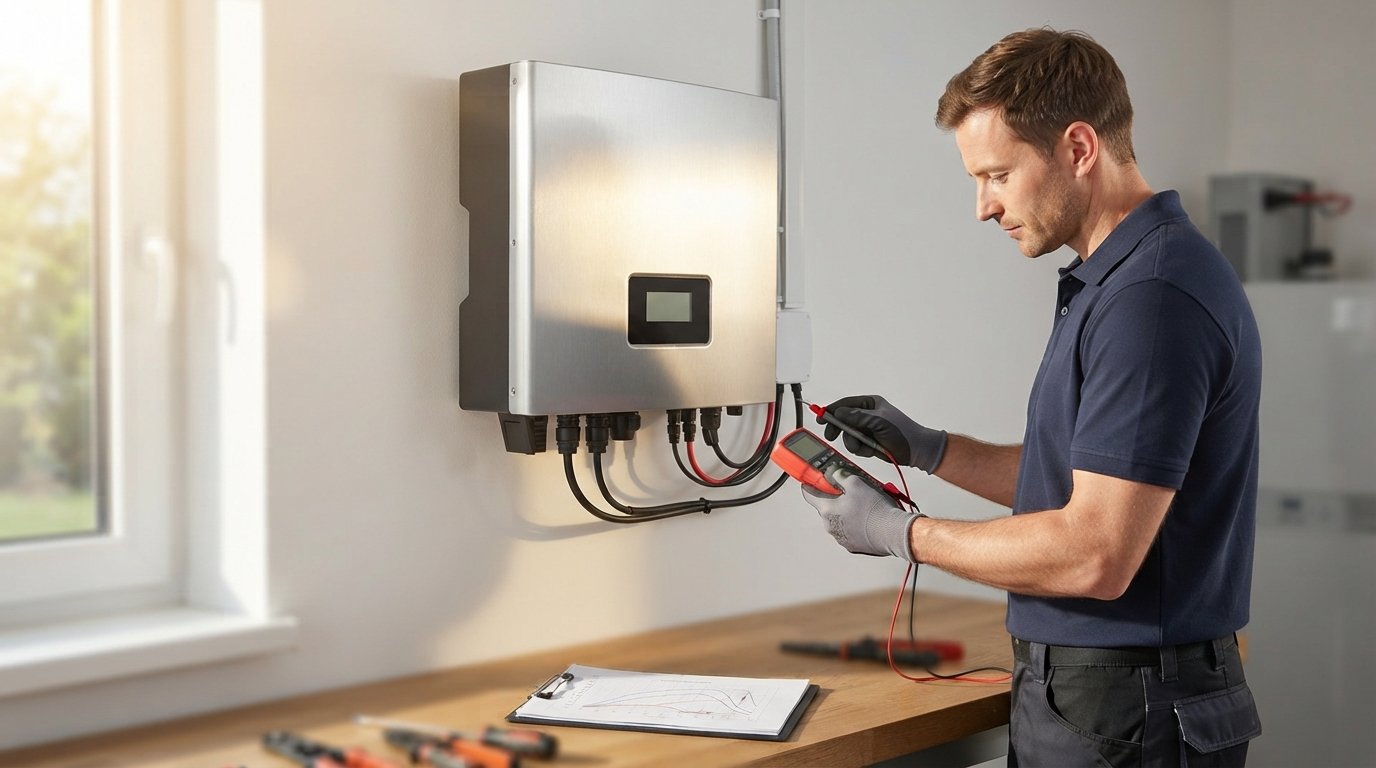
Solar Inverter Efficiency Comparison Chart 2026: Top Picks
See the 2026 solar inverter efficiency comparison chart to find the best inverter type for your roof and budget.

By Owen Phillips
Learn more about Solar Panel Installation and Repair for guides, costs, and what to expect.
Compare Solar Panel Installation and Repair Pros Near You

Enter your ZIP code to compare top-rated local professionals and request free quotes.
When you invest in solar panels, you expect every ray of sunshine to translate into lower electricity bills. Yet the unsung hero of your entire system, the solar inverter, often determines whether you harvest 95 percent or 99 percent of that available energy. As we move through 2026, inverter technology has reached a point where efficiency differences of a few percentage points can mean hundreds of dollars in savings over a system's lifetime. That is why a clear solar inverter efficiency comparison chart 2026 is more than a nice-to-have; it is your roadmap to maximizing return on investment.
This guide breaks down the top inverter types, real-world efficiency numbers, and the factors that matter more than the sticker on the box. Whether you are replacing an aging unit or designing a new rooftop array, understanding these specs helps you choose a system that performs year after year.
What Is Inverter Efficiency and Why Should You Care?
Inverter efficiency measures how much direct current (DC) electricity from your solar panels gets converted into usable alternating current (AC) electricity for your home. No conversion is perfect; some energy is always lost as heat. The efficiency rating, usually expressed as a percentage, tells you how much of that DC power actually reaches your outlets.
For example, a 96 percent efficient inverter converts 960 watts of AC power for every 1,000 watts of DC input. The remaining 40 watts are lost. Over a 25-year system lifespan, that seemingly small gap compounds into thousands of kilowatt-hours of lost production. In high-heat climates like Phoenix or Las Vegas, where inverters operate at elevated temperatures, the difference between a 96 percent and a 98 percent unit can be even more pronounced.
Modern inverters typically fall into three efficiency bands:
- Good: 95.0 to 96.5 percent, common among budget string inverters.
- Better: 96.5 to 97.5 percent, typical of premium string inverters and many microinverters.
- Best: 97.5 to 99.0 percent, achieved by top-tier microinverters and optimized power electronics.
But efficiency is not the only spec that counts. A high-efficiency inverter with poor reliability or limited monitoring features can cost you more in downtime and service calls than the few extra percent of conversion ever saves. That is why the 2026 comparison chart below weighs efficiency alongside warranty, temperature tolerance, and smart features.
Solar Inverter Efficiency Comparison Chart 2026: The Main Players
To make the numbers easy to digest, we have compared leading inverter families based on published CEC efficiency ratings, which are tested under standardized conditions. These figures are more realistic than peak efficiency claims because they account for real-world operating conditions.
Here is a snapshot of the top performers for residential and small commercial systems in 2026:
- Enphase IQ8 Series (Microinverters): CEC efficiency of 97.8 percent, with a 25-year warranty. Excellent for complex roofs with shading.
- SolarEdge HD-Wave (String with Optimizers): CEC efficiency of 99.0 percent, though real-world performance is closer to 97.5 percent under high heat. Includes module-level monitoring.
- SMA Sunny Boy (String Inverter): CEC efficiency of 97.5 percent, known for rugged build and excellent heat dissipation.
- Fronius Primo Gen24 (String Inverter): CEC efficiency of 97.2 percent, with integrated backup-ready design.
- Hoymiles HMS-2000 (Microinverter): CEC efficiency of 97.6 percent, a budget-friendly option with strong performance.
When you compare these numbers side by side, the efficiency spread is only about 1.8 percentage points. Yet on a 10 kW system producing 14,000 kWh annually, a 1 percent efficiency difference equals roughly 140 kWh per year, enough to power a refrigerator for four months. Over 25 years, that is 3,500 kWh, or about $500 to $700 in electricity savings, depending on your local rates.
String Inverters vs. Microinverters vs. Power Optimizers
To read the comparison chart correctly, you must understand the three main inverter architectures. Each has distinct efficiency characteristics and tradeoffs.
String Inverters: Simplicity and Cost-Effectiveness
A central string inverter connects all your solar panels in series, converting the combined DC power to AC in one unit. These devices are usually the least expensive per watt and have a long track record of reliability. Their efficiency is generally high, but they have a critical weakness: the entire string performs at the level of the weakest panel. If one panel is shaded or dirty, it drags down the output of the whole system.
Modern string inverters from SMA, Fronius, and Huawei achieve CEC efficiencies between 96.5 and 98 percent. They are a great choice when your roof has no shading issues and you want the lowest upfront cost. However, their maximum power point tracking (MPPT) operates at the string level, so they cannot optimize for each panel individually.
Microinverters: Panel-Level Optimization
Microinverters attach to each solar panel, converting DC to AC right at the source. This design offers two key advantages. First, each panel operates independently, so shading or soiling on one panel does not affect its neighbors. Second, you gain panel-level monitoring, which makes it easier to spot performance issues.
Enphase leads this market with the IQ8 series, which boasts a CEC efficiency of 97.8 percent. That is actually higher than many string inverters because there are no DC losses from long cable runs. Microinverters also handle partial shading better, which can boost real-world energy harvest by 5 to 15 percent in shaded installations. The tradeoff is a higher upfront cost, typically 10 to 20 percent more than a comparable string inverter system.
Power Optimizers: A Hybrid Approach
Power optimizers are DC-to-DC converters attached to each panel, paired with a central string inverter. They provide module-level MPPT and monitoring, but still require a single inverter for DC-to-AC conversion. SolarEdge is the dominant brand, and its HD-Wave technology achieves an impressive 99 percent CEC efficiency rating.
That 99 percent figure is somewhat misleading in real-world conditions. The inverter's internal cooling fan and heat sink must work harder in hot climates, which reduces actual efficiency to around 97.5 percent during peak summer afternoons. Still, optimizers offer a strong balance between cost and performance, especially for roofs with moderate shading or multiple orientations.
Beyond the Chart: Factors That Affect Real-World Efficiency
Efficiency ratings from the chart are measured at 77 degrees Fahrenheit (25 degrees Celsius) with a specific input voltage. Your actual inverter efficiency will vary based on several environmental and system factors.
Temperature is the biggest variable. Inverters generate heat as they convert power, and their internal components become less efficient as temperatures rise. Most inverters derate their output when the ambient temperature exceeds 104 degrees Fahrenheit. In states like Arizona and Texas, that means your inverter may run at 1 to 3 percent lower efficiency during the hottest months. Look for inverters with lower temperature coefficients (measured as a percentage loss per degree Celsius above 25°C). For example, a coefficient of -0.3%/°C means the inverter loses 0.3 percent efficiency for every degree above the standard. A unit with -0.2%/°C will perform better in summer.
Input voltage also matters. Efficiency tends to peak when the DC input voltage is near the inverter's maximum operating range. If your panels are connected in strings that are too short or too long, you may operate outside that sweet spot. This is why proper system design is as important as choosing a high-efficiency model. A professional installer will calculate your string lengths to keep the inverter in its optimal voltage window.
Partial shading is a system-level challenge. Even with a high-efficiency inverter, a tree that shades one panel in the afternoon can cut system output by 10 to 20 percent. Microinverters and power optimizers mitigate this by isolating the shaded panel, but a string inverter without optimization cannot. If your roof has any shading, you are better off spending a little more on panel-level electronics.
How to Use the Chart to Choose the Right Inverter
Now that you understand the numbers, the selection process becomes clearer. Start by checking your roof's orientation, tilt, and any potential shading sources. Then match your needs to the right technology class.
For a simple, south-facing roof with no shade, a premium string inverter like the SMA Sunny Boy or Fronius Gen24 offers excellent efficiency at the lowest cost. You will sacrifice panel-level monitoring, but you can add a third-party monitoring solution if you want per-panel data. These units typically last 10 to 15 years, so plan on replacing them once during your solar system's 25-year life.
If your roof has multiple angles or trees nearby, invest in microinverters or power optimizers. The Enphase IQ8 series is our top recommendation for residential installations because of its high efficiency, 25-year warranty, and robust monitoring platform. SolarEdge HD-Wave systems are also excellent, especially if you want the ability to add battery storage later, but they have experienced some reliability concerns in hot climates over the past few years.
Finally, always cross-reference the inverter's efficiency with its reliability record. A unit that is 1 percent more efficient but fails after eight years will cost you more in replacement labor and lost production than the efficiency gain ever saved. Check online reviews and ask your installer about their experience with specific models in your area. You can also read our detailed guide on solar inverter failure warning signs to know what to watch for as your system ages.
Future Trends in Inverter Efficiency for 2026 and Beyond
Inverter manufacturers are pushing efficiency higher every year. Silicon carbide (SiC) and gallium nitride (GaN) transistors are replacing traditional silicon-based switches, reducing switching losses and improving efficiency at higher temperatures. Some high-end models now achieve 99 percent CEC efficiency, and we expect that to become standard within the next five years.
Another trend is the integration of artificial intelligence and smart monitoring. Inverters are no longer just power converters; they are becoming the brain of your home energy system. They can now predict cloud cover, manage battery charging based on time-of-use rates, and even participate in grid services like voltage support. These features do not directly improve efficiency, but they maximize the value of every kilowatt-hour you produce.
When comparing inverters in 2026, pay attention to software capabilities as much as hardware specs. A unit with a 98.5 percent efficiency but limited communication protocols may not integrate with your future battery or smart home system. Choose a brand that offers regular firmware updates and a robust mobile app. The best inverter is one that not only converts power efficiently but also helps you monitor and optimize your energy usage over time.
Making the Right Investment: Efficiency vs. Cost vs. Reliability
As you finalize your decision, remember that the solar inverter efficiency comparison chart 2026 is a starting point, not the final word. A difference of 0.5 percent between two models may not justify a large price gap, especially if the cheaper unit has a longer track record. Conversely, paying a 5 percent premium for a microinverter system can be worth it if your roof has shading, because the real-world energy gain can be 10 percent or more.
At the end of the day, the most efficient solar system is the one that produces the most energy over its lifetime while requiring the least maintenance. That means choosing an inverter with a strong warranty (10 years is standard, 20 or 25 is better), good thermal performance, and a manufacturer that will still be around to honor that warranty. Companies like Enphase, SMA, and Fronius have proven their staying power, while newer entrants may offer attractive specs but carry more risk.
Before you commit, collect multiple quotes from reputable installers and ask them to justify their inverter choice with real performance data. A good installer will walk you through the efficiency chart and explain how they sized the system for your specific roof. They should also be transparent about the inverter's operating temperature range and how it will perform in your climate.
If you are still evaluating whether solar is right for you, or if you want to compare system costs with different inverter options, using a free quote service can help you see what local installers are offering. FreeSolarPowerQuotes connects you with vetted professionals who can provide customized proposals based on your energy needs and roof characteristics. This gives you a clear picture of how inverter efficiency translates into real dollar savings for your specific situation.
In the end, the best inverter is the one that balances efficiency, reliability, and cost to maximize your energy independence. Use the 2026 chart as your guide, but rely on trusted installers and your own energy goals to make the final call. The sun is free; your job is to capture as much of it as possible for the next 25 years.
Learn more about Solar Panel Installation and Repair for guides, costs, and what to expect.
Compare Solar Panel Installation and Repair Pros Near You
Enter your ZIP code to compare top-rated local professionals and request free quotes.