How Much Does a Professional Energy Audit Cost Business?
How much does a professional energy audit cost business? Get typical price ranges and payback math. Call (833)-434-4023 for expert guidance.

By Victor Walsh
Learn more about Weatherization for guides, costs, and what to expect.
Compare Weatherization Pros Near You

Enter your ZIP code to compare top-rated local professionals and request free quotes.
Every month, your business writes checks to the utility company, and those checks may be larger than they need to be. A professional energy audit is the diagnostic tool that reveals exactly where your building wastes power, which systems underperform, and what fixes deliver the fastest payback. For business owners weighing the investment, the central question is simple: how much does a professional energy audit cost business, and what return can you expect? The answer depends on building size, system complexity, and the depth of analysis you request, but the typical range is narrower than most owners assume. More importantly, the audit often pays for itself within months through identified savings, utility rebates, and smarter capital planning. This guide breaks down real pricing, scope differences, report contents, and the payback math that turns an audit from a line item into a profit center.
Typical Energy Audit Costs for Small and Mid-Size Commercial Buildings
Commercial energy audits follow a tiered framework, and pricing tracks directly with the level of engineering rigor. A small retail shop or office under 5,000 square feet usually needs a walk-through assessment (ASHRAE Level 1), which runs roughly $500 to $2,000. This level includes a visual inspection, utility bill analysis, and a list of low-cost operational fixes. A mid-size building between 5,000 and 50,000 square feet typically warrants a Level 2 audit, priced from $2,000 to $10,000. Here, auditors deploy metering equipment, model energy use, and produce cost estimates for each recommended measure. Large facilities above 50,000 square feet or those pursuing deep retrofits may require a Level 3 audit with detailed engineering and financial modeling, often exceeding $10,000 and sometimes reaching $30,000 or more for complex campuses.
Several variables move the price within these bands. Buildings with unusual process loads, such as restaurants, manufacturing floors, or data rooms, demand more instrumentation and take longer to analyze. Older structures with incomplete documentation add discovery time. Conversely, businesses that bundle the audit with a broader energy services engagement, including solar readiness or electrical upgrades, often secure better pricing. The key is to match the audit level to your decision-making needs: if you are planning a major capital project, the extra engineering detail of a higher-level audit is worth the cost because it reduces the risk of costly mistakes.
What a Quality Audit Report Should Include
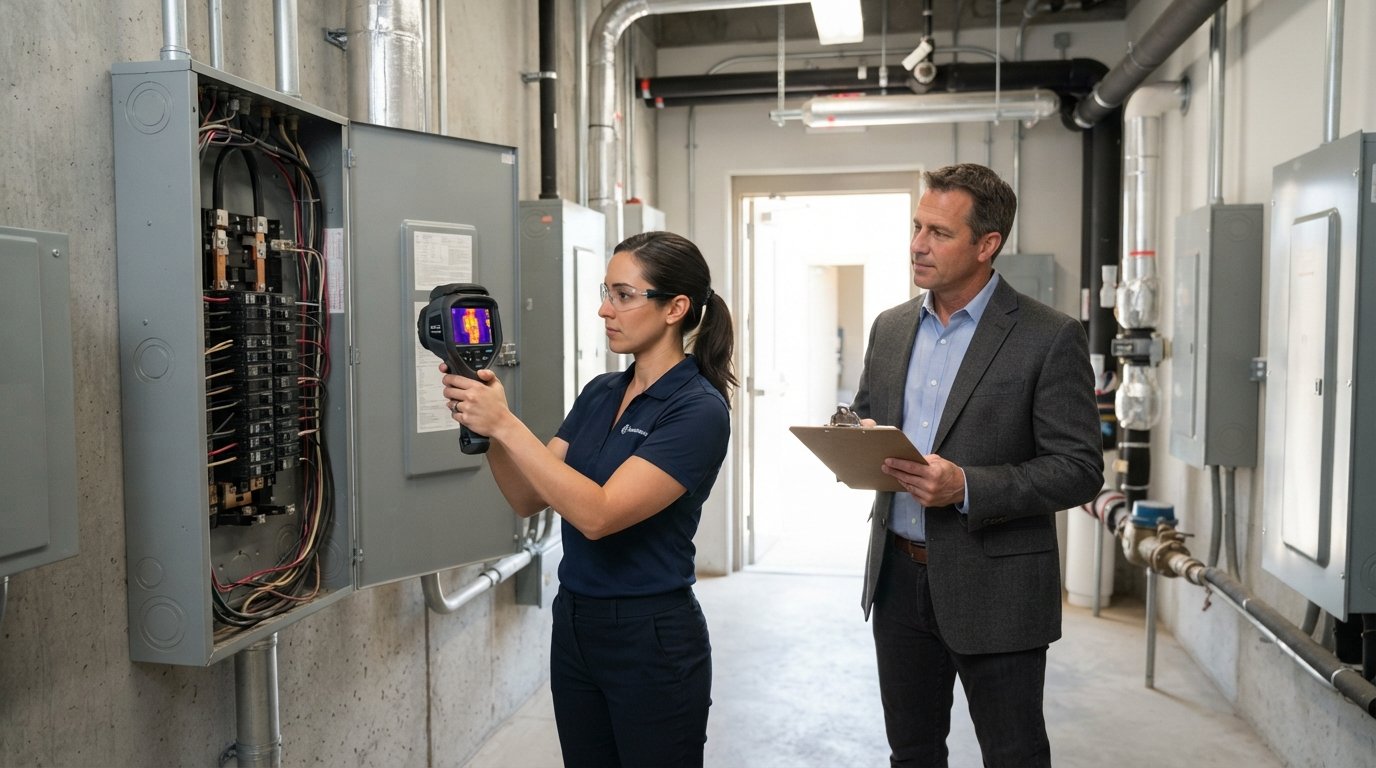
A professional energy audit is only as valuable as the report it produces. Before you sign a contract, ask for a sample deliverable and confirm it contains the elements that make recommendations actionable. A strong report begins with a clear baseline: twelve months of utility data normalized for weather and occupancy, so you understand current consumption patterns. From there, it should document every inspected system, including lighting, HVAC, envelope, controls, and plug loads, with photographs and measured data where relevant.
The heart of the report is a prioritized list of energy conservation measures (ECMs). Each measure should carry an estimated implementation cost, projected annual savings in dollars and kilowatt-hours, and a simple payback period. Quality reports also flag available utility rebates and tax incentives, which can dramatically shorten payback. Finally, the report should include a measurement and verification plan so you can confirm savings after implementation. If a report lacks these components, it is a sales brochure, not an engineering document. Use our guide on professional energy audits that cut business operating costs to benchmark what your provider should deliver.
Common Findings That Justify Solar Readiness Upgrades
Energy audits frequently uncover issues that intersect directly with solar planning. The most common finding is poor power quality or an undersized electrical panel, which can block a solar installation until upgraded. Auditors also identify inefficient HVAC equipment, failing insulation, and uncontrolled lighting schedules that inflate baseline consumption. These findings matter for solar because the value of a photovoltaic system depends on the load it offsets. If your building wastes 20 percent of its electricity, you will oversize the solar array or accept a longer payback.
Other frequent findings include outdated fluorescent lighting that can be replaced with LEDs, economizer controls that are stuck or disabled, and air infiltration around loading docks and windows. Each of these represents a low-cost fix that reduces demand before you invest in generation. Addressing them first is the sequencing that maximizes solar return. An audit also verifies whether your roof structure and electrical service can accommodate a future array, saving you from discovering costly barriers after a solar contract is signed.
Payback Math for Audit-Recommended Improvements Before Adding Solar
The financial case for an audit rests on the improvements it identifies. Consider a 20,000 square foot office building with an annual electric bill of $60,000. A Level 2 audit costing $6,000 might recommend LED retrofits ($18,000 cost, $9,000 annual savings), HVAC controls tuning ($4,000 cost, $3,500 annual savings), and schedule adjustments (near-zero cost, $2,000 annual savings). The combined investment of $22,000 yields $14,500 in annual savings, a payback of roughly 18 months. After these measures, the building's load drops by nearly 25 percent, which means a smaller solar array can meet a larger share of consumption.
This sequencing improves solar economics in two ways. First, you avoid paying for panels to offset wasted energy. Second, many utilities offer rebates for efficiency measures that reduce the net cost of the audit and upgrades. When you layer solar incentives on top, the combined package often delivers a payback under five years. To estimate how efficiency gains change your solar sizing, use the Solar Savings Calculator after your audit establishes a new baseline. The audit fee itself is frequently recovered within the first year through these stacked savings.
How to Sequence an Audit With a Solar Site Survey
Timing matters. A solar site survey evaluates roof condition, shading, structural capacity, and interconnection options. An energy audit evaluates consumption and efficiency. Running the audit first ensures the solar survey is sized to an accurate, optimized load rather than yesterday's waste. The ideal sequence begins with the audit, followed by implementation of low-cost measures, and then a solar site survey that incorporates the reduced load profile.
- Commission the energy audit and establish a normalized consumption baseline.
- Implement no-cost and low-cost operational fixes immediately.
- Complete capital improvements with strong paybacks, such as lighting and controls.
- Request a solar site survey using post-improvement load data.
- Compare solar proposals and incentives with a clear picture of future energy use.
This order prevents the common mistake of sizing a solar array to a load that no longer exists after efficiency upgrades. It also positions you to negotiate with installers from a position of knowledge. If your business is planning a relocation in the near term, however, sequencing changes: efficiency investments may not pay back before you move, so a lighter audit focused on solar readiness makes more sense. For owners planning a move, resources like Moving.Homes relocation guides can help coordinate timelines so energy projects align with occupancy dates.
Factors That Change the Price and How to Control Them
Beyond building size, several factors influence what you pay. Access to utility data is a major one: businesses with consolidated, interval-metered accounts require less manual analysis. The number of systems and their age also matter, as does the auditor's credential (a certified energy manager commands higher fees but delivers more defensible analysis). Geographic variation exists, with dense urban markets typically pricing higher than rural areas.
You can control costs by preparing documentation in advance, including utility bills, equipment schedules, and floor plans. Bundling the audit with other services, such as an electrical security assessment or emergency lighting review, can spread mobilization costs. Finally, ask about utility-sponsored audit programs: many utilities offer free or subsidized assessments for small businesses, and some states provide grants. These programs can reduce out-of-pocket cost to near zero while still delivering a usable report.
Making the Investment Decision
When you evaluate how much a professional energy audit costs business, compare the fee to the savings it uncovers, not to your operating budget alone. An audit that costs $5,000 and identifies $20,000 in annual savings is not an expense; it is one of the highest-return investments available to a facility owner. The report also strengthens applications for utility rebates and provides documented justification for capital requests. In competitive markets, efficiency and solar readiness increasingly factor into lease terms and property valuations, adding another layer of return.
Start by requesting quotes from at least two credentialed providers, specifying the audit level you need and the report contents you expect. Ask each provider how they handle solar readiness and whether they coordinate with installation teams. With a clear scope and a focus on actionable findings, the audit becomes the first step in a broader energy strategy that lowers operating costs, reduces emissions, and prepares your building for renewable generation.