Commercial Solar Installation Guide: Cut Energy Costs Now
This commercial solar installation guide covers costs, incentives, and steps to cut your business energy bills. Start saving today.

By Dylan Harris
Learn more about Solar Panel Installation and Repair for guides, costs, and what to expect.
Compare Solar Panel Installation and Repair Pros Near You

Enter your ZIP code to compare top-rated local professionals and request free quotes.
For business owners, the monthly electric bill is often one of the largest operating expenses. A commercial solar installation is no longer just an environmental statement; it is a strategic financial move that can stabilize energy costs for decades. This guide walks through the entire process, from initial feasibility to final grid connection, so you can approach your project with confidence and a clear understanding of the return on investment.
Unlike residential projects, commercial solar installations involve unique considerations: larger scale, complex financing, different incentive structures, and greater scrutiny on engineering and safety. This guide breaks down what you need to know to avoid costly mistakes and maximize the value of your investment. Whether you own a warehouse, an office building, a retail store, or a manufacturing facility, the principles here apply to your energy needs.
Why Commercial Solar Is a Smart Business Investment
Commercial solar systems are not just about reducing carbon footprints. They deliver tangible financial benefits that directly impact your bottom line. The most obvious advantage is the reduction in electricity costs. By generating your own power during peak sunlight hours, you draw less from the grid, which can lead to significant monthly savings. For businesses with high daytime energy consumption, the savings can be substantial.
Beyond the direct savings, solar provides a hedge against future utility rate increases. Electricity prices have historically risen over time, and a solar installation effectively locks in a portion of your energy costs for the next 25 to 30 years. This predictability makes budgeting easier and improves financial forecasting.
Another key benefit is the potential increase in property value. Commercial properties with solar installations often have higher appraisal values and can be more attractive to tenants who value sustainability and lower operating costs. Additionally, many customers and clients prefer to do business with environmentally responsible companies, enhancing your brand reputation.
Finally, there are significant tax benefits. The federal Investment Tax Credit (ITC) allows you to deduct a substantial percentage of your solar installation costs from your federal taxes. Many states and local jurisdictions offer additional incentives, such as rebates, tax exemptions, or performance-based incentives. To understand the full financial picture, it is wise to consult a financial advisor who can model the specific incentives available in your area.
Key Steps in the Commercial Solar Installation Process
Navigating a commercial solar project can seem complex, but it follows a predictable sequence. Understanding each stage helps you manage expectations and coordinate with your installation partner effectively.
- Site Assessment and Energy Audit: A qualified solar company will analyze your facility's roof or ground space, structural integrity, and shading issues. They will also review your historical electricity usage to determine the optimal system size.
- System Design and Engineering: Based on the assessment, engineers will create a detailed system design, including panel layout, inverter selection, and electrical schematics. This step ensures the system meets local building codes and utility interconnection requirements.
- Permitting and Approvals: Your installer will handle the necessary permits from your local building department and file an interconnection agreement with your utility company. This can take several weeks, depending on your jurisdiction.
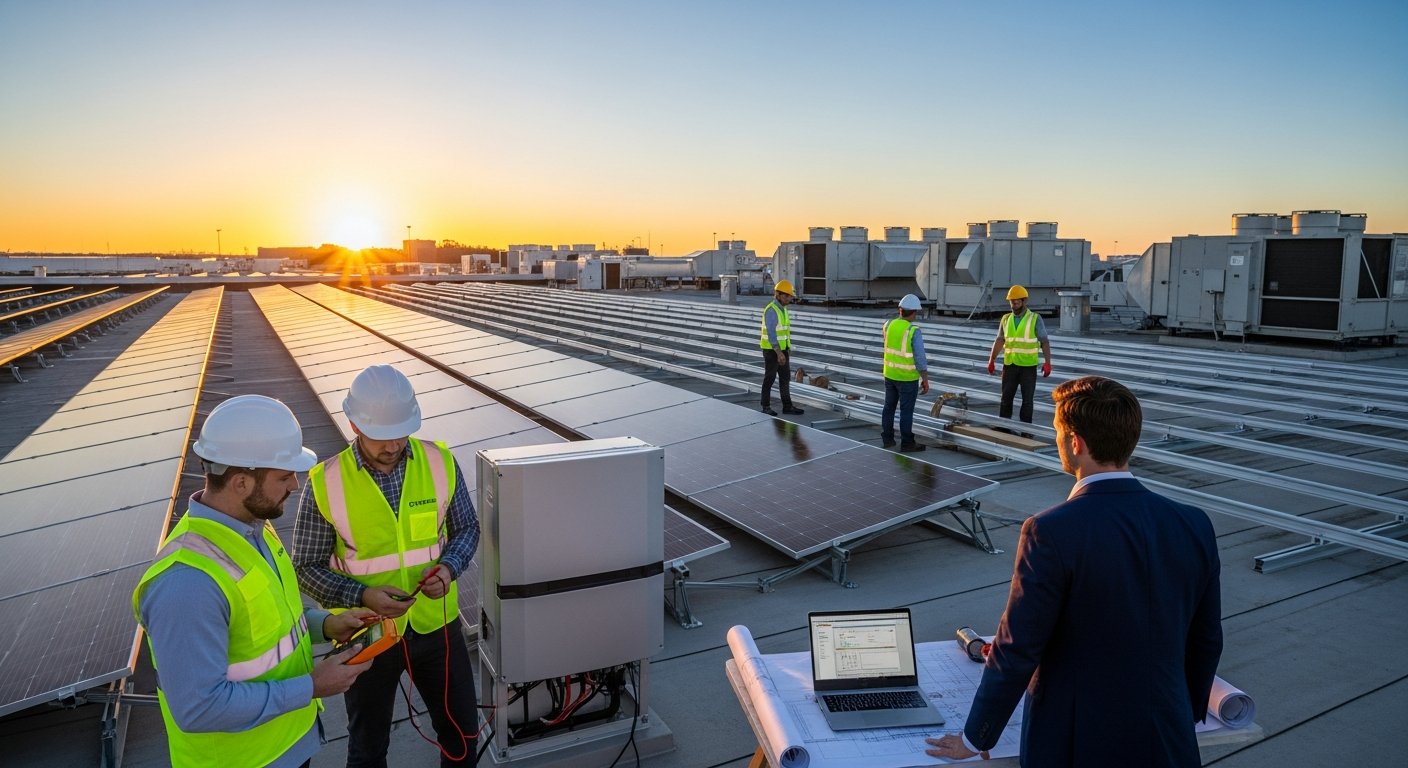
- Procurement and Installation: Once permits are approved, the equipment is ordered and the installation begins. This involves mounting the panels, running conduit, installing inverters, and connecting everything to your main electrical panel.
- Inspection and Grid Connection: After installation, local inspectors will verify the system meets all codes. Finally, the utility company will inspect the connection and authorize the system to be turned on.
Throughout this process, communication is vital. A reliable installer will provide regular updates and be transparent about timelines. The entire process, from contract signing to operational system, typically takes 2 to 4 months for a commercial project, though larger or more complex installations can take longer.
Choosing the Right Commercial Solar Installer
The success of your solar project largely depends on the competence of your installation partner. Selecting an inexperienced or underqualified contractor can lead to design flaws, installation errors, and costly delays. You need a partner who understands the unique demands of commercial installations.
When vetting companies, ask for references from similar commercial projects and verify their licensing and insurance. Look for certifications from reputable organizations like the North American Board of Certified Energy Practitioners (NABCEP). A strong track record and positive client testimonials are critical indicators of reliability.
Ask about their project management approach. Who will be your single point of contact? How do they handle unexpected challenges? A professional team will have clear processes for quality assurance and safety. They should also be transparent about warranties, offering performance guarantees for both the equipment and the workmanship. You can find more tips on what to look for in our guide on solar installation in Orlando, FL, which applies broadly to commercial projects.
Understanding Commercial Solar Costs and Financing
The upfront cost of a commercial solar system can be significant, but it must be viewed as an investment with a predictable return. The cost per watt decreases with system size, so commercial systems often have a lower cost per watt than residential ones. However, the total capital outlay is higher, making financing a crucial aspect of the decision.
There are several common financing options for commercial solar:
- Cash Purchase: This offers the highest long-term return because you own the system outright and collect all incentives and savings.
- Solar Loans: These allow you to spread the cost over time, often with low-interest rates. You own the system from day one, but you have monthly payments.
- Power Purchase Agreement (PPA): With a PPA, a third party owns the system on your property, and you agree to buy the electricity it generates at a fixed rate, typically lower than your utility's rate. This requires no upfront cost.
- Lease: Similar to a PPA, a lease involves paying a fixed monthly fee to use the system, regardless of its energy production.
Each option has its pros and cons. A cash purchase maximizes ROI, but a PPA or lease might be better if you want to conserve capital. A reputable installer can help you evaluate these options and connect you with financing partners. It is also wise to use a solar savings calculator to model your specific payback period. For a detailed analysis of your potential savings, you can get a solar installation estimate tailored to your business's energy profile.
Maximizing Your Return with Incentives and Tax Credits
The economics of commercial solar are heavily influenced by federal, state, and local incentives. The most significant is the federal Investment Tax Credit (ITC), which allows you to deduct a percentage of the system cost from your federal taxes. This percentage has fluctuated, so it is essential to verify the current rate for your project's timeline.
In addition to the ITC, many states offer their own tax credits, rebates, or performance-based incentives. Some utilities provide financial rewards for generating renewable energy. Depreciation benefits can also provide a substantial tax advantage, allowing you to write off the system's cost over a shorter period.
Working with a tax professional who understands renewable energy incentives is crucial. They can ensure you claim all eligible deductions and structure your ownership to maximize the financial return. Your solar installer should also be knowledgeable about local incentives and can help you navigate the paperwork. For more insights into how solar can reduce your operating costs, see our article on how commercial solar cuts electricity bills.
Maintenance and Long-Term Performance
A well-designed commercial solar system requires minimal maintenance, but it is not zero-maintenance. The primary maintenance task is keeping the panels clean. Dust, dirt, bird droppings, and pollen can reduce energy production, especially in arid climates. Depending on your location, you may need to schedule periodic cleaning, either via a professional service or with an in-house maintenance plan.
In addition to cleaning, you should monitor your system's performance. Most modern inverters come with monitoring software that allows you to track daily and monthly energy production. By comparing actual output to expected output, you can quickly identify any issues, such as a faulty panel or a wiring problem. Many commercial installers offer annual maintenance check-ups that include electrical inspections and thermal imaging scans to detect hot spots.
Most solar panels come with a 25 to 30-year performance warranty, and inverters typically have a 10 to 15-year warranty. Understanding these warranties is essential. A good installer will help you understand the claims process if a component fails. Proactive maintenance is the key to ensuring your system continues to deliver the expected savings for decades to come.
In conclusion, a commercial solar installation is a complex but highly rewarding project. By understanding the financial benefits, following a structured process, selecting a qualified installer, and securing the right financing, you can make a smart investment that reduces operational costs, increases energy independence, and supports your sustainability goals. The key is to approach it with thorough planning and the right professional partners.