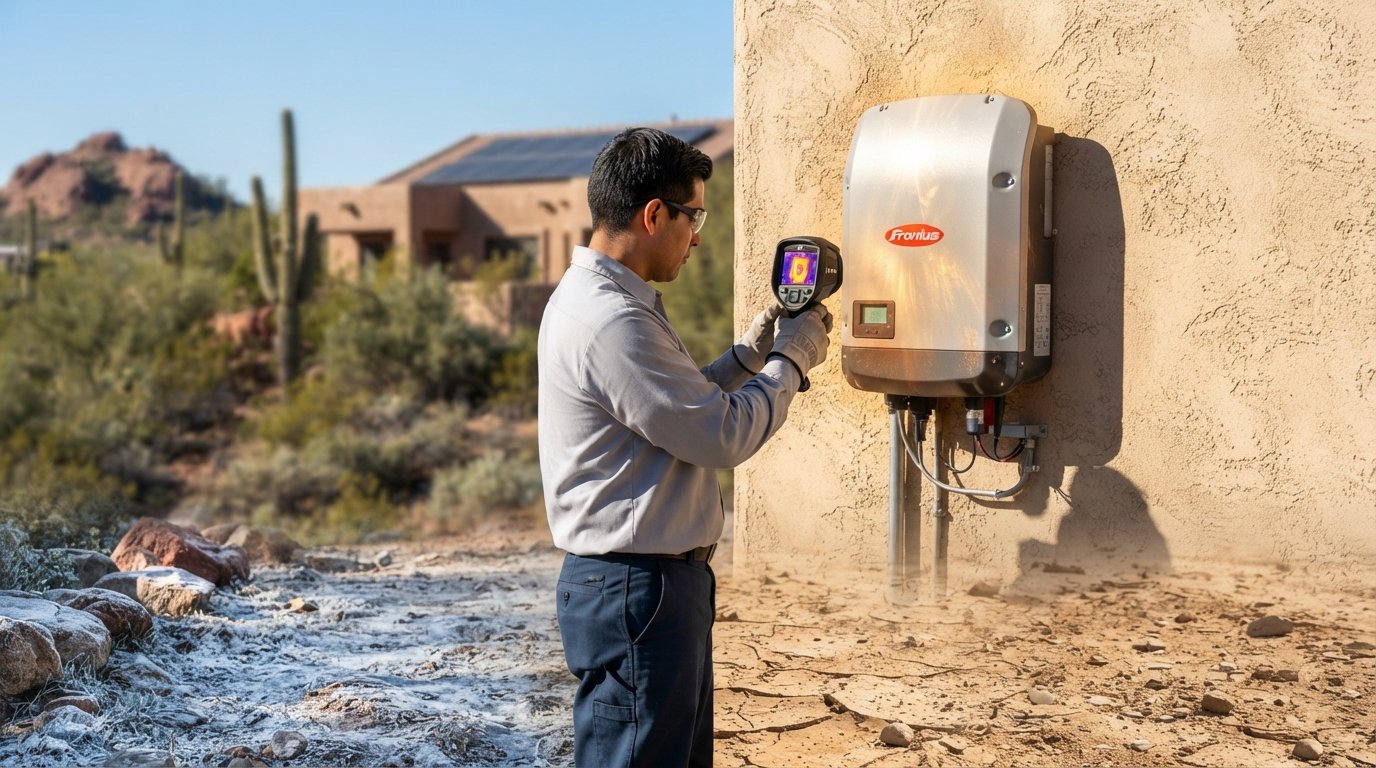
Best Inverters for Extreme Heat and Cold Climates
Compare the best inverters for extreme heat and cold climates, including derating curves, battery heating, and installation tactics that protect energy output.

By Mason Carter
Learn more about Solar Panel Installation and Repair for guides, costs, and what to expect.
Compare Solar Panel Installation and Repair Pros Near You

Enter your ZIP code to compare top-rated local professionals and request free quotes.
Your solar panels get all the attention, but the inverter is the component that actually determines whether your system survives a Phoenix heat wave or a Minnesota deep freeze. When temperatures swing from 115 F in summer to minus 20 F in winter, a standard inverter can derate, shut down, or fail years ahead of schedule. Choosing the best inverters for extreme heat and cold climates is one of the highest-leverage decisions you will make for long-term energy production and return on investment.
This guide breaks down the inverter technologies, temperature ratings, and installation practices that keep a solar array producing in the harshest conditions. You will learn why some units thrive at 120 F while others throttle back at 95 F, how cold weather changes voltage and battery behavior, and which features matter most when your climate refuses to cooperate.
Why Extreme Temperatures Destroy Ordinary Inverters
Inverters convert direct current from your panels into usable alternating current for your home. That conversion process generates heat, and electronics hate heat. Most residential inverters are rated for operation up to about 113 F to 122 F, but that rating assumes ideal mounting with free airflow. Real-world installations on a west-facing garage wall in Arizona can see ambient temperatures well above that, plus the inverter's own heat load. The result is thermal derating, where the inverter deliberately reduces output to protect its internal components.
Cold creates a different set of problems. Lithium-ion batteries lose usable capacity below freezing, and some chemistries cannot charge at all when cell temperatures drop below 32 F. Voltage also rises in cold weather, and if your inverter's maximum input voltage is already near the string limit, a cold snap can push it past the threshold and trigger a shutdown. Meanwhile, repeated freeze-thaw cycles stress sealed enclosures and cable glands, leading to moisture intrusion that corrodes circuit boards.
The best inverters for extreme heat and cold climates are engineered around these realities. They use wider operating temperature ranges, smarter thermal management, and in many cases active heating or cooling for batteries. They also carry ingress protection ratings that keep dust, rain, and snow out of sensitive electronics. Understanding those specifications is the first step toward a system that lasts 12 to 15 years instead of 6 to 8.
Key Specifications to Compare Before You Buy
Manufacturer marketing pages tend to highlight efficiency and wattage while burying the details that matter in extreme climates. When you compare inverters for a desert or northern installation, the following specifications should drive your decision more than peak efficiency numbers.
- Operating temperature range: Look for a range that extends well beyond your local record highs and lows, ideally minus 40 F to 140 F for central inverters and similar ranges for power electronics.
- Derating curve: Some inverters begin reducing output at 95 F, while others hold full power to 113 F. Ask for the derating curve, not just the maximum rating.
- Ingress protection (IP) and NEMA rating: NEMA 4X or IP65 and above resists dust, rain, and hose-directed water, which matters in dusty deserts and snow-heavy regions.
- Battery heating and thermal management: For hybrid systems, confirm whether the battery includes internal heaters, liquid cooling, or both.
- Warranty terms for temperature extremes: Some warranties exclude damage from ambient temperatures above a certain threshold. Read the fine print.
A unit with slightly lower peak efficiency but a flatter derating curve will often produce more annual kilowatt-hours in a hot climate than a higher-efficiency model that throttles at midday. Similarly, a battery with active heating may cost more upfront but deliver usable capacity every winter day instead of sitting idle for three months.
String Inverters in Extreme Climates
String inverters remain the most common choice for residential solar because they are affordable, simple, and easy to service. In extreme climates, the best string inverters share a few traits: wide temperature ratings, robust thermal design, and smart cooling strategies. Many modern units use passive cooling with large heat sinks rather than fans, which reduces failure points in dusty environments where fans clog and seize.
Placement matters as much as the hardware. Mounting a string inverter on a shaded north wall, inside a ventilated garage, or under a purpose-built shade structure can drop operating temperatures by 20 F or more. In cold climates, the same inverter may benefit from being mounted where snow cannot bury it and where freeze-thaw cycles are less severe. If you are weighing string inverters against module-level electronics, our guide on microinverters vs power optimizers explains how each architecture handles heat, shading, and maintenance differently.
For homeowners in places like Phoenix, Las Vegas, or West Texas, a string inverter with a 140 F maximum ambient rating and NEMA 4X enclosure is a sensible baseline. Pair it with a mounting location that gets morning sun but afternoon shade, and you will avoid most derating events. In colder regions, the same inverter can work well as long as snow clearance and voltage limits are addressed during system design.
Microinverters and Power Optimizers for Harsh Weather
Microinverters mount directly behind each panel, which means they experience the same heat and cold as the modules themselves. That proximity can be an advantage in cold climates, where waste heat from the panels keeps electronics slightly warmer, and a disadvantage in hot climates, where rooftop temperatures can exceed 160 F. The best microinverters for extreme heat use potted electronics, wide temperature ratings, and no moving parts.
Power optimizers are a middle ground. They perform maximum power point tracking at the module level but send DC power to a central inverter. This design moves the heat-generating conversion stage off the roof, which can improve reliability in desert installations. Optimizers also make it easier to monitor and maintain individual panel performance, a useful feature when heat or snow affects parts of an array unevenly.
Both technologies add cost compared with a single string inverter, but they can pay for themselves through higher uptime and easier troubleshooting. In regions with extreme temperature swings, the ability to isolate a single failing unit without shutting down the whole system is a real operational advantage.
Hybrid Inverters and Battery Storage in Temperature Extremes
Hybrid inverters combine solar conversion with battery management, which makes them attractive for homeowners who want backup power and energy independence. In extreme climates, however, the battery is often the weak link. Lithium iron phosphate (LFP) batteries handle heat better than older lithium-ion chemistries and are generally the preferred choice for hot climates, while some manufacturers offer heated enclosures or internal heating pads for cold climates.
Where you install the battery matters enormously. A garage that stays above freezing in winter and below 90 F in summer is close to ideal. An unconditioned shed or exterior wall in a desert or northern climate will shorten battery life and may void the warranty. Many hybrid inverters now support remote monitoring and AI-driven charge scheduling, which can shift charging to cooler hours and reduce stress on the battery.
For homeowners who want a single system that handles both temperature extremes, a hybrid inverter with an LFP battery, active thermal management, and a NEMA 4X enclosure is the most robust configuration available today. It costs more upfront, but it avoids the cycle of premature replacements that plagues poorly specified systems.
Installation and Maintenance Tactics That Extend Inverter Life
Even the best inverter will underperform if it is installed carelessly. In hot climates, the goal is to minimize heat gain: shade the unit, avoid enclosed cabinets, leave clearance for airflow, and consider a small ventilation fan in extreme cases. In cold climates, the goal is to keep snow and ice away from vents and to prevent condensation from forming inside the enclosure as temperatures rise and fall.
Maintenance should be scheduled around the seasons. Before summer, clean heat sinks, check fan operation if applicable, and verify that shading from new vegetation has not appeared. Before winter, inspect cable glands and seals, confirm that snow guards or mounting height will keep the inverter accessible, and review battery heating settings. These simple steps can add years to equipment life.
Monitoring is your early warning system. Most modern inverters report internal temperature, derating events, and fault codes. If you see frequent derating in summer or voltage faults in winter, those are signals to adjust placement, add ventilation, or consult a professional before a small issue becomes a failure. SolarEnergy.ai connects homeowners with vetted local installers who understand regional climate challenges and can design systems around them.
How to Choose the Right Inverter for Your Climate Zone
Start by identifying your climate zone and the specific stresses it places on solar equipment. Hot-dry climates like Arizona and Nevada demand heat tolerance and dust protection. Hot-humid climates like Florida and the Gulf Coast add corrosion and moisture concerns. Cold climates like the Upper Midwest and Mountain West require cold-temperature battery performance and voltage management. Mixed climates with both extremes need a system that can handle the full range.
Next, match specifications to those stresses. For hot climates, prioritize high ambient temperature ratings, passive cooling, and NEMA 4X enclosures. For cold climates, prioritize battery heating, wide voltage windows, and snow-shedding mounting. For both, prioritize remote monitoring and a manufacturer with a strong warranty and local service network.
Finally, get quotes from installers who have experience in your specific region. A contractor who works primarily in mild coastal climates may not appreciate how quickly an inverter derates in a desert or how cold affects battery charging in a northern winter. When you compare quotes, ask each installer to explain how their proposed inverter handles your worst-case temperature conditions. If they cannot answer clearly, keep looking. For free, no-obligation quotes from solar providers who understand extreme-climate installations, visit FreeSolarPowerQuotes to compare options in your area.
Choosing the best inverters for extreme heat and cold climates is ultimately about matching engineering to environment. The right inverter will not just survive your climate; it will produce reliably through decades of temperature swings, protecting your investment and your energy independence. Take the time to compare derating curves, battery thermal management, and installation practices, and your solar system will keep working when your neighbors' systems are sitting idle.