Microinverters vs Power Optimizers: Solar Choice Guide
Compare microinverters vs power optimizers solar setups: learn which boosts energy harvest, cuts costs, and fits your roof for maximum savings.

By Mason Carter
Learn more about Solar Panel Installation and Repair for guides, costs, and what to expect.
Compare Solar Panel Installation and Repair Pros Near You

Enter your ZIP code to compare top-rated local professionals and request free quotes.
Choosing the right power electronics for a solar array often comes down to a single decision that shapes performance, safety, and long-term savings. Microinverters and power optimizers both solve the problem of shading and panel mismatch, but they do it in fundamentally different ways. One converts DC to AC at each panel, while the other conditions DC power at the panel and sends it to a central inverter. That difference affects everything from roof layout flexibility to monitoring granularity to how quickly a system pays for itself. For homeowners comparing quotes in 2026, understanding microinverters vs power optimizers solar configurations is essential for making a confident investment.
What Microinverters and Power Optimizers Actually Do
Solar panels produce direct current (DC) electricity. Homes and businesses run on alternating current (AC). An inverter handles that conversion. In a traditional string system, one central inverter manages the entire array. That works well when every panel faces the same direction and receives identical sunlight. Real rooftops rarely cooperate. Trees, chimneys, vent pipes, and adjacent buildings create shade that drags down the output of an entire string.
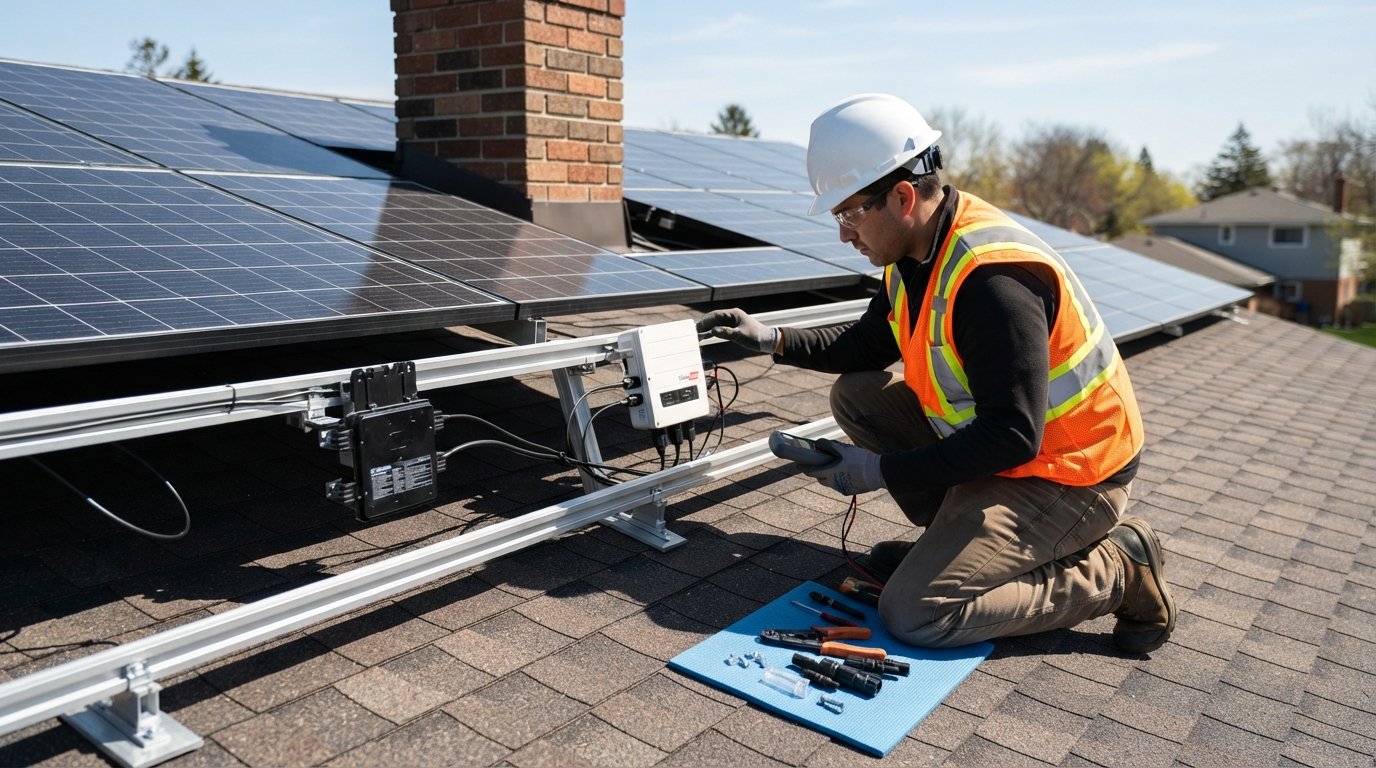
Microinverters solve this by attaching a small inverter to each individual panel. Each unit converts DC to AC right at the panel, so every module operates independently. If one panel is shaded, the others continue producing at full capacity. Power optimizers take a different route. They are DC-to-DC converters mounted at each panel that condition voltage and current before sending power to a central string inverter. The optimizer ensures each panel contributes its maximum available power, and the central inverter handles the final DC-to-AC conversion.
Both approaches deliver module-level optimization, but the architecture matters. Microinverters eliminate the central inverter entirely, which means no single point of failure for power conversion. Power optimizers keep the central inverter but add intelligence at the panel level. The choice influences installation complexity, replacement costs, monitoring capabilities, and compatibility with battery storage. According to the U.S. Department of Energy, module-level power electronics can increase energy harvest by 5 to 25 percent on systems with shading or complex roof geometry.
Performance in Real-World Conditions
Shading is the most common reason homeowners explore module-level electronics. A single leaf, a utility pole shadow, or a dormer can reduce string output dramatically in a traditional system. Microinverters isolate that loss to the affected panel. Power optimizers achieve similar results by allowing each panel to operate at its own maximum power point, then combining the conditioned DC for the central inverter.
Studies and field data generally show comparable performance between the two technologies in shaded conditions. The difference emerges in edge cases. Microinverters handle partial shading and panel mismatch with slightly more granularity because there is no central inverter clipping or efficiency loss. Power optimizers can actually outperform microinverters in very cold climates because central inverters tend to be more efficient at low temperatures, and optimizers benefit from that centralized conversion.
Temperature also plays a role. Microinverters sit under each panel, exposed to the same heat as the modules. High ambient temperatures can reduce their efficiency and lifespan. Power optimizers are more heat-tolerant, but the central inverter still needs proper ventilation. In hot climates like Arizona or Texas, installers often weigh these thermal factors carefully. The following list summarizes how each technology handles common real-world challenges:
- Partial shading: Microinverters isolate losses per panel; optimizers achieve similar results through per-panel MPPT.
- Panel mismatch: Both technologies mitigate mismatch, but microinverters offer slightly better isolation.
- High heat: Optimizers handle heat better; microinverters may derate in extreme temperatures.
- Snow and debris: Both recover well, though microinverters may thaw faster due to distributed heat.
- Long wire runs: Optimizers can extend DC runs efficiently; microinverters convert to AC early, reducing DC losses.
For homeowners in areas with complex shading patterns, either technology represents a major upgrade over a plain string inverter. The decision often comes down to cost, monitoring preferences, and future plans for battery storage.
Cost, Installation, and Maintenance
Upfront cost is where microinverters and power optimizers diverge most noticeably. Microinverters typically cost more per watt because each panel requires its own inverter. Power optimizers are generally less expensive because they share a central inverter. Installation labor can also differ. Microinverters require mounting and wiring at each panel, which can add time on complex roofs. Optimizers add similar per-panel work but still require a central inverter installation, which some installers find more familiar.
Maintenance and replacement costs tell a more nuanced story. If a microinverter fails, a technician must access the roof to replace it. That can be costly and inconvenient. However, microinverters often come with 25-year warranties, matching panel lifespans. Power optimizers typically carry 25-year warranties as well, but the central inverter usually lasts 10 to 15 years and will need replacement at least once during the system's life. That replacement cost can range from $1,000 to $2,500 depending on system size.
Monitoring is another differentiator. Microinverters provide panel-level data out of the box, which helps homeowners and installers pinpoint issues quickly. Power optimizers also offer panel-level monitoring, but the data flows through the central inverter, which can sometimes mask communication issues. Both systems integrate with smart home platforms and energy management tools. For those interested in maximizing savings through intelligent monitoring, optimizing solar energy with AI can unlock additional value from either configuration.
Safety, Reliability, and Code Compliance
Safety is a critical consideration for any solar installation. Microinverters convert DC to AC at the panel, which means the wiring running down from the roof carries AC power. AC arcs are easier to extinguish than DC arcs, and the risk of high-voltage DC shock is largely eliminated. Power optimizers reduce DC voltage to safe levels when the system is shut down, a feature known as rapid shutdown. Both technologies comply with National Electrical Code rapid shutdown requirements, but microinverters provide an extra layer of safety by eliminating high-voltage DC on the roof entirely.
Reliability statistics vary by manufacturer, but both technologies have matured significantly over the past decade. Early microinverters had higher failure rates, but modern units from tier-one manufacturers boast failure rates below 0.5 percent. Power optimizers have similarly improved, with fewer moving parts and robust electronics. The central inverter remains the weakest link in an optimizer system because it handles high power and operates continuously.
For homeowners in areas with frequent lightning or grid instability, microinverters offer a slight advantage because there is no single central component to protect. Optimizer systems can also be protected with surge devices, but the central inverter is still vulnerable. Both technologies support rapid shutdown, which is required by code in most states. Installers should always follow local regulations and manufacturer guidelines.
Battery Storage and Future Expansion
Battery storage is increasingly part of the solar conversation. Microinverter systems are inherently AC-coupled, which means adding a battery is straightforward: the battery connects to the home's electrical panel and charges from AC power. Power optimizer systems are DC-coupled, which can be more efficient for battery charging because the power stays in DC form. However, DC-coupled batteries require a hybrid inverter or a separate charge controller, which can add cost and complexity.
For homeowners planning to add batteries later, microinverters offer flexibility because they work with most AC-coupled batteries on the market. Optimizer systems may require a specific hybrid inverter that is compatible with the chosen battery. That said, DC-coupled systems can be more efficient for daily cycling, especially if the battery is sized for self-consumption. The best choice depends on whether the homeowner prioritizes simplicity or maximum efficiency.
Future expansion also matters. Microinverter systems are easy to expand because each panel operates independently. Adding panels means adding microinverters, with no need to resize a central inverter. Optimizer systems require careful planning because the central inverter has a maximum capacity. Adding panels may require a larger inverter or a second unit. For homeowners who anticipate gradual expansion, microinverters offer more flexibility.
Which One Fits Your Solar Project?
The decision between microinverters and power optimizers depends on several factors: roof complexity, shading, budget, climate, and future plans. The following numbered list provides a simple framework for evaluating your options:
- Assess shading: If your roof has significant shading from trees or structures, both technologies help, but microinverters offer slightly better isolation.
- Evaluate climate: In hot climates, optimizers may be more durable; in cold climates, optimizers benefit from efficient central inversion.
- Consider budget: Optimizers typically cost less upfront; microinverters cost more but may save on inverter replacement later.
- Plan for batteries: Microinverters simplify AC-coupled storage; optimizers suit DC-coupled systems with a hybrid inverter.
- Check warranty and service: Both offer long warranties, but microinverter replacements require roof access.
For many homeowners, the choice comes down to whether they value upfront savings or long-term simplicity. Power optimizers are often the better financial choice for straightforward roofs with minimal shading. Microinverters shine on complex roofs, in situations where panel-level monitoring is critical, or when the homeowner wants to avoid a central inverter replacement down the road.
It is also worth noting that some manufacturers offer hybrid solutions, combining optimizers with a central inverter that has built-in monitoring and rapid shutdown. These systems can be a good middle ground, offering many benefits of module-level electronics without the full cost of microinverters. Installers can help homeowners weigh the trade-offs based on their specific site conditions and energy goals.
Making the Right Choice for Your Home
Both microinverters and power optimizers represent significant improvements over traditional string inverters. They increase energy harvest, improve safety, and provide valuable monitoring data. The best choice depends on your roof, your budget, and your plans for the future. Homeowners who want maximum flexibility and are willing to pay a premium often choose microinverters. Those who want a proven, cost-effective solution with a central inverter often choose power optimizers.
Before making a final decision, it is wise to consult with a qualified solar installer who can evaluate your site and recommend the best configuration. SolarEnergy.ai connects homeowners with vetted solar professionals who can provide accurate quotes and expert guidance. You can also explore independent solar education resources to compare costs, incentives, and equipment options. With the right information and a trusted installer, you can choose the system that delivers the best return on investment for your home.