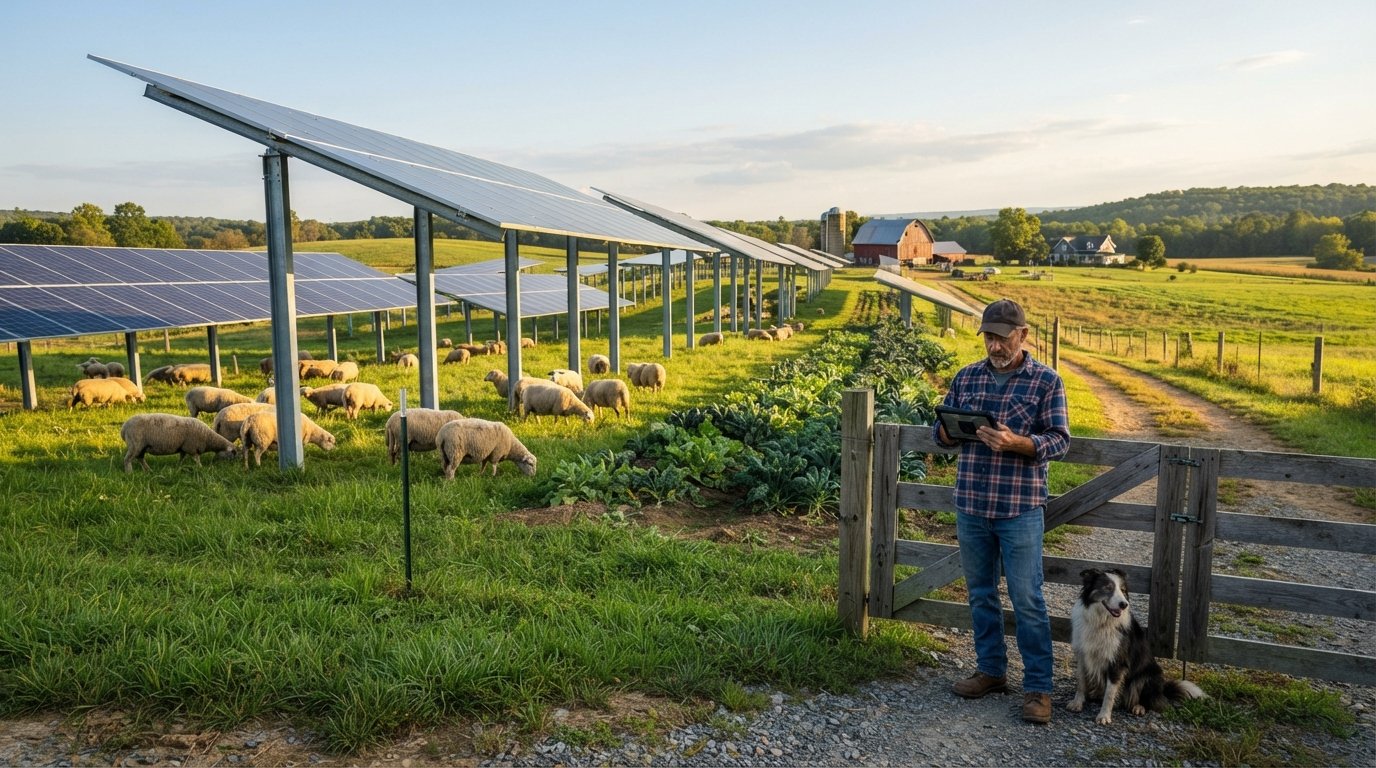
Agrivoltaics Solar Farming Income for Landowners
Agrivoltaics solar farming income for landowners can stack lease payments with grazing or crop revenue. Call (833)-434-4023 to plan your dual-use project.

By Adam Adler
Learn more about Solar Panel Installation and Repair for guides, costs, and what to expect.
Compare Solar Panel Installation and Repair Pros Near You

Enter your ZIP code to compare top-rated local professionals and request free quotes.
Farmland is expensive to hold, property taxes never sleep, and a single drought year can erase a season of margin. For many landowners, the question is no longer whether to diversify revenue but how to do it without selling acreage or abandoning agriculture entirely. Agrivoltaics, the practice of pairing solar panels with crops or livestock on the same parcel, has moved from university test plots into commercial projects across the United States, and it is creating a new income stream that complements rather than replaces the farm. The appeal is straightforward: you keep the land in production, you collect a lease or own the asset outright, and you hedge against commodity price swings that are entirely outside your control.
What makes agrivoltaics solar farming income for landowners worth serious study right now is the dual-use math. A conventional solar lease pays a fixed per-acre rent for 20 to 35 years, but it takes the land out of farming. An agrivoltaic design keeps grazing, forage, or shade-tolerant crops in the rotation, which means the landowner can stack agricultural revenue on top of energy revenue. In states with strong renewable portfolio standards and active rural electric cooperatives, the combined return can outperform either use alone. This article walks through how the model works, which crops and livestock fit, how lease and ownership economics compare, what federal and state programs support development, and what US research says about soil, water, and yield effects.
How Agrivoltaics Combines Crop or Grazing Land With Solar Arrays
The core design principle is height and spacing. Conventional utility-scale solar arrays mount panels roughly 3 to 5 feet off the ground and pack rows tightly to maximize megawatts per acre. Agrivoltaic arrays raise panels to 6 to 10 feet or more and widen row spacing so equipment, livestock, and sunlight can pass through. That design change reduces energy density per acre, but it preserves the agricultural function of the land, which is the entire point. Researchers at sites like the University of Massachusetts Crop and Animal Research and Education Farm have tested elevated arrays over hay and vegetable plots, while projects in the Upper Midwest have run sheep grazing beneath trackers that rotate to follow the sun.
From a landowner's perspective, the arrangement splits into two legal and financial structures. In a lease, a developer or utility owns and operates the array, pays you rent, and manages the vegetation, often with your livestock under a separate grazing agreement. In an ownership model, you or a cooperative finance the array, sell the electricity through a power purchase agreement or net metering arrangement, and keep the agricultural revenue directly. Most landowners start with the lease because it requires no capital and transfers construction, interconnection, and operations risk to the developer. Ownership makes sense for larger operations with access to capital, tax appetite for the investment tax credit, and a clear offtake path.
Interconnection is the gatekeeper in either model. The local utility must study whether the distribution or transmission grid can absorb the output, and that study can take 12 to 24 months in crowded markets. Landowners who begin conversations with their utility and a qualified developer early, before signing anything, tend to get better terms and fewer surprises. The same discipline applies to title work: mineral rights, easements, and existing farm loans can all complicate a solar lease, so a title review belongs at the front of the process, not the end.
Crops and Livestock Best Suited to Shaded Solar Environments
Not every crop tolerates partial shade, and pretending otherwise is the fastest way to a failed project. The strongest agrivoltaic candidates share three traits: they tolerate 30 to 50 percent shade, they have a harvest window compatible with panel maintenance, and they command a price that justifies the extra management complexity. Leafy greens, spinach, kale, and lettuce have performed well in elevated-array trials because they prefer cooler soil and bolt less in shade. Root vegetables like carrots and radishes, plus brassicas such as broccoli and cabbage, are also common test crops. Pasture and forage grasses are the workhorse option for grazing operations, and they pair naturally with sheep.
Livestock is where agrivoltaics has scaled fastest in the US. Sheep are the ideal species: they graze low, they do not scratch or peck at panel hardware, and they control vegetation that would otherwise require mowing or herbicide. Goats are riskier because they climb, and cattle are generally too tall and too rough for standard elevated arrays unless the racking is engineered for them. Poultry can work in mobile coops moved between rows, though shade and predator pressure need careful management. Pollinator habitat planted between rows is another revenue-adjacent option, supporting honey production and qualifying some projects for conservation cost-share programs.
Here is a practical shortlist of agrivoltaic pairings that US growers and researchers have validated or are actively testing:
- Sheep grazing on cool-season pasture beneath elevated or tracker arrays, with stocking rates adjusted to panel row spacing.
- Shade-tolerant vegetables (leafy greens, brassicas, root crops) in raised beds between panel rows, often with drip irrigation.
- Hay and forage production on the array footprint, harvested with compact equipment sized to the row geometry.
- Pollinator plantings and honeybee hives along array perimeters and between rows.
- Nursery and specialty crops in containers that can be moved to manage shade exposure.
The common thread is management intensity. A sheep operation under panels still requires fencing, water, predator control, and a plan for moving animals when panels are serviced. Vegetable production under arrays requires equipment that fits the rows and a labor schedule coordinated with the developer's maintenance windows. Landowners who treat the agricultural side as a real enterprise, not a decorative add-on, capture the dual-income benefit that agrivoltaics promises. Those who treat it as an afterthought usually end up with a conventional solar lease in all but name.
Lease Versus Ownership Economics for Farmland Solar Projects
Lease payments for agrivoltaic projects vary widely by region, project size, and grid value, but the structure is consistent. Developers typically offer a fixed annual rent per acre, often with 1 to 2 percent annual escalators, plus a decommissioning bond and restoration obligations at the end of the term. In strong markets, rents for dual-use projects can run several hundred to over a thousand dollars per acre per year, though the range is broad and depends heavily on interconnection capacity. The landowner keeps the agricultural revenue, which can add grazing or crop income on top. The tradeoff is control: the developer decides the array design, the vegetation plan, and the timeline, and the landowner's ability to farm the parcel is constrained by the lease terms.
Ownership flips the math. The landowner or a cooperative funds construction, claims the federal investment tax credit (currently a 30 percent base credit with additional adders for domestic content, energy communities, and low-income siting), and sells electricity through a power purchase agreement or net metering. Ownership can produce a higher long-term return, but it concentrates risk: construction cost overruns, interconnection delays, inverter failures, and offtake credit risk all land on the owner. For most family farms, a hybrid is the realistic path: lease the land to a developer for a utility-scale array while retaining a grazing agreement, or develop a smaller behind-the-meter system to offset farm electricity costs and keep the agricultural operation intact.
Financing options matter as much as the structure itself. USDA Rural Energy for America Program (REAP) grants can cover up to 50 percent of project costs for renewable energy systems, including solar, for agricultural producers and rural small businesses. Commercial lenders familiar with solar can finance the balance, and some rural electric cooperatives offer favorable terms for member-owned projects. Landowners exploring lower-capital pathways should also review low income solar financing programs and grants, which, while designed for households, illustrate the range of grant and credit structures that can reduce upfront burden on small-scale projects. On the ownership side, the investment tax credit and accelerated depreciation are the two largest levers, and both require tax counsel to model accurately.
One more economic factor deserves attention: the land itself. Solar leases can raise farmland values in areas with strong grid access, but they can also complicate a future sale because buyers inherit the lease terms. Easements, title exceptions, and restoration obligations should be reviewed by an attorney before signing. For landowners who may relocate or transfer the property to heirs, understanding how the lease interacts with a future sale is as important as the payment schedule. Resources like Moving.Homes relocation guides can help landowners think through the logistics of transitioning a property, though the lease review itself belongs with a real estate attorney.
Federal and State Programs That Support Agrivoltaic Development
Policy support for agrivoltaics has expanded meaningfully at both the federal and state levels. The Inflation Reduction Act created the foundation: the investment tax credit for solar, the production tax credit alternative, and bonus adders for projects in energy communities and those serving low-income consumers. For agricultural producers, USDA REAP provides grants and guaranteed loans for renewable energy systems and energy efficiency improvements. The Rural Utilities Service and rural electric cooperatives also fund distributed generation that can include agrivoltaic designs. On the conservation side, the Environmental Quality Incentives Program (EQIP) and the Conservation Reserve Program (CRP) can support pollinator habitat and vegetation management under and around arrays.
State programs fill in the gaps. Massachusetts, New Jersey, and Illinois have adopted agrivoltaic-specific incentives or set-asides within their solar programs, recognizing that dual-use projects cost more to build and deserve differentiated support. New York's NY-Sun program and its agricultural technical assistance resources have funded agrivoltaic research and demonstration projects. Minnesota's solar grazing programs pair sheep producers with solar site operators, creating a market for grazing services. Several states offer property tax abatements or exemptions for solar equipment, which can materially change the economics of an ownership model.
Net metering rules are the wild card. In states with strong net metering, a smaller behind-the-meter array can offset farm electricity costs at the retail rate, which is often more valuable per kilowatt-hour than a wholesale power purchase agreement. In states that have moved to avoided-cost compensation or export fees, the value proposition shifts toward self-consumption and storage. Landowners should verify current rules with their state public utility commission and their utility before modeling returns, because these policies change and are frequently under legislative review.
Soil, Water, and Yield Effects Documented in US Research
US research on agrivoltaics has matured from anecdotal observation to replicated field trials, and the findings are encouraging but nuanced. Studies at the University of Arizona's Biosphere 2 and field sites in the Southwest have documented meaningful water savings under elevated arrays, because panels reduce direct soil evaporation and moderate temperature extremes. In arid regions, that water savings can be as valuable as the electricity, particularly for irrigated forage and vegetable production. Research at the University of Massachusetts and in the Midwest has reported comparable or slightly reduced yields for shade-tolerant crops, with the best results in leafy greens and forage and the weakest results in full-sun row crops like corn and soybeans.
Soil health effects are still being quantified, but early results suggest that partial shade and reduced evaporation support microbial activity and can improve soil moisture retention. Pollinator plantings between rows contribute to beneficial insect populations and can support adjacent crop pollination. The microclimate under panels tends to be cooler and more humid than open field conditions, which can reduce heat stress on livestock and crops alike. These effects are site-specific, and landowners should expect variability based on soil type, rainfall, panel density, and crop choice.
The honest summary is that agrivoltaics is not a universal yield booster. It is a risk-management and diversification strategy that performs best when the agricultural component is matched to the site conditions. A sheep grazing operation under panels in the Northeast is a different proposition from a vegetable trial in the Southwest or a forage system in the Upper Midwest. Landowners should insist on site-specific data, talk to growers who have operated under arrays for multiple seasons, and build a plan that treats the agricultural enterprise as a genuine business line. Done well, the dual-income model can stabilize farm revenue, hedge against commodity volatility, and position the land for the next generation of energy and agricultural policy.
For landowners ready to move from research to a real project, the practical next step is a conversation with a qualified solar professional who understands dual-use design. SolarEnergy.ai connects landowners with vetted installers and provides tools like the solar savings calculator and incentives guide to model returns before committing capital. Whether you lease, own, or start with a small behind-the-meter system, the land under your care can work harder than it does today, and the income it generates can be as durable as the soil itself.
Learn more about Solar Panel Installation and Repair for guides, costs, and what to expect.
Compare Solar Panel Installation and Repair Pros Near You
Enter your ZIP code to compare top-rated local professionals and request free quotes.