When to Replace Solar Inverter Lifespan: 7 Clear Signs
Solar inverter lifespan is typically 10 to 15 years. Learn the 7 clear signs your inverter is failing and know exactly when to replace it to avoid losing power.

By Ryan Brooks
Learn more about Solar Panel Installation and Repair for guides, costs, and what to expect.
Compare Solar Panel Installation and Repair Pros Near You

Enter your ZIP code to compare top-rated local professionals and request free quotes.
Your solar panels are built to last 25 years or more, quietly converting sunlight into savings decade after decade. But the inverter, the device that acts as the brain of your entire solar system, operates under a much shorter clock. Most homeowners only think about their inverter when the monitoring app goes dark or the system stops producing entirely. By then, you are already losing money on every hour of downtime. Understanding when to replace solar inverter lifespan is not just about avoiding a sudden blackout; it is about protecting your return on investment and ensuring your system performs at its peak for the full duration of its life.
Many assume that a solar system is a set-and-forget investment, but the inverter is a moving part, electrically speaking. It works hardest on the hottest days, precisely when you need it most. Unlike the static panels on your roof, the inverter is constantly switching power, managing voltage, and communicating with the grid. This relentless workload leads to thermal stress and component fatigue. Knowing the difference between a minor fault and a terminal failure can save you hundreds of dollars in unnecessary service calls and prevent costly damage to your solar array.
This guide walks you through the critical indicators that your inverter is nearing the end of its road. We will break down the typical solar inverter lifespan, the specific failure modes you should watch for, and the financial logic behind replacement versus repair. Whether you have a string inverter in your garage or microinverters on your roof, you will leave with a clear action plan to keep your energy production high and your household powered efficiently.
Typical Solar Inverter Lifespan Expectations
Before you can spot the signs of failure, you need a baseline for what is normal. The industry standard for a string inverter, the most common type installed in residential settings, is between 10 and 15 years. This is a stark contrast to the 25 to 30 year performance warranty on your solar panels. If you bought your system a decade ago, your inverter is likely entering its twilight years right now. In contrast, microinverters and power optimizers, which are attached to individual panels, often carry warranties of 20 to 25 years, matching the panel lifespan more closely.
This discrepancy is not a design flaw but a trade-off. Centralized string inverters are cheaper to replace and easier to access for maintenance. They handle the DC to AC conversion for the entire array in one unit, which means they bear the brunt of the heat and electrical stress. Microinverters spread that load across multiple smaller units, reducing the strain on any single component. However, they are more expensive to install initially and harder to service if one fails, as it requires getting on the roof.
The environment plays a massive role in determining the actual lifespan. An inverter installed in a shaded, ventilated garage in Seattle will likely outlast an identical model baking in the Arizona sun next to a stucco wall. Heat is the primary killer of inverter electronics. Capacitors dry out, solder joints crack, and cooling fans seize up when exposed to extreme temperatures for prolonged periods. If your inverter is in direct sunlight or an unventilated space, expect a shorter operational life.
Sign #1: The Display Is Dead or Error Codes Appear
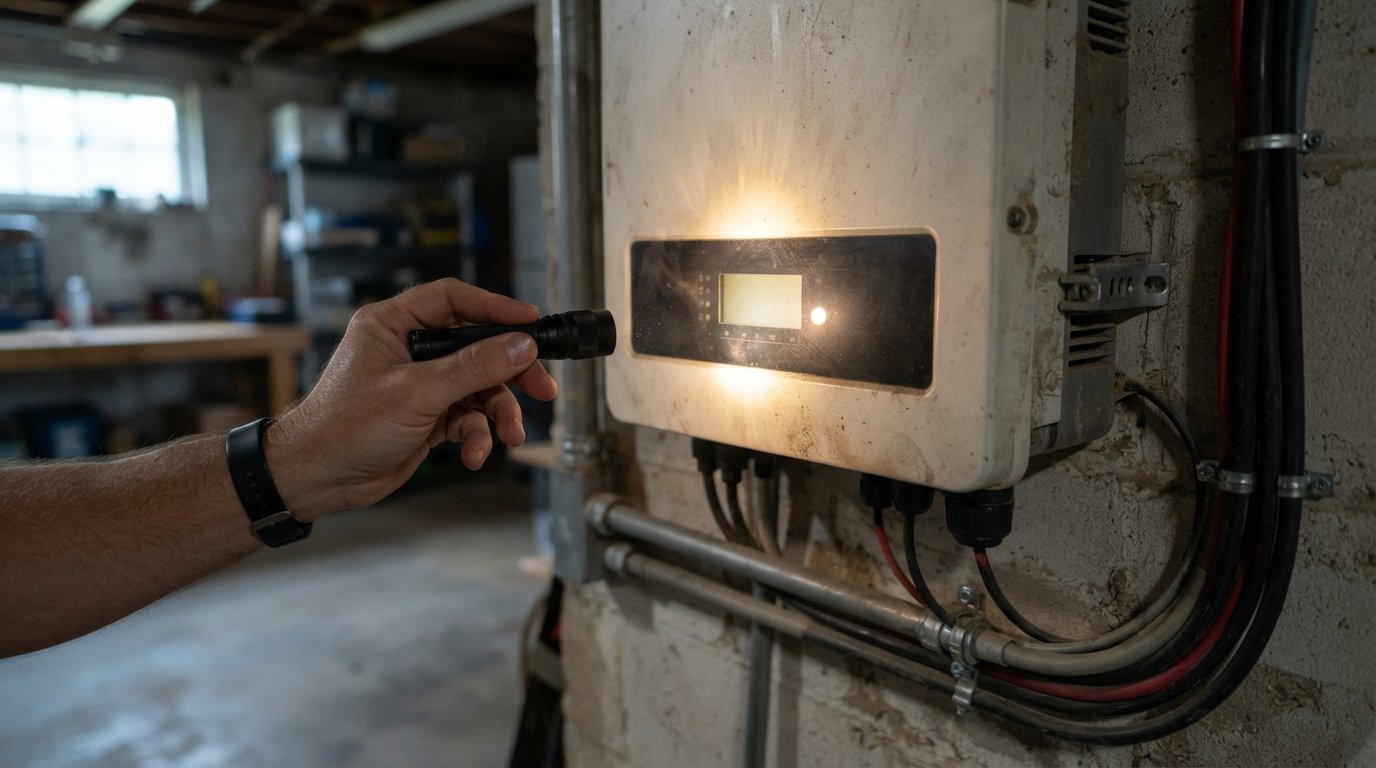
The first physical sign of trouble is often visual. A healthy inverter typically has a glowing green LED or a digital screen showing current power output. If the screen is blank or showing a red or orange fault light, the system has likely stopped converting power. While a blank screen can indicate a simple tripped breaker or a blown fuse, it often points to an internal power supply failure. If resetting the breakers does not bring the display back to life, the inverter's internal logic board may be fried.
Modern inverters are diagnostic machines. They display specific error codes that tell a technician exactly what is wrong. Codes like "Ground Fault" or "DC Arc Fault" are serious safety issues that must be addressed immediately. However, recurring nuisance codes such as "Grid Voltage Too High" or "Fan Error" often signal that the internal components are struggling to operate within their tolerances. If you see a code that clears itself and then returns within a few days, the inverter is usually degrading internally.
Do not ignore these warnings. A fault condition does not just stop production; it can leave your solar panels energized with DC power while the inverter is offline, creating a potential safety hazard for anyone working on the system. If you see persistent error codes, especially ones you have not seen before, it is time to call a professional. While a technician may clear the code, the underlying wear is usually irreversible, making this a prime indicator for when to replace solar inverter lifespan has been reached.
Sign #2: Production Has Dropped Significantly
Your solar monitoring platform is your best friend for spotting inverter degradation. If you notice a steady, unexplained decline in energy production that does not correlate with weather, shading, or seasonal changes, the inverter is likely losing efficiency. All inverters lose a small percentage of efficiency over time, but a sudden drop of 10 to 20 percent is a red flag. You are not just losing power; you are losing the financial value of every kilowatt-hour that is not being generated.
To diagnose this, compare your production data month over month and year over year. If your system produced 900 kWh last May and only 750 kWh this May under similar sunlight conditions, something is wrong. Panels rarely degrade this fast, so the inverter is the prime suspect. Internal capacitor degradation reduces the inverter's ability to smooth out the DC power, leading to inefficient conversion.
Another subtle sign is a change in the "DC to AC" ratio. The inverter may be blinking or showing a lower output than the panels are sending. This is often called "clipping" or "derating," where the inverter intentionally throttles back production to protect itself from overheating. While some clipping is normal on the sunniest days, chronic derating during mild weather indicates the inverter is running too hot internally and cannot handle its rated capacity. At this point, the cost of lost production often exceeds the cost of a new inverter.
Sign #3: Physical Wear and Audible Noise
Your ears can tell you a lot about your inverter's health. A healthy inverter emits a low, consistent hum from its cooling fan and transformer. If you hear loud grinding, clicking, or a high-pitched whine, the internal bearings are failing. A faulty fan will eventually cause the inverter to overheat, leading to a thermal shutdown. You might notice that the unit shuts off during the hottest part of the day and restarts in the evening, a clear sign of heat-related failure.
Physical inspection is equally important. Bulging or discolored capacitors on the circuit board are a death sentence for the unit. Look for any signs of burnt smell, soot, or melted plastic around the vents. This indicates that a component has failed catastrophically. Also, check for corrosion on the DC input terminals or the AC output wiring. Moisture ingress is a common cause of inverter failure, especially in humid climates or if the enclosure's rubber gaskets have dried out.
While a fan can be replaced individually, the labor cost to open up the unit and the risk of damaging other components often make it impractical. If the inverter is over eight years old and experiencing mechanical failures, replacement is usually the smarter financial choice. You would be paying hundreds of dollars to repair a unit that may only have a few years of life left anyway.
The Financial Math: Repair vs. Replace
When your inverter shows signs of failure, you will inevitably face a choice: fix it or swap it. For a unit under warranty, the choice is easy, you call the manufacturer and get a replacement. However, most inverter warranties are 10 or 12 years. If you are in year 13 or 14, the warranty is void. A service call to diagnose the issue will cost you anywhere from $150 to $300, just for the visit. Adding a repair, such as a new fan or a communication board, can easily run $500 to $800.
Now, weigh that against the cost of a new inverter. A standard 5kW string inverter will cost between $1,000 and $1,500 for the hardware, plus $500 to $800 for professional installation. In many cases, the delta between repairing an old unit and installing a new one is less than $500. The new unit will come with a fresh warranty, likely be more efficient, and might even have better monitoring features.
Here is a quick framework to help you decide:
- Age: If the inverter is over 10 years old, always replace. The repair will not extend life enough to justify the cost.
- Warranty Status: If it is under warranty, file the claim. If not, replacement is often the better route.
- Efficiency Gains: Newer inverters are 2-3% more efficient. Over 10 years, that efficiency gain can pay for a significant portion of the replacement cost.
- Safety: If there are signs of burning or a strong smell, do not repair. Replace immediately to avoid fire risk.
Replacing an inverter is also a chance to upgrade your system. If you have added battery storage or changed your electricity usage patterns, a new inverter with a larger capacity might be a worthwhile investment. Furthermore, a modern inverter with built-in rapid shutdown capabilities can increase the safety compliance of your older system.
How to Maximize Inverter Lifespan Before Replacement
Even if you are on the verge of replacement, understanding how to extend the life of your next unit is crucial. The most effective strategy is heat management. Ensure your inverter is installed in a location that avoids direct sunlight. A shaded north-facing wall or an interior garage wall is ideal. If your inverter is outdoors, consider building a small awning over it to block UV rays while allowing for airflow. Never enclose an inverter in a sealed box, as this will trap heat and void the warranty.
Keep the cooling fins and fan intake clean. Dust and pet hair can clog the vents, restricting airflow and causing the internal temperature to rise. You can use a can of compressed air to blow out debris every six months. Also, check the torque on the electrical connections annually. Loose connections create resistance, which generates heat and can melt terminals. A simple check with a thermal camera by a professional can identify hot spots before they cause a failure.
Finally, consider your monitoring habits. Set up alerts in your monitoring app to notify you of any fault codes or production drops immediately. The faster you respond to a minor issue, the less likely it is to cascade into a major failure. For those looking to upgrade, you can use resources like FreeSolarPowerQuotes to research installer costs and get competitive bids for a replacement, ensuring you do not overpay for the labor involved in your upgrade.
The Future: Smart Inverters and Extended Warranties
The market is shifting toward smarter, more durable hardware. Modern string inverters are designed with better thermal management and more reliable components, pushing their expected lifespan toward 15 years. Many manufacturers now offer extended warranty options, allowing you to purchase a 20-year warranty for a nominal fee. When buying a replacement, always ask about the extended warranty price. It is often the cheapest insurance you can buy for your solar asset.
Smart inverters also offer grid services that can help stabilize the local utility grid. These features require more complex communication hardware, but they also provide granular data about your system's health. If you are planning to add a battery later, ensure your new inverter is "battery-ready" or choose a hybrid inverter that can manage both solar and storage. This future-proofing prevents you from having to replace the inverter twice in five years.
Ultimately, the decision to replace your inverter is a balance of economics and reliability. A failing inverter is a drag on your system's performance and your wallet. By monitoring your production, understanding the error codes, and acting on the signs of physical wear, you can schedule a replacement on your terms rather than in an emergency. An inverter replacement is not a failure of your solar investment; it is a routine maintenance event that ensures your panels continue to generate clean, cheap power for another decade or more.
Don't wait for a complete system shutdown to act. If you have noticed any of the signs mentioned above, check your production data today and compare it to last month. If the numbers look off, call a certified solar technician for an assessment. The cost of a diagnostic visit is far less than the cost of weeks of lost production during the peak summer months. Taking proactive steps now will ensure your home continues to run on sunshine efficiently for years to come.
Learn more about Solar Panel Installation and Repair for guides, costs, and what to expect.
Compare Solar Panel Installation and Repair Pros Near You
Enter your ZIP code to compare top-rated local professionals and request free quotes.