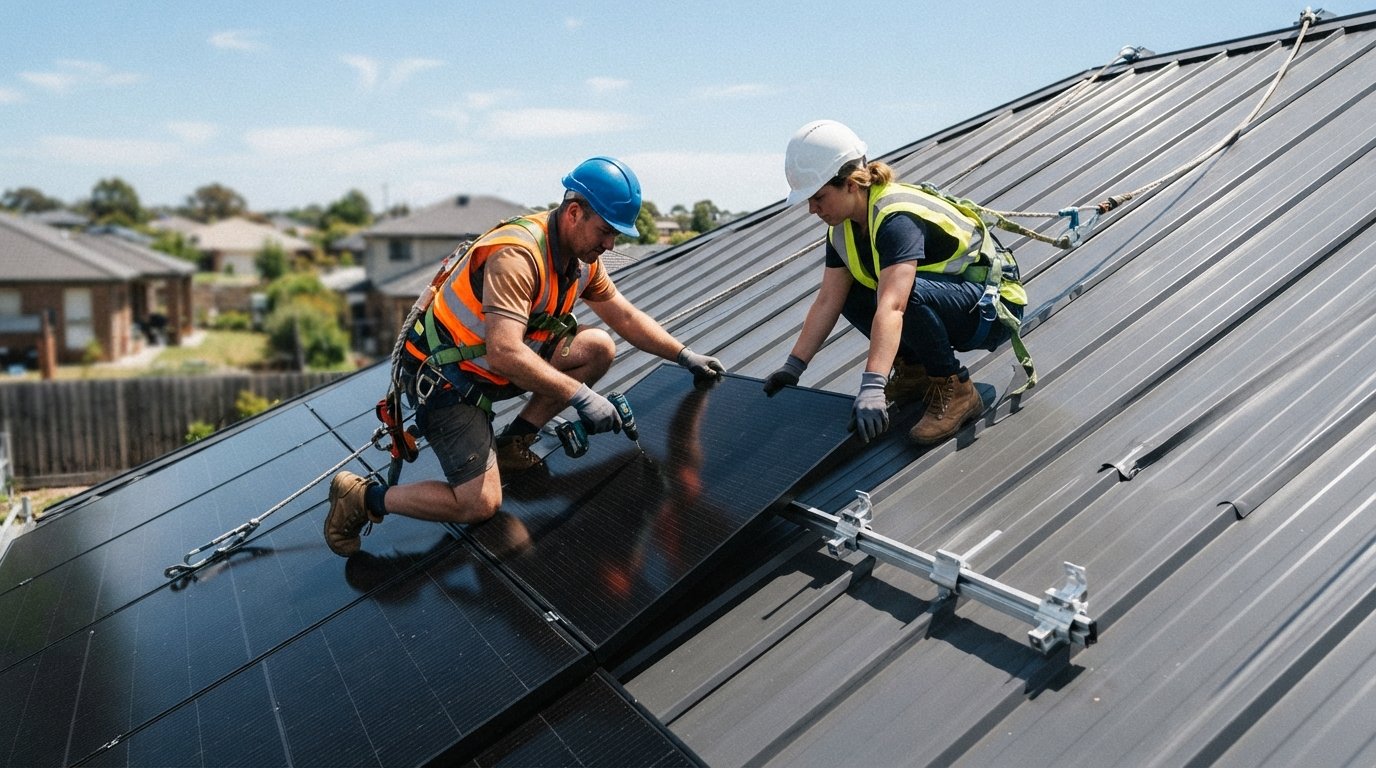
Standing Seam Metal Roof Solar Panel Installation Guide
Solar panel installation on metal roofs standing seam uses non-penetrating clamps to protect your roof warranty. Call (833)-434-4023 for expert guidance.

By Adam Adler
Learn more about Solar Panel Installation and Repair for guides, costs, and what to expect.
Compare Solar Panel Installation and Repair Pros Near You

Enter your ZIP code to compare top-rated local professionals and request free quotes.
If your home has a standing seam metal roof, you already own one of the most durable and energy-efficient roofing systems available. But when it comes to adding solar panels, that sleek metal surface raises a critical question: how do you mount solar panels without piercing the roof and voiding its warranty? The answer lies in understanding clamp-based mounting systems, seam spacing, and the careful coordination between roofing and solar professionals. This guide walks you through the essentials of solar panel installation on metal roofs standing seam, from non-penetrating clamps to corrosion concerns, so you can make an informed decision and protect your investment.
Why Standing Seam Metal Roofs Are Ideal for Solar
Standing seam metal roofs are increasingly popular among homeowners for their longevity, energy efficiency, and clean aesthetic. Unlike asphalt shingles, which may need replacement every 20 years, a quality metal roof can last 50 years or more. That makes it an excellent host for solar panels, which typically have a 25- to 30-year lifespan. Pairing the two means you may never need to remove and reinstall the solar array due to roof failure.
Moreover, metal roofs reflect sunlight and help reduce cooling costs, and they shed snow and rain efficiently. When you add solar panels, you amplify those benefits by generating clean electricity. But the key advantage for solar installation is the standing seam itself: the raised vertical seams allow for non-penetrating clamps that grip the seam securely without putting a single hole in the roof. This preserves the roof's integrity and manufacturer warranties, which is a major concern for homeowners.
However, not all metal roofs are created equal. Standing seam roofs have seams that run vertically, typically spaced 12 to 24 inches apart. The seam height and profile vary by manufacturer, and these details determine which clamps will work. Understanding your roof's specific seam spacing and profile is the first step in planning a solar installation that is both safe and code-compliant.
Clamp-Based Mounts vs. Penetrative Bracket Systems
When it comes to solar panel installation on metal roofs standing seam, there are two primary mounting approaches: clamp-based (non-penetrating) and penetrative bracket systems. Each has its place, but for standing seam, clamps are almost always the preferred method because they avoid roof penetrations.
Clamp-based mounts attach directly to the standing seam using stainless steel or aluminum clamps that are tightened with set screws. These clamps grip the seam firmly and provide a stable base for the solar racking rails. Because no holes are drilled, the roof's weatherproofing remains intact, and most metal roof manufacturers warrant their roofs against leaks when clamps are used according to specifications. This is a huge advantage for homeowners who want to avoid the risk of leaks and the hassle of resealing penetrations over time.
Penetrative bracket systems, on the other hand, require drilling through the metal panel and into the roof structure. While these can be used on corrugated metal roofs or when clamps are not feasible, they introduce potential leak points. Proper sealing with EPDM washers and sealant is essential, but even with careful installation, penetrations can void some roof warranties. For standing seam roofs, penetrative mounts are generally unnecessary and should be avoided unless the seam profile is incompatible with clamps.
To put it simply, here are the key differences:
- Clamp-based mounts: No roof penetrations, preserve warranty, faster installation, and less risk of leaks. They require compatible seam profiles and proper torque during installation.
- Penetrative brackets: Require drilling and sealing, may void warranty, higher leak risk, but can be used on roofs where clamps are not an option.
For most standing seam metal roofs, clamps are the clear winner. They also allow for thermal expansion and contraction of the metal roof, which is important because metal expands and contracts with temperature changes. A properly designed clamp system accommodates this movement without loosening over time.
Roof Seam Spacing and Panel Layout Constraints
The spacing of the standing seams directly affects how solar panels can be laid out on your roof. Seams are typically spaced 12, 16, or 24 inches on center, depending on the manufacturer and panel width. Solar panels themselves are usually about 39 to 41 inches wide (for residential modules), so the racking rails must be positioned to align with the seams at the correct intervals.
If your seams are spaced at 24 inches, you may need to use two clamps per seam per rail to ensure adequate support, or you may need to adjust the rail spacing. The goal is to ensure that the solar array is securely attached and that the load is distributed evenly across the roof structure. A professional installer will measure the seam spacing and consult the clamp manufacturer's specifications to determine the maximum allowable span between clamps.
Another constraint is the seam height and profile. Some clamps are designed for specific seam shapes, such as trapezoidal or bulb-shaped seams. Using the wrong clamp can result in an insecure attachment or damage to the seam. It is essential to identify your roof's seam profile and choose clamps that are explicitly compatible. Many clamp manufacturers provide a compatibility chart, and your installer should verify this before ordering materials.
Panel layout also needs to account for roof edges, ridges, and valleys. You want to avoid placing clamps too close to the edge of the roof, where wind uplift forces are highest. Local building codes may specify minimum edge distances, and your installer should follow them. Additionally, you need to leave enough space for thermal expansion and for water drainage. A well-planned layout will look clean and perform reliably for decades.
Corrosion, Dissimilar Metal, and Coating Compatibility
Metal roofs are susceptible to corrosion if incompatible materials are used together. The most common issue is galvanic corrosion, which occurs when two dissimilar metals come into contact in the presence of moisture. For example, if you use aluminum clamps on a steel roof, the aluminum can corrode rapidly, and the steel may also be affected. To avoid this, all mounting hardware that contacts the roof should be made of compatible materials, such as stainless steel or aluminum with a protective coating.
The roof coating also matters. Many metal roofs have a painted finish or a metallic coating like zinc or Galvalume. Clamps with sharp edges or set screws can scratch the coating during installation, creating a spot for rust to start. High-quality clamps have smooth surfaces and protective pads to prevent coating damage. Your installer should also avoid overtightening the set screws, which can deform the seam and compromise the coating.
Another consideration is the use of isolation tape or pads between dissimilar metals. Some clamp designs include a rubber or plastic barrier to separate the clamp from the roof seam, preventing galvanic corrosion. If your roof is made of steel with a zinc coating, stainless steel clamps are generally safe. For aluminum roofs, aluminum clamps are preferred. Always consult the roof manufacturer's recommendations for compatible mounting hardware.
Finally, think about the long-term effects of environmental exposure. Coastal areas with salt spray require extra corrosion resistance, so marine-grade stainless steel (316) is often recommended. In areas with heavy pollution or acid rain, protective coatings on the clamps can extend their life. By paying attention to these details, you can ensure that your solar installation on metal roofs standing seam remains corrosion-free for decades.
Working with Roofing and Solar Contractors on Warranty Coordination
One of the biggest concerns for homeowners is voiding the roof warranty. Most metal roof manufacturers offer warranties that cover both materials and labor, but they often have specific requirements for penetrations and attachments. Non-penetrating clamps are generally approved, but the installer must follow the manufacturer's guidelines. It is crucial to involve both your roofing contractor and your solar installer in the planning process to ensure warranty compliance.
Start by obtaining a copy of your roof warranty and reading the sections on attachments and modifications. Some warranties explicitly allow solar installations with clamps, while others may require prior approval or the use of specific products. If you are unsure, contact the roof manufacturer directly. A reputable solar installer will be familiar with these requirements and can provide documentation to protect your warranty.
Coordination between trades is also important for scheduling and quality control. Ideally, the solar installer should work with the roofing contractor to verify seam spacing and roof condition before installation. If your roof is older or showing signs of wear, it may be wise to address repairs or replacements before adding solar panels. After all, you do not want to remove the solar array to fix a roof issue later.
For homeowners seeking vetted professionals, platforms like ContractorHomeQuotes can help you find and compare local contractors who specialize in both metal roofs and solar installations. This ensures that all parties are on the same page regarding warranty and installation best practices.
Cost and Timeline Differences vs. Asphalt Shingle Installs
Solar panel installation on metal roofs standing seam often costs more than on asphalt shingles, primarily due to the specialized mounting hardware and the additional care required. Clamps are more expensive than standard flashing and brackets, and labor may be higher because installers need to be trained in metal roof practices. However, the extra cost can be offset by the fact that you avoid penetrations and potential leak repairs, and you preserve your roof warranty.
In terms of timeline, a standing seam installation can be faster because there is no need to drill and seal penetrations. Clamps are quick to install once the layout is set, and the racking goes up smoothly. However, the planning phase may take longer because of the need to verify seam compatibility and warranty requirements. On average, a residential solar installation on a metal roof takes one to three days, similar to asphalt shingle roofs, but the prep work may be more detailed.
For asphalt shingle roofs, installers use flashing and sealant around each penetration, which adds time and introduces potential failure points. Metal roofs with clamps eliminate that step, reducing the risk of leaks and callbacks. Over the life of the system, the lower maintenance and higher durability of metal roofs can lead to significant savings. Additionally, metal roofs reflect heat, which can improve solar panel efficiency by keeping the panels cooler.
When budgeting for your project, consider both the upfront cost and the long-term value. While the initial investment for solar panel installation on metal roofs standing seam may be higher, the combination of a longer-lasting roof and a non-penetrating solar array often results in a better return on investment. To explore how solar can reduce your energy bills, you can use tools like the AI in solar panel efficiency guide to understand how smart technology can further optimize your savings.
Frequently Asked Questions
Can I install solar on a standing seam metal roof without drilling?
Yes, absolutely. Clamp-based mounting systems are designed specifically for standing seam metal roofs and require no drilling. They grip the seams securely and preserve the roof's integrity and warranty.
What is the typical seam spacing for standing seam roofs?
Seam spacing is usually 12, 16, or 24 inches on center, but it varies by manufacturer. Your installer will measure the spacing to determine the correct clamp placement and rail configuration.
How do I prevent corrosion with solar mounts on a metal roof?
Use clamps made of compatible metals, such as stainless steel or aluminum, and ensure they have protective pads to avoid scratching the roof coating. Avoid mixing dissimilar metals without isolation barriers.
Will solar panels void my metal roof warranty?
Not if installed correctly. Most warranties allow non-penetrating clamps, but you should review your warranty terms and work with experienced contractors to ensure compliance.
How long does installation take on a metal roof compared to shingles?
The timeline is similar, typically one to three days, but metal roof installations may be faster because there is no need for flashing and sealing penetrations.
Installing solar panels on a standing seam metal roof is a smart investment that combines durability, energy efficiency, and warranty protection. By choosing non-penetrating clamps, verifying seam compatibility, and coordinating with qualified professionals, you can enjoy decades of clean energy without compromising your roof. Whether you are in the planning stages or ready to request quotes, taking the time to understand these details will pay off in the long run.