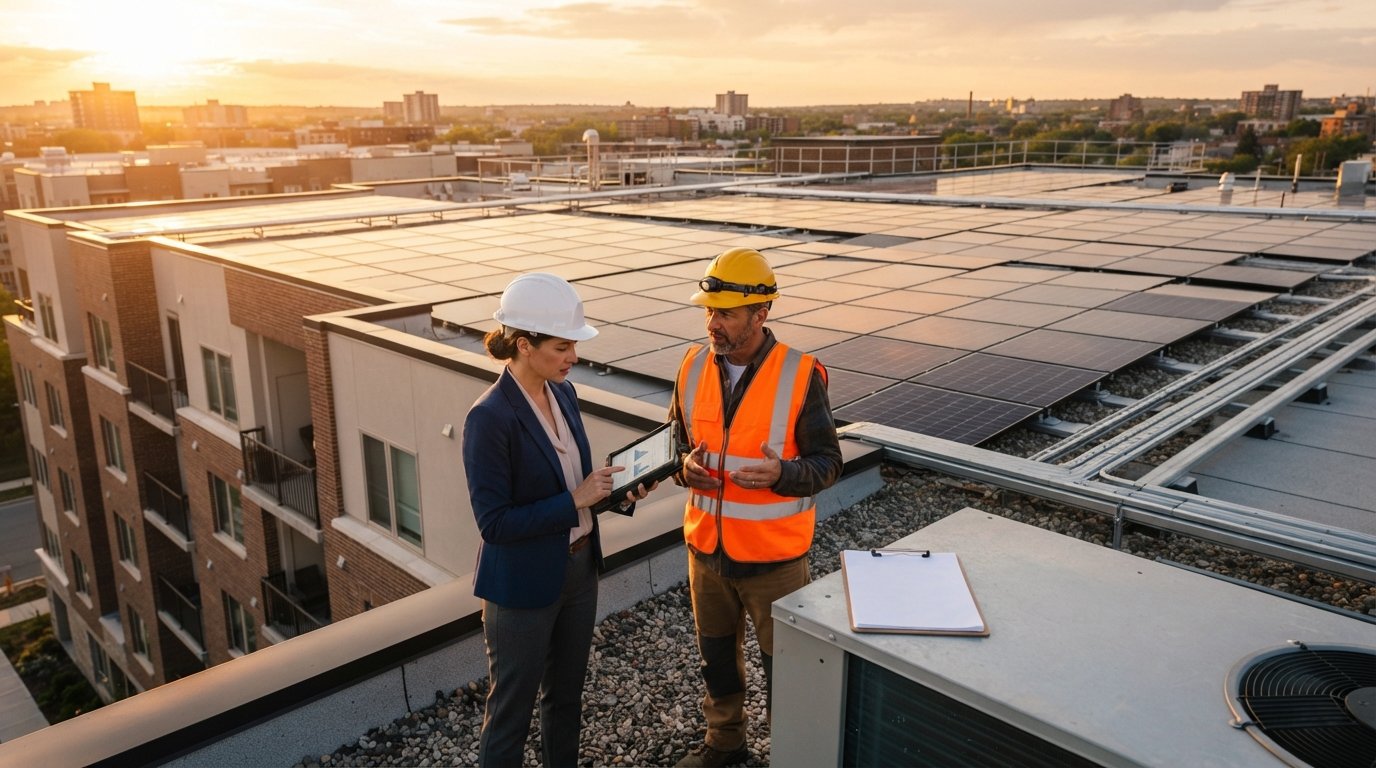
Solar System Financing for Multifamily and Rental Properties
Solar system financing for multifamily and rental properties can mean $0 upfront and immediate cash flow. Call 8334344023 for expert help.

By Owen Phillips
Learn more about Solar Panel Installation and Repair for guides, costs, and what to expect.
Compare Solar Panel Installation and Repair Pros Near You

Enter your ZIP code to compare top-rated local professionals and request free quotes.
Multifamily property owners face a unique challenge in 2026: tenants expect modern amenities and lower utility costs, but capital budgets are tight. Installing solar panels on an apartment complex or rental duplex can slash operating expenses and boost net operating income (NOI), yet the upfront cost often feels prohibitive. The good news is that solar system financing for multifamily and rental properties has evolved into a robust marketplace with options ranging from $0-down leases to commercial property assessed clean energy (C-PACE) loans. This guide breaks down how these financing structures work, which ones maximize cash flow, and how to avoid common pitfalls that erode returns.
Why Financing Beats Paying Cash for Rental Solar
Paying cash for a solar array on a rental property might seem like the simplest path, but it often ties up capital that could be deployed elsewhere. A 100-unit apartment building may require a 200 kW system costing $400,000 or more before incentives. Writing a check for that amount depletes reserves for roof repairs, vacancy turnovers, or emergency maintenance. Financing preserves liquidity while still capturing the long-term energy savings.
More importantly, the federal Investment Tax Credit (ITC) currently covers 30% of system costs for commercial installations, and many states add rebates or tax exemptions on top. When you finance, you can still claim these incentives, provided the ownership structure is correct. For example, a direct ownership loan lets you depreciate the asset and take the ITC yourself. A lease or power purchase agreement (PPA) transfers those benefits to the third-party owner in exchange for lower monthly payments or a fixed electric rate.
The key is matching the financing term to your hold period. If you plan to sell the property in five years, a 20-year loan may create a lien that complicates the sale. Conversely, a 7-year lease with a buyout option might align better with your exit strategy. Always model the financing against your pro forma to ensure the solar payment is less than the energy savings from day one.
Core Financing Structures for Multifamily Solar
There is no one-size-fits-all solution. The right choice depends on your tax appetite, credit profile, and whether you want to own the system outright. The following four structures dominate the market for rental properties with five or more units.
- Solar Loans (Direct Ownership): You borrow from a lender and own the system. You claim the 30% ITC, accelerated depreciation, and any state incentives. Monthly loan payments are often offset by reduced utility bills, creating positive cash flow if sized correctly.
- Solar Leases: A third party owns the system and leases it to you for a fixed monthly payment. You avoid upfront costs and maintenance, but you do not claim the ITC. Lease payments are typically lower than your previous electric bill.
- Power Purchase Agreements (PPAs): Similar to a lease, but you pay per kilowatt-hour (kWh) generated at a rate lower than the utility. This hedges against rate hikes and works well for properties with high common-area electric loads.
- C-PACE Financing: A property assessed clean energy loan that attaches to the property tax bill. It requires no upfront cash, offers long terms (up to 25 years), and transfers to the next owner upon sale. Ideal for large multifamily complexes.
Each structure has tax and accounting implications. For instance, a lease is treated as an operating expense, which reduces NOI and may lower property value under a cap-rate valuation. A loan, by contrast, is a balance sheet item and does not reduce NOI, potentially preserving valuation. Work with a CPA who understands renewable energy tax law before committing.
For landlords with smaller portfolios (2 to 4 units), residential-style financing may apply. Fannie Mae and Freddie Mac have green financing programs that offer better loan terms for energy-efficient improvements, including solar. These programs often require an energy audit, which can be arranged through platforms like SolarEnergy.ai that connect owners with vetted professionals.
How to Evaluate a Solar Financing Offer
Not all solar financing offers are created equal. Some lenders bury fees in the loan balance, while some leases escalate payments annually at rates that outpace utility inflation. To compare offers apples-to-apples, focus on these metrics:
- Effective Cost per Watt: Divide the total financed amount (including fees) by the system's DC wattage. Compare this to the cash price to see the financing premium.
- Monthly Payment vs. Energy Savings: The system should produce enough electricity to cover the payment plus a buffer. Ask for a production guarantee or estimated kWh output.
- Escalator Clause: Leases and PPAs often include an annual payment increase (e.g., 1.9%). Ensure the escalation rate is lower than your utility's historical rate hikes.
- Buyout Terms: If you want to own the system later, understand the fair market value (FMV) or predetermined buyout price. Some leases allow early purchase after 5 years.
- Transferability: If you sell the property, can the next owner assume the lease or loan? C-PACE and most leases are transferable, but loans may require lender approval.
Always request a detailed disclosure of all fees, including origination, dealer, and administrative charges. A reputable installer will provide a clear breakdown. If a salesperson pressures you to sign before reviewing the contract, walk away. The solar industry has matured, and transparent financing is now the norm.
One often-overlooked factor is the impact on property insurance. Rooftop solar adds replacement cost value, and some insurers require additional coverage. However, a well-installed system can also reduce risk by providing backup power during outages if paired with batteries. Discuss the installation with your insurance agent early to avoid surprises.
Incentives and Tax Credits in 2026
The federal solar Investment Tax Credit (ITC) remains at 30% for commercial systems through 2032, with a gradual step-down thereafter. For multifamily properties, the credit is available to the system owner, whether that is you (via a loan) or a third party (via a lease or PPA). Some states offer additional incentives, such as property tax exemptions, sales tax exemptions, and performance-based rebates.
Depreciation is another powerful benefit. The Modified Accelerated Cost Recovery System (MACRS) allows commercial solar assets to be depreciated over five years, and bonus depreciation may allow you to deduct a significant portion in year one. When combined with the ITC, these tax benefits can cover 50% or more of the system cost. However, tax equity rules are complex, so consult a tax advisor.
For affordable housing properties, the Low-Income Housing Tax Credit (LIHTC) program may offer additional incentives for solar. Some states have created carve-outs or adders for renewable energy in LIHTC developments. If you own or manage affordable housing, explore these opportunities with your state housing finance agency.
To find current incentives, use the Database of State Incentives for Renewables & Efficiency (DSIRE) or consult a solar professional. SolarEnergy.ai offers an Incentives & Rebates Guide that aggregates federal, state, and utility programs. Always verify eligibility and expiration dates, as programs can change annually.
Special Considerations for Rental Properties
Rental properties introduce a split-incentive problem: the landlord pays for the solar system, but the tenant receives the benefit of lower electric bills. This can make financing harder to justify unless you can recover the cost through higher rent or a utility allowance. Here are strategies to bridge that gap:
- RUBS (Ratio Utility Billing System): Allocate a portion of the solar savings to tenants via a utility bill, reducing your net cost.
- Green Lease Provisions: Include a clause that allows you to pass through a fixed solar fee or a share of savings.
- Higher Rents: Market the property as energy-efficient, justifying a premium of $20 to $50 per unit per month in many markets.
- Common Area Loads: Offset electricity for hallways, laundry rooms, and parking lot lights, which you pay directly.
For smaller landlords with just one or two rentals, the math is simpler: you can often install a system sized to offset the tenant's usage and include electricity in the rent. This attracts longer-tenured tenants and reduces vacancy. However, you must ensure the lease clearly states that the solar system is your property and that the tenant cannot alter it.
Another consideration is net metering. Some utilities allow you to roll over excess credits to other accounts, which is valuable if you have multiple properties. Others have moved to a lower export rate, reducing the value of excess generation. In those cases, sizing the system to match on-site consumption becomes critical. A professional energy audit can help you determine the optimal size.
Choosing the Right Installer and Financing Partner
The financing is only as good as the installation. A poorly installed system can underperform, void warranties, or even damage your roof. When selecting an installer, look for certifications from the North American Board of Certified Energy Practitioners (NABCEP) and a track record with multifamily projects. Ask for references from similar properties and review their safety record.
Financing partners matter too. Some lenders specialize in commercial solar and understand the nuances of tax equity, while others are general equipment financiers. Banks with green lending programs often offer better rates for energy-efficient improvements. Credit unions may also offer competitive terms for local properties.
If you prefer a turnkey approach, consider a solar service agreement where the installer handles financing, installation, and maintenance. This simplifies operations but may cost more over the life of the system. For owners who want to maximize ROI, direct ownership with a loan is often the most lucrative path.
To compare offers and get free quotes from pre-vetted solar providers, visit FreeSolarPowerQuotes. This platform connects you with reputable installers who can tailor a financing plan to your property's needs. It is a no-obligation way to see what is available in your area.
Frequently Asked Questions
Can I use solar financing for a duplex or triplex? Yes. While most commercial financing targets properties with five or more units, residential solar loans and leases are available for 2 to 4 unit properties. Fannie Mae's HomeStyle Energy loan can also finance solar as part of a mortgage refinance.
What happens if I sell the property before the loan is paid off? With a loan, you typically pay off the balance at closing, or the buyer may assume the loan if the lender allows. With a lease or PPA, the buyer must agree to assume the contract, which is usually straightforward but should be disclosed early in the sale process.
Do tenants have to pay for the solar electricity? Not necessarily. If you include electricity in the rent, you absorb the cost but benefit from lower bills. If you use RUBS, you can allocate a portion of the savings to tenants. The lease should clearly outline how solar costs and credits are handled.
Is solar worth it for a rental property with low electric rates? It depends on the local rates and incentives. In areas with high electric rates (e.g., California, New York, Massachusetts), solar is almost always a win. In low-rate states, the payback may be longer, but tax credits and depreciation can still make it attractive. Run a custom analysis using a tool like the Solar Savings Calculator on SolarEnergy.ai.
How does solar affect property taxes? Many states offer a property tax exemption for solar installations, meaning the added value is not assessed. However, C-PACE financing is repaid through a property tax assessment, so it will appear on your tax bill. Check your state and local rules.
Maximizing ROI Through Smart Energy Management
Financing is just the beginning. Once your solar system is installed, you can boost savings by integrating AI-driven energy management. These systems monitor production, consumption, and battery storage in real time, automatically shifting loads to maximize self-consumption. For example, they can charge batteries when solar production is high and discharge during peak utility rates, reducing demand charges.
For a deeper dive into how AI can cut bills and optimize solar performance, see our guide on AI Energy Management Systems: Cut Bills and Go Solar. It explains how these platforms work with your financing strategy to deliver faster payback.
Additionally, regular maintenance ensures your system produces as promised. Dirty panels can lose 15% to 25% of output, and faulty inverters can go unnoticed for months. Many financing agreements include monitoring and maintenance, but if you own the system, schedule annual inspections and cleaning. This protects your investment and keeps the savings flowing.
Finally, consider pairing solar with other energy efficiency upgrades, such as LED lighting, smart thermostats, and insulation. These measures reduce overall consumption, allowing you to size your solar system smaller and save on financing costs. Some green lenders offer better terms if you bundle efficiency improvements with solar.
In 2026, the landscape for solar system financing for multifamily and rental properties is more favorable than ever. With a range of options, from $0-down leases to C-PACE loans, you can find a structure that fits your financial goals. The key is to do your homework, compare offers, and work with trusted professionals. By taking action now, you can lock in lower operating costs, increase property value, and position your portfolio for long-term resilience.