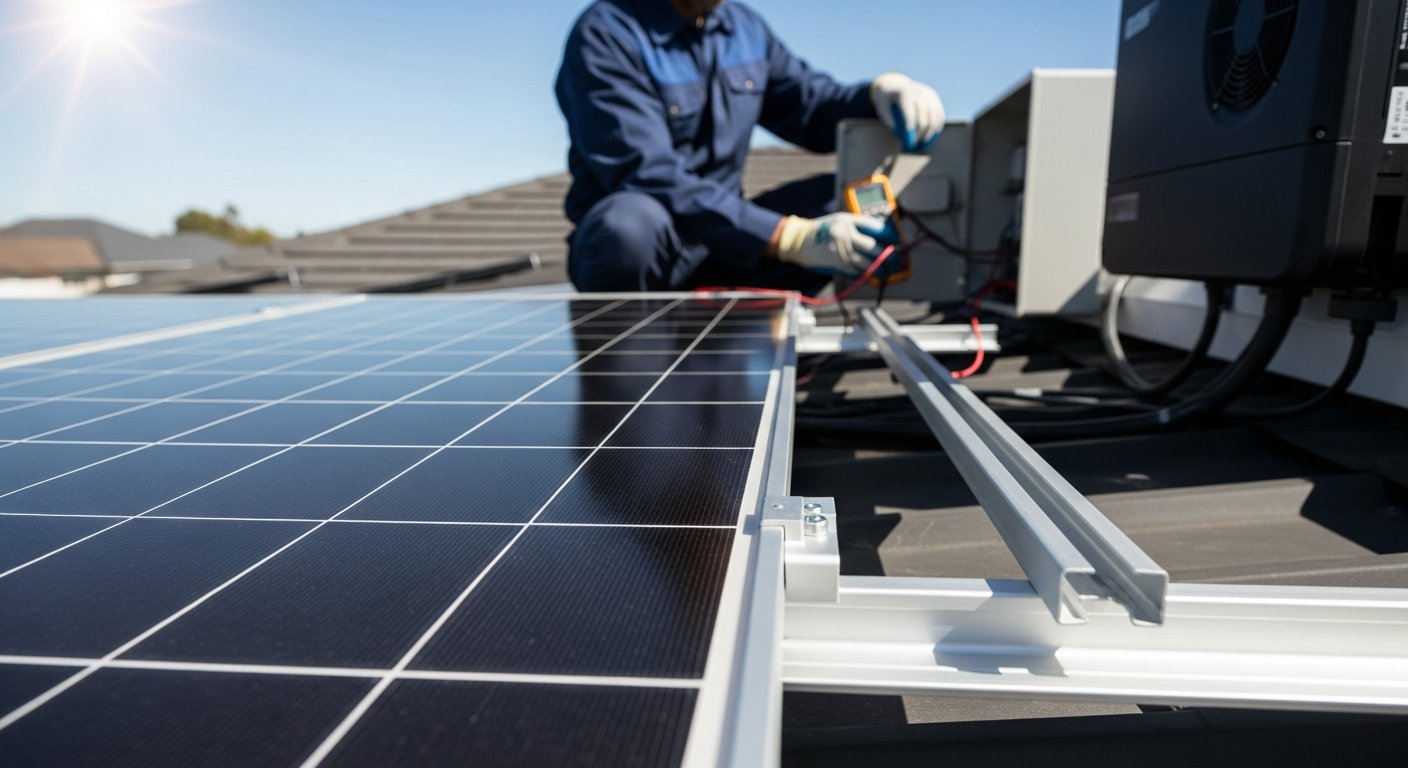
Solar System Components: Key Parts Explained
Learn how solar panels, inverters, batteries, and monitoring work together in a complete solar system to maximize your energy savings and home value.

By Dylan Harris
Learn more about Solar Panel Installation and Repair for guides, costs, and what to expect.
Compare Solar Panel Installation and Repair Pros Near You

Enter your ZIP code to compare top-rated local professionals and request free quotes.
When you consider switching to solar energy, the first image that often comes to mind is a rooftop covered in gleaming panels. While solar panels are the most visible part of a photovoltaic (PV) system, they are only one piece of a larger, interconnected puzzle. A fully functional solar installation relies on several critical components working together to capture sunlight, convert it into usable electricity, and deliver it safely to your home or business. Understanding these solar system components is essential for making informed decisions about installation, maintenance, and long-term savings. Whether you are a homeowner evaluating your first quote or a professional seeking to deepen your technical knowledge, this guide breaks down each element of a modern solar energy system, explaining its function, importance, and how it contributes to overall performance.
Solar Panels: The Heart of Energy Capture
Solar panels, also known as PV modules, are the most recognizable component of any solar energy system. Their primary job is to convert sunlight into direct current (DC) electricity through the photovoltaic effect. Each panel contains dozens of individual solar cells, typically made from silicon, that absorb photons and release electrons, creating an electric current.
There are three main types of solar panels available on the market today: monocrystalline, polycrystalline, and thin-film. Monocrystalline panels are the most efficient and space-efficient, making them ideal for residential rooftops with limited area. Polycrystalline panels offer a lower cost per watt but slightly lower efficiency. Thin-film panels are lightweight and flexible but require significantly more space, so they are less common for home installations. When choosing panels, you should consider efficiency ratings, temperature coefficient, degradation rate, and the manufacturer's warranty. Most quality panels come with a 25-year performance warranty, guaranteeing they will still produce at least 80% of their original output after that period.
The orientation and tilt of your panels also play a major role in energy production. In the United States, south-facing roofs at an angle between 15 and 40 degrees typically yield the highest annual output. However, east- and west-facing arrays can still be viable, especially with time-of-use utility rates. Shading from trees, chimneys, or nearby buildings can dramatically reduce performance, so a professional site assessment is critical before installation.
Inverters: Converting DC to Usable AC Power
While solar panels generate DC electricity, your home and the electrical grid operate on alternating current (AC). The inverter is the component responsible for this crucial conversion. Without a properly functioning inverter, the electricity from your panels would be unusable for most household appliances. Inverters also perform safety functions, such as shutting down the system during a grid outage to protect utility workers.
There are three primary inverter technologies used in solar systems today:
- String inverters: These are the most common and cost-effective option. All panels in a single string are connected to one inverter. The main drawback is that if one panel is shaded or underperforming, the output of the entire string drops to the level of the weakest panel.
- Microinverters: These small units are attached to each individual panel. They allow each panel to operate independently, maximizing energy harvest even when some panels are shaded. Microinverters also provide panel-level monitoring, making it easy to detect performance issues.
- Power optimizers: These devices are paired with a string inverter. Like microinverters, they are attached to each panel to condition the DC power before sending it to the central inverter. They offer many of the same benefits as microinverters but at a slightly lower cost.
Choosing between these options depends on your roof's shading profile, orientation, and budget. For complex roofs with multiple angles or partial shading, microinverters or power optimizers often deliver better long-term returns. For simple, unshaded south-facing roofs, a string inverter may be the most economical choice. In our guide on why solar systems need monitoring for maximum savings, we explain how advanced inverter technology enables real-time performance tracking.
Racking and Mounting Systems: Securing Your Investment
Solar panels do not simply sit on your roof; they are attached using a racking and mounting system that must withstand wind, snow, and seismic loads. This hardware is often overlooked by homeowners, but it is critical for the safety and longevity of the entire installation. A high-quality mounting system ensures that panels are properly angled for optimal sun exposure and that the roof remains watertight.
There are two main types of mounting systems: roof-mounted and ground-mounted. Roof-mounted systems are the most common for residential properties. They typically involve rails that attach to the roof rafters through flashing and seals to prevent leaks. Ground-mounted systems use poles or frames set into concrete foundations, allowing for optimal tilt and orientation adjustments. Ground mounts are often used when roof space is insufficient or when the roof is shaded.
Professional installers must follow strict building codes and manufacturer specifications when installing racking. Improper installation can void warranties and lead to costly roof damage. Additionally, some mounting systems now include integrated grounding and bonding features, which simplify installation and improve safety. The racking system also determines how easily panels can be removed for roof repairs or replacement, an important consideration for older homes.
Battery Storage: Energy Independence and Backup Power
Battery storage has become one of the most sought-after additions to solar systems, allowing homeowners to store excess energy generated during the day for use at night or during power outages. While not strictly required for a solar installation, batteries dramatically increase energy independence and can improve the financial return of a system by enabling time-of-use arbitrage. This means you can charge your battery when electricity rates are low and discharge it when rates are high.
Modern solar batteries are typically lithium-ion, which offer high energy density, long cycle life, and low maintenance compared to older lead-acid batteries. Popular home batteries include the Tesla Powerwall, LG Chem RESU, and Enphase Encharge. When sizing a battery, you should consider your daily energy consumption, the capacity you need for critical loads during an outage, and your budget. A typical home battery stores between 10 and 15 kilowatt-hours (kWh) of usable energy.
Batteries also come with their own inverter or can be integrated with a hybrid inverter that manages both solar and storage. Some systems are AC-coupled (the battery has its own inverter and connects to the AC side of the solar system), while others are DC-coupled (the battery connects directly to the solar array before the inverter). DC-coupled systems are generally more efficient because they avoid multiple DC-to-AC conversions. As battery technology continues to evolve, costs are declining, making storage more accessible for the average homeowner.
Monitoring Systems: Keeping an Eye on Performance
A solar monitoring system is the brain behind your energy setup, providing real-time data on production, consumption, and system health. Most modern inverters come with built-in monitoring capabilities, but third-party monitoring platforms can offer more detailed analytics and alerts. Monitoring helps you verify that your system is performing as expected and quickly identify issues such as a failed panel, inverter error, or shading problem.
Monitoring systems typically include a web portal or mobile app that displays:
- Real-time and historical energy production
- Energy consumption patterns (if paired with consumption monitoring)
- Carbon offset data
- System alerts and error codes
- Weather data and performance ratio
Advanced monitoring can also integrate with smart home systems and time-of-use rate schedules to optimize energy usage. For example, some systems can automatically divert excess solar power to an electric vehicle charger or water heater. The ability to track performance at the panel level (available with microinverters and power optimizers) is especially valuable for diagnosing issues quickly. To understand how artificial intelligence is transforming this space, read our analysis on how AI monitors solar systems in real time for savings.
Electrical Balance of System: Wiring, Disconnects, and Safety
Beyond the major components, a solar installation includes a variety of smaller but essential parts collectively known as the balance of system (BOS). This category covers wiring, conduit, junction boxes, fuses, circuit breakers, and disconnects. These components ensure that electricity flows safely from the panels to the inverter and then to your home's electrical panel or the grid.
One critical BOS component is the rapid shutdown device. Since 2017, the National Electrical Code (NEC) has required that solar systems include a rapid shutdown function that reduces the voltage on the roof to a safe level within 30 seconds. This protects firefighters and first responders in case of an emergency. Another important piece is the AC disconnect, a manually operated switch that isolates the solar system from the grid. This is required by most utility companies for interconnection.
Properly sized wiring and overcurrent protection are non-negotiable for safety and efficiency. Undersized wires can overheat and cause fires, while oversized fuses may not trip quickly enough during a fault. A licensed electrician should always handle the electrical BOS installation to ensure compliance with local codes and manufacturer specifications. The quality of these components directly impacts the reliability and lifespan of your entire solar system.
Comparing System Types: Grid-Tied vs. Off-Grid vs. Hybrid
The specific combination of solar system components you need depends on the type of system you choose. There are three main configurations, each serving different goals and budgets.
Grid-tied systems are the most common for residential homes. They connect directly to the utility grid and do not include battery storage. Excess energy is sent to the grid in exchange for net metering credits, which offset the cost of electricity you draw from the grid at night. These systems are the least expensive because they require fewer components. However, they do not provide backup power during a grid outage. For safety, grid-tied inverters automatically shut down when the grid goes down, preventing backfeed onto utility lines.
Off-grid systems are completely independent of the utility grid. They require a larger battery bank to store enough energy for nighttime and cloudy days, as well as a charge controller to manage battery charging. Off-grid systems also typically need a backup generator for extended periods of low sun. These systems are more complex and expensive, but they offer total energy independence. They are ideal for remote cabins, RVs, or locations where grid connection is prohibitively expensive.
Hybrid systems combine grid connection with battery storage. They offer the best of both worlds: you can store solar energy for backup power during outages and still sell excess energy back to the grid. Hybrid systems use advanced inverters that can manage multiple power sources simultaneously. This is the fastest-growing segment of the residential solar market. For a detailed comparison of cost and performance, see our article on AI vs traditional solar systems: which saves more.
Ultimately, the best system type depends on your location, utility rates, energy needs, and budget. A professional solar installer can help you evaluate these factors and design a system that maximizes your return on investment. Regardless of the configuration, each component must be carefully selected and integrated to ensure safety, reliability, and optimal energy production. By understanding the role of every part, from the panel on your roof to the circuit breaker in your basement, you can make confident decisions that lead to years of clean, affordable energy.
Learn more about Solar Panel Installation and Repair for guides, costs, and what to expect.
Compare Solar Panel Installation and Repair Pros Near You
Enter your ZIP code to compare top-rated local professionals and request free quotes.