Solar Power for Tiny Homes and Off Grid Cabins: Cost Breakdown
Get a realistic solar power for tiny homes and off grid cabins cost breakdown, from battery banks to backup generators. Call (833)-434-4023 for expert help.

By Dylan Harris
Learn more about Solar Panel Installation and Repair for guides, costs, and what to expect.
Compare Solar Panel Installation and Repair Pros Near You

Enter your ZIP code to compare top-rated local professionals and request free quotes.
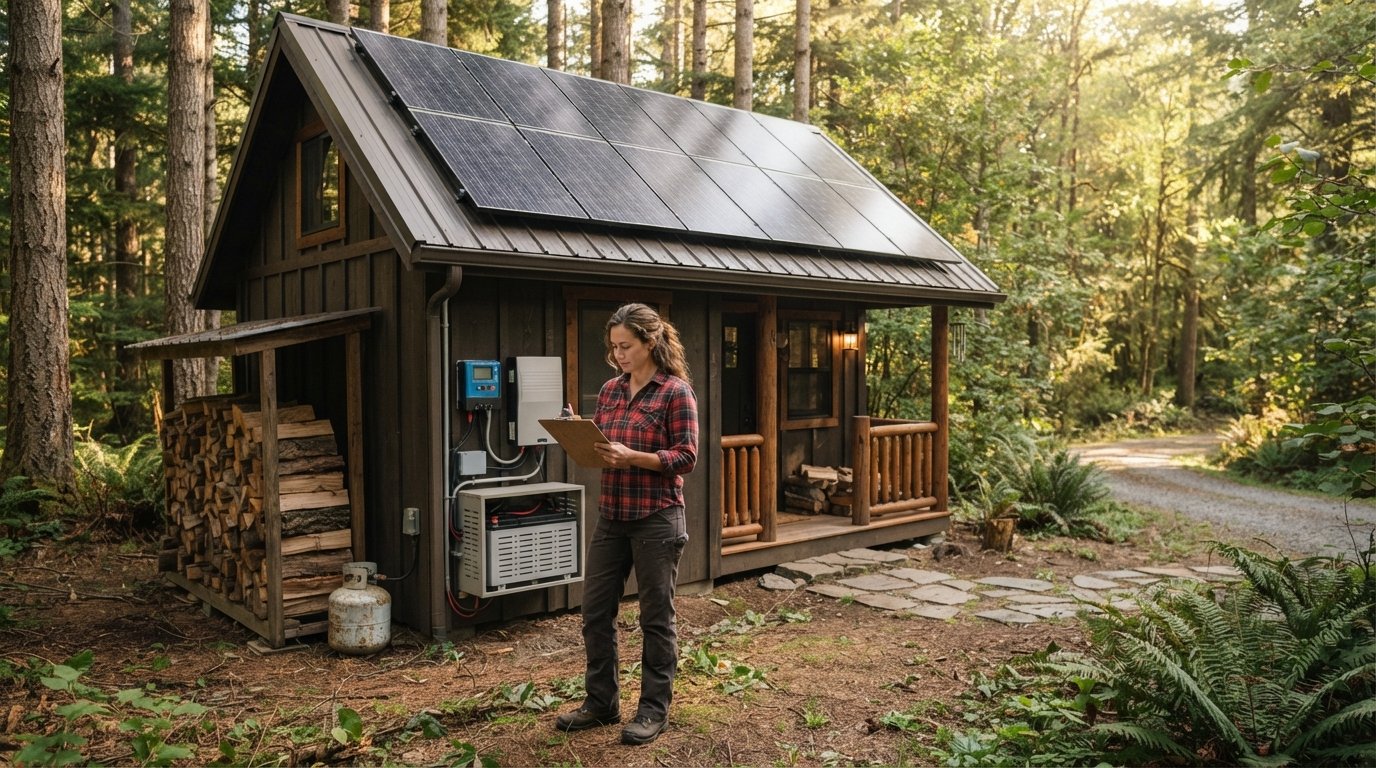
When you picture a tiny home or off grid cabin, you probably imagine quiet mornings, a wood stove, and a roof full of solar panels. What you might not picture is the real price tag: a fully off grid solar system can range from $8,000 for a minimal weekend setup to $35,000 or more for a full time, four season home. That spread confuses a lot of owners, because solar quotes for tiny structures vary wildly. The reason is simple: cost is driven by how much energy you use, how often you use it, and how much backup you need for cloudy weeks and winter. This guide breaks down solar power for tiny homes and off grid cabins cost breakdown so you can budget with confidence and avoid the two most common mistakes: undersizing the battery bank and forgetting the hidden costs of permits and code compliance.
Start With a Load Audit, Not a Panel Count
Before you look at solar panels, you need to know what you are powering. A load audit is a simple inventory of every device you plan to run, how many watts it draws, and how many hours per day it runs. For tiny homes and cabins, the list is short but the stakes are high: a single inefficient refrigerator can use more power than all your lights and electronics combined. Start by listing the essentials: lights, a water pump, a fridge, a fan or small AC, a laptop, a router, and a phone charger. Then add the optional loads: a coffee maker, a blender, a TV, or a power tool charger.
For a compact off grid setup, here are typical daily energy users and their approximate consumption:
- LED lights: 4 to 6 bulbs at 5 to 10 watts each, 4 hours per day = about 100 to 240 watt hours
- Water pump: 1/2 HP pump, 400 to 800 watts, 0.5 to 1 hour per day = 200 to 800 watt hours
- Refrigerator: 10 to 15 cubic feet, 1 to 1.5 kWh per day (a 12V efficient model can cut this in half)
- Internet and electronics: router, laptop, phone, 100 to 300 watt hours per day
- Small fan or evaporative cooler: 50 to 200 watts, 4 to 8 hours per day = 200 to 1,600 watt hours
Add those up and a modest cabin might use 1.5 to 3 kWh per day. A full time tiny home with a standard fridge, a small AC, and a work-from-home setup can easily reach 5 to 8 kWh per day. That difference matters: doubling your daily energy use roughly doubles your battery and panel costs. If you want a shortcut, use an online load calculator or a plug-in power meter to measure actual usage for a week. Many owners are surprised to find that their biggest load is not the lights but the fridge or a space heater.
Once you have your daily watt hours, divide by 0.8 to account for system losses (inverter efficiency, wiring, and battery round-trip). That gives you the solar array size you need in kilowatts. For example, 3 kWh per day divided by 0.8 equals 3.75 kWh, which means roughly 1 kW of panels in a sunny climate with 4 to 5 peak sun hours. In cloudy regions, you will need 1.5 to 2 kW to reliably cover the same load. This is the foundation of any solar power for tiny homes and off grid cabins cost breakdown: get the load right, and every other number falls into place.
Battery Bank Sizing for Weekend vs Full Time Use
Batteries are the most expensive component of an off grid system, and the most common source of budget overruns. The size you need depends on how many days of autonomy you want, meaning how many cloudy days you can ride out without sun. A weekend cabin might only need one day of autonomy because you can skip a trip if the weather is bad. A full time home needs three to five days to be safe, especially in winter.
Here is a simple framework for sizing your battery bank:
- Calculate your daily kWh use. Use the load audit above.
- Choose days of autonomy. Weekend: 1 to 2 days. Full time: 3 to 5 days.
- Account for depth of discharge. Lithium (LiFePO4) can safely use 80 to 90 percent of capacity; lead acid should only use 50 percent.
- Add a margin for cold temperatures. Lithium loses capacity in freezing weather, so oversize by 10 to 20 percent if you live in a cold climate.
For a weekend cabin using 2 kWh per day with 2 days of autonomy and lithium batteries at 80 percent depth of discharge, you need about 5 kWh of battery capacity. That is roughly one 48V 100Ah lithium battery (5.12 kWh), which costs $1,500 to $2,500. For a full time tiny home using 6 kWh per day with 4 days of autonomy, you need 30 kWh of storage, or about six of those batteries, which pushes the battery cost to $9,000 to $15,000. That is the single biggest line item in most off grid budgets, and it is why full time systems cost so much more than weekend setups.
Panel wattage follows the same logic. A weekend cabin with 2 kWh daily use and 4 peak sun hours needs about 625 watts of panels after losses. A full time home with 6 kWh daily use and 3.5 peak sun hours in winter needs about 2,150 watts. Panel costs have fallen to $0.50 to $1.00 per watt for DIY buyers, so the panel itself is rarely the budget breaker. The balance of system (charge controller, inverter, wiring, mounting, and fuses) often costs as much as the panels and batteries combined. For a detailed look at how intelligent controls can stretch every watt, see this guide to intelligent solar power systems that save more on energy bills.
Generator or Alternator Backup for Winter and Cloudy Weeks
No off grid system is complete without a backup plan. Even a well sized array can struggle during a week of heavy clouds or snow cover. A small generator or a DC alternator on your vehicle can bridge the gap and let you keep a smaller, cheaper battery bank. The goal is not to run your whole house on a generator, but to recharge the batteries when solar production drops below your daily use.
For a weekend cabin, a 2,000 watt inverter generator (around $500 to $900) is usually enough to run a battery charger and a few loads. For a full time tiny home, a 3,500 to 5,000 watt generator ($800 to $1,500) can power a 48V charger at 50 to 80 amps, recharging a 10 kWh battery bank in a few hours. If you already own a truck or SUV, a 200 to 300 amp alternator with a DC-to-DC charger ($300 to $600) can add 2 to 3 kWh of charge per hour of driving, which is a quiet and fuel-efficient backup for weekend trips.
Budget $500 to $1,500 for backup equipment, plus fuel and maintenance. Some owners skip the generator entirely and rely on a larger battery bank and a few extra panels, but that trade-off usually costs more upfront. A generator is cheap insurance, and it also gives you a way to run power tools or a welder during construction. Just make sure your inverter and charge controller can accept generator input, and that you have a safe, ventilated spot to store fuel.
Permits, Inspection, and Code Considerations for Small Structures
Off grid does not mean off the grid of regulations. Most jurisdictions require a permit for any structure with electrical wiring, and many require a solar permit even for a cabin. The rules vary widely: some rural counties have no inspections for small cabins under 200 square feet, while others require full plan review, engineered drawings, and a licensed electrician. Before you buy a single panel, call your local building department and ask three questions: Do I need a permit for a tiny home or cabin? Do I need a separate solar or electrical permit? What inspections are required, and can I do the work myself?
Common code requirements for off grid systems include:
- Disconnect means: a visible, lockable disconnect between the solar array and the charge controller, and between the battery bank and the inverter
- Grounding and bonding: proper equipment grounding, especially for metal roofs and trailers
- Conduit and wiring methods: outdoor-rated conduit and UV-rated wire for exposed runs
- Battery ventilation and placement: lithium batteries need temperature control; lead acid needs ventilation
- Signage: warning labels for dual power sources (solar and generator)
Permit and inspection costs typically run $200 to $1,500 depending on your location and the scope of work. If you hire a licensed electrician for the final connections and inspection, add $500 to $2,000. These soft costs are easy to overlook, but they are part of the real solar power for tiny homes and off grid cabins cost breakdown. Skipping permits can void insurance and create problems when you sell the property, so budget for them from the start.
Full Cost Breakdown by System Size
Now let us put the numbers together. The table below shows realistic installed costs for three common off grid scenarios, using mid-range lithium batteries and DIY or owner-builder labor. If you hire a full service installer, add 20 to 40 percent to these figures.
- Weekend cabin (2 kWh/day, 1 to 2 days autonomy): panels $600 to $1,000; batteries $1,500 to $2,500; charge controller and inverter $800 to $1,500; mounting and wiring $500 to $1,000; backup generator $500 to $900; permits and inspection $200 to $800. Total: $4,100 to $7,700.
- Full time tiny home, mild climate (6 kWh/day, 3 days autonomy): panels $1,500 to $2,500; batteries $7,000 to $12,000; charge controller and inverter $1,500 to $3,000; mounting and wiring $1,000 to $2,000; backup generator $800 to $1,500; permits and inspection $500 to $1,500. Total: $12,300 to $22,500.
- Full time cabin, cold climate with well pump (8 kWh/day, 4 days autonomy): panels $2,000 to $3,500; batteries $10,000 to $16,000; charge controller and inverter $2,000 to $4,000; mounting and wiring $1,500 to $2,500; backup generator $1,000 to $1,800; permits and inspection $800 to $2,000. Total: $17,300 to $29,800.
These ranges assume you do some of the work yourself and shop carefully. Turnkey installers often charge $25,000 to $40,000 for a full time off grid system, and that is before any battery replacement costs in 10 to 15 years. The good news is that you can phase your build: start with a smaller system and add panels or batteries later as your budget allows. Many owners begin with a weekend setup and expand it when they move in full time.
To compare your options and get a sense of what local installers charge in your area, you can request quotes through a trusted marketplace. For a free quote in minutes from vetted solar professionals, visit NewSolarQuotes. They connect homeowners with local experts who can size a system for your specific cabin or tiny home, and they can help you understand incentives that may apply even to off grid properties.
Hidden Costs and Money-Saving Tips
Beyond the major components, a few hidden costs can blow your budget if you are not careful. Shipping for batteries and panels can add $200 to $800, especially for heavy lithium batteries that require freight. Mounting hardware for a metal roof or a ground mount can cost more than you expect, and snow guards or tilt mounts add another $300 to $1,000. If you need a trench for underground wiring from a ground mount to the cabin, budget $10 to $30 per foot. And do not forget tools: a crimper, a multimeter, and a torque wrench are essential, and they can add $150 to $400 if you do not already own them.
Here are a few ways to keep costs down without sacrificing reliability:
- Buy efficient appliances first. A 12V refrigerator and LED lights can cut your daily load in half, which shrinks every other component.
- Start with a smaller battery and add later. Lithium batteries are modular, so you can begin with one and expand as your budget allows.
- Use a generator for heavy loads. Run power tools, a welder, or a space heater on a generator instead of sizing your solar system for them.
- Check for incentives. The federal residential clean energy credit may apply to off grid systems, and some states offer additional rebates. Always verify with a tax professional.
Finally, remember that the cheapest system is the one sized correctly the first time. Oversizing batteries and panels wastes money, but undersizing leads to generator dependence and premature battery failure. Take the time to do a real load audit, measure your actual usage, and plan for the worst week of weather in your area. That is the difference between a cabin that feels like freedom and one that feels like a never-ending construction project.
Solar power for tiny homes and off grid cabins cost breakdown comes down to three numbers: daily energy use, days of autonomy, and backup capacity. Nail those down, add 15 percent for surprises, and you will have a realistic budget that lets you enjoy the quiet parts of off grid living. Whether you are building a weekend retreat or a full time homestead, the right system is within reach when you plan from the load up, not the panel down.