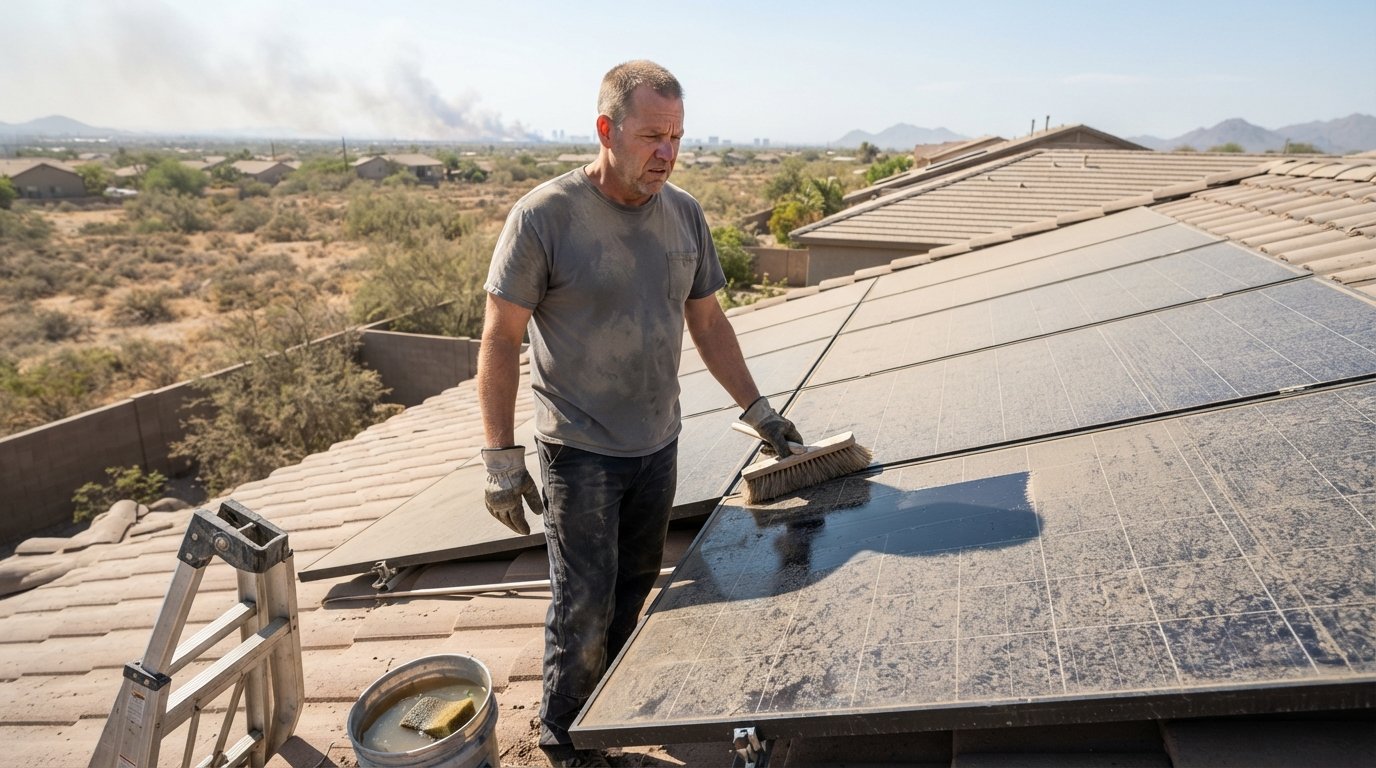
Solar Panel Soiling Loss After Dust Storms and Wildfire Smoke
Solar panel soiling loss after dust storms and wildfire smoke can cut output by 5% to 30%. Call (833)-434-4023 for a professional cleaning assessment.

By Victor Walsh
Learn more about Solar Panel Cleaning for guides, costs, and what to expect.
Compare Solar Panel Cleaning Pros Near You

Enter your ZIP code to compare top-rated local professionals and request free quotes.
Your solar array just survived a dust storm or a week of wildfire smoke, and now your inverter app shows a dip in production. Is it dirt, smoke, or something worse? The answer matters more than most homeowners realize: soiling loss after dust storms and wildfire smoke can quietly shave 5% to 30% off your system's output, and in extreme cases even more. Unlike a broken panel, soiling is invisible from your couch, and it rarely triggers an error code. It simply makes your meter spin a little slower and your savings a little smaller. Understanding how dust, ash, and smoke interact with your panels, when cleaning is worth the cost, and how to monitor production so you catch losses early is the difference between a system that pays for itself on schedule and one that underperforms for years.
How Dust Storms and Wildfire Smoke Create Soiling Loss
Soiling is the accumulation of particles on the glass surface of a solar panel. Dust storms deposit coarse mineral grains and fine silt. Wildfire smoke carries ash, char, and volatile organic compounds that can stick to glass and, over time, form a stubborn film. Pollen adds a seasonal sticky layer that traps even more dust. Each particle type blocks or scatters sunlight before it reaches the photovoltaic cells, and the effect compounds because a dirty surface also attracts moisture, which cements particles in place.
The physics is straightforward: every gram of dust per square meter reduces transmittance. Research from arid regions shows that a heavy dust event can cut output by 10% to 20% within hours, while fine ash from wildfires can reduce production by 5% to 15% depending on concentration and wind. The loss is not always uniform. Panels tilted at lower angles accumulate more debris, and the bottom row of a rooftop array often soils faster because dust slides down and collects at the frame edge. In snow country, dark ash on white snow can also change albedo and affect bifacial gains, though that is a secondary concern for most residential systems.
What makes soiling after dust storms and wildfire smoke especially tricky is that it can look minor while doing real damage. A thin, even layer of ash may be barely visible, yet it can cost you several percentage points of daily yield. And because solar production naturally varies with weather, homeowners often blame clouds or shorter days instead of dirt. The result: months of lost generation before anyone notices.
Regional and Seasonal Patterns: Where Soiling Hits Hardest
Soiling loss is not evenly distributed across the United States. The Southwest, including Arizona, Nevada, New Mexico, and parts of California, faces the highest dust loads, with spring and early summer winds lifting desert silt onto rooftops. The Great Plains and Texas see dust events from agricultural activity and dry fronts. Wildfire smoke, meanwhile, has become a seasonal reality across the West and increasingly the Midwest and East, where Canadian wildfire smoke drifted in recent summers. Pollen seasons add a spring layer in the Southeast and Northeast.
Seasonality matters for cleaning decisions. In dusty regions, the period after a wind event is the highest-risk window. In wildfire zones, late summer and fall bring smoke and ash that may settle for weeks. In agricultural areas, harvest season can coat panels with chaff and dust. Homeowners in these regions should expect to clean or have panels cleaned more often than the generic once-a-year advice suggests. A system in Phoenix may need attention twice a year, while a rooftop in Seattle may rarely need manual cleaning at all.
It also helps to think in terms of tilting and mounting. Steeply pitched roof arrays shed dust and ash more effectively than low-slope or flat-mounted systems. Ground-mounted arrays can be easier to inspect and clean, which is one reason some rural homeowners prefer them. If you are still sizing a system, our guide on a 200 watt solar panel explains how small arrays behave in off-grid and shed applications, where soiling can be even more noticeable because there is less generation headroom.
When Output Loss Justifies Professional Cleaning
The practical question is not whether soiling exists (it almost always does) but whether the lost energy is worth the cost of cleaning. A simple rule of thumb: if production monitoring shows a sustained drop of 5% or more compared with a clean baseline under similar weather, cleaning is usually justified. For a typical 8 kW residential system producing about 1,200 kWh per month, a 5% loss equals 60 kWh, which at 15 cents per kWh is roughly $9 per month. A professional cleaning often costs $150 to $400 depending on system size and access, so the payback depends on how quickly the soiling accumulates.
Several factors tip the decision toward professional cleaning:
- Visible ash or dust that remains after a rain event (rain can make mud that bonds to glass).
- A measured production drop of 5% or more that persists for two weeks.
- Wildfire ash that includes oily or charred residue, which rain alone will not remove.
- Low-tilt or flat-mounted panels where debris does not slide off.
- Upcoming peak production months when every kilowatt-hour counts toward savings.
Conversely, waiting for rain can make sense in regions with frequent, gentle rain and light soiling, especially if your panels are steeply tilted and your monitoring shows only a 1% to 3% dip. But be careful with the rain myth: a light drizzle mixed with dust can create muddy streaks that reduce transmittance more than dry dust. Heavy rain cleans well; light rain often makes things worse. In wildfire smoke zones, ash can be alkaline and slightly corrosive when wet, so leaving it on glass for weeks is not ideal.
Professional cleaning is also a safety and warranty matter. Rooftop work is hazardous, and improper cleaning can void a panel manufacturer's warranty if it causes scratches or microcracks. If you are unsure whether your system needs service, connecting with vetted local pros through a platform like SolarEnergy.ai's installer network is a low-risk way to get an assessment. Many homeowners pair cleaning with a quick inspection of wiring, connectors, and mounting hardware, which catches small issues before they become expensive.
Ash, Smoke, and Air Quality: Production and Health Considerations
Wildfire smoke affects solar production in two ways. First, particulate matter in the air reduces the amount of sunlight reaching the panels even before anything settles on the glass. Second, ash and char deposit on the surface and stay there after the smoke clears. During heavy smoke events, production can drop 10% to 30% or more depending on density and panel technology. Thin-film panels and some older modules are more sensitive to low-light conditions, while high-efficiency monocrystalline panels handle diffuse light better but still lose output.
Air quality is the other half of the story. Cleaning panels during a smoke event exposes you or a contractor to unhealthy air, and rooftop work in low visibility is risky. The better approach is to wait until air quality improves, then assess soiling and clean if needed. Keep in mind that ash can be irritating to skin and lungs, so professional crews use appropriate PPE. If you have asthma or other respiratory conditions, do not attempt DIY cleaning after a wildfire event.
Smoke also complicates monitoring. Production dips during smoke may look like soiling, but they are atmospheric effects that resolve when the air clears. The key is to compare post-smoke production with pre-smoke production under similar sun conditions. If output does not recover within a few days of clear skies, soiling is the likely culprit. Some monitoring platforms let you overlay weather data and air quality index, which makes this diagnosis easier.
Cleaning Methods That Protect Panels and Warranties
Cleaning solar panels is not like washing a window. The glass has an anti-reflective coating, and the frame and seals are designed to shed water but not withstand harsh chemicals or abrasive tools. The safest methods use soft brushes, deionized water, and mild, pH-neutral soap. Never use abrasive pads, powdered cleansers, or high-pressure washers, which can scratch the glass, force water past seals, or crack cells. Also avoid cleaning during the hottest part of the day, when cold water on hot glass can cause thermal stress.
A simple, warranty-friendly cleaning sequence looks like this:
- Check the manufacturer's cleaning guidelines and your installer's recommendations first.
- Shut down the system if your inverter manual requires it (many do not, but confirm).
- Rinse loose dust and ash with a gentle hose spray before brushing to avoid grinding particles into the glass.
- Use a soft-bristled brush or microfiber pad with mild soapy water, working top to bottom.
- Rinse thoroughly with deionized or filtered water to prevent mineral spots, then let air dry.
For rooftop arrays, safety gear and fall protection are non-negotiable. If you are not comfortable on a roof, hire a professional. Many solar installers offer cleaning as part of a maintenance package, and some panel manufacturers specify professional cleaning to maintain warranty coverage. DIY cleaning can be fine for ground-mounted arrays or single-story roofs with safe access, but document your process and avoid anything that could be construed as negligence. If you are moving into a home with an existing solar system, resources like Moving.Homes offer checklists for homeowners that can help you track maintenance schedules and service records during a move.
Using Production Monitoring to Catch Soiling Early
The most effective defense against soiling loss is data. Modern inverters and monitoring apps log daily, hourly, and even per-panel production. The goal is to establish a clean baseline during the first few weeks after installation or after a professional cleaning, then watch for deviations. A sustained drop of 5% or more relative to the baseline, adjusted for weather and season, is your signal to inspect and possibly clean.
Here is a practical monitoring routine that works for most homeowners:
- Record production on clear, sunny days at the same time of day for a clean reference point.
- Set alerts in your monitoring app for daily production below a threshold you define (for example, 10% below the rolling 30-day average).
- After dust storms or smoke events, compare the next clear day's production with your baseline.
- Log cleaning dates and production recovery so you can predict future cleaning intervals.
- Review monthly trends against weather data to separate soiling from seasonal changes.
Per-panel monitoring adds another layer. If one panel or string underperforms while others are normal, you may have a localized soiling issue (bird droppings, a nearby tree, or debris accumulation at a roof valley) rather than a system-wide problem. Some AI-driven platforms now flag soiling automatically by comparing irradiance forecasts with actual output. SolarEnergy.ai's resources on AI energy management and solar monitoring explain how these tools can help you spot soiling before your bills rise. If you prefer a hands-off approach, ask your installer whether they offer monitoring alerts and cleaning as part of a service plan.
Planning Ahead: Maintenance Schedules and Professional Support
Soiling loss after dust storms and wildfire smoke is predictable enough to plan for. In high-dust regions, schedule an inspection and possible cleaning in late spring and again after the first major wind event of fall. In wildfire-prone areas, plan a post-smoke-season check once air quality returns to normal. In agricultural areas, clean after harvest. Rather than guessing, use your monitoring data to set intervals: if production drops 5% every three months, clean quarterly; if it takes a year to reach that threshold, annual cleaning may suffice.
Professional support is worth considering for more than just cleaning. A qualified solar technician can inspect for loose connectors, cracked glass, degraded seals, and shading issues at the same time, which improves overall system health. SolarEnergy.ai connects homeowners with local solar specialists for installation, repairs, and panel cleaning, and the platform's free quote tool makes it easy to compare options. For businesses and homeowners with larger arrays, an energy survey can identify soiling patterns and recommend a maintenance plan that maximizes return on investment.
Finally, keep records. Document cleaning dates, production before and after, and any service invoices. These records help with warranty claims and can be valuable when selling a home, since buyers increasingly ask about solar system maintenance. If you are planning a move, organizing these documents alongside your other home records will make the handoff smoother and protect the value of your solar investment.
Dust storms and wildfire smoke are unavoidable in many parts of the country, but the resulting soiling loss does not have to erode your savings. With a clean baseline, a simple monitoring routine, and a willingness to clean when the data says so, you can keep your panels producing at their best and protect the return you expected when you went solar.