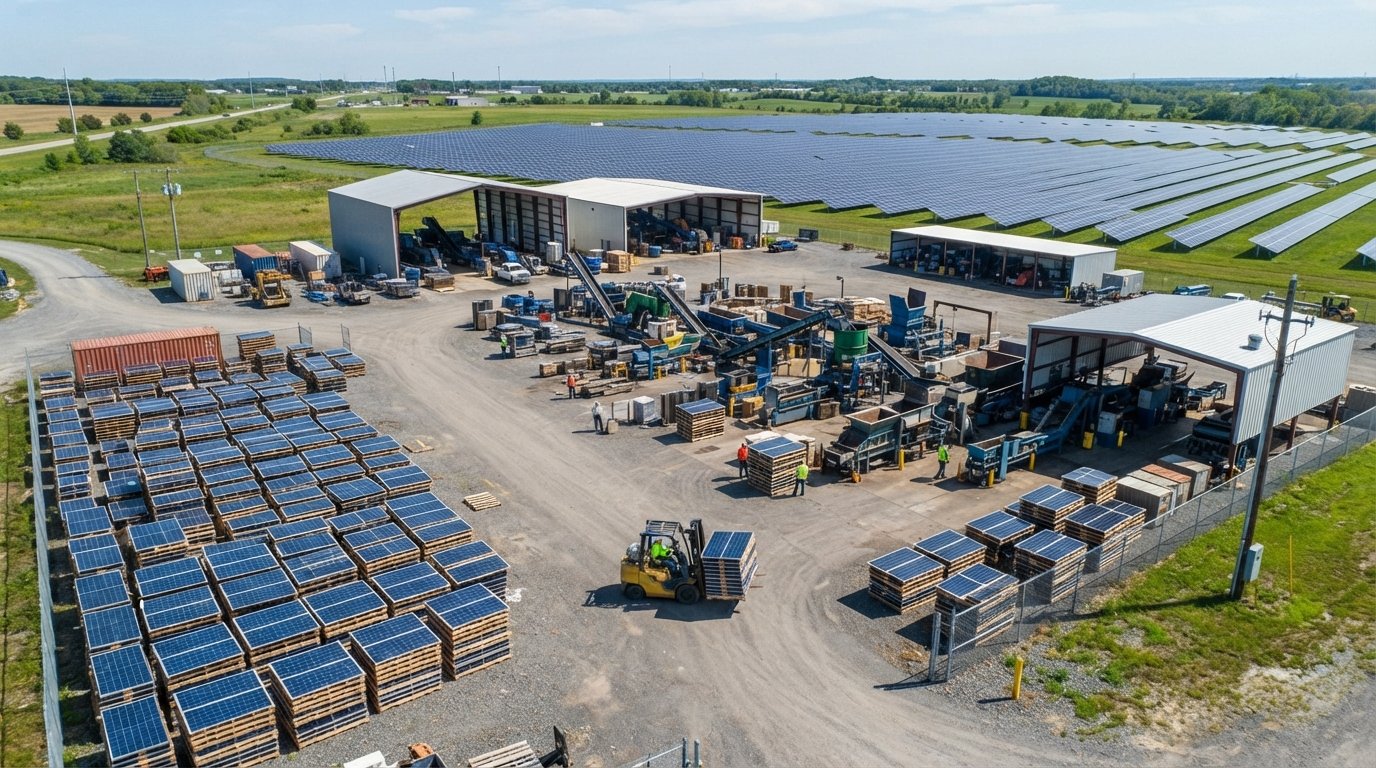
Solar Panel Manufacturing Recycling: A Balanced Environmental View
Solar panel manufacturing recycling balanced environmental view: learn how panels pay back their carbon debt and how to plan for end-of-life. Call (833)-434-4023.

By Wendy Young
Learn more about Solar Panel Installation and Repair for guides, costs, and what to expect.
Compare Solar Panel Installation and Repair Pros Near You

Enter your ZIP code to compare top-rated local professionals and request free quotes.
Solar panels are the cornerstone of a clean energy future, but environmentally conscious buyers are asking harder questions than ever before. What happens before a panel reaches your roof? What happens after it comes down? The solar panel manufacturing recycling balanced environmental view requires looking at the full lifecycle, not just the decades of clean electricity a system produces. This article examines the energy payback period, material sourcing, end-of-life infrastructure, and how to plan for disposal when you buy solar today. The goal is not to discourage adoption, but to give you the honest context you need to make a confident, informed decision.
The Energy Payback Period: How Long Until Solar Pays Back Its Carbon Debt?
Every solar panel begins its life with an energy investment. Mining, refining, manufacturing, and transporting the components all consume energy, mostly from fossil fuels. The question that matters is how long a panel must operate to offset that initial energy debt. For modern silicon-based panels, the energy payback period ranges from one to four years, depending on the technology, location, and manufacturing efficiency. In sunny regions like the American Southwest, payback can be as short as one year. In cloudier northern states, it may stretch to three or four years. Since most panels carry a 25 to 30 year performance warranty, the system will generate clean electricity for 20 to 29 years beyond the payback point. That is a strong net positive for the climate.
What makes this calculation so favorable? Manufacturing efficiency has improved dramatically. Thinner silicon wafers, higher module efficiencies, and smarter factory processes mean less energy is wasted in production. At the same time, panel output has risen, so each unit of manufacturing energy is spread over more kilowatt-hours of generation. The result is that the carbon intensity of solar electricity continues to fall. According to the National Renewable Energy Laboratory, the lifecycle greenhouse gas emissions of solar photovoltaics are now roughly 40 grams of CO2 equivalent per kilowatt-hour, compared to over 1,000 grams for coal and about 400 grams for natural gas. That is a 25 to 50 times reduction in carbon intensity over the system's life.
Some critics point out that panels are often manufactured in countries with coal-heavy grids, which shifts emissions overseas. That is a valid concern, but it does not erase the net benefit. Even when manufacturing occurs in a coal-powered region, the panel will offset far more emissions over its lifetime than were used to build it. The key is to ensure that end-of-life recycling also becomes energy-efficient, so the circular economy does not reintroduce new environmental costs. For homeowners who want to dive deeper into how technology is improving efficiency, our guide on AI in solar panel efficiency explains how smart monitoring can squeeze more value from every ray of sunlight.
Materials in Solar Panel Manufacturing: Sourcing and Sustainability Considerations
A typical crystalline silicon panel is a sandwich of several materials. The top layer is tempered glass, which protects the cells and allows light to pass through. Below that are the silicon cells themselves, wired together with thin ribbons of copper or silver. A polymer encapsulant holds everything in place, and a backsheet provides electrical insulation and moisture protection. The frame is usually aluminum, and the junction box contains copper wiring and sometimes small amounts of lead or other metals. Each of these materials has its own supply chain, and each carries environmental and social implications.
Silicon is the second most abundant element in the Earth's crust, so raw material scarcity is not a major issue. However, refining silicon to solar-grade purity is energy-intensive. It requires melting quartz in electric arc furnaces at very high temperatures, then purifying it through the Siemens process or similar methods. That energy use is the main contributor to the manufacturing carbon footprint. Glass and aluminum are also energy-intensive to produce, though both are highly recyclable. Silver, used in the conductive paste on cells, is a precious metal with significant mining impacts. The industry has been reducing silver usage per cell, but it remains a cost and environmental factor.
Sourcing transparency is improving but still uneven. Some manufacturers publish life cycle assessments and source materials from certified mines. Others do not. For buyers who care about the full picture, asking your installer about the panel brand's sustainability reporting is a reasonable step. The Solar Energy Industries Association has been pushing for stronger domestic manufacturing standards, which could reduce shipping emissions and improve labor conditions. As you evaluate quotes, remember that the lowest price does not always reflect the best environmental outcome. A slightly more expensive panel from a manufacturer with a robust recycling program may deliver a better net impact over its lifetime.
Current US Recycling Infrastructure: What Happens to Retired Panels?
Here is where the balanced view gets less rosy. The United States does not yet have a mature, nationwide recycling infrastructure for solar panels. Most retired panels today end up in landfills, partly because recycling is more expensive than disposal in many regions. The EPA estimates that by 2030, the US will have cumulatively installed enough solar to generate millions of tons of panel waste by 2050. Without action, that waste stream will grow rapidly. However, the situation is changing. Several states, including California and Washington, have begun classifying solar panels as universal waste or requiring recycling. Private companies like First Solar and Veolia operate dedicated recycling facilities, though capacity is still limited.
Recycling a solar panel is technically challenging because the materials are bonded together. The glass, silicon, metals, and polymers must be separated. Common methods include mechanical shredding, thermal treatment, and chemical processes. Mechanical recycling can recover glass and aluminum, but often loses the silicon and silver. Thermal and chemical methods can achieve higher purity but consume more energy and may use hazardous chemicals. The most promising approach is a combination of mechanical pre-processing and advanced hydrometallurgical extraction, which can recover over 90 percent of the mass. A few pilot plants in Europe and the US are demonstrating this, but commercial scale is still years away.
For now, the practical reality is that a panel you install today will likely be recycled if you live in a state with active programs, or landfilled if you do not. That is not a reason to avoid solar, but it is a reason to support policies and manufacturers that prioritize recyclability. The industry is moving toward design for recycling, with fewer adhesives and easier-to-separate components. As a consumer, you can advocate for better end-of-life options by asking your installer about take-back programs. Some manufacturers now offer to recycle panels at no extra cost when you purchase a new system, which is a meaningful step forward.
Planning for End-of-Life Disposal When You Buy Solar Today
Even though your panels may last 30 years, planning for their eventual disposal is part of responsible ownership. The decisions you make at the point of purchase can make recycling easier and less costly down the road. Start by asking your installer whether the manufacturer has a take-back or recycling program. Some brands, like SunPower and certain European manufacturers, have explicit commitments to recycle panels at end of life. If your installer cannot answer, that is a red flag. You can also check whether your state has a solar stewardship program, which places the responsibility for recycling on the manufacturer or installer.
Another consideration is the system design itself. Panels that are easier to remove and transport will be cheaper to recycle. Ground-mounted systems are generally simpler to decommission than roof-mounted ones, but roof mounts are still manageable. If you are building a new home or planning a major renovation, you might consider leaving space for future panel removal. It also helps to keep your purchase documentation and warranty information in a safe place, because some recycling programs require proof of purchase or may offer credits based on the original equipment.
When the time comes to replace or remove your panels, do not simply call a general contractor. Look for a certified solar decommissioning or recycling service. The Solar Energy Industries Association maintains a list of recyclers, and some installers now offer removal and recycling as part of a system upgrade. If you are moving to a new home and leaving your solar system behind, you can find helpful checklists and moving resources at Moving.Homes to ensure the transition goes smoothly for both you and the new owners. Planning ahead turns a potential hassle into a routine part of home maintenance.
Balancing Lifecycle Emissions Against Decades of Clean Energy Production
The central question for environmentally conscious buyers is whether the manufacturing and disposal impacts outweigh the benefits of clean electricity. The evidence strongly says no. A solar panel will offset its manufacturing carbon footprint within one to four years, then produce zero-emission electricity for another two to three decades. Even accounting for recycling energy and transportation, the net emissions savings are substantial. A typical residential system avoids 100 to 200 tons of CO2 over its lifetime, equivalent to planting thousands of trees. That is a powerful climate benefit that no other mainstream energy technology can match at the same scale.
That said, a balanced view acknowledges that solar is not impact-free. Mining, manufacturing, and disposal all have environmental costs. The goal is not to pretend those costs do not exist, but to minimize them through better design, cleaner manufacturing, and robust recycling. The industry is moving in that direction. Module efficiency is rising, meaning fewer panels are needed for the same output. Manufacturing is shifting to renewable-powered factories. And recycling technology is advancing, with several companies aiming for 95 percent material recovery. As these trends continue, the lifecycle profile of solar will only improve.
For homeowners, the most impactful choice is to buy from manufacturers with strong sustainability commitments and to support policies that fund recycling infrastructure. You can also extend the life of your panels through regular maintenance and cleaning, which delays the need for replacement. If you are considering solar for the first time, use a trusted platform to compare installers who prioritize quality and responsible end-of-life practices. SolarEnergy.ai connects you with vetted local professionals who can answer your questions about manufacturing, recycling, and everything in between. The transition to clean energy is not about achieving perfection; it is about making continuous progress. A balanced environmental view gives you the confidence that solar is a net positive, even when you account for the full lifecycle.