Solar Panel Hail Ratings: Impact Resistance Standards Explained
Understand solar panel hail rating and impact resistance standards before storm season. Call (833)-434-4023 for expert guidance on protecting your investment.

By Ryan Brooks
Learn more about Solar Panel Installation and Repair for guides, costs, and what to expect.
Compare Solar Panel Installation and Repair Pros Near You

Enter your ZIP code to compare top-rated local professionals and request free quotes.
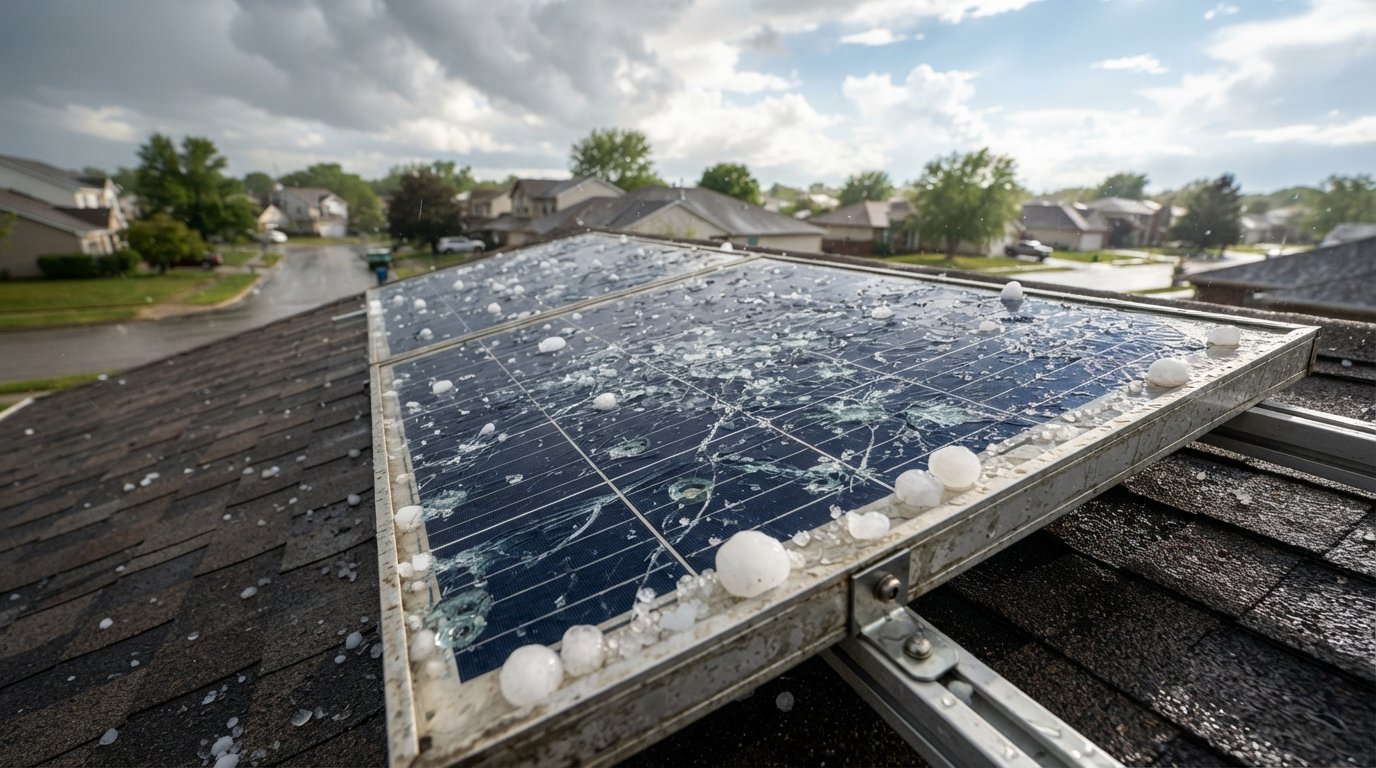
One afternoon of golf-ball-sized hail can turn a confident solar investment into a stressful insurance negotiation. Homeowners in hail-prone states like Texas, Colorado, and Nebraska increasingly ask a sharper question than 'are solar panels worth it': will my panels survive the next big storm? The answer lives in a spec-sheet number most installers mention but few explain clearly. Solar panel hail rating and impact resistance standards tell you how a module performed in a controlled laboratory test, not how it will fare on your roof during a freak weather event. Understanding that distinction is the difference between a covered claim and a surprise repair bill.
What the Hail Impact Test Rating on a Spec Sheet Actually Covers
Almost every modern solar module sold in the United States carries an impact resistance certification tied to a specific standard. The most common is IEC 61215, which includes a hail test that fires ice balls at the module face at a defined speed and diameter. Manufacturers also reference ASTM E1038, a similar protocol used for impact testing. When you see a panel marketed as 'hail rated' or 'certified for 1-inch hail at 50 mph,' that language traces back to one of these tests.
The test itself is straightforward in concept. A laboratory machine launches ice spheres at the panel's front surface, typically at multiple points, and technicians check for cracks, electrical degradation, and safety failures. A module passes if it shows no major damage and continues to operate within specified limits. The critical detail is that the standard defines the ice ball size and velocity, not the real-world storm on your roof. A panel certified to withstand 25 mm (about 1 inch) hail at roughly 50 mph has passed a specific test condition, not a universal guarantee against all hail.
Several variables determine whether a panel passes. Glass thickness, tempering quality, frame rigidity, cell layout, and backsheet construction all influence impact resistance. Tempered glass, usually 3.2 mm on residential modules, absorbs energy better than standard glass. Frameless or thin-film modules behave differently under impact, which is why commercial and utility-scale buyers often review hail ratings more carefully than homeowners do. For a deeper look at how panel construction affects overall performance, our guide on solar panel efficiency ratings explains how electrical characteristics and physical build quality interact.
It also helps to know which certifications carry weight. UL 61730 covers safety, not hail specifically, while IEC 61215 and IEC 61730 together form the baseline most US jurisdictions and utilities expect. Some manufacturers pursue additional internal testing beyond the standard, and a few publish their own hail ratings, such as 'withstands 35 mm hail at 27 m/s.' Those claims are useful but should be read as marketing-adjacent unless they reference a recognized third-party test protocol.
Real-World Damage Patterns Versus Lab Testing
Laboratory hail tests are repeatable, controlled, and narrow. Real storms are chaotic. Hailstones are rarely perfect spheres; they form irregular shapes, strike at angles, and cluster in ways a test machine does not replicate. A panel that passes a single impact test may still suffer microcracks when hit repeatedly in the same area, or when debris and wind-driven rain accompany the hail. This gap between lab and roof is the single most important thing to understand about solar panel hail rating and impact resistance standards.
Field observations from hail-prone regions reveal consistent patterns. Damage tends to concentrate on:
- Panel corners and edges, where the frame offers less support and glass stress concentrates
- Areas already weakened by thermal cycling or prior microcracks
- Modules mounted at steeper angles, which present a more direct target to falling hail
- Older panels with degraded encapsulant or backsheets that no longer absorb energy as designed
Microcracks deserve special attention because they are invisible from the ground. A panel can look fine after a storm while internal cell fractures slowly reduce output over months. That is why a post-hail inspection should include electrical testing, not just a visual check. Infrared imaging and IV curve tracing reveal damage that the naked eye misses. Homeowners who skip this step sometimes discover a 10 to 20 percent production loss a year later, long after the insurance claim window has closed.
Mounting and tilt also shape real-world outcomes. Panels mounted flush to a low-slope roof experience different impact dynamics than panels on a steep pitch. Tilt affects both the angle of incidence and how hail bounces or shatters on contact. In regions with frequent small hail, a steeper tilt can help stones glance off rather than strike directly, though the effect is modest compared to glass quality and frame design. Racking systems that allow some flex can absorb energy, while rigid mounts transfer more force to the module.
Insurance Deductible and Claim Decisions After Hail
The financial aftermath of a hail event often matters more than the physical damage. Most homeowners insurance policies cover solar panels as part of the dwelling structure, but the details vary widely by carrier and state. Some policies apply a separate wind and hail deductible, often a percentage of the dwelling coverage rather than a flat dollar amount. On a $400,000 home with a 2 percent hail deductible, that is $8,000 out of pocket before insurance pays anything. Understanding this before a storm hits is essential.
Claim decisions hinge on documentation. Adjusters want evidence that damage occurred during a specific event, that the panels were in good condition beforehand, and that repairs are necessary rather than cosmetic. Homeowners who keep installation records, pre-storm inspection reports, and production data have a significant advantage. After a hail event, the sequence below improves your odds of a fair settlement:
- Document the storm date and keep weather reports or hail reports from a reputable source.
- Photograph the panels from multiple angles before touching anything, including close-ups of any visible cracks.
- Request an electrical performance test from a qualified solar technician, not just a visual inspection.
- File the claim promptly and provide production data showing any drop in output.
- Get an independent repair estimate before accepting the insurer's assessment.
Insurers increasingly ask whether the panels met recognized impact resistance standards at the time of installation. A module certified under IEC 61215 gives you a stronger position than an uncertified bargain panel. That said, certification is not a guarantee of coverage; policy language governs. Some carriers now offer endorsements specifically for solar equipment, and a few require separate riders. Reviewing your policy with an agent before installation is far cheaper than discovering a gap after a claim.
Repair decisions also involve practical tradeoffs. Replacing a single damaged module is often straightforward, but matching an older panel's specifications can be difficult as models retire. Some homeowners choose to replace an entire array section for consistency. Others accept minor cosmetic damage if electrical testing shows no performance loss. The right call depends on the extent of damage, your deductible, and how long you plan to stay in the home.
Preventive Mounting and Tilt Considerations
You cannot control the weather, but you can influence how your system meets it. Mounting and tilt decisions made at installation have a lasting effect on hail resilience. The most protective setups share a few characteristics: robust racking, careful attention to edge support, and a tilt angle appropriate for the region's typical storm patterns.
Racking choice matters more than many homeowners realize. Rail-based systems that support the module along its long edges distribute impact forces better than short-edge-only clamping. Mounting hardware should be rated for the local wind and snow loads, and installers should follow manufacturer torque specifications precisely. Loose clamps or over-tightened bolts create stress points that hail can exploit. If you are comparing installation quotes, ask each installer how their racking handles impact loads and whether they follow the module manufacturer's mounting instructions exactly.
Tilt angle involves tradeoffs. A steeper tilt (30 to 45 degrees) can help hail glance off and may reduce direct strikes, but it also increases wind exposure and changes production profiles. A shallower tilt reduces wind load but presents a flatter target. In hail-prone regions, many installers favor moderate tilts that balance production, wind resilience, and impact exposure. Ground-mounted systems offer more flexibility because you can adjust tilt seasonally and inspect panels more easily after storms.
Beyond mounting, a few practical steps improve outcomes. Trimming overhanging tree branches reduces debris impact during storms. Scheduling a professional inspection after any significant hail event catches microcracks early. Keeping gutters and drainage clear prevents water pooling that can worsen damage. And when repairs are needed, working with vetted local professionals matters. Platforms like Repairmen connect homeowners with licensed service providers for maintenance and emergency repairs, which is useful when a storm leaves you sorting through damage and insurance paperwork simultaneously.
It is also worth revisiting your system design as standards evolve. Newer modules increasingly advertise enhanced hail ratings, and some manufacturers now test to higher ice-ball velocities than the baseline standard requires. If you are planning a new installation in a hail-prone state, ask your installer to show the actual test certification, not just a marketing claim. Pair that with a review of your insurance policy and a realistic assessment of your deductible, and you have a system that is prepared for the storm rather than surprised by it.
Solar panel hail rating and impact resistance standards are not a promise of invulnerability. They are a benchmark, a starting point for smarter decisions about equipment, mounting, insurance, and maintenance. Homeowners who understand what the numbers mean, and what they do not, are better positioned to protect their investment when the sky turns green. If you are evaluating a new system or reviewing an existing one, start with the certification details, confirm your insurance coverage, and schedule an inspection before storm season arrives.
Learn more about Solar Panel Installation and Repair for guides, costs, and what to expect.
Compare Solar Panel Installation and Repair Pros Near You
Enter your ZIP code to compare top-rated local professionals and request free quotes.