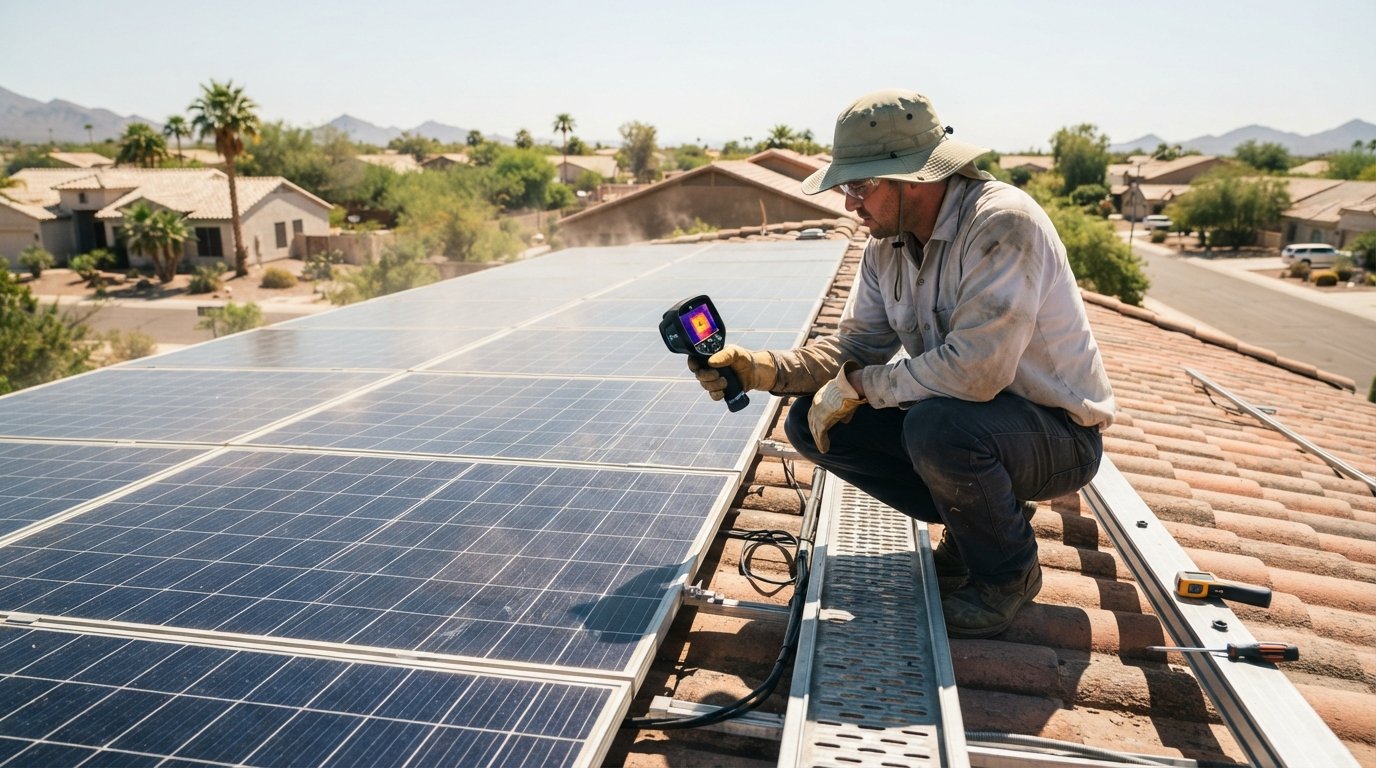
Solar Panel Efficiency Loss From Heat in Hot Climates
Heat cuts solar output in hot climates. Learn how temperature coefficients and smart design protect your savings. Call (833)-434-4023 for expert help.

By Julia Nguyen
Learn more about Solar Panel Installation and Repair for guides, costs, and what to expect.
Compare Solar Panel Installation and Repair Pros Near You

Enter your ZIP code to compare top-rated local professionals and request free quotes.
When you picture solar panels, you probably imagine them soaking up the sun on a bright summer day, generating plenty of clean electricity. The reality is more nuanced: while sunlight is essential, excessive heat actually reduces a panel's ability to convert that light into power. In hot climates like Arizona, Texas, Nevada, and Florida, homeowners often see their solar production dip just when they expect it to peak. Understanding why this happens, and what you can do about it, is key to maximizing your investment and avoiding unpleasant surprises on your energy bill.
In this guide, we will break down the science of solar panel efficiency loss from heat in hot climates, explain how temperature coefficients work, and share practical design and maintenance tactics that keep your system performing at its best even during scorching afternoons. Whether you are planning a new installation or looking to optimize an existing one, these insights will help you get the most out of your solar array.
Why Heat Hurts Solar Panel Performance
Solar panels are tested and rated under standard test conditions: 25 degrees Celsius (77 degrees Fahrenheit) cell temperature, 1,000 watts per square meter of sunlight, and an air mass of 1.5. In the real world, especially in hot climates, cell temperatures can soar well above that benchmark. A dark-colored panel exposed to full sun on a 95-degree day can easily reach 140 to 160 degrees Fahrenheit (60 to 71 degrees Celsius) on its surface. At those temperatures, the semiconductor material inside the panel becomes less efficient at separating electrons, and voltage drops, which directly reduces power output.
This phenomenon is not a defect; it is a fundamental property of photovoltaic materials. The effect is quantified by the temperature coefficient, usually expressed as a percentage per degree Celsius. For typical residential panels, this coefficient ranges from -0.30% to -0.45% per degree Celsius. That means for every degree above 25 C, the panel loses a small fraction of its rated power. On a 95 F (35 C) day with cell temperatures hitting 65 C, a panel with a -0.35%/C coefficient would lose about 14% of its output compared to its rated capacity. In extreme heat waves, losses can exceed 20%.
Importantly, heat-induced losses are not linear with air temperature alone; they depend on how well the panel sheds heat, which is influenced by mounting, airflow, and the panel's own thermal characteristics. This is why two identical panels installed differently can produce noticeably different amounts of energy on the same hot day.
Temperature Coefficient Explained in Plain Numbers
The temperature coefficient tells you how sensitive a panel is to temperature changes. It is expressed as a negative percentage per degree Celsius, meaning power decreases as temperature rises. Manufacturers typically report the coefficient for power (Pmax), but you may also see coefficients for voltage (Voc) and current (Isc). Voltage drops significantly with heat, while current increases slightly, but the net effect is a loss in power.
To make this concrete, consider three common panel types and their typical temperature coefficients:
- Monocrystalline silicon: -0.30% to -0.35% per degree C. These panels are generally the most heat-tolerant among mainstream options.
- Polycrystalline silicon: -0.35% to -0.45% per degree C. Slightly more sensitive to heat than monocrystalline.
- Thin-film (CdTe or CIGS): -0.25% to -0.35% per degree C, with some thin-film technologies performing better in high heat, though they may have lower overall efficiency.
Let us run the numbers. Suppose you have a 400-watt monocrystalline panel with a -0.35%/C coefficient. On a hot day when the cell temperature reaches 65 C (about 149 F), the temperature difference from 25 C is 40 C. Multiply 40 by 0.35% to get a 14% power loss. That 400-watt panel now produces only about 344 watts under full sun. If you have 20 such panels, your array's peak output drops from 8,000 watts to roughly 6,880 watts, a difference of over 1,100 watts. Over the course of a hot summer afternoon, that lost energy adds up.
Choosing panels with a lower (less negative) temperature coefficient can meaningfully reduce these losses. When comparing quotes, look beyond the nameplate wattage and consider the coefficient, especially if you live in a region with prolonged high temperatures.
How Roof Mounting and Ventilation Affect Cell Temperature
The way panels are mounted plays a surprisingly large role in how hot they get. A panel that is flush-mounted close to the roof surface has little room for air to circulate behind it, so heat builds up. In contrast, panels mounted on standoffs or rails with several inches of clearance allow convective airflow to carry heat away, keeping cell temperatures lower.
For example, a study by the National Renewable Energy Laboratory found that panels mounted with a 4-inch gap between the module and roof can run 5 to 10 degrees Celsius cooler than flush-mounted panels under identical conditions. That translates to roughly 2% to 4% more power output during peak heat. On a 10 kW system, that could mean an extra 200 to 400 watts on a hot afternoon, enough to run a refrigerator or charge an electric vehicle for a few miles.
Roof material also matters. Dark asphalt shingles absorb and radiate heat, while lighter-colored or reflective roofing (such as cool roofs) stays cooler and can reduce the ambient temperature around the panels. Additionally, mounting panels on a tilted rack rather than parallel to the roof surface improves airflow and reduces heat accumulation. If you are planning a new installation, ask your installer about mounting clearance and ventilation strategies; it is a low-cost way to boost summer performance.
Why Orientation and Tilt Influence Heat Buildup
Panel orientation and tilt affect both how much sunlight hits the surface and how effectively the panel sheds heat. In hot climates, the goal is to balance energy harvest with thermal management. South-facing panels at a fixed tilt optimized for winter performance may receive more direct sun in summer, leading to higher cell temperatures. However, tilting panels at a steeper angle can improve airflow and reduce the angle of incidence of sunlight, potentially lowering heat gain.
In regions with intense afternoon sun, west-facing panels may capture more late-day production but also endure the hottest part of the day. East-facing panels benefit from cooler morning temperatures but may miss peak solar intensity. A common strategy is to use a slightly steeper tilt than the latitude angle to shed heat and capture more consistent production throughout the day. Ground-mounted systems with adjustable tilt offer even more flexibility to optimize for seasonal conditions.
Furthermore, panel orientation relative to prevailing winds can enhance convective cooling. If your roof allows, orienting panels so that prevailing summer breezes flow across the backside can help dissipate heat. While orientation is often dictated by roof geometry, discussing these nuances with your installer can lead to a design that performs better in heat.
Inverter Clipping and Heat Derating During Peak Afternoons
Inverters, the devices that convert direct current (DC) from panels into alternating current (AC) for home use, are also susceptible to heat. Most residential inverters are rated to operate at full power up to a certain ambient temperature, typically around 40 C (104 F). Above that, they may derate, meaning they reduce their output to protect internal components. In hot climates, especially if the inverter is mounted in a garage or on a sunny wall, derating can occur during the hottest part of the day, just when panels are producing at their peak.
Additionally, oversizing the array relative to the inverter (a common practice to maximize energy harvest) can lead to clipping, where the inverter limits DC input to its maximum AC output. While clipping is normal and often economically justified, heat can exacerbate the situation if the inverter is already derating. To mitigate this, installers should mount inverters in shaded, well-ventilated locations and consider inverters with higher temperature tolerances or active cooling.
For homeowners, monitoring inverter performance during heat waves can reveal whether derating is an issue. Many modern inverters provide real-time data and alerts. If you notice consistent drops in AC output on hot afternoons, consult your installer about repositioning or upgrading the inverter.
Design and Maintenance Tactics to Limit Heat-Related Losses
While you cannot eliminate heat entirely, you can significantly reduce its impact through smart design and regular maintenance. Here are some actionable strategies:
- Choose panels with a low temperature coefficient. As discussed, monocrystalline panels often have coefficients around -0.30% to -0.35%/C, making them a better choice for hot climates than polycrystalline or some thin-film options.
- Ensure adequate mounting clearance. Aim for at least 3 to 6 inches of gap between the panel and roof surface to promote airflow. Use elevated mounting structures where possible.
- Optimize tilt and orientation. Work with your installer to select a tilt that balances energy production with thermal performance. In some cases, a slightly steeper tilt can reduce heat buildup.
- Keep panels clean. Dust, pollen, and bird droppings not only block sunlight but can also create hotspots that increase cell temperature. Regular cleaning (every few months in dusty areas) helps maintain efficiency and reduces thermal stress.
- Install inverters in cool locations. Shade the inverter or mount it in a ventilated garage or on a north-facing wall to avoid direct sun and high ambient temperatures.
- Consider active cooling or phase-change materials. Emerging technologies, such as phase-change materials or small fans, can help dissipate heat, though these are not yet mainstream for residential systems.
Beyond these tactics, pairing your solar array with smart energy management can help you make the most of the power you do produce. For instance, AI-driven systems can shift heavy loads (like EV charging or water heating) to cooler, more productive times of day. To explore how artificial intelligence can further optimize your solar savings, see our guide on AI in solar panel efficiency.
Finally, if you are planning a move to a sunnier climate or need to transport a solar system, resources like Moving.Homes relocation guides can help you plan a smooth transition. And remember, regular professional inspections can catch heat-related issues early, such as loose wiring or degraded connectors, before they become costly problems.
By understanding the causes of solar panel efficiency loss from heat in hot climates and implementing these design and maintenance strategies, you can protect your investment and keep your system producing reliable clean energy for decades, even in the most demanding environments.