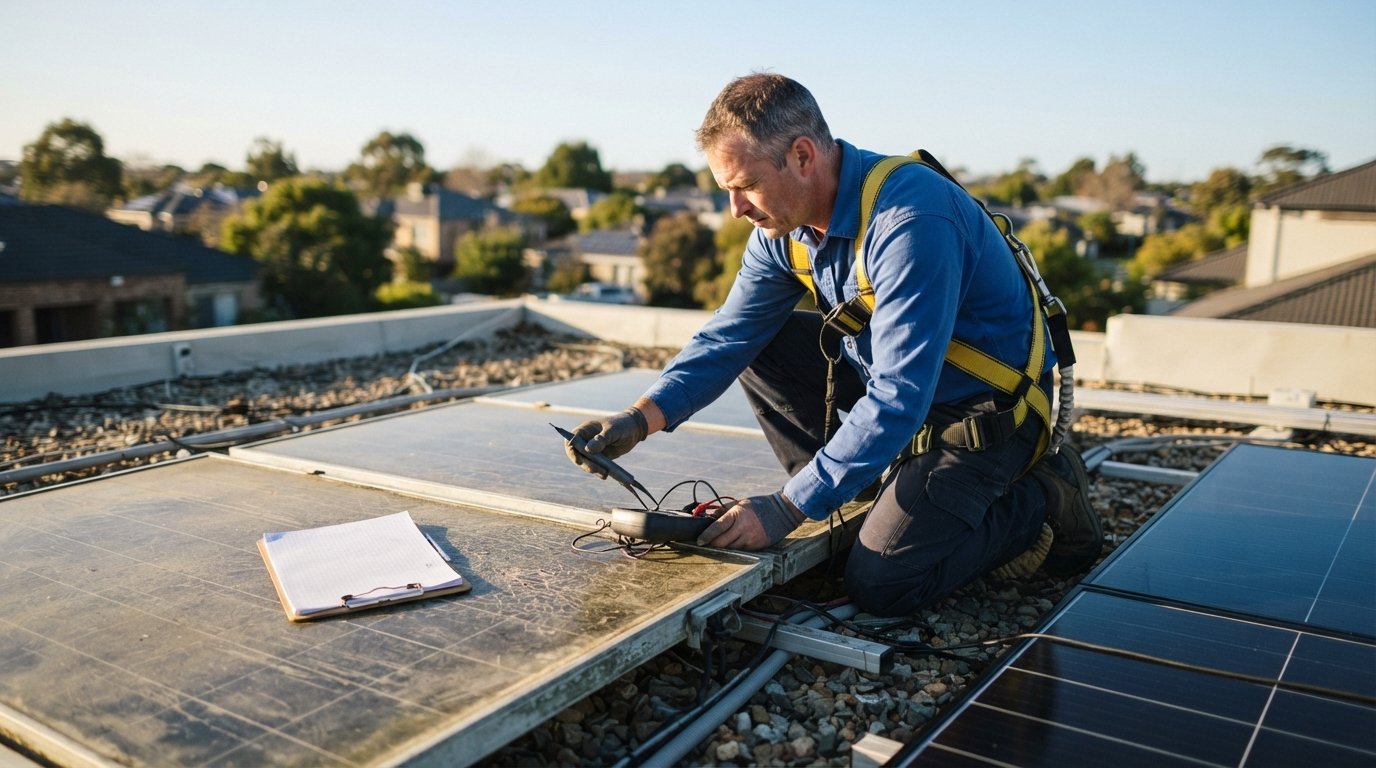
Solar Panel Degradation Rate Factors Affecting Long Term Output
Solar panel degradation rate factors affecting long term output determine how much power your array loses each year. Learn what drives the decline and how to slow it.

By Mason Carter
Learn more about Solar Panel Installation and Repair for guides, costs, and what to expect.
Compare Solar Panel Installation and Repair Pros Near You

Enter your ZIP code to compare top-rated local professionals and request free quotes.
Your solar panels will not produce the same amount of electricity in year 25 as they did on day one. That is not a defect; it is physics. The question that matters for your wallet is how much output you lose, how fast it disappears, and what pushes the decline steeper than it needs to be. Understanding the solar panel degradation rate factors affecting long term output turns a vague worry about aging equipment into a concrete number you can plan around, whether you are sizing a new system or evaluating the one already on your roof.
Most quality panels today degrade slowly, often losing only about 0.5 percent of their rated capacity each year. Over a typical 25 year performance warranty, that compounds into a meaningful but manageable drop. But averages hide the real story. Heat, humidity, installation quality, and the electronics paired with your panels can all shift that curve, sometimes by a lot. This guide walks through each factor in plain language so you can protect your investment and set realistic expectations for decades of production.
What Solar Panel Degradation Actually Means
Degradation is the gradual, permanent reduction in a panel's ability to convert sunlight into electricity. Manufacturers express it as a percentage of the original rated output lost per year. A panel rated at 400 watts that degrades 0.5 percent annually would be expected to produce roughly 380 watts after 10 years and about 350 watts after 25 years, assuming average conditions. The first year is usually the steepest because of light induced degradation, a rapid initial drop that stabilizes quickly.
Two numbers matter most when you evaluate a panel's durability. The first is the annual degradation rate, which tells you the expected yearly decline. The second is the end of warranty power output, which guarantees a floor, commonly 80 to 92 percent of the original rating after 25 or 30 years. A panel with a 0.25 percent annual rate and a 92 percent end of warranty guarantee is a fundamentally different long term asset than one that loses 0.7 percent per year with only an 80 percent floor.
Because degradation compounds, small differences add up. At 0.5 percent per year, you retain about 88 percent of output after 25 years. At 0.7 percent, that figure falls to roughly 84 percent. On a large system, those few percentage points translate into real kilowatt hours and real dollars over the life of the array. This is why the degradation rate belongs next to efficiency and price when you compare quotes.
The Main Factors That Drive Degradation Rates
No single variable controls how fast a panel ages. Instead, a handful of environmental, material, and installation factors interact. The dominant ones are heat, humidity and moisture ingress, ultraviolet exposure, mechanical stress, and the quality of the cells and encapsulants themselves. How these combine at your specific location determines whether your panels sit near the low end of the degradation range or drift toward the high end.
Temperature is the factor most homeowners underestimate. Panels are tested at 25 degrees Celsius (77 degrees Fahrenheit) cell temperature, but real rooftop cells routinely run 20 to 40 degrees hotter. Every degree above the test condition reduces voltage and efficiency, and sustained heat accelerates the chemical and physical processes that degrade cells and solder joints. In hot climates such as Arizona, Nevada, or southern Florida, heat driven degradation is a primary concern and a good reason to prioritize panels with strong temperature coefficients.
Moisture is the second major driver. Water vapor that penetrates a panel's backsheet or frame seals can corrode metal contacts, delaminate the encapsulant, and create conductive paths that sap power. Humid, coastal, and storm prone regions see more of this. Potentially induced degradation, often shortened to PID, is a related failure mode in which voltage, heat, and moisture combine to cause power losses that can reach double digits if the panel lacks mitigation features.
Ultraviolet radiation and mechanical stress round out the list. UV exposure slowly breaks down polymer materials in the encapsulant and backsheet, causing yellowing and brittleness that reduce light transmission. Meanwhile, thermal cycling, the daily expansion and contraction of materials as panels heat and cool, fatigues solder bonds and ribbon connections. Wind, snow loads, and poor mounting practices add physical strain that can crack cells or loosen junctions, each of which shows up as lost output.
How Panel Technology and Manufacturing Quality Shift the Curve
The degradation rate is not fixed by physics alone; it is engineered. Cell chemistry, encapsulant choice, frame design, and factory quality control all influence how gracefully a panel ages. Monocrystalline panels, now the dominant technology, generally offer lower degradation rates than older polycrystalline products because of higher purity silicon and better manufacturing consistency. Thin film panels behave differently, with some variants showing excellent heat tolerance but different long term loss profiles.
Encapsulant and backsheet materials are quietly important. Premium panels often use advanced encapsulants and robust backsheets that resist moisture and UV damage longer than budget alternatives. Junction box design and bypass diode quality also matter, because a single failing diode can cut a panel's output significantly. These are the details that separate a 25 year workhorse from a panel that underperforms after a decade.
Manufacturing defects, though rare among tier one brands, can cause early or accelerated degradation. Hot spots, microcracks from handling, and solder inconsistencies may not appear at installation but can worsen under heat and cycling. This is why buying from established manufacturers with transparent warranties and rigorous testing standards is worth a modest price premium. If you want to see how modern monitoring and optimization technology can catch these issues early, a look at AI in solar panel efficiency shows how data driven systems flag underperformance before it quietly erodes your savings.
Environmental and Site Specific Influences
Where you live shapes your degradation rate as much as what you buy. Climate, air quality, and local weather patterns create conditions that either slow or accelerate aging. Two identical systems installed in different regions can diverge noticeably over 20 years, even if neither experiences a failure.
Consider the following site level factors that commonly move the needle:
- Ambient temperature and heat: Hotter climates accelerate thermal degradation and reduce real world output through temperature related efficiency losses.
- Humidity and salt air: Coastal and humid environments increase corrosion and moisture ingress risk, especially at frames, edges, and junction boxes.
- Snow, hail, and wind: Heavy mechanical loads can crack cells or loosen mounting hardware, creating localized hot spots and power loss.
- Airborne dust and pollution: Soiling does not permanently degrade panels, but it masks output and, if left unchecked, can contribute to hot spots and long term stress.
- Shading and system design: Persistent shading forces cells to work harder and can accelerate wear, while poor string design magnifies the impact.
These factors rarely act alone. A hot, humid coastal site combines heat, moisture, and salt into a triple threat. A high desert installation faces intense UV and dramatic day night temperature swings. Knowing your local risk profile helps you choose panels, mounting systems, and maintenance schedules that match the environment rather than fight it.
Installation Quality and System Design Matter More Than Most Owners Realize
Even the best panel can be compromised by a careless installation. Mounting that does not allow proper airflow traps heat beneath the array and raises cell temperatures. Poorly torqued hardware, pinched wiring, or inadequate grounding can create resistance and safety risks. String sizing that ignores partial shading or mismatched panel orientations forces some modules to operate below their potential, which can accelerate stress on weaker cells.
Inverter choice also interacts with degradation. A system designed with a modest DC to AC ratio and a quality inverter will tolerate gradual panel decline without clipping losses, while an aggressively oversized or undersized design may underperform as the array ages. Battery storage adds another layer, because how the system charges and discharges affects the cycling stress on the panels and power electronics.
The practical takeaway is that degradation is a system property, not just a panel property. A meticulous installation by experienced professionals, with attention to airflow, wiring, grounding, and shading, can keep a system closer to its rated degradation curve for decades. This is one reason it pays to work with vetted installers rather than the lowest bidder. Platforms such as NewSolarQuotes help homeowners compare local solar professionals and request quotes, which makes it easier to find a crew that treats installation quality as a priority rather than an afterthought.
Realistic Output Projections Over 25 Years
To make degradation concrete, it helps to run a simple projection. Start with your system's rated capacity, apply the annual degradation rate, and compound it year by year. Then adjust for temperature, soiling, and shading to estimate real world production. The result will not be perfect, but it will be far more useful than assuming flat output forever.
Here is a simplified comparison for a 10 kilowatt system under two different degradation scenarios:
- Low degradation (0.35 percent per year): After 10 years, output is roughly 96.5 percent of original; after 25 years, about 91.6 percent.
- Average degradation (0.5 percent per year): After 10 years, roughly 95.1 percent; after 25 years, about 88.2 percent.
- High degradation (0.75 percent per year): After 10 years, roughly 92.8 percent; after 25 years, about 82.9 percent.
Notice how the gap widens over time. The difference between the low and high scenarios after 25 years is nearly 9 percentage points of output, which on a 10 kilowatt system could mean hundreds of kilowatt hours per year and thousands of dollars in lost value over the remaining life of the array. That is the cost of ignoring degradation when you choose equipment and installation partners.
It is also worth remembering that degradation is not the only factor in long term savings. Electricity rate inflation, net metering rules, and incentives all shape your return. A system that degrades slowly but faces unfavorable rate changes may still underperform a slightly faster degrading system in a high rate market. Modeling both sides of the equation gives you the clearest picture.
Monitoring, Maintenance, and Protecting Your Output
You cannot stop degradation, but you can slow it and catch problems early. Monitoring is your first line of defense. Modern systems report production at the panel or string level, so a sudden drop in one module stands out immediately rather than hiding in a blended total. Alerts for underperformance let you investigate before a small issue becomes a permanent loss.
Maintenance is the second line. Keeping panels clean preserves output and reduces the risk of hot spots caused by uneven soiling. Inspecting mounting hardware, wiring, and junction boxes after severe weather catches mechanical damage before it worsens. Having a professional review the system every few years verifies that inverters, optimizers, and connections are performing as expected.
Warranty management is the third. Keep your documentation, understand what the performance warranty covers, and act quickly if production falls below the guaranteed floor. Most manufacturers require proof of proper installation and maintenance, so a paper trail protects your claim. If a panel fails prematurely, a strong warranty and a responsive installer can turn a potential loss into a covered replacement.
Finally, plan for the end of life. Even a well maintained array will eventually produce less, and at some point repowering with newer, more efficient panels may make more sense than repairing aging ones. Knowing your degradation curve helps you decide when that moment arrives and how to budget for it.
Choosing Panels and Partners With Degradation in Mind
When you evaluate quotes, look beyond the sticker price and efficiency rating. Ask for the annual degradation rate and the end of warranty power output in writing. Compare temperature coefficients, because a panel that performs better in heat will deliver more real world output in warm climates. Check the warranty terms for exclusions and transferability, since a strong warranty only helps if it survives a home sale or covers the failure you actually experience.
Then look at the installer. Experience with your climate, roof type, and local code matters. A crew that understands airflow, shading, and proper grounding will deliver a system that stays closer to its ideal degradation curve. Reading reviews and comparing multiple quotes helps you separate marketing claims from genuine expertise.
Degradation is inevitable, but steep degradation is not. By understanding the factors that drive it, choosing quality equipment, insisting on careful installation, and monitoring performance over time, you can keep your system producing close to its potential for decades. That translates into predictable savings, fewer surprises, and a solar investment that lives up to its promise.
Learn more about Solar Panel Installation and Repair for guides, costs, and what to expect.
Compare Solar Panel Installation and Repair Pros Near You
Enter your ZIP code to compare top-rated local professionals and request free quotes.