Solar Inverter Clipping Explained: Production Loss or Normal?
Solar inverter clipping explained production loss or normal: learn why a flat-topped production curve is usually a sign of smart design, not a fault.

By Mason Carter
Learn more about Solar Panel Installation and Repair for guides, costs, and what to expect.
Compare Solar Panel Installation and Repair Pros Near You

Enter your ZIP code to compare top-rated local professionals and request free quotes.
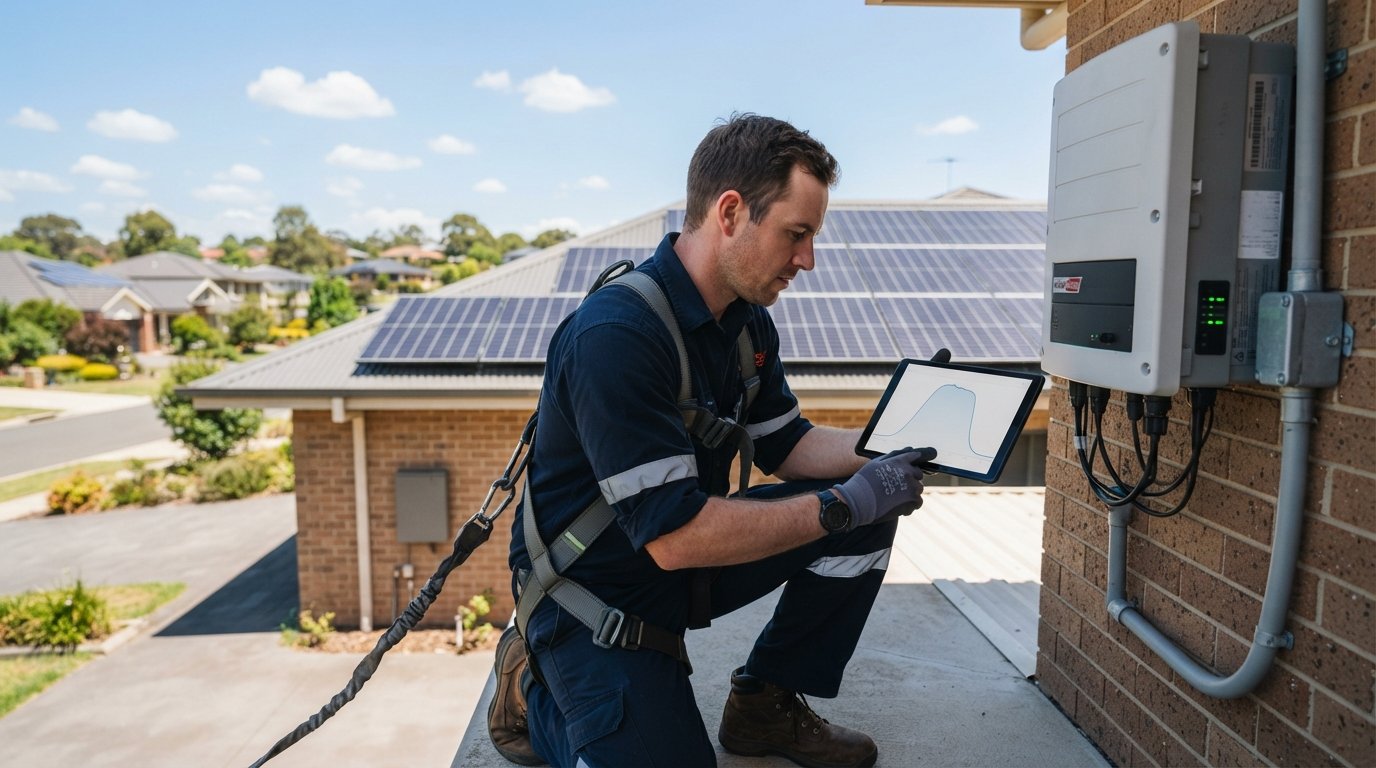
You have probably seen the flat top on your solar production curve during a sunny afternoon and wondered whether your system is broken. That plateau, known as inverter clipping, is one of the most misunderstood events in residential solar. Some homeowners panic when they see it. Others ignore it entirely. The truth sits in the middle: clipping is usually a sign of smart system design, not a malfunction. Understanding why it happens, how much energy it truly costs, and when it deserves attention will help you judge whether your installation is performing as intended or whether something needs fixing.
This guide breaks down solar inverter clipping explained production loss or normal in plain language, with real numbers, practical thresholds, and clear steps you can take to confirm your system is healthy. Whether you are evaluating a new quote or reviewing years of monitoring data, you will finish with a working framework for making sense of that flat-topped curve.
What Solar Inverter Clipping Actually Is
Clipping occurs when your solar panels produce more direct current (DC) power than your inverter can convert into alternating current (AC). The inverter caps its output at its rated capacity, and any surplus DC energy is simply not converted. On a production graph, this looks like a smooth bell curve that suddenly flattens at the top for an hour or two around solar noon.
Consider a concrete example. A system with 8 kW of panels paired with a 6 kW inverter will clip whenever panel output exceeds 6 kW. On a cool, clear spring day, those panels might briefly push 7.2 kW. The inverter holds steady at 6 kW, and roughly 1.2 kW of potential production is shed during that window. The DC-to-AC ratio here is 1.33, a figure known as the oversizing ratio.
This behavior is not accidental. Installers deliberately pair larger arrays with smaller inverters because real-world conditions rarely match laboratory ratings. Heat, dust, wiring losses, and seasonal sun angles all reduce panel output below nameplate values for most of the year. A slightly oversized array compensates for those losses and keeps the inverter running near its sweet spot more often.
Why Clipping Is Often a Sign of Good Design
Inverters are most efficient when they operate near their rated capacity. An inverter that is heavily underloaded for most of the year wastes money on hardware you rarely use. By contrast, a modestly oversized array pushes the inverter into its high-efficiency band during more hours of the day, which can offset the energy lost to clipping.
There is also an economic calculation at play. Inverters cost money, and larger inverters cost more. If a 6 kW inverter captures 98 percent of the energy an 8 kW inverter would capture, the extra hardware may never pay for itself. Installers balance this trade-off using modeling tools that simulate hourly production across a full year.
The result is that clipping of 1 to 3 percent of annual production is widely considered normal and acceptable. In many cases, that small loss is more than recovered by the lower upfront cost and higher average efficiency of the smaller inverter. A system that never clips is not automatically better; it may simply be carrying an oversized inverter that adds cost without adding meaningful output.
How Much Production Loss Clipping Really Causes
The honest answer is that it depends on your location, your array size, your inverter size, and your weather patterns. In sunny regions like Arizona, California, and Texas, clipping tends to be higher because panel output peaks sharply and often. In cloudier climates, clipping may barely register.
Here is a practical range you can use as a reference:
- Under 1 percent annual loss: negligible, essentially a non-issue.
- 1 to 3 percent annual loss: normal and expected for most oversized systems.
- 3 to 5 percent annual loss: worth reviewing, but often still economically justified.
- Above 5 percent annual loss: a signal to examine system design or monitoring data more closely.
These figures assume a well-designed system with a DC-to-AC ratio between 1.1 and 1.3. Ratios above 1.4 can push losses higher, especially in hot, high-irradiance markets. If you are reviewing a proposal and the modeling software projects clipping losses above 5 percent, it is reasonable to ask your installer to justify the design or consider a larger inverter.
It also helps to separate clipping from other forms of production loss. Shading, soiling, inverter downtime, and wiring issues can all reduce output, and they are not the same as clipping. A monitoring platform that isolates clipping from total losses gives you a much clearer picture of where your energy is actually going.
When Clipping Becomes a Real Problem
Clipping crosses from normal to problematic when it starts eating into savings that you paid for. This usually happens for one of three reasons: the inverter is undersized relative to the array, the system was designed for a climate with less sun than yours, or the inverter is failing to reach its rated output because of a fault.
If your monitoring data shows clipping for four or more hours on most sunny days, and your annual loss estimate exceeds 5 percent, it is worth a conversation with your installer. In some cases, upgrading to a larger inverter or adding a second inverter can recover meaningful production. In other cases, the numbers still favor the original design, and the clipping is simply the cost of a more affordable system.
There is also a maintenance angle. An inverter that once clipped regularly but no longer does may be degrading. If production drops without a change in weather, check whether the inverter is reaching its usual peak. A sudden loss of clipping can be an early warning sign of inverter trouble.
How to Tell Whether Your Clipping Is Normal
The fastest way to assess your situation is to pull a year of monitoring data and compare it against your original production estimate. Most monitoring apps show daily and monthly production curves, and many flag clipping automatically. If you do not have access to that data, your installer can usually retrieve it.
Once you have the numbers, run through this simple framework:
- Identify your DC-to-AC ratio by dividing array size by inverter size.
- Estimate annual clipping loss using your monitoring platform or a production model.
- Compare that loss to the ranges above (under 1 percent, 1 to 3 percent, and so on).
- Check whether clipping happens seasonally (spring and fall) or year-round.
- Confirm the inverter is reaching its rated output on clear days.
If your ratio is between 1.1 and 1.3, your losses are under 3 percent, and your inverter hits its rated output on sunny days, your clipping is normal. If any of those conditions fail, it is time to dig deeper. For a broader look at how intelligent monitoring and optimization can squeeze more value out of the same hardware, see this guide to AI solar energy optimization, which explains how modern platforms detect and respond to performance anomalies.
Design Choices That Reduce or Eliminate Clipping
If you are still in the planning stage, you have several levers to pull. The most direct is to choose a larger inverter, which raises the ceiling and reduces clipping. The trade-off is higher upfront cost and, in some cases, lower average efficiency when the array is not producing at peak.
Another option is to split the array across multiple inverters or use microinverters, which distribute conversion across many small units. This approach can reduce clipping at the system level and improve performance under partial shading, but it usually costs more per watt.
Battery storage changes the calculus as well. With a battery, excess DC energy can sometimes be diverted to charging rather than being clipped, depending on the system architecture. This is one reason storage-ready designs often tolerate higher DC-to-AC ratios.
Finally, module-level power electronics and smart optimizers can help smooth production and reduce the sharp peaks that trigger clipping. These devices are not free, but they can be worthwhile in complex installations. When you request quotes through a platform like NewSolarQuotes, you can ask installers directly how they handle oversizing and what clipping losses they project for your roof.
What This Means for Your Savings and Payback
Clipping affects your bottom line, but usually less than homeowners fear. A 2 percent annual production loss on a system that generates 12,000 kWh per year amounts to about 240 kWh. At a retail rate of 15 cents per kWh, that is roughly 36 dollars per year. Over a 25-year lifespan, it is around 900 dollars in nominal terms, though rising electricity rates and inflation adjust that figure upward.
Compare that to the savings from a smaller, cheaper inverter. If the smaller inverter saves 800 to 1,500 dollars upfront, the math often favors accepting the clipping. This is why financial modeling, not just production modeling, drives good system design.
That said, if your clipping losses are pushing past 5 percent and your inverter is undersized for your climate, the long-term cost can exceed the upfront savings. In those cases, a larger inverter or a design revision is the better call. The key is to run the numbers rather than rely on rules of thumb.
Steps to Take If You Suspect a Problem
If your monitoring data suggests clipping is higher than it should be, start with a conversation with your installer. Ask for the original production model, the projected clipping loss, and the DC-to-AC ratio. A reputable installer will have those figures on hand and can explain the design rationale.
If the installer is unresponsive or the numbers do not add up, consider a third-party system audit. An independent review can confirm whether the inverter is functioning correctly, whether the array is performing as expected, and whether a design change would pay off. In some cases, a simple firmware update or monitoring recalibration resolves the issue without hardware changes.
Keep in mind that clipping is only one variable among many. Shading, soiling, inverter efficiency, and panel degradation all shape your real-world production. A holistic review is almost always more useful than fixating on a single metric.
The Bottom Line on Clipping
Solar inverter clipping is normal in well-designed systems, and in most cases it represents a deliberate trade-off that saves money upfront while sacrificing a small amount of annual production. Losses under 3 percent are typically nothing to worry about. Losses above 5 percent deserve a closer look, especially if your climate is sunny and your inverter is significantly undersized.
The smartest approach is to treat clipping as one data point in a larger performance picture. Review your monitoring data, understand your DC-to-AC ratio, and talk to your installer if something looks off. With those habits in place, you can enjoy the benefits of solar without losing sleep over a flat-topped production curve.