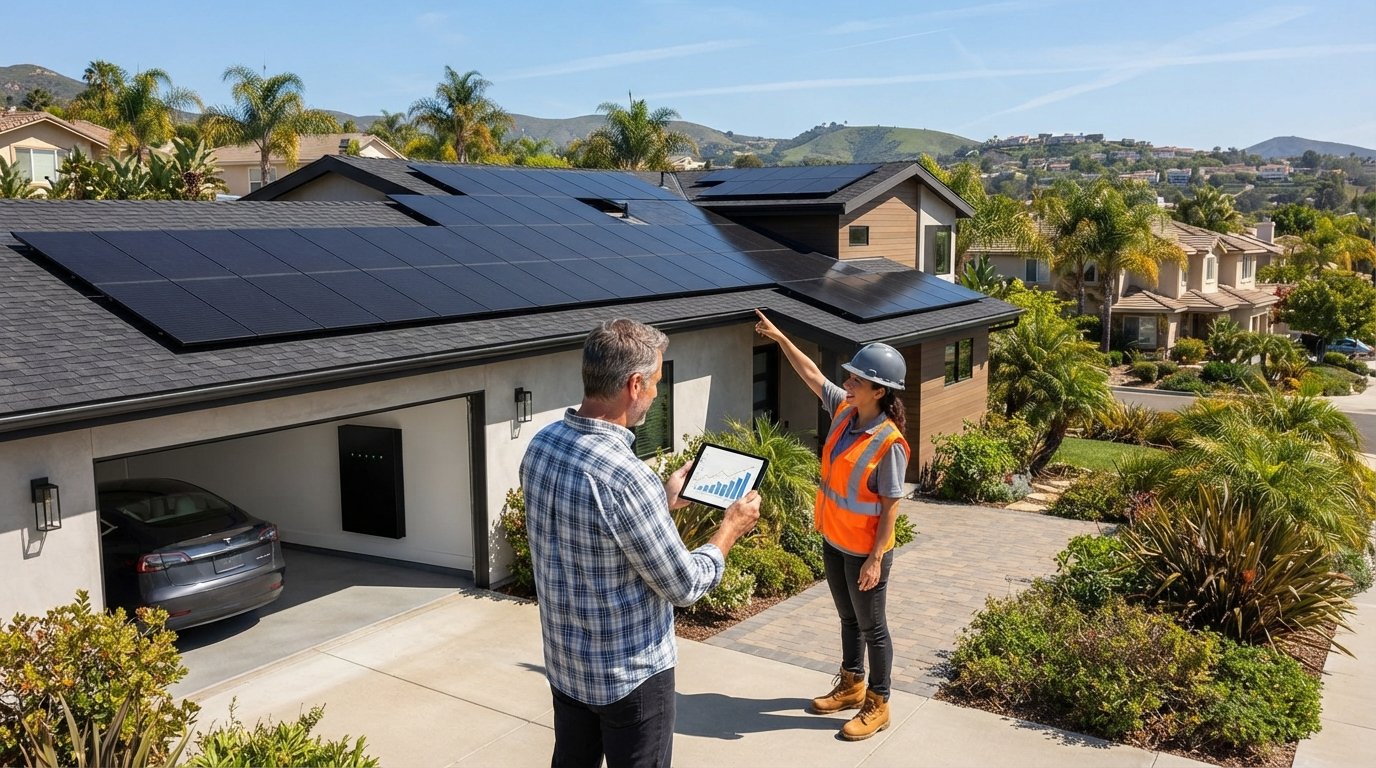
Solar Incentives in California 2026: Full Guide
Discover the solar incentives in california 2026 complete guide to maximize your savings with federal tax credits and battery rebates.

By Dylan Harris
Learn more about Solar Panel Installation and Repair for guides, costs, and what to expect.
Compare Solar Panel Installation and Repair Pros Near You

Enter your ZIP code to compare top-rated local professionals and request free quotes.
California has long been the undisputed leader in American solar energy, but the market has shifted dramatically in recent years. The transition away from the old Net Energy Metering (NEM) 2.0 framework to the Net Billing Tariff (NEM 3.0) has fundamentally changed the financial equation for rooftop panels. Pair that with new federal rules and changing state policies, and many homeowners are left wondering if solar still makes sense. The short answer is yes, but only if you understand the new landscape of incentives, credits, and rate structures.
This guide delivers a complete walkthrough of the solar incentives in california 2026 complete guide, breaking down what is available, what expired, and how to maximize your savings under the current rules. We will cover the federal tax credit, state-level rebates, the crucial shift to battery storage, and the emerging value of virtual power plants. By the end, you will know exactly which programs apply to your situation and how to structure your purchase for the best return on investment.
The New Baseline: Understanding NEM 3.0 and Net Billing
Before diving into specific incentives, you must understand the compensation mechanism that dictates the value of the energy your panels produce. As of April 2023, California switched from NEM 2.0 to NEM 3.0, officially called the Net Billing Tariff. Under the old system, utility companies credited solar customers at the full retail rate for every kilowatt-hour (kWh) they sent to the grid. Under the new system, the credit is based on the "Avoided Cost" of that energy, which is typically much lower, often around 5 to 8 cents per kWh.
This drastic reduction in export rates means that selling excess power back to the grid is no longer a lucrative strategy. Instead, the financial model has flipped to favor self-consumption. The most valuable kWh is the one you produce and use immediately in your home, because that offsets the retail electricity rate you would otherwise pay, which in California is among the highest in the nation. Consequently, the most critical "incentive" is not a rebate but the design of your system and the addition of storage to capture excess daytime production for evening use.
Federal Investment Tax Credit (ITC) for 2026
The most significant direct financial incentive remains the federal Investment Tax Credit (ITC), administered by the IRS. Under the Inflation Reduction Act (IRA), the credit was extended and stabilized, allowing homeowners to claim 30% of the total cost of their solar system against their federal income tax liability. This applies to systems installed between 2022 and 2032.
In 2026, you are still able to claim the full 30% credit, provided your system is placed in service (operational) by December 31, 2032. This credit covers not only the panels but also the inverter, racking equipment, and labor. It is crucial to understand that this is a dollar-for-dollar reduction in your tax bill, not a deduction, and it does not have an upper dollar limit for residential systems. If you do not owe $10,000 in federal taxes this year but have a $10,000 credit, the remaining amount rolls over to the next tax year, ensuring you eventually receive the full value.
One major update for 2026 involves battery storage. Previously, batteries were only eligible for the ITC if they were charged exclusively by solar. The IRA now allows batteries to qualify for the 30% credit even if they are charged from the grid, provided they are paired with a solar system. This is a game-changer for California homeowners under NEM 3.0, as it effectively subsidizes the cost of the battery that is essential for making the economics work.
Calculating Your Federal Credit Base
To maximize your ITC, ensure your contractor provides a detailed breakdown of costs. The credit base includes the price of the solar panels, inverters, mounting hardware, and electrical panel upgrades required to accommodate solar, as well as permits and inspection fees. However, it does not include additional roofing work or general home repairs. If you finance your system, you can only claim the ITC on the cash price of the equipment, not on the interest charges or loan fees. Be wary of some financing options that include dealer fees, which inflate the principal amount and may distort your true cost basis.
California State Rebates: SGIP and Equity Programs
While California no longer offers a direct upfront rebate for solar panels themselves, it does provide a critical rebate for energy storage through the Self-Generation Incentive Program (SGIP). This program is specifically designed to promote battery adoption, which is now essential for maximizing savings under net billing. The SGIP provides rebates for qualifying battery systems, with higher amounts available for low-income households and those living in communities disproportionately affected by pollution or at high risk for power shutoffs.
For the average homeowner, the SGIP rebate is currently lower than in previous years, but it is still worth pursuing. For equity and non-equity residential applicants, the rebate is often around $200 per kilowatt-hour (kWh) of storage capacity. However, for those in the "Equity Resiliency" or "Disadvantaged Communities" categories, the rebate can be substantially higher, reaching $850 per kWh or more. Since a typical home battery has a usable capacity of 10 to 13.5 kWh, this can translate to thousands of dollars in savings, making the payback period much shorter.
It is important to note that SGIP funding is distributed on a first-come, first-served basis and can be depleted quickly. You should ask your installer to submit your application as early as possible, ideally before the physical installation begins, to secure your place in the queue. You can verify the current funding status on the official SGIP website managed by the California Public Utilities Commission.
Net Metering Alternatives and the Value of Batteries
Because the export rates under NEM 3.0 are so low, the most effective way to use solar is to pair it with a battery and shift your consumption. During the day, your panels power your home and charge your battery. In the evening, when rates spike (especially during peak hours from 4 PM to 9 PM), you draw from the battery instead of pulling expensive power from the grid. This strategy, known as load shifting, allows you to bypass the low export credit entirely.
Batteries also provide backup power during Public Safety Power Shutoff (PSPS) events, which are common in wildfire-prone areas. This resilience adds a non-monetary value that is crucial for many Californians. When evaluating quotes, do not look at the cost of solar alone; look at the cost of solar plus storage. Many installers now offer systems with batteries as the default configuration, not an add-on.
Virtual Power Plants (VPPs) and Demand Response
An emerging incentive in California is participation in Virtual Power Plants (VPPs). Utilities like Pacific Gas & Electric (PG&E), Southern California Edison (SCE), and San Diego Gas & Electric (SDG&E) have launched programs that pay customers for using their home batteries to discharge energy to the grid during periods of extreme demand. This is a win-win: the utility gets extra capacity to prevent blackouts, and you get paid for providing it.
For example, PG&E's VPP program pays participating customers a bill credit for every kWh their battery discharges during a "VPP Event." These events are typically called on hot summer afternoons. Some programs offer a flat participation incentive for signing up, while others pay based on performance. Over the course of a year, a homeowner with a 10 kWh battery could earn several hundred dollars just for sharing a few hours of stored energy. This is a passive income stream that helps offset the cost of the system, and it is an incentive that did not exist in the NEM 2.0 era.
Solar Incentives in California 2026: Complete Guide to Financing
The way you finance your solar system influences which incentives you can access and how much you save. There are three primary routes: cash purchase, solar loan, and solar lease or Power Purchase Agreement (PPA).
Purchasing with cash or a home equity loan is the most advantageous for maximizing incentives because you own the system and can claim the full 30% federal ITC. With a solar loan, you also own the system, but you must ensure the loan is structured correctly so that the ITC is not used to inflate the loan principal. Reputable lenders will require you to pay the ITC amount to the loan servicer within 18 months, reducing your principal. With a lease or PPA, you do not own the equipment, so you cannot claim the federal tax credit or SGIP rebates; the leasing company receives these benefits and passes on some savings through lower monthly payments, but you miss out on the long-term equity and the most substantial financial perks.
Before signing any contract, ask for a "Net Investment Analysis" that clearly shows the payback period and the 20-year total cost of ownership. A good deal should show a payback period of 5 to 7 years for a solar-plus-storage system when accounting for the ITC and SGIP. If the payback period stretches beyond 8 years, consider getting a second opinion from another installer.
Property Tax Exclusion and Other Local Perks
California offers a specific state tax advantage that is often overlooked: the property tax exclusion for solar systems. Under California law, installing a solar energy system does not increase your property tax assessment. This means that even though your home value may increase by $30,000 or more due to the solar installation, your annual property tax bill will not rise to reflect that added value. This is a passive incentive that saves you money every year for as long as you own the home.
Additionally, many local municipalities offer expedited permitting for solar installations, and some utilities provide specific rebates for energy efficiency upgrades that pair well with solar. Check with your local building department to see if they offer a "Solar Readiness" program or reduced permit fees. While these are smaller than the federal credit, they contribute to lowering the soft costs of installation.
Comparing Quotes and Installer Responsibilities
When navigating this complex environment, the most practical step is comparing multiple quotes from licensed and insured contractors. A reputable company will handle the SGIP application, file the necessary interconnection agreements with your utility, and provide you with clear documentation for the federal ITC. Beware of installers who quote a system without a battery, as this will almost certainly result in a poor return on investment under NEM 3.0.
We recommend using an independent educational resource to understand your rights and options. For instance, NewSolarQuotes provides excellent background information on solar technology and market trends, helping you ask the right questions during the sales process.
When you receive your final proposals, compare the cost per watt. In 2026, a fair price for a quality solar-plus-storage system in California is between $2.80 and $3.50 per watt before the tax credit. If a quote comes in significantly higher, ask why. Often, it is due to a high dealer fee hidden in the financing, which you should avoid by seeking a cash quote first. Furthermore, check that the installer is certified by the North American Board of Certified Energy Practitioners (NABCEP), as this indicates a high level of technical competence.
Timeline and Application Steps for 2026
Acting quickly is essential due to the limited nature of the SGIP funds. Here is a simplified step-by-step timeline to follow:
- Step 1: Research and select 3 to 5 installers. Ask for a system design that includes a battery and provides a Net Investment Analysis.
- Step 2: Choose your installer and sign a contract. Ensure the contract specifies that the installer will submit the SGIP reservation on your behalf.
- Step 3: Have your installer submit the SGIP application immediately to lock in the rebate amount.
- Step 4: Complete the physical installation. The utility will then perform an inspection and approve your Permission to Operate (PTO).
- Step 5: Apply for the federal ITC when you file your taxes, using the full receipt of the system cost.
You should also check if your utility requires a smart inverter or specific communication settings for grid support. The installer should handle all of these technical details, but you should be aware that the switch to NEM 3.0 requires software settings that optimize for battery usage during peak hours.
The Bottom Line on Solar Value
The era of installing solar panels just to sell power back to the grid is over. Today, the value proposition relies on capturing energy and using it intelligently. The combination of the 30% federal tax credit, the SGIP battery rebate, and the property tax exclusion makes a solar-plus-storage system a sound financial investment for most California homeowners, despite the lower export rates. The key is to treat the battery not as an optional luxury but as the core of the system that enables you to achieve energy independence.
By focusing on self-consumption and participating in demand response programs, you can still achieve a strong return on investment. The solar incentives in california 2026 complete guide landscape is less about free money and more about intelligent tax planning and energy management. As electricity rates continue to climb, the value of generating your own power and storing it for peak times will only increase, making the switch to solar a resilient choice for the future.