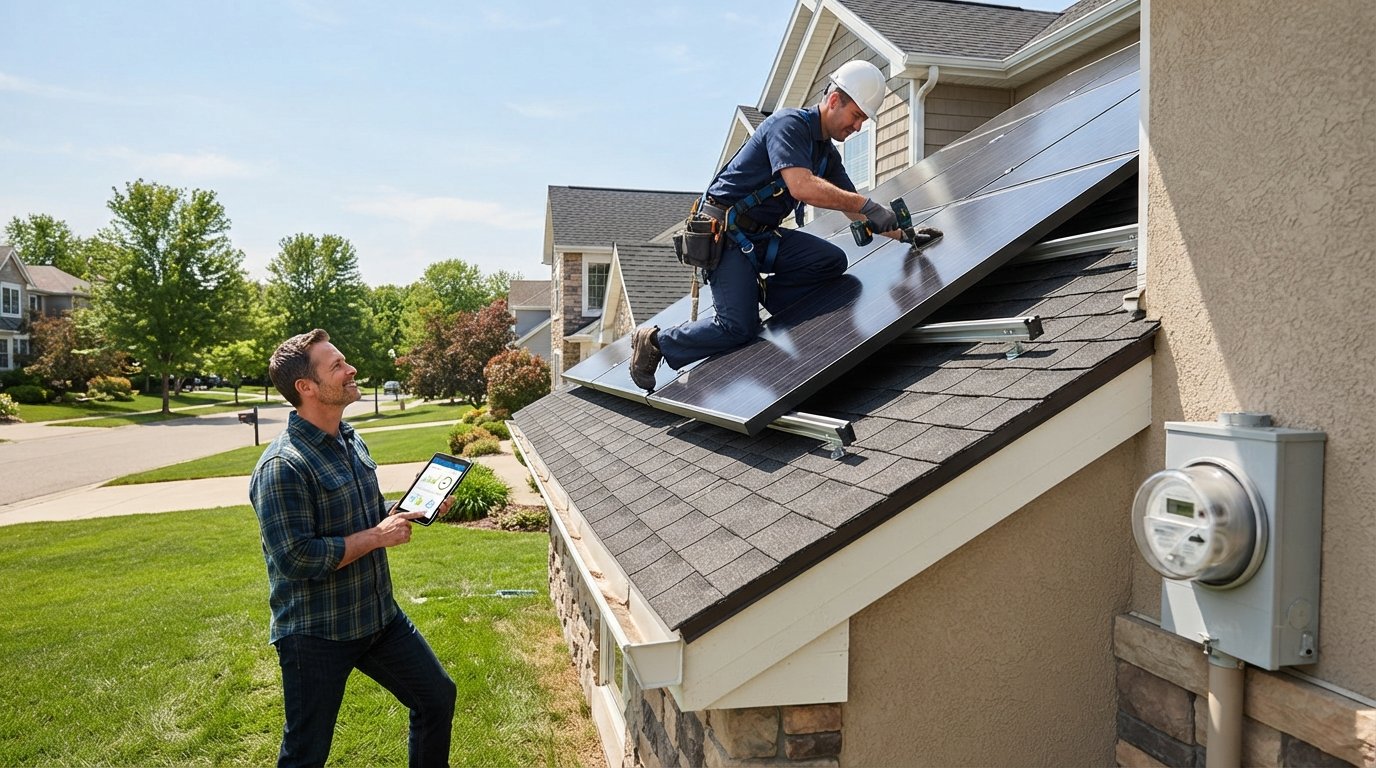
Solar Energy Facts: What Homeowners Must Know
Discover essential solar energy facts for homeowners in 2026, including costs, payback periods, and incentives that can save you thousands.

By Dylan Harris
Learn more about Solar Panel Installation and Repair for guides, costs, and what to expect.
Compare Solar Panel Installation and Repair Pros Near You

Enter your ZIP code to compare top-rated local professionals and request free quotes.
Solar power has moved from a niche environmental choice to a mainstream financial decision for American homeowners. Every hour, the sun delivers enough energy to power the entire planet for a year, yet most households still rely on fossil fuels for their electricity. The gap between solar's potential and its practical adoption comes down to information. Homeowners hesitate because they are unsure about costs, payback periods, and whether panels will work on their roofs. This article separates proven solar energy facts from outdated myths, giving you the clarity you need to decide if solar is right for your home. You will learn how much you can save, what incentives exist in 2026, and why system design matters more than panel brand.
Understanding the physical and economic realities of solar energy is the first step. A typical residential solar system in the United States ranges from 5 to 10 kilowatts (kW), producing between 600 and 1,200 kilowatt-hours (kWh) per month, depending on your location and roof orientation. That output can cover 70 to 100 percent of an average home's electricity needs. The financial benefit is equally clear: the national average payback period is now between 6 and 10 years, down from 15 years in 2010. With panels lasting 25 to 30 years, the savings window is substantial.
How Solar Panels Convert Sunlight Into Usable Power
Solar panels rely on the photovoltaic (PV) effect, a process where sunlight knocks electrons loose from silicon cells, creating a direct current (DC). An inverter then converts that DC into alternating current (AC), which powers your home's lights, appliances, and electronics. This conversion happens silently, with no moving parts, which is why panels require so little maintenance. The efficiency of this process has improved dramatically. Modern monocrystalline panels convert 20 to 23 percent of sunlight into electricity, while budget polycrystalline panels sit closer to 16 to 18 percent. Higher efficiency means you need fewer panels to produce the same power, which matters if your roof has limited south-facing space.
Your roof's angle and shading also play a critical role. Panels facing south at a 30 degree tilt capture the most sunlight in North America, but east and west orientations can still generate 70 to 80 percent of that maximum. Trees, chimneys, and nearby buildings can cast shadows that reduce output far more than most homeowners expect. A professional site assessment, like the energy surveys offered through SolarEnergy.ai, measures shade patterns across all four seasons to calculate realistic output. Without this data, your savings estimate could be off by 30 percent or more.
The Real Cost of Solar in 2026 and How to Pay for It
The upfront price of a solar system remains the biggest barrier for many families. In 2026, the average installed cost is between $2.50 and $3.50 per watt, meaning a typical 6 kW system costs $15,000 to $21,000 before incentives. That price includes panels, inverters, racking, wiring, permits, and labor. It also includes the installer's overhead and warranty coverage, so the cheapest quote is not always the best value. Low-bid installers often use inferior components or skip critical steps like load calculations and fire safety setbacks, which can void your roof warranty or fail inspection.
Financing options make solar accessible with little to no upfront money. Cash purchases deliver the highest long-term savings, but solar loans let you pay over 10 to 20 years with monthly payments that are often lower than your previous electric bill. Leases and power purchase agreements (PPAs) require no down payment and guarantee a fixed rate per kWh, but they do not let you claim the federal tax credit. The 30 percent Investment Tax Credit (ITC) remains intact through 2032, reducing a $18,000 system by $5,400. Many states add their own rebates or performance-based incentives. You can use the Solar Savings Calculator on SolarEnergy.ai to model your specific payback period with your local utility rates and available incentives.
Why Net Metering Changes Your Payback Math
Net metering is the policy that credits you for excess electricity your panels send to the grid. When your system produces more than your home uses, your meter spins backward, and you earn credits at the retail rate. Those credits offset what you draw from the grid at night or on cloudy days. In states with full retail net metering, like New Jersey and Massachusetts, your payback period can shrink by two or three years. In states with reduced credit rates, such as California's Net Billing Tariff, you need to size your system closer to your actual consumption or add battery storage to shift your usage. Check your utility's current net metering rules before signing any contract, as this policy is changing rapidly across the country.
Solar Energy Facts About Battery Storage and Smart Home Integration
Battery storage has become the fastest-growing add-on to residential solar systems. A lithium-ion battery, such as the Tesla Powerwall or Enphase IQ, stores excess daytime generation for use during peak evening hours when electricity rates spike. This shift, called load shifting, can cut your grid purchases by 40 to 60 percent. Batteries also provide backup power during outages, which is increasingly valuable as extreme weather events become more common. The cost of batteries has dropped 70 percent since 2015, and the 30 percent ITC applies to storage when it is charged by solar, making the combined system more affordable than ever.
Pairing your solar array with smart home technology takes savings further. AI-driven energy management systems, like the ones discussed in our guide on AI tools for solar energy, analyze your production and consumption patterns in real time. They automatically run your dishwasher, charge your EV, or heat your water when your panels are producing the most power. This reduces your reliance on grid electricity and maximizes the value of every solar kWh you generate. Some homeowners report an additional 15 to 20 percent savings on their electric bill just from smart scheduling.
Battery sizing is not one-size-fits-all. A typical home needs 10 to 15 kWh of usable capacity to cover overnight loads, while larger homes with electric heating or EV charging might require 20 kWh or more. Oversizing a battery wastes money, while undersizing leaves you pulling from the grid during peak hours. A professional installer will calculate your average overnight consumption and recommend a battery that meets 80 to 90 percent of that load, striking the right balance between cost and independence.
Maintenance Myths and Real-World Panel Performance
One of the most persistent solar energy facts that surprises homeowners is how little maintenance panels actually require. Rain naturally washes away most dust and pollen, and panels have no moving parts to wear out. On average, you only need to clean your panels once or twice a year, and that cleaning can be as simple as hosing them down from the ground. However, if you live in a dusty area, near a highway, or have heavy bird activity, annual professional cleaning can boost output by 5 to 8 percent. Snow, contrary to popular belief, is rarely a problem. Panels are mounted at an angle, so snow slides off within a few hours, and the dark surface actually attracts sunlight to melt it faster.
Performance degradation is also slower than most people expect. Panels lose about 0.5 percent of their output per year, meaning after 25 years, a high-quality panel still produces around 88 percent of its original rating. This degradation is covered by most manufacturers' linear performance warranties, which guarantee a minimum output for 25 years. Inverters, however, have a shorter lifespan. String inverters last 10 to 15 years and may need replacement once during your system's life, costing $1,500 to $2,500. Microinverters and power optimizers, which sit on each panel, last 20 to 25 years but cost more upfront. Factor this replacement cost into your long-term savings estimate, and you will still come out ahead by tens of thousands of dollars.
Environmental Impact and Property Value: The Hidden Benefits
Beyond your electric bill, solar panels deliver measurable environmental benefits. A typical 6 kW system offsets roughly 4.5 metric tons of carbon dioxide per year, equivalent to planting 200 trees annually. Over its 25-year life, that same system prevents about 112 tons of CO2 from entering the atmosphere. This reduction matters for homeowners who want to align their energy use with their values. Solar also reduces strain on the grid during peak demand, which lowers the risk of blackouts and reduces the need for new natural gas peaker plants.
Property value is another rarely discussed solar energy fact. Multiple studies, including one from Zillow, show that homes with solar panels sell for 4 to 6 percent more than comparable homes without them. For a $400,000 house, that is a $16,000 to $24,000 premium. This value holds because buyers recognize the long-term savings and lower utility costs. If you sell before your system's payback period ends, the added resale value often recoups your remaining investment. The key is owning your system outright. Leased systems can complicate sales, as buyers may be reluctant to assume a lease agreement.
To maximize this benefit, choose a reputable installer and keep all warranty and maintenance records. A clean, well-documented system signals quality to appraisers and potential buyers. You can find vetted local installers through SolarEnergy.ai's guide on daily solar energy use, which also explains how to maximize your system's visibility and curb appeal during a home sale.
How to Choose the Right Solar Installer and Avoid Scams
The quality of your installation matters more than the brand of your panels. A poorly installed system can leak, underperform, or even create fire hazards, so vetting your installer is critical. Start by checking for valid licenses, insurance, and certifications like NABCEP (North American Board of Certified Energy Practitioners). Ask for at least three local references and visit a few completed installations if possible. Read online reviews on Google and the Better Business Bureau, but focus on long-term performance complaints rather than one-off issues.
Be wary of door-to-door salespeople who pressure you to sign that day or claim you qualify for a "government program" that is actually a lease. Reputable installers provide transparent quotes with line-item costs for equipment, labor, permits, and warranty. They will also help you complete the necessary paperwork for the federal tax credit and any state incentives. If an offer seems too good to be true, it probably is. Compare at least three quotes from different companies, and use neutral tools like SolarEnergy.ai's solar pros network to find pre-screened installers in your area. Remember, the lowest bid can become the most expensive over time if it leads to leaks or inverter failures.
After installation, ensure you understand your warranty coverage. Most panels come with a 25-year product and performance warranty, while inverters carry a 10 to 25-year warranty depending on the type. Your installer should also offer a workmanship warranty of at least 5 years, covering roof penetrations and wiring issues. Keep all documentation in a safe place, and register your system's warranty with the manufacturer to activate it. A well-documented system protects your investment and simplifies future claims.
Solar Energy Facts: What the Future Holds
The solar industry is evolving rapidly, and 2026 brings new technologies that will make solar even more attractive. Perovskite solar cells, which are cheaper and more efficient than traditional silicon, are moving from labs to pilot production lines. These cells can achieve 30 percent efficiency, a 50 percent improvement over current panels, and they can be applied to flexible surfaces like window films or vehicle roofs. While commercial availability is still a few years away, early adopters can future-proof their homes by choosing inverters and racking systems that are upgrade-compatible.
Artificial intelligence is also transforming how solar systems operate. AI-driven platforms, as detailed in our article on using AI for solar energy to cut your electric bill, now predict your home's energy consumption hour by hour, adjusting battery charging and appliance usage to avoid peak rates. These systems learn your habits and local weather patterns to optimize every kWh, often cutting grid reliance by an additional 10 to 20 percent. As utilities introduce time-of-use rates with higher evening prices, this kind of intelligent control becomes a financial necessity, not just a convenience.
For homeowners considering solar in 2026, the timing is favorable. Panel prices have stabilized after a post-pandemic spike, the federal tax credit is still at 30 percent, and battery costs continue to fall. The most important step is to get a personalized assessment that accounts for your roof, shading, electricity usage, and local incentives. Use the resources on SolarEnergy.ai, including the cost guide and savings calculator, to build an accurate financial model. Then, connect with vetted local installers through the platform to receive competitive quotes. Solar is a long-term investment, but with the right information and a quality installation, it can deliver reliable savings and energy independence for decades.
Learn more about Solar Panel Installation and Repair for guides, costs, and what to expect.
Compare Solar Panel Installation and Repair Pros Near You
Enter your ZIP code to compare top-rated local professionals and request free quotes.