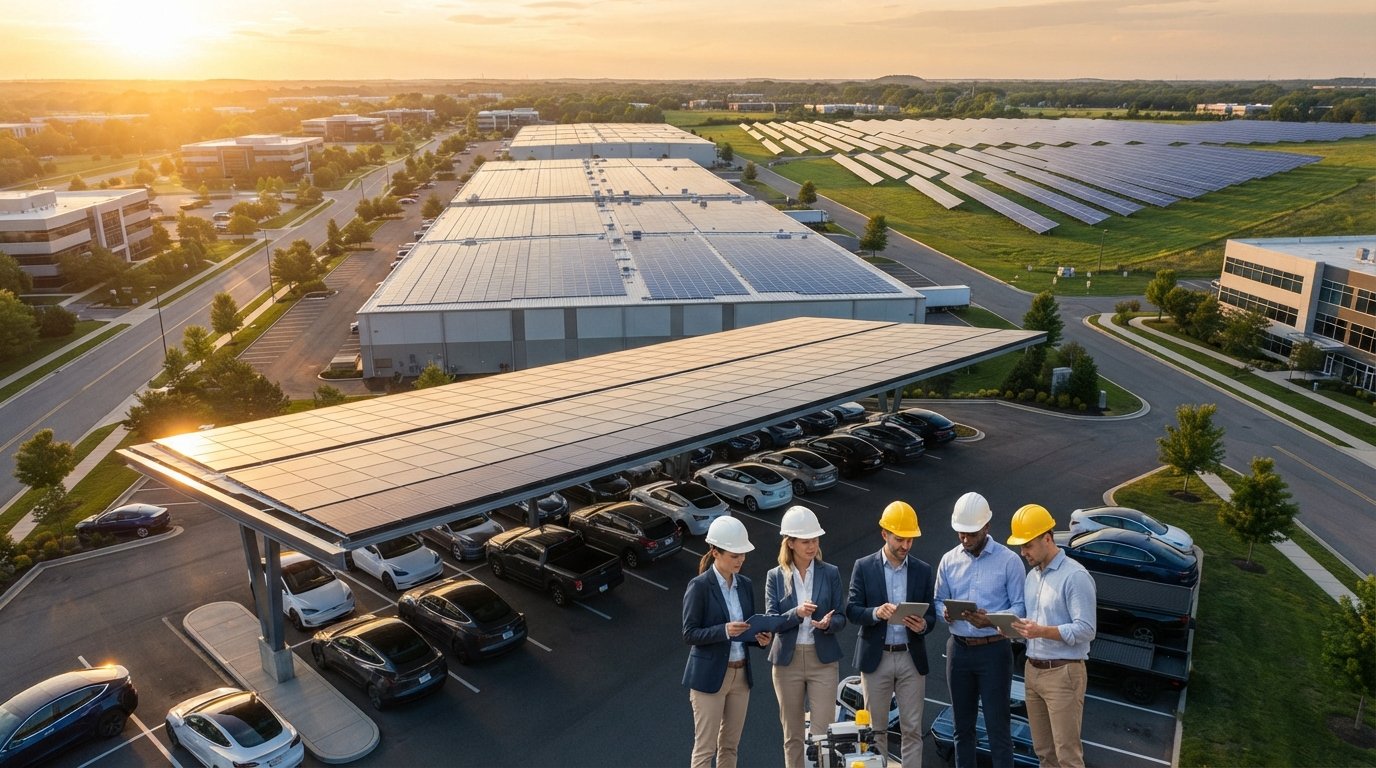
Solar Carport vs Rooftop vs Ground Mount for Business
Compare solar carport vs rooftop vs ground mount for businesses. See how cost, yield, and incentives differ so you can pick the right commercial solar mount.

By Ryan Brooks
Learn more about Solar Panel Installation and Repair for guides, costs, and what to expect.
Compare Solar Panel Installation and Repair Pros Near You

Enter your ZIP code to compare top-rated local professionals and request free quotes.
Choosing where to put a commercial solar array is one of the highest-stakes decisions a business owner will make during an energy upgrade. The mounting decision affects your capital outlay, your available tax incentives, your roof warranty, your parking lot layout, and even how customers perceive your brand. Three configurations dominate the commercial market: solar carports, rooftop arrays, and ground mounts. Each one solves a different problem, and each one carries trade-offs that rarely show up in a simple payback spreadsheet.
This comparison walks through the real-world differences between a solar carport, rooftop system, and ground mount for businesses. You will see how site constraints, structural capacity, utility interconnection rules, and incentive eligibility shift the math. By the end, you should be able to match your property profile to the configuration that maximizes return without creating hidden liabilities.
How Mounting Choice Drives Commercial Solar Economics
Every commercial solar project starts with the same basic equation: generate as much electricity as possible for the lowest installed cost per watt while preserving the property's core function. Mounting type changes all three variables. A rooftop system typically costs the least per watt because it reuses existing structure and land. A ground mount costs more because it requires foundations, trenching, and often fencing, but it opens up ideal tilt and orientation. A solar carport costs the most because it is a dual-purpose structure that must satisfy building codes for both energy production and vehicle shelter.
Those cost differences are not static. A roof that needs structural reinforcement can erase the rooftop cost advantage. A ground mount on prime development land carries an opportunity cost that dwarfs the racking premium. A carport that unlocks a previously unusable parking area can generate revenue or brand value that pure energy math misses. The correct comparison, then, is not cost per watt in isolation. It is cost per watt adjusted for land value, structural readiness, incentive stacking, and non-energy benefits.
Financing structures also interact with mounting type. Power purchase agreements and leases are common across all three, but lenders often view carports and ground mounts as more financeable when they sit on owned property with clear title. Rooftop systems on leased buildings can complicate the investment tax credit for the property owner, which is why many businesses evaluate a roof mount solar panel guide before signing a 25-year agreement. Understanding these structural and financial nuances early prevents expensive redesigns later.
Rooftop Solar for Businesses: Strengths and Hidden Risks
Rooftop solar remains the default choice for warehouses, big-box retail, manufacturing plants, and office buildings with large, unobstructed roof planes. The primary advantage is cost efficiency. Racking attaches directly to the roof structure, trenching is minimal, and the array sits above parking lots, inventory, and employees, so it consumes no additional land. For a building with a new standing-seam metal roof and 100,000 square feet of clear space, rooftop solar is usually the fastest path to a positive return.
The hidden risks appear when the roof is older, structurally marginal, or covered by a warranty that restricts penetrations. Ballasted systems avoid roof penetrations on some membrane roofs, but they add weight and may not be permitted in high-wind zones. If the roof needs replacement within the solar asset's life, the cost to remove and reinstall the array can run into six figures. Businesses should always coordinate a roof condition assessment with a structural engineer before committing to rooftop solar.
Interconnection is another variable. Rooftop systems are typically sized to offset on-site load, which keeps them under utility review thresholds in many states. That can speed approval and reduce upgrade costs. However, if the building has low daytime load, a large rooftop array may export power at unfavorable rates. In those cases, adding battery storage or shifting to a carport or ground mount with a different production profile may improve the value of each kilowatt-hour.
Key rooftop considerations for commercial properties include:
- Remaining roof life and warranty compatibility with racking attachments
- Structural capacity for dead load (panels and racking) and wind uplift
- Shading from HVAC units, vents, and adjacent buildings
- Fire code setbacks and access pathways for first responders
- Interconnection limits and net metering or net billing rules
When those boxes are checked, rooftop solar often delivers the lowest levelized cost of energy of the three options. When they are not, the apparent savings can evaporate during construction or in year ten when the roof fails.
Solar Carports for Businesses: Dual-Use Structures With Premium Benefits
A solar carport turns an open parking lot into a power plant and a shaded amenity. The structure consists of steel columns, a canopy, and solar modules mounted on top. Businesses gain covered parking, reduced heat island effect, and a visible sustainability statement. Employees and customers appreciate protection from sun, rain, and snow, and the shaded surface can extend asphalt life by reducing thermal cycling.
The economics of carports are more complex than rooftop or ground mount. Steel, foundations, and engineering add cost, so the installed price per watt is typically 20 to 40 percent higher than a rooftop system of similar capacity. That premium can be justified when land is scarce or expensive, when the parking lot is already due for resurfacing, or when the business wants to monetize parking through EV charging. Carports also create an opportunity to integrate electric vehicle supply equipment, which can attract tenants and customers in retail and office settings.
Incentive eligibility deserves careful attention. Because a carport is a structure, it may qualify for accelerated depreciation and the investment tax credit on the entire asset, not just the panels. Some businesses also qualify for bonus depreciation on the canopy portion. These stacked benefits can narrow the gap with rooftop solar, especially for profitable companies with significant tax appetite. However, rules vary by jurisdiction and by the ownership structure, so verification with a tax professional is essential.
Practical constraints include parking disruption during construction, snow shedding onto walkways, and drainage design. A well-planned carport project sequences installation in phases so the lot remains usable. It also accounts for future EV charger conduit and panel capacity, avoiding costly retrofits later.
Ground Mount Solar for Businesses: Maximum Design Freedom
Ground mount solar offers the most engineering freedom of the three configurations. Arrays can be tilted at the optimal angle for the site's latitude, spaced to avoid row-to-row shading, and oriented to match the utility's time-of-use rates. Maintenance is easier because technicians work at grade level, and there is no roof warranty risk. For businesses with unused acreage, a brownfield site, or a large buffer zone, ground mount solar can be the highest-yield option per installed panel.
The trade-offs are land, permitting, and visibility. A ground mount consumes real estate that might otherwise be developed, farmed, or sold. It usually requires a fence for safety and security, and in some jurisdictions it triggers landscaping or screening requirements. Trenching for conduit from the array to the interconnection point adds cost, especially if the distance is long or the soil is rocky. Permitting can also be more involved than rooftop, particularly if the site has wetlands, floodplain, or historical designation.
Ground mounts shine in specific scenarios: businesses with excess land and high electricity rates, sites where the roof cannot support solar, and projects that need to scale beyond the building's electrical service capacity. They also pair well with battery storage and microgrid controls, because the array and batteries can be co-located in a secure compound. For manufacturers with 24/7 loads, a ground mount sized to the facility's baseline demand can deliver predictable savings for decades.
Before choosing ground mount, businesses should confirm:
- Land ownership, zoning, and any deed restrictions on power generation
- Soil conditions and foundation requirements for the racking system
- Distance to the interconnection point and available conduit pathways
- Security, fencing, and vegetation management obligations
- Future site plans that could conflict with a 25-year asset
When those factors align, ground mount solar can outperform rooftop and carport on pure energy yield. When they do not, the hidden costs of land and permitting can push the payback beyond acceptable thresholds.
Comparing Cost, Output, and Incentives Across All Three
A side-by-side comparison helps clarify where each option wins. The table below summarizes typical commercial ranges, but actual numbers depend on location, labor rates, and utility rules.
- Installed cost per watt: Rooftop is usually lowest, ground mount is mid-range, and carport is highest due to steel and foundations.
- Energy yield per panel: Ground mount and carport often outperform rooftop because they can be optimally tilted and spaced, while rooftop arrays must follow roof pitch and avoid obstructions.
- Land use: Rooftop uses none, carport uses existing parking, and ground mount consumes open land.
- Incentive stacking: Carports and ground mounts may capture depreciation on structures and foundations, while rooftop systems are limited to the solar equipment and racking.
- Maintenance access: Ground mount is easiest, carport is moderate, and rooftop is most restrictive.
Financing options also differ. Many businesses use a power purchase agreement or lease to avoid upfront capital, but the value of the investment tax credit depends on who owns the system. Tax-equity structures can monetize credits for non-profit or low-tax-appetite entities, but they add complexity. For businesses that want to own the asset outright, a commercial solar loan or property-assessed clean energy financing may offer the best blend of cash flow and long-term savings.
It is also worth noting that utility interconnection rules can favor one configuration over another. Some utilities cap rooftop exports at a percentage of the service size, while ground mounts may be treated as separate generators with different review paths. Carports are often treated like ground mounts because they are separate structures. Understanding these classifications before design prevents costly redesigns during permitting.
Site Selection Framework: Matching Your Property to the Right Mount
Use a simple decision framework to narrow the options. Start with the roof. If the roof is new, structurally sound, and free of heavy shading, rooftop solar should be the baseline. It is usually the cheapest and fastest to deploy. If the roof is near the end of its life or cannot support racking, move to the next option.
Next, evaluate the parking lot. If the business has a large lot with high traffic and customers or employees who would value covered parking, a solar carport can justify its premium through amenity value, EV charging, and visible sustainability. Carports are especially attractive for retail centers, office campuses, hospitals, and universities where the parking experience matters.
Finally, assess the land. If the property has unused acreage, a brownfield, or a buffer zone that cannot be developed, a ground mount may deliver the highest yield and easiest maintenance. Ground mounts are also the best choice when the building's electrical service is too small for the desired array size, because the array can be interconnected at a separate point.
Businesses that want a data-driven answer can use an independent educational resource such as NewSolarQuotes to compare installation costs, incentive estimates, and savings projections before requesting bids. Combining that research with a professional site survey and a solar savings calculator will produce a realistic payback range for each mounting option.
Once the shortlist is clear, request proposals from at least three vetted commercial installers. Ask each one to model the same electricity rate escalation, the same incentive assumptions, and the same financing terms. That apples-to-apples comparison reveals which configuration truly delivers the best return for your specific property, not just the lowest sticker price.
The right mounting choice comes down to your site, your tax position, and your operational priorities. A rooftop system may win on cost, a carport may win on dual-use value, and a ground mount may win on yield and maintainability. By evaluating all three against the same financial and technical criteria, your business can invest in solar with confidence and avoid the costly surprises that come from choosing a mount before understanding the site.