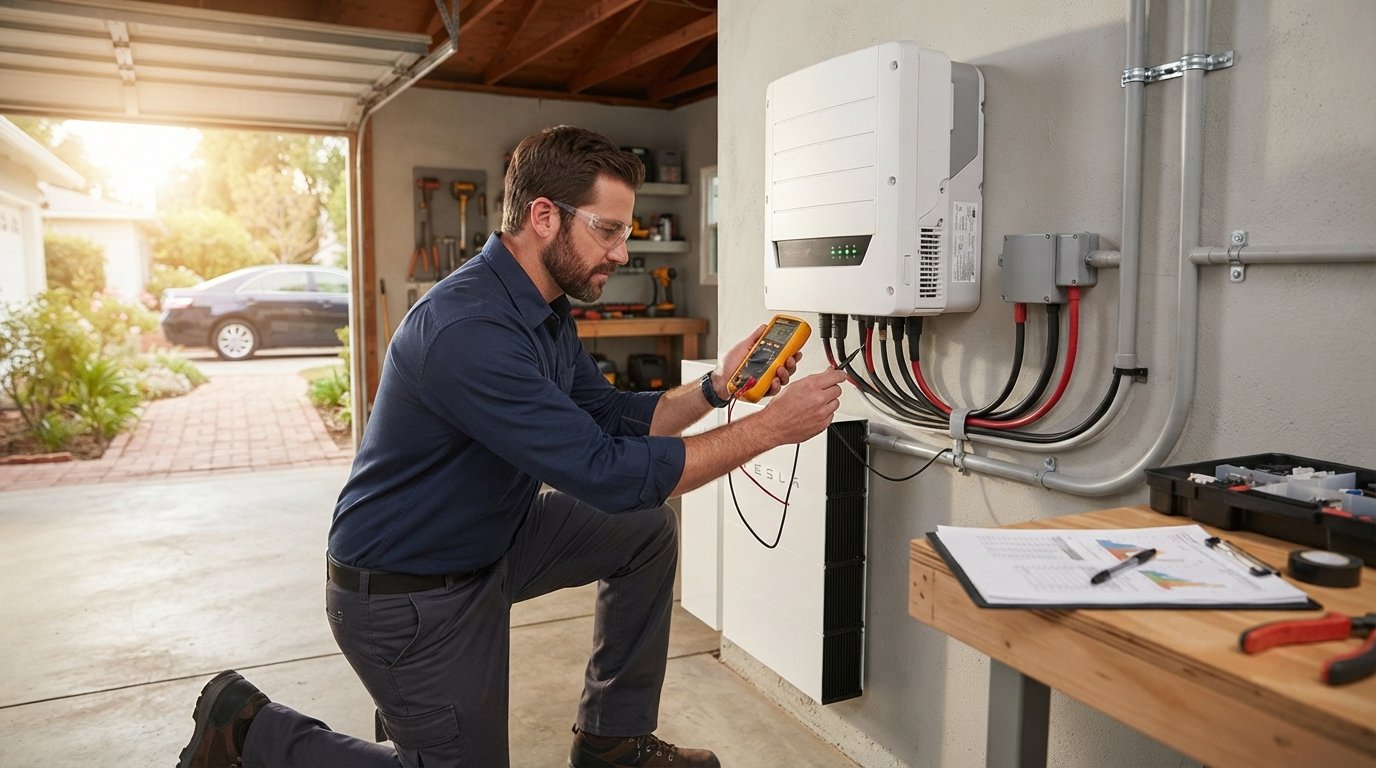
Solar Battery Inverter Sizing for Whole Home Backup
Size your solar battery inverter for whole home backup with confidence. Call (833)-434-4023 for expert help and avoid costly mistakes.

By Wendy Young
Learn more about Solar Panel Installation and Repair for guides, costs, and what to expect.
Compare Solar Panel Installation and Repair Pros Near You

Enter your ZIP code to compare top-rated local professionals and request free quotes.
When the grid goes down, your lights, refrigerator, and medical equipment should keep running without a second thought. But a whole home backup system is only as reliable as its inverter and battery sizing. Many homeowners focus on battery capacity alone, then discover their inverter cannot handle the surge from a well pump or air conditioner. The result is a system that fails exactly when you need it most. This guide walks through the critical steps to size both the inverter and battery for whole home backup, so you invest in a system that delivers true resilience.
Why Inverter Sizing Drives Backup Performance
The inverter is the heart of your backup system. It converts DC power from your solar panels and batteries into AC power for your home. If the inverter is undersized, it will trip offline when loads exceed its capacity, even if the batteries are full. Oversizing the inverter adds unnecessary cost and may reduce efficiency. The goal is to match inverter capacity to your home's actual power demands, both continuous and surge.
Continuous wattage is the steady power your home draws during normal operation. Surge wattage is the brief spike when motors start, such as a furnace blower, refrigerator compressor, or well pump. Inverters are rated for both, but surge ratings are typically for a few seconds only. Ignoring surge requirements is one of the most common mistakes in backup sizing. For example, a 5 kW inverter may handle a 7.5 kW surge for a few seconds, but a well pump with a locked rotor might demand three times its running wattage. Always check the surge rating of your inverter against the starting wattage of your largest motor loads.
To size the inverter correctly, start by listing all loads you want to backup. Distinguish between essential and non-essential circuits. Essential loads typically include lighting, refrigeration, heating/cooling, medical devices, and communication equipment. Non-essential loads might include pool pumps, electric vehicle chargers, and shop tools. For whole home backup, you need to account for all loads that could run simultaneously, but you can manage non-essential loads manually or with smart controls. A professional energy audit can measure actual startup and running watts, but you can estimate using appliance nameplate data and a watt meter.
Sizing Battery Capacity: Essential Circuits vs Whole Panel
Battery capacity determines how long your backup lasts. The first decision is whether to back up the entire electrical panel or just a subpanel with essential circuits. Whole panel backup requires a larger battery and inverter to handle the full load of the home, but it offers seamless coverage without rewiring. Essential circuit backup is more affordable and often sufficient for short outages, but it requires careful planning to ensure all critical loads are included.
To size battery capacity, calculate your daily energy consumption for the loads you want to backup. Use the formula: daily watt-hours = sum of (appliance wattage x hours used per day). For essential circuits, a typical home might need 10-15 kWh per day. For whole home backup, that could be 30 kWh or more, depending on home size and climate. Battery capacity is measured in kilowatt-hours (kWh), and you should account for depth of discharge (DoD). Most lithium-ion batteries allow 80-100% DoD, while lead-acid should not be discharged below 50%. Therefore, a 10 kWh lithium battery can deliver about 8-10 kWh usable, whereas a lead-acid battery of the same rating delivers only 5 kWh usable.
Consider the duration of outages in your area. If you experience frequent multi-day outages, you need enough battery capacity to cover those periods, plus a plan to recharge from solar. A battery sized for one day of autonomy may not suffice if cloudy weather persists. Many homeowners aim for 2-3 days of essential load autonomy. For whole home backup, that translates to 30-45 kWh for a typical home. Work with an installer to model your specific usage and solar production.
How Solar Recharge and Weather Affect Backup Duration
Battery capacity alone does not guarantee uninterrupted power. Your solar array must be able to recharge the batteries during outages. If your solar system is undersized relative to battery capacity, you may not fully recharge during short winter days or cloudy periods. The recharge time depends on solar production, battery capacity, and inverter efficiency. A common rule of thumb is to have enough solar to recharge the battery from 50% to 100% in one sunny day. For a 10 kWh battery, that means producing about 5-7 kWh surplus after covering home loads.
Weather patterns in your region play a critical role. In sunny climates, a smaller battery may suffice because solar recharges quickly. In areas with prolonged cloudy weather, you need either a larger battery or a generator backup. Some inverters support generator input, which can be a lifesaver during extended outages. Also, consider the time of year: winter has shorter days and lower sun angles, reducing solar output. Size your system for the worst-case month, not the best.
To optimize recharge, ensure your inverter is compatible with your battery and solar array. Hybrid inverters combine solar and battery management, simplifying installation. If you have a existing solar system, check whether your inverter can be retrofitted with batteries or if you need a new hybrid inverter. Many modern inverters offer seamless backup transition and smart load management, which can prioritize essential circuits and extend backup duration.
Common Mistakes That Undersize Backup Systems
Several pitfalls can leave your backup system incapable of handling real-world loads. One major mistake is ignoring surge requirements for heating, ventilation, and air conditioning (HVAC) systems. Air conditioners and heat pumps have high starting currents, often 2-3 times their running wattage. A soft-start kit can reduce surge, but you still need an inverter rated for the remaining surge. Another mistake is forgetting well pumps, which can draw significant surge and run for long periods. If you rely on a well for water, size your inverter and battery accordingly.
Electric vehicle (EV) charging is another load that can overwhelm a backup system. Level 2 chargers draw 7-11 kW continuously, which could deplete a battery quickly. Unless you have a massive battery and solar array, exclude EV charging from backup or use a smart load manager to disable it during outages. Similarly, electric resistance heating (baseboard heaters, electric furnaces) consumes large amounts of power. A heat pump is more efficient, but still requires proper sizing.
Other common errors include:
- Underestimating continuous loads by forgetting small devices that add up (e.g., networking equipment, phone chargers, clocks).
- Using optimistic weather data for solar recharge, leading to insufficient backup during cloudy spells.
- Choosing a battery with inadequate usable capacity due to depth of discharge limits.
- Overlooking the inverter's idle consumption, which can drain small batteries.
To avoid these mistakes, perform a detailed load analysis and consult a professional. Many installers use software to simulate year-round performance, including worst-case weather. If you are comparing solar options, our AI solar system comparison guide can help you evaluate different configurations and their backup capabilities.
Step-by-Step Sizing Framework
Follow this practical framework to size your solar battery inverter for whole home backup. First, determine your backup goals: whole home or essential circuits? Second, list all loads and their wattages, noting surge requirements for motor-driven appliances. Third, calculate daily energy consumption for backup loads. Fourth, decide on autonomy days based on local outage patterns. Fifth, size the battery bank to meet usable capacity needs. Sixth, size the inverter to handle continuous and surge wattage of all simultaneous loads. Seventh, verify solar recharge capability. Finally, consult a certified installer to validate your design and ensure code compliance.
For accurate load measurements, consider a home energy monitor or a professional energy audit. Many utilities offer free or discounted audits. SolarEnergy.ai also provides resources like a solar savings calculator and guides on incentives to help you plan. If you prefer to work with a vetted professional, find solar installers in your area who specialize in backup systems.
When selecting equipment, pay attention to inverter surge ratings and battery depth of discharge. Look for inverters with scalable capacity if you plan to add batteries later. Ensure the inverter is compatible with your battery chemistry (lithium-ion is now standard for new installations). Also, consider whether you want a whole-home surge protector to safeguard electronics during grid switching.
Finally, remember that proper sizing is not just about numbers; it is about matching the system to your lifestyle and risk tolerance. A slightly larger battery or inverter can provide peace of mind during extreme weather. But oversizing unnecessarily wastes money. A balanced approach, informed by data and professional advice, delivers the best value.
For independent educational resources and cost calculators, you can also visit NewSolarQuotes to compare options and understand financing. Their tools complement the expert guidance you will find here.
By following these steps and avoiding common pitfalls, you can design a solar battery inverter system that keeps your home powered through any outage, giving you confidence and comfort year-round.