Solar Battery Backup for Medical Equipment and Critical Loads
Solar battery backup for medical equipment and critical loads keeps essential devices running through outages. Call (833)-434-4023 for expert help.

By Wendy Young
Learn more about Solar Panel Installation and Repair for guides, costs, and what to expect.
Compare Solar Panel Installation and Repair Pros Near You

Enter your ZIP code to compare top-rated local professionals and request free quotes.
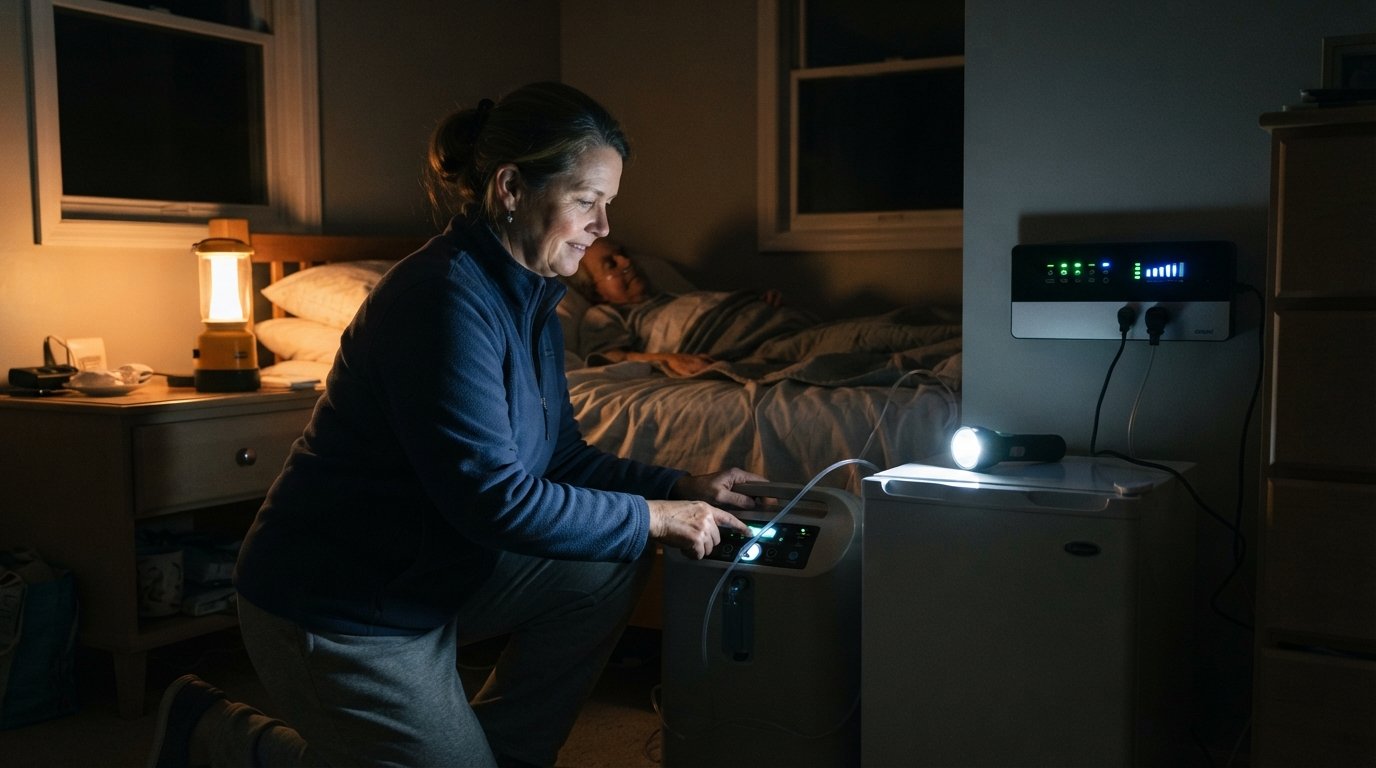
When the grid goes down, a home medical device cannot wait for a utility crew to finish repairs. For families managing oxygen concentrators, home dialysis machines, infusion pumps, or refrigerated medications, a power outage is not an inconvenience; it is a health emergency. Solar battery backup for medical equipment and critical loads closes that gap by storing daytime solar production and releasing it instantly when the grid fails, keeping essential circuits alive without a generator, fuel run, or noisy exhaust. The stakes are high, and the planning deserves the same rigor you would apply to any life-safety system. This guide walks through circuit identification, winter runtime math, panel configurations, battery and inverter selection, testing routines, and how to coordinate the electrical and solar trades so the system works on the worst night of the year, not just the easiest.
Start by Mapping Critical Circuits and Real Outage Runtime
Every reliable backup design begins with an inventory, not a product. Walk through the home and list every device that must remain powered for health, safety, or preservation of medication. Medical loads usually fall into three tiers. Tier one covers life-sustaining devices: oxygen concentrators, ventilators, BiPAP and CPAP machines used for respiratory conditions, home dialysis, infusion pumps, and enteral feeding pumps. Tier two covers temperature-sensitive storage such as medication refrigerators and insulin cooling cases, plus communication devices and phone charging. Tier three covers comfort and convenience loads that make an extended outage tolerable, like a few lights, a refrigerator, and a fan. Separating these tiers prevents the common mistake of sizing a battery for the whole house when a fraction of the load actually protects health.
Next, convert the inventory into watts and watt-hours. Check the label or manual for each device and note running watts and, where relevant, surge watts at startup. Many motors and compressors draw two to three times their running wattage for a second or two. A portable oxygen concentrator might draw 150 to 300 watts continuously, while a stationary concentrator with a compressor can draw 400 watts or more. Multiply running watts by the hours per day the device operates, then by the number of outage days you want to cover. A realistic winter planning horizon for many households is 48 to 72 hours, because storms that knock out power in cold weather often take longer to repair than summer outages.
Winter adds two complications that inflate the number. First, solar production drops, so the battery receives less recharge each day and must carry more of the load itself. Second, heating loads and longer darkness increase household consumption. Build in a 20 to 30 percent buffer above your calculated watt-hours, and treat the result as a floor rather than a target. A simple worksheet keeps the math honest:
- List each critical device with its running watts and daily hours of use.
- Multiply watts by hours to get daily watt-hours per device, then sum the total.
- Add surge allowance for any compressor or motor-driven device.
- Multiply by the number of outage days you want to cover (48 to 72 hours is a sensible starting point).
- Add a 20 to 30 percent winter buffer, then compare against usable battery capacity.
That final comparison is where many plans fail. A battery rated at 10 kWh does not deliver 10 kWh if it is a lithium iron phosphate unit reserved at 10 percent depth of discharge, or a lead-acid bank that should not be discharged below 50 percent. Usable capacity, not nameplate capacity, is the number that matters. If your winter calculation lands at 6 kWh per day and you want two days of autonomy, you need roughly 12 kWh of usable storage, which means a larger nameplate rating once reserve margins are applied. Doing this arithmetic before shopping prevents the painful discovery, mid-outage, that the system was sized for a summer weekend rather than a February ice storm.
Whole-Home Backup Versus a Critical-Load Panel
Once the load list exists, the next decision is architectural: back up the entire service panel or install a dedicated critical-load subpanel. Whole-home backup is the simplest to live with because nothing changes during an outage; every circuit keeps working until the battery depletes. It requires an inverter and battery bank sized for the home's peak demand, which for a house with electric resistance heat, a heat pump, or an electric range can push equipment costs sharply higher. Whole-home systems also demand careful load management so that simultaneous high-draw appliances do not trip the inverter. For households with modest electrical demand and a generous budget, whole-home backup offers unmatched convenience and avoids any rewiring of branch circuits.
Critical-load panel backup takes the opposite approach. An electrician installs a dedicated subpanel fed through a transfer mechanism, and only the circuits you designate move to it. Medical equipment, medication refrigeration, a few lights, internet router, and phone charging go on the subpanel; the water heater, dryer, and electric oven stay on the main panel and go dark during an outage. The advantages are substantial: a smaller, less expensive battery and inverter, simpler code compliance, and a clearer mental model of what stays on. The tradeoff is discipline during installation, because adding a circuit later means another electrician visit. Most medical-need households find the critical-load approach the better balance of cost and capability, especially when the goal is protecting specific devices rather than running the whole house.
Whichever path you choose, the transfer equipment matters. A manual transfer switch requires someone to be home and physically move the switch, which is unacceptable if the patient cannot operate it. An automatic transfer switch senses the outage and shifts the critical panel to battery power within milliseconds to seconds, depending on the equipment. For sensitive medical devices, confirm the transfer time with the inverter manufacturer and, if necessary, add a small uninterruptible power supply on the single most critical device as a bridge. The combination of a whole-home or critical-load battery system plus a compact UPS on the ventilator or infusion pump gives layered protection that no single component provides.
Choosing Battery Chemistry and Inverters for Sensitive Medical Devices
Medical equipment is less forgiving than a refrigerator. Many devices contain sensitive electronics that dislike voltage sags, frequency drift, and modified sine wave output. The inverter is therefore the heart of the system, and a pure sine wave inverter is non-negotiable for any circuit feeding medical equipment. Pure sine wave output matches utility power closely enough that device power supplies, chargers, and control boards behave normally. Modified sine wave inverters, still sold on the budget end of the market, can cause overheating, buzzing, and erratic behavior in medical devices and should be avoided entirely for this application.
Battery chemistry deserves equal attention. Lithium iron phosphate (LiFePO4) has become the default for residential backup because it offers high usable depth of discharge, long cycle life, low maintenance, and stable chemistry that does not vent flammable gases. It also tolerates partial state of charge well, which matters in winter when solar recharge may be incomplete for several days. Lead-acid batteries, whether flooded or sealed AGM, cost less upfront but require deeper reserve margins, deliver less usable capacity per rated kilowatt-hour, and need ventilation and periodic maintenance. For a life-safety application where reliability is the whole point, lithium iron phosphate is usually the rational choice despite the higher purchase price.
Beyond chemistry, confirm the inverter's continuous and surge ratings against your load list, and check its idle consumption. An inverter that draws 40 watts just to stay on will quietly drain a small battery over a multi-day outage. Look for equipment with a documented backup mode, generator support, and the ability to prioritize critical loads automatically. If your home already has solar, verify that the battery inverter can operate without the grid (grid-forming capability) and can recharge from solar during an outage. Many early battery systems were grid-tied only and shut down when the grid failed, which defeats the purpose. When comparing options, ask specifically whether the system can black-start from the battery and recharge from panels while the grid is down. For a broader look at how storage banks are evolving, the guide on solar battery banks and energy storage covers the technology landscape in more depth.
Testing, Maintenance, and Confirming Backup Readiness
A backup system that has never been tested is a hope, not a plan. Establish a routine that proves the system works before you need it. Once a month, simulate an outage by opening the main breaker or using the system's test mode, and confirm that the critical panel transfers, the medical devices keep running, and the battery state of charge behaves as expected. Record the results in a log with date, starting state of charge, loads running, and any anomalies. Quarterly, review the log for drift and check that firmware updates have not changed transfer behavior. Annually, have a qualified technician inspect terminations, verify torque on battery connections, test the transfer switch, and confirm that the battery still meets its capacity specification.
Winter readiness deserves its own checklist. Before storm season, confirm that the battery reaches full charge on a sunny day, that snow clearing is planned for the array, and that the critical panel has no newly added loads that exceed the design. If a new medical device enters the home, recalculate the load list and update the system or its settings accordingly. Keep a printed copy of the load list, the system manual, and the installer's contact information in the same place as the medication and emergency supplies, because during an outage you may not be able to look anything up online.
Maintenance also includes the human side. Everyone in the household should know how to read the battery state of charge, where the critical panel is, and what to turn off to stretch runtime. A short printed card taped inside the panel door with the top three load-shedding steps is worth more than a thick manual nobody reads. If the system includes an app, enable alerts for low state of charge and equipment faults, and make sure at least two people receive them. Backup power is a system of equipment, documentation, and habits, and the habits are the cheapest part to improve.
Coordinating Solar Pros and Electricians on a Dedicated Transfer Panel
Critical-load backup sits at the intersection of two trades, and the project goes smoothly when both are involved from the start. The electrician owns the load calculation, the subpanel design, the transfer switch, and code compliance. The solar professional owns array sizing, battery selection, inverter configuration, and interconnection. When one trade designs without the other, the result is often a battery that cannot carry the panel, a panel that includes circuits the battery cannot support, or an interconnection that fails inspection. Bring both to the same conversation before any equipment is ordered.
Start with a documented load calculation and a clear statement of medical need. Ask the electrician to identify which circuits will move to the critical panel and to confirm that the transfer switch is rated for the service. Ask the solar pro to size the battery for the winter autonomy target and to confirm grid-forming inverter capability and solar recharge during an outage. Then compare quotes side by side, including permits, inspection fees, and any panel upgrade the utility may require. Homeowners planning a broader renovation alongside this work can use resources such as contractor quote comparisons for home projects to benchmark pricing and vet tradespeople before signing. A single coordinated scope, signed by both trades, prevents the change orders that inflate budgets and delay protection for the patient.
Finally, plan for the inspection and commissioning day. The electrician and solar pro should test the transfer together, document the as-built configuration, and walk the homeowner through the shutdown and restart sequence. Ask for the load list, the one-line diagram, and the battery specification sheet in writing. These documents are what a future technician, insurer, or buyer will need, and they are far easier to obtain at commissioning than to reconstruct later. With the right design and a tested routine, solar battery backup for medical equipment and critical loads becomes a dependable layer of protection that lets a household face storm season with confidence rather than dread.