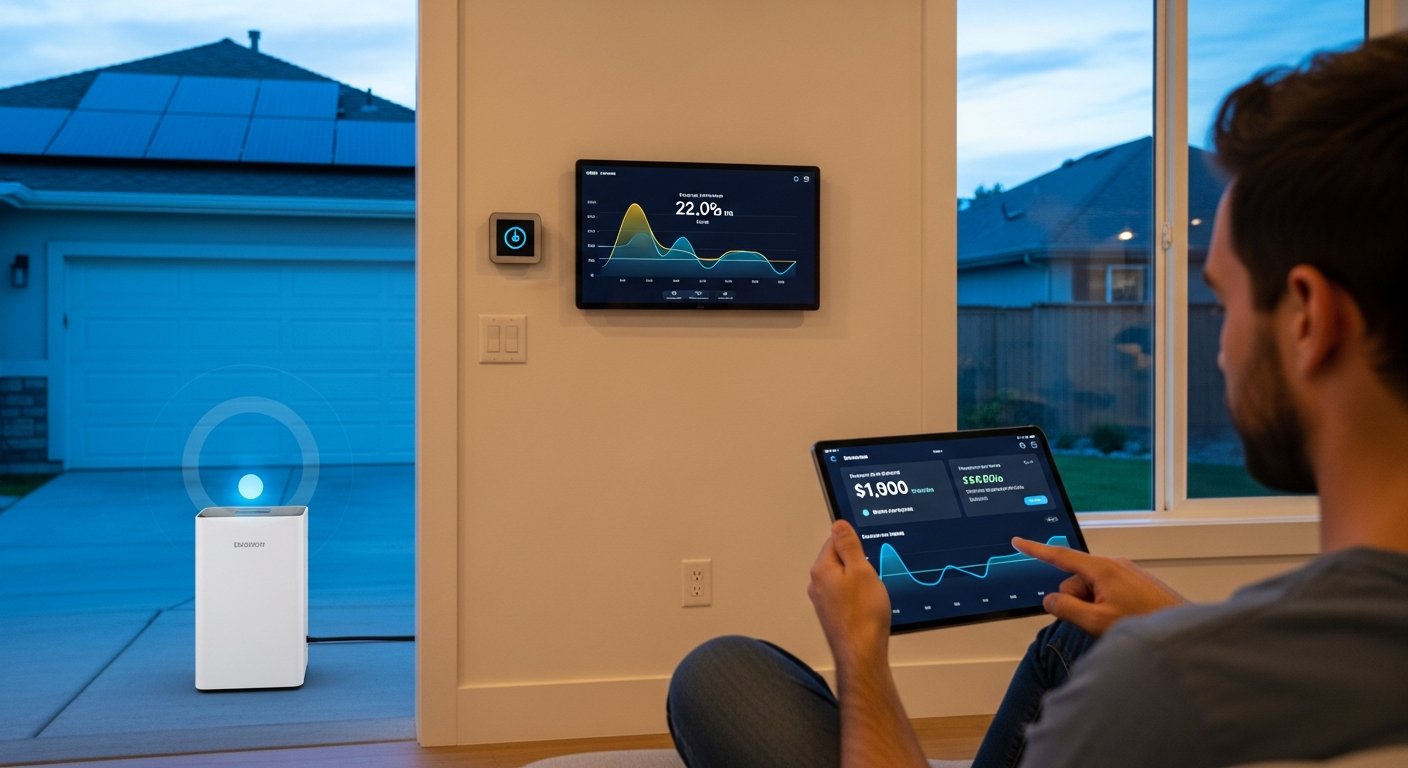
Smart Solar Systems: Cut Bills With AI Monitoring
Smart solar systems use AI and battery storage to boost self-consumption, shortening payback periods and shielding you from peak electricity rates.

By Dylan Harris
Learn more about Solar Panel Installation and Repair for guides, costs, and what to expect.
Compare Solar Panel Installation and Repair Pros Near You

Enter your ZIP code to compare top-rated local professionals and request free quotes.
Rising electricity rates and extreme weather events are pushing homeowners to rethink how they produce and consume power. Traditional solar arrays have delivered savings for years, but they operate as passive assets, generating energy during daylight hours without any real awareness of household consumption patterns or grid conditions. Smart solar systems change that equation entirely. By combining intelligent hardware, machine learning algorithms, and real-time data analytics, these advanced setups actively optimize every kilowatt-hour your panels produce. The result is not just lower utility bills, but a more resilient, efficient, and responsive home energy ecosystem that pays for itself faster than conventional installations.
What Sets Smart Solar Systems Apart From Standard Panels
A conventional solar installation consists of photovoltaic panels, an inverter, and a monitoring portal that shows basic production data. While functional, this setup has a critical blind spot: it cannot adapt. If a cloud passes over, production drops. If your home uses more power in the evening than the panels generate during the day, you draw expensive grid electricity without any strategy to avoid it. Smart solar systems close this gap using sophisticated software and hardware integration.
The core difference lies in active management. These systems use weather forecasting, consumption analytics, and battery storage coordination to make split-second decisions about where your energy flows. For example, a smart system might detect that a storm is approaching and preemptively charge your home battery to 90 percent capacity before the clouds roll in. Alternatively, it might shift heavy appliance usage to peak solar production hours automatically, reducing grid dependence. This proactive approach creates a dynamic energy loop where generation, storage, and consumption are constantly balanced against each other.
Furthermore, smart systems learn your habits. Over the first few weeks of operation, the AI engine studies when you wake up, when you cook, when you run the washing machine, and when you charge your electric vehicle. It then builds a predictive model of your energy needs. This model allows the system to maximize self-consumption, which is the single most important metric for solar ROI. The more of your own solar power you use directly, the less you pay the utility company.
The Role of AI in Maximizing Solar ROI
Artificial intelligence is the engine that drives the intelligence in modern solar systems. The AI does not just track data; it interprets it and acts on it. One of the primary functions of this AI layer is to manage the flow of energy between your panels, your battery, and the grid. When electricity rates spike during peak hours, the AI will typically discharge your battery to power your home, avoiding the high cost of grid power. Conversely, when rates are low, it might allow the battery to charge from the grid if solar production is insufficient, ensuring you have stored energy for the next peak period.
This capability is especially valuable for homeowners enrolled in time-of-use (TOU) rate plans. In our detailed guide on how AI monitors solar systems in real time for savings, we explain how this granular control can shave hundreds of dollars off annual energy bills. The AI also performs predictive maintenance. It monitors the health of your inverter and panels, looking for anomalies that might indicate a fault or degradation. If a micro-inverter fails, the system flags it immediately, allowing for fast repairs that prevent prolonged downtime.
Another significant advantage is the handling of grid outages. While standard grid-tied systems shut down for safety during a blackout, smart systems with battery backup can seamlessly disconnect from the grid and run your essential loads. The transition is smooth, and the system automatically manages the battery draw to ensure your refrigerator, lights, and internet stay online for days, not just hours.
Key Benefits of AI-Driven Energy Management
When you upgrade from a static solar setup to a smart one, you unlock several distinct financial and operational advantages. The technology is not just about convenience; it is about making your solar investment work harder. Here are the primary benefits:
- Increased Self-Consumption: AI shifts energy usage to align with solar production, often boosting self-consumption rates from 40 percent to over 80 percent.
- Peak Shaving: The system automatically draws from battery storage during high-rate periods, avoiding the most expensive electricity on the grid.
- Battery Longevity: Smart charging algorithms prevent overcharging and deep discharging, extending the lifespan of your expensive battery bank.
- Real-Time Alerts: Immediate notifications about system faults, unusual energy usage, or potential safety hazards keep you in control.
These features combine to deliver a payback period that is often two to three years shorter than a traditional system. The intelligence ensures that every ray of sunlight is used effectively, and no excess energy is sold back to the grid at a pittance when it could have been used to power your air conditioning instead. This is the difference between owning a solar array and owning a solar asset that actively manages your financial exposure to the utility company.
Battery Storage and the Smart Solar Connection
Battery storage is the physical counterpart to the AI's digital intelligence. Without a battery, a smart solar system has limited ability to act. The battery provides the buffer that allows the AI to shift energy across time. During midday, when production peaks, the battery charges. During the evening, when consumption peaks, the battery discharges. This simple shift is the foundation of energy independence.
However, not all batteries are created equal, and the smart system's software must be compatible with the battery's management system. Modern lithium-ion batteries, such as the Tesla Powerwall or the Enphase IQ Battery, come with their own internal computers. The smart solar system communicates with these computers via protocols like SunSpec or Modbus, ensuring that the AI's commands are executed precisely. This integration allows for features like 'storm watch' mode, where the system pre-charges the battery in anticipation of a grid outage.
Moreover, a smart system can help you capitalize on net metering policies. In states where net metering credits are low, it makes sense to store your energy rather than sell it. The AI calculates the value of the credit versus the value of storing the energy for later use, always choosing the most profitable option. In states with high feed-in tariffs, it might do the opposite, selling excess power to the grid and keeping the battery in reserve. This level of financial optimization is impossible to achieve manually.
Installation, Cost, and Financial Incentives
The upfront cost of a smart solar system is higher than a conventional one, primarily due to the battery and the advanced monitoring equipment. However, the investment is often offset by the 30 percent federal solar Investment Tax Credit (ITC), which applies to the entire system cost, including batteries. Additionally, many states and utilities offer rebates for adding storage, further reducing the net price. When you factor in the increased savings from higher self-consumption, the lifetime value of a smart system usually exceeds that of a passive one.
Before installation, a professional energy survey is essential. This audit assesses your home's insulation, appliance efficiency, and existing electrical panel capacity. It identifies whether your roof has shading issues that might affect production and calculates the optimal battery size for your needs. A standard 7 kW system with a 10 kWh battery might cost between $25,000 and $35,000 before incentives. After the ITC, that figure drops to roughly $17,500 to $24,500. Financing options are widely available, and many solar companies offer $0-down leases or power purchase agreements (PPAs) that allow you to start saving immediately without a large capital outlay.
It is also wise to compare the long-term operational costs. Smart systems rely on software that requires occasional updates. Most manufacturers provide these updates over the air (OTA) for free, but some may charge a subscription fee for premium AI features or extended monitoring. When evaluating quotes, ask specifically about software costs and whether the AI features are included in the base price. A system that saves you $150 per month but costs $30 per month in software fees is still a net win, but you should know that number upfront.
Choosing Between Smart and Traditional Solar
The decision to go with a smart system often comes down to your lifestyle and energy goals. If you are rarely home during the day and cannot shift your energy usage, a smart system is almost mandatory to achieve good ROI, as the battery will capture the solar energy for you to use later. If you live in an area with frequent power outages, the backup capability of a smart system is invaluable. Alternatively, if your utility offers net metering at full retail rates, a traditional system might still make sense, though this policy is becoming rarer.
To help clarify the trade-offs, consider the key differences in a side-by-side comparison. The choice impacts not only your wallet but also your resilience and your contribution to grid stability. For a deeper dive into these trade-offs, our analysis of AI vs traditional solar systems which saves more breaks down the financial scenarios in detail. Similarly, our comparison of AI solar vs traditional solar systems highlights the operational differences you can expect daily.
Ultimately, the smart system offers a superior experience for those who want to be hands-off. You do not need to check the app every day to adjust settings; the AI does it for you. This convenience, combined with the higher savings potential, makes it the recommended choice for most modern homeowners. As electricity rates continue to climb, the ability to actively avoid peak prices becomes a critical feature, not just a luxury.
Investing in a smart solar system is a step toward true energy autonomy. It transforms your roof from a simple power generator into a sophisticated energy management hub. With the right configuration, you can protect yourself from rate hikes, ensure your home stays powered during emergencies, and significantly reduce your carbon footprint. The technology has matured, the prices are dropping, and the incentives are compelling. Now is the time to make your energy work for you.
Learn more about Solar Panel Installation and Repair for guides, costs, and what to expect.
Compare Solar Panel Installation and Repair Pros Near You
Enter your ZIP code to compare top-rated local professionals and request free quotes.