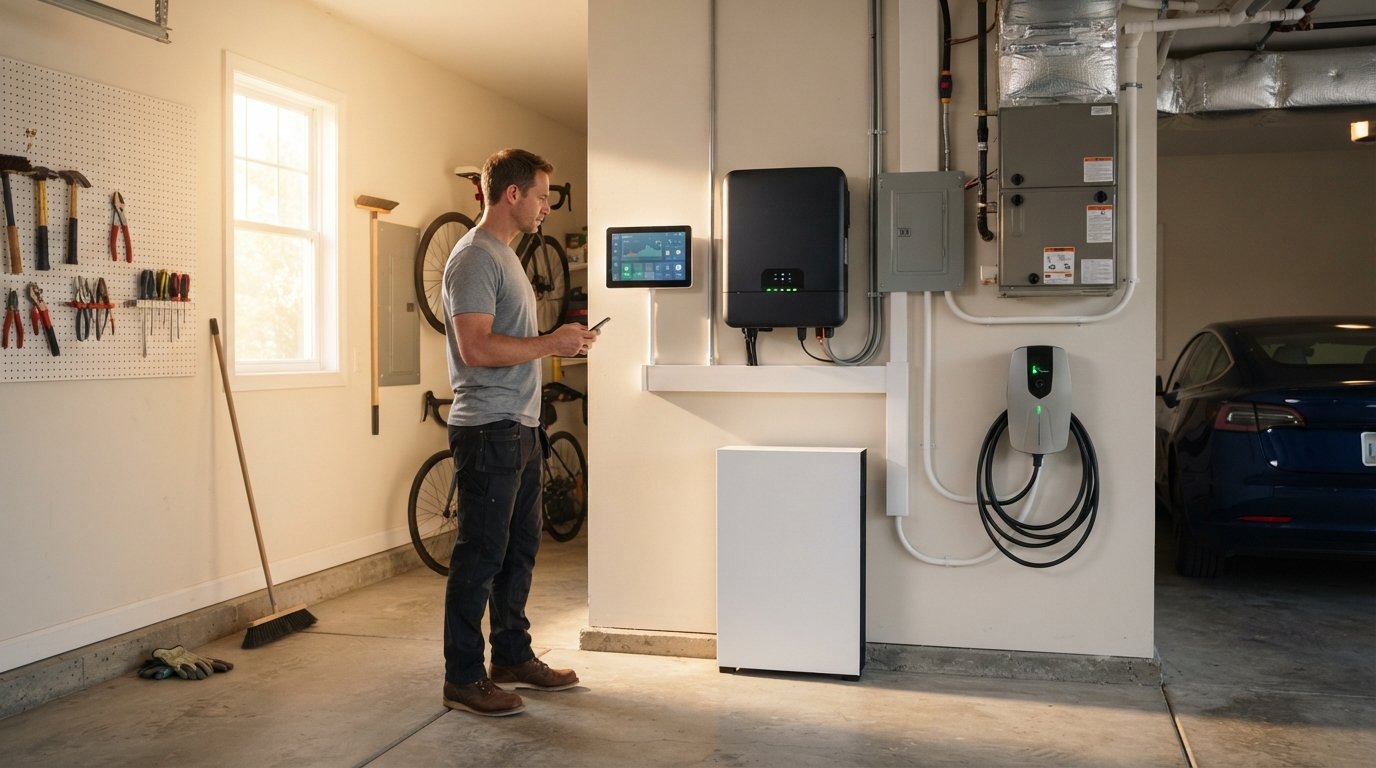
Smart Load Management Solar Peak Demand Charges
Smart load management solar peak demand charges can cut your bill by shaving costly peaks. Call (833)-434-4023 for expert guidance.

By Owen Phillips
Learn more about Solar Panel Installation and Repair for guides, costs, and what to expect.
Compare Solar Panel Installation and Repair Pros Near You

Enter your ZIP code to compare top-rated local professionals and request free quotes.
That monthly utility bill can feel like a guessing game. You install solar panels, watch your production climb, and still see a demand charge that makes no sense. For many homeowners and business owners, the culprit is not the panels themselves. It is the way power gets pulled from the grid during a handful of high-stakes moments each month. Smart load management changes that equation by controlling when and how your biggest electrical loads run, so you stop paying premium rates for power you could have shifted or avoided entirely.
Peak demand charges are common on commercial rate schedules and increasingly appear on residential time-of-use plans. They are calculated from your highest 15-minute or 30-minute usage window during a billing cycle, not your total consumption. That means one careless hour of running everything at once can spike your bill for the whole month. Solar alone does not automatically solve this, because solar production peaks at midday while many demand charges hit in the late afternoon or early evening. Pairing solar with intelligent load control is how you turn a generation asset into a bill-reduction strategy.
What Peak Demand Charges Actually Measure
Most people understand energy charges, which are based on kilowatt-hours consumed over time. Demand charges work differently. They measure the maximum rate at which you draw power from the grid, expressed in kilowatts. Your utility records that peak in short intervals, typically every 15 minutes, and bills you based on the single highest interval of the month. A brief surge from an electric dryer, air conditioner, EV charger, and oven running simultaneously can set a demand level that follows you for weeks.
This structure exists because utilities must build and maintain infrastructure sized for worst-case peaks. If everyone draws maximum power at 6 p.m., the grid needs enough capacity for that moment even if average usage is far lower. Demand charges pass that cost to the customers who create the peaks. For businesses with refrigeration, manufacturing equipment, or multiple HVAC zones, demand charges can represent 30 to 70 percent of the total electric bill. For homeowners on time-of-use rates, the same principle shows up as dramatically higher prices during peak windows.
Solar helps by generating power during the day, which reduces net consumption and can shave demand if production coincides with your peak. The problem is timing. In many regions, solar output falls off in the late afternoon just as air conditioning and cooking loads ramp up. Without storage or load control, you export cheap midday power and then buy expensive evening power at the worst possible moment.
How Smart Load Management Fits With Solar
Smart load management is the practice of monitoring and controlling electrical loads in real time so they run when power is cheapest, cleanest, or most available. Instead of letting every appliance and system operate on its own schedule, a controller coordinates them. It might delay an EV charge, stagger HVAC compressor starts, pre-cool a building before peak rates begin, or pause a pool pump during a demand event. The goal is to flatten your usage curve and avoid the spikes that trigger demand charges.
When combined with solar, load management becomes even more powerful. The system can prioritize running loads when solar production is high, effectively using your own generation instead of exporting it for a low credit. It can also charge a battery during surplus production and discharge it during peak windows. This coordination reduces both energy charges and demand charges, and it improves the return on your solar investment.
Modern platforms use machine learning and weather data to predict production and consumption. In our guide on solar output prediction, we explain how forecasting improves these decisions. When the controller knows a cloudy afternoon is coming, it can adjust load schedules in advance rather than reacting after the fact.
The Main Load Management Strategies
There is no single approach that works for every property. The right mix depends on your rate structure, your biggest loads, and whether you have battery storage. Most effective programs combine several tactics at once.
Here are the core strategies that deliver the strongest demand charge reduction:
- Load shifting: Move flexible loads like EV charging, pool pumps, and dishwashers to off-peak or high-solar hours.
- Load shedding: Temporarily turn off or dim non-essential loads during a peak event or when demand approaches a threshold.
- Staggered starts: Prevent large motor loads from starting simultaneously, which avoids instantaneous spikes.
- Battery dispatch: Discharge stored energy during peak windows to serve loads without drawing from the grid.
- Pre-cooling and pre-heating: Condition a space before peak rates begin so the HVAC system can coast through the expensive period.
Each strategy has trade-offs. Load shedding can affect comfort or operations if not carefully configured. Battery dispatch depends on having enough capacity and proper inverter settings. Staggered starts require compatible equipment or smart relays. The best results come from a controller that can apply multiple strategies automatically based on real-time conditions.
For businesses, the stakes are higher because demand charges are larger and operational disruptions are costly. A supermarket cannot simply turn off refrigeration, but it can pre-cool cases before a peak event and then let temperatures drift slightly within safe limits. A manufacturing plant might reschedule a batch process to avoid a coincident peak. These decisions require visibility into what each load is doing and how it contributes to the monthly maximum.
Solar Plus Storage: The Demand Charge Killer
Batteries are the most direct tool for demand charge reduction. When the controller detects that facility demand is approaching a preset threshold, it discharges the battery to supply the difference. The grid never sees the spike, so the demand charge stays low. This is often called peak shaving, and it can pay for itself quickly on rate schedules with high demand charges.
The sizing question matters. A battery that is too small will not cover the peak, while an oversized battery adds cost without proportional benefit. The right size depends on your load profile, the length of your peak windows, and how often peaks occur. A professional energy survey can measure actual demand patterns and recommend a system that matches your needs. SolarEnergy.ai offers on-site energy surveys that include this kind of analysis, along with electrical security and emergency lighting services that complement a full energy upgrade.
Battery dispatch also interacts with solar production. If the battery charges from solar during the day and discharges during the evening peak, you are essentially time-shifting your own generation. That reduces both demand charges and energy charges, and it lowers your reliance on the grid during the most expensive hours. Over a year, the savings can be substantial, especially in regions with strong time-of-use rates or demand-based commercial tariffs.
What to Expect From a Smart Load Management System
A well-designed system gives you visibility and control. You should be able to see real-time consumption, historical demand peaks, and which loads are driving your costs. The controller should automate routine decisions, but you should also be able to override or adjust settings when needed.
Key capabilities to look for include:
- Real-time monitoring of whole-building and circuit-level usage
- Automated load shifting and shedding based on rate schedules and solar production
- Battery integration with peak shaving and time-of-use optimization
- Alerts when demand approaches a threshold or when equipment behaves abnormally
- Reporting that shows demand peaks and savings over time
Installation complexity varies. A residential system might use smart breakers, a connected thermostat, and an EV charger with scheduling capability. A commercial system may involve industrial controllers, sub-metering, and integration with building management systems. In both cases, the goal is the same: coordinate loads so the whole property operates as a single optimized system rather than a collection of independent devices.
It is also worth noting that load management supports resilience. During a grid outage, a battery can power essential loads while non-essential loads stay off. That extends backup duration and keeps critical systems running. For businesses, this can mean the difference between a minor inconvenience and a major disruption.
Calculating the Savings
Demand charge savings depend on your rate structure and how much you can reduce your peak. A simple way to estimate is to multiply your current demand charge by the percentage reduction you expect. If your demand charge is $500 per month and you shave 30 percent, you save $150 per month, or $1,800 per year. Add energy charge savings from load shifting and solar self-consumption, and the total can be significantly higher.
Battery costs and controller costs must be factored in. Many utilities offer incentives for storage and demand response participation, which improve the economics. Federal tax credits may also apply. Because rules change, always verify current incentives with official sources or a qualified installer.
For homeowners, the math is often simpler. If your utility charges higher rates during peak hours, shifting laundry, dishwashing, and EV charging to off-peak or solar hours can cut your bill without any hardware beyond a smart plug or two. Adding a battery increases savings but also increases upfront cost. A solar savings calculator can help you model different scenarios before you commit.
Getting Started Without Overcomplicating It
The first step is understanding your current usage. Review a year of utility bills and identify when your peak demand occurs. If you have solar, check whether your production aligns with that peak. If it does not, load management or storage is likely to help.
Next, list your largest and most flexible loads. EV chargers, water heaters, pool pumps, HVAC systems, and commercial refrigeration are common candidates. Determine which can be shifted, which can be shed briefly, and which must run continuously. This inventory guides the control strategy.
Finally, work with a qualified professional to design and install the system. The equipment must be compatible, the settings must match your rate schedule, and the controls must be intuitive enough that you will actually use them. A certified installer can also help you capture available incentives and ensure the system meets local code requirements.
For homeowners and businesses exploring solar plus storage, NewSolarQuotes is an independent educational resource that offers guides, cost calculators, and savings analysis to help you compare options. Pairing that research with a professional energy survey gives you a clear picture of what is possible.
Smart load management is not a gadget or a fad. It is a practical response to rate structures that punish uncontrolled peaks. When you combine solar, storage, and intelligent controls, you stop paying for power at the worst possible times. You use your own generation more fully, you reduce stress on the grid, and you keep more of your money. The technology is mature, the savings are measurable, and the time to act is now.